

1929: Inside the Greatest Crash in Wall Street History--and How It
Andrew Ross Sorkin
 English
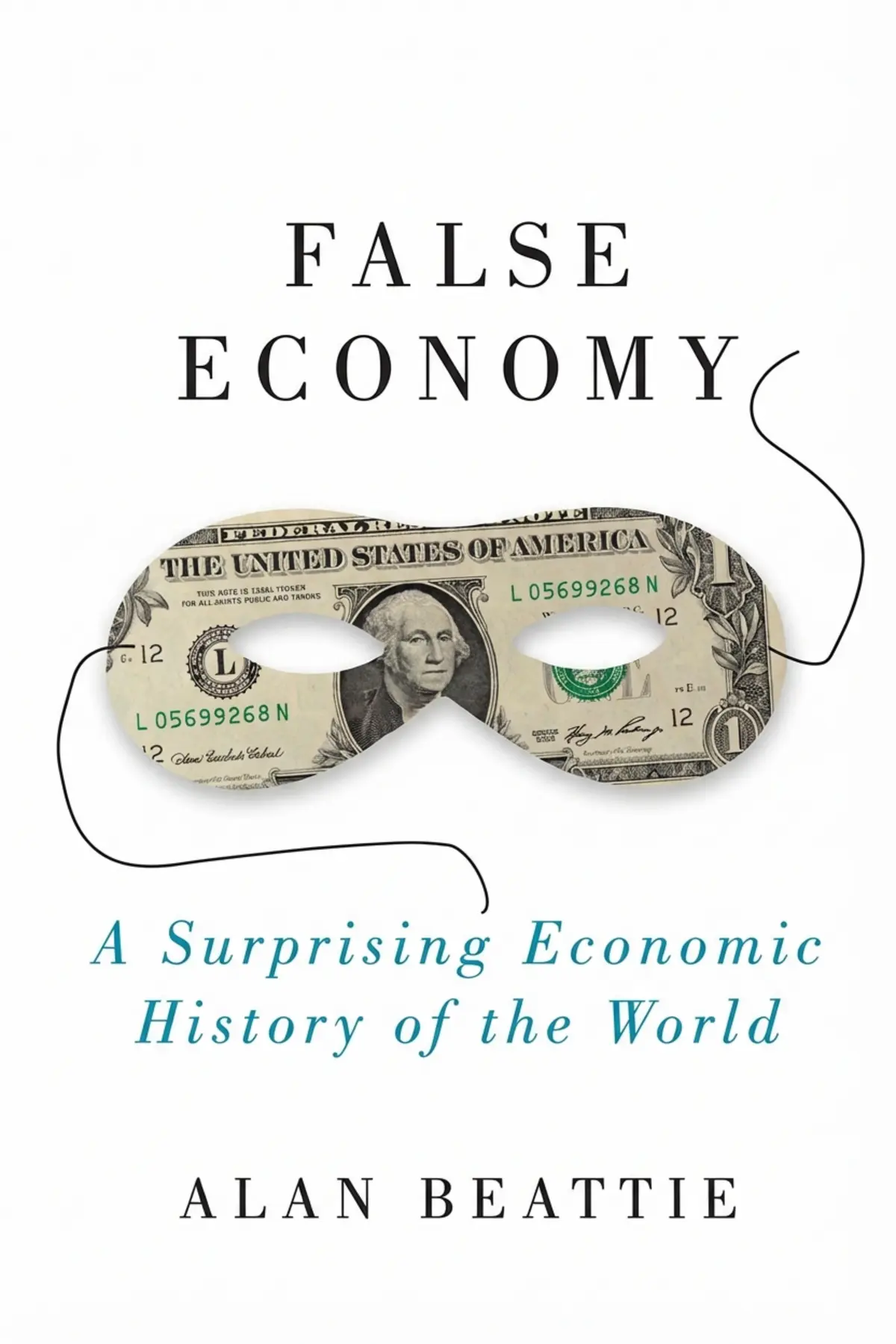
Beattie shows why countries that start out alike can end up rich or poor. Again and again the cause is choices about land, trade, cities and natural resources, not climate, culture, religion or fate.
1 min 04 sec
If you have ever blamed a struggling country’s troubles on its climate, its culture or its faith, Alan Beattie wants you to look again. In False Economy, the former Bank of England economist and Financial Times trade editor starts with two nations, the United States and Argentina, which began with the same promise of fertile land and ended up worlds apart. A string of decisions separated them.
That is Beattie’s case across the whole book. The wealth or poverty of nations comes mostly from choices about land, trade, cities and resources, rather than from fate, religion or even the honesty of their leaders. And because they are choices, they can be changed.
Along the way you meet Peruvian asparagus, a Saudi Arabia full of jobless young men, a diamond deal in Botswana and a brutal Indonesian president who got the economics right. By the end you will read the economic news differently, with a short set of questions to put to any country or city whose fortunes touch yours.
1 min 47 sec
Two young republics in the Americas both had vast farmland and big ambitions. Two centuries later, one leads the world economy and the other has gone bankrupt. The split began with a question about who should own the soil.
1 min 40 sec
For more than a century, respected thinkers have tied national wealth to what people believe. Each time the theory seemed proven, events turned against it. Beattie shows what keeps going wrong with this tempting explanation.
1 min 55 sec
One president seized power through mass killing; another was a modest, honest former teacher. Most people would bet on the second to build a thriving economy. Beattie’s comparison of their records is deeply uncomfortable.
1 min 39 sec
A booming capital looks like proof of success. Beattie argues that an oversized city can just as easily be a warning sign, and that the healthiest cities share one feature that Detroit lacked.
1 min 41 sec
Why would anyone ship asparagus thousands of miles, or a desert country stop growing its own bread? These odd trade patterns turn out to be sensible, and they reveal how one bad border can sink a whole export industry.
2 min 01 sec
Oil, copper and diamonds should make a country rich. Instead they have fed unemployment, civil war and unstable governments. A handful of nations avoided the trap, and their methods are surprisingly simple.
1 min 41 sec
Russia and China, two countries with similar backgrounds, each set out to enter the free-market economy. One defaulted and retreated; the other kept opening. Beattie explains what made the difference, and why neither ending was fixed.
1 min 15 sec
False Economy keeps returning to one image: two countries, two leaders or two diamond producers starting from much the same place and ending far apart. Each time, Beattie finds the gap in a choice. Argentina gave its land to a few, Zambia pushed investors out, Nyerere closed Tanzania’s borders and Putin pulled energy back under the state. The United States, Botswana, Suharto’s Indonesia and China went the other way, toward openness, partnership and variety. In Beattie’s telling, the global economy rewards countries that set policies to use globalization and punishes those that shut themselves away.
That gives you a sharper way to read the news. When someone blames a nation’s poverty on its religion or its people, ask what its government decided about land, trade and resources. When a place or a business depends on one industry, one crop or one client, see the risk before the slump arrives. And when good fortune lands, borrow Norway’s habit and put the surplus where it can steady the bad years.
Beattie’s final point is also his most practical one. No country is a giant panda. It can always choose again.
Why did the United States become an economic giant while Argentina, which started with the same fertile promise, lurched from crisis to crisis? The usual answers point to climate, natural wealth, religion or national character. Alan Beattie, a former Bank of England economist and Financial Times trade editor, argues that they mostly miss the point. His case is that economic fate is made, not given. Across centuries and continents he follows the decisions that split winners from losers. One country hands its land to skilled families and another gives it to a few landlords. One leader opens the borders and another closes them. One diamond producer partners with an experienced firm and another chases quick riches. The examples run from ancient Rome and Peruvian asparagus to Saudi unemployment, Botswana's diamonds and the different roads Russia and China took into the market economy. Readers get a clearer way to make sense of economic news. They learn to doubt explanations built on culture or faith, to spot the risk in dependence on one industry or resource, and to take seriously Beattie's hopeful conclusion that no country is locked into its past.
Professionals who follow world news and want a clear way to judge why some economies thrive.
Students of economics, history or politics looking for vivid country comparisons.
Founders and investors weighing risk in countries, cities or businesses that lean on one industry.
Alan Beattie holds a master's degree in economics from Cambridge and a BA in Modern History from Oxford. He worked as an economist at the Bank of England and then joined the Financial Times in 1998. There he served as economics leader writer and spent two years in Washington as chief US economics correspondent. In 2004 he became world trade editor, leading the paper's reporting on trade policy and economic globalization.
Listeners consider this work to be fascinating and stimulating, calling it an enlightening read that offers top-tier analysis of diverse economic subjects.
As someone who usually struggles with dry economics, I found these historical vignettes surprisingly accessible and quite thought-provoking. Beattie has a gift for taking complex theories—like Mancur Olson’s interest group theory—and explaining them through Peruvian asparagus exports. It’s the kind of book that makes you look at the grocery store or a gas station in a completely different way. He challenges the lazy assumption that some countries are just naturally 'better' than others. Instead, he shows how specific moments in history, like the repeal of the Corn Laws, set off chain reactions that we are still feeling today. The writing is incredibly smooth, and the way he weaves together history, sociology, and trade policy is impressive. Even when I didn't agree with his conclusions, I appreciated the way he presented the analysis. This is a must-read for anyone wanting to see the 'big picture' of global economic history.
Show moreTruth is, we often blame 'culture' or 'religion' for poverty when the reality is actually just a series of terrible policy choices. Beattie does a fantastic job of proving that Argentina isn't poor because of its Spanish heritage, but because of how it managed its land and trade. It’s a powerful argument for human agency in a world that often feels like it's governed by forces beyond our control. The book is definitely pro-globalization, but it’s not blind to the failures of the current system. I especially liked the comparison between 'honest' Tanzania and 'corrupt' Indonesia. It challenges your preconceptions about what actually drives growth in the developing world. It’s easily one of the most interesting books I’ve read this year.
Show moreThe chapter on the divergent paths of Argentina and the United States alone makes this worth the cover price. Beattie argues convincingly that economic success isn't just about what you have, but what you choose to do with it. While the comparison of landowners versus smallholders in the 18th century is fascinating, the book occasionally feels like it’s skimming the surface of complex issues. It’s written in that crisp, authoritative Financial Times style that makes everything sound like common sense, even when the data is a bit thin. I appreciated the move away from geographic determinism, though some chapters feel like they are oversimplifying the impact of colonial history. It’s a great pick for fans of pop-economics who want more historical context than your average Gladwell book.
Show morePicked this up because I enjoy Freakonomics, but Beattie’s tone feels a bit more like a dry lecture. The premise is solid: countries aren't doomed by fate, but by their own policy decisions. I found the section on 'Dutch disease' and the resource curse to be the strongest part. However, the author’s tendency to breeze past counterarguments can be frustrating. To be fair, it’s intended for a general audience, so the lack of heavy statistics is probably fine for most readers.
Show moreFinally got around to reading this and I’m genuinely impressed by how Beattie dismantles the idea of geographic predestination. The comparison between the US and Argentina is a masterclass in explaining how land distribution shapes a nation's future. It’s refreshing to see an economist acknowledge that 'fate' is often just a collection of bad decisions made by elites. My only gripe is that the chapter on Islam felt a bit underdeveloped compared to the others. He rejects the 'Protestant work ethic' idea, which is great, but his alternative explanation feels a bit rushed. Still, the writing is engaging and keeps you moving through topics that could easily become mind-numbingly boring in other hands.
Show moreEver wonder why Africa doesn't have a massive cocaine trade while South America is riddled with it? Beattie uses this bizarre question to dive into a deep analysis of transaction costs and infrastructure. He explains that even illegal industries need a certain level of political and physical stability to thrive. It’s these kinds of counterintuitive examples that make the book such an eye-opening experience for the casual reader. Look, the book isn't perfect, and the author definitely has a specific pro-market agenda that peeks through occasionally. But for anyone trying to understand the 'why' behind global inequality, this offers a much more nuanced perspective than the usual 'they're just poor' tropes. He makes a compelling case that even the most successful entrepreneurs, whether they're selling beef or narcotics, are dependent on the underlying systems their governments build. It’s a fascinating, multifarious look at why some places flourish while others seem to stagnate indefinitely despite having resources.
Show moreBy focusing on the 'embedded water' in Egypt’s grain imports, the author highlights how trade is often about invisible resources. This was probably the most insightful chapter for me, as it changed how I think about food security and national policy. Beattie is at his best when he is using specific, odd examples to illustrate broad economic trends. He manages to make topics like refrigerated railcars and the telegraph feel exciting because of how they revolutionized the beef industry. To be fair, the book can be a bit chaotic at times, jumping from one continent to another with very little transition. But if you enjoy learning about the minutiae of history, you’ll find plenty to like here.
Show moreBeattie’s writing is crisp and professional, yet I found his dismissive take on pandas as 'incompetent, inefficient buffoons' to be a bit jarring. He uses the panda as a metaphor for countries that are stuck on a path toward extinction without external help. While his logic about economic efficiency makes sense, the cold lens he applies to every living thing feels a little heartless. The book is essentially a collection of nine comparative scenarios that are hit-or-miss depending on your interests. The stuff on 'embedded water' in Egypt was brilliant, but the section on corruption in Indonesia felt a little repetitive. It's a decent read for a history buff, but it lacks a strong, cohesive emotional core that would make it truly memorable.
Show moreThis book feels like the peak of neoliberal arrogance, wrapping personal opinions in a 'matter-of-fact' style that often lacks supporting evidence. Beattie spends a lot of time complimenting the IMF and defending free trade while completely ignoring the human cost of these policies. His thesis—that economic destiny is a choice—is constantly undermined by his own examples of geographic and historical 'accidents.' One minute he’s saying it’s all about choices, and the next he’s citing Guns, Germs, and Steel to explain Africa's struggles. It’s a confusing, contradictory mess that tries to be subversive but ends up sounding like a defense of the status quo. If you want a well-argued leftist perspective, stick to something with more substance.
Show moreNot what I expected from a 'surprising economic history' because many of the arguments felt incredibly middle-of-the-road and safe. Beattie writes like he’s trying to emulate Malcolm Gladwell but he lacks the narrative flair to really pull off the 'big idea' format. He makes broad, sweeping assertions about literacy in India or the 'uselessness' of certain species without providing the citations I’d expect from a work of non-fiction. Frankly, the book feels like a collection of Financial Times op-eds that have been stretched out into chapters. It’s not that the writing is bad—it’s actually quite professional—it’s just that the arguments lack the bite and the data required to be truly convincing.
Show moreBeattie argues that a country’s economic success or failure comes mostly from the choices its governments make, not from fate, climate, religion or culture. His central example is the United States and Argentina, which started with similar farmland but split apart over land ownership and trade. Countries that opened up and diversified tended to prosper, while those that closed themselves off struggled.
According to Beattie, America divided its land among skilled individuals and families, attracting capable European farmers, while Argentina gave land to a few rich landlords and drew few skilled settlers. In the twentieth century the United States embraced manufacturing and trade, whereas Argentina chased self-sufficiency, blocked imports, taxed exports heavily and protected state monopolies. In 2001 its government went through one of history’s largest state bankruptcies.
Not by themselves. Beattie shows oil and diamonds bringing turmoil when badly managed: Saudi Arabia has 25 percent unemployment despite its oil wealth, and illicit diamond trading helped prolong Sierra Leone’s eleven-year civil war. Norway and Chile put surplus resource income into stabilization funds, and Botswana partnered with De Beers under a long-term revenue sharing deal, which gave it a steady income and stability.
Beattie says neither is decisive. Mostly Catholic Italy, Spain and Ireland undercut Max Weber’s 1905 theory that Protestants do better in business, and largely Islamic Malaysia and Indonesia made sound economic choices. Indonesia prospered under the brutal, corrupt Suharto, who opened trade and balanced the budget, while honest Julius Nyerere’s closed, collectivized Tanzania stagnated. Policy, not piety or personal virtue, made the difference.
Use Beattie’s cases as questions. When a nation’s poverty is blamed on its culture, look for the policy choices behind it. When a city, business or income depends on one industry or client, recognize the risk Detroit faced with cars. Treat windfalls as Norway treats oil, saving the surplus. And remember his closing claim that it is never too late to change course.
Andrew Ross Sorkin

Ha-Joon Chang
Niall Kishtainy


William J. Bernstein




Yanis Varoufakis
AUDIO SUMMARY AVAILABLE
Get the key ideas from False Economy by Alan Beattie, plus 5,000+ more nonfiction titles.









