
Us vs. Them: The Failure of Globalism
Ian Bremmer
 English
Explains why no country now leads the world, how that vacuum turns climate and food problems into national quarrels, which kinds of countries gain from it, and the four orders that could replace it.
1 min 02 sec
If world news feels like a string of crises that nobody solves, Ian Bremmer has an explanation: since the 1990s, no country or group of countries has been both willing and able to lead. In Every Nation For Itself, the political scientist who founded Eurasia Group calls this a G-Zero world, a twist on the G8 and G20, the clubs of the richest and strongest economies. In this world, nobody sits at the head of the table.
Bremmer argues the vacuum is real, costly and temporary. Governments buried in debt and caring for aging populations look inward, so climate and food problems go unmanaged and each nation shields itself. Flexible countries profit from that disorder, while those leaning on one protector are exposed. And the vacuum will end in one of four ways, depending mostly on whether the United States and China work together.
His reasoning gives you a pattern for sorting the headlines, and a few sharp questions to ask about any country, market or partner you rely on.
2 min 09 sec
Neither the established powers nor the rising ones are stepping up to lead, and none has the political and economic weight to do it alone. Much of their reluctance comes from what each government faces at home, where heavy domestic burdens make global duties unappealing.
2 min 12 sec
A failed climate deal sounds distant from your grocery bill, and a food safety scare sounds like a health story. Bremmer shows how, with no one in charge, both can end in governments turning on each other.
2 min 09 sec
For thirty years, the safest bet was to stay close to the strongest ally. Bremmer argues that the same closeness now looks like a weakness, and he names the countries on each side of the line.
2 min 00 sec
If the world’s two largest economies decide to work as partners, the rest of the world could be sidelined or invited in. What decides which one happens may be a disaster nobody wants.
1 min 57 sec
A split between two superpowers sounds like a rerun of the twentieth century. Bremmer points to one difference that changes the whole contest, and to a quieter alternative in which the world breaks into regions.
1 min 10 sec
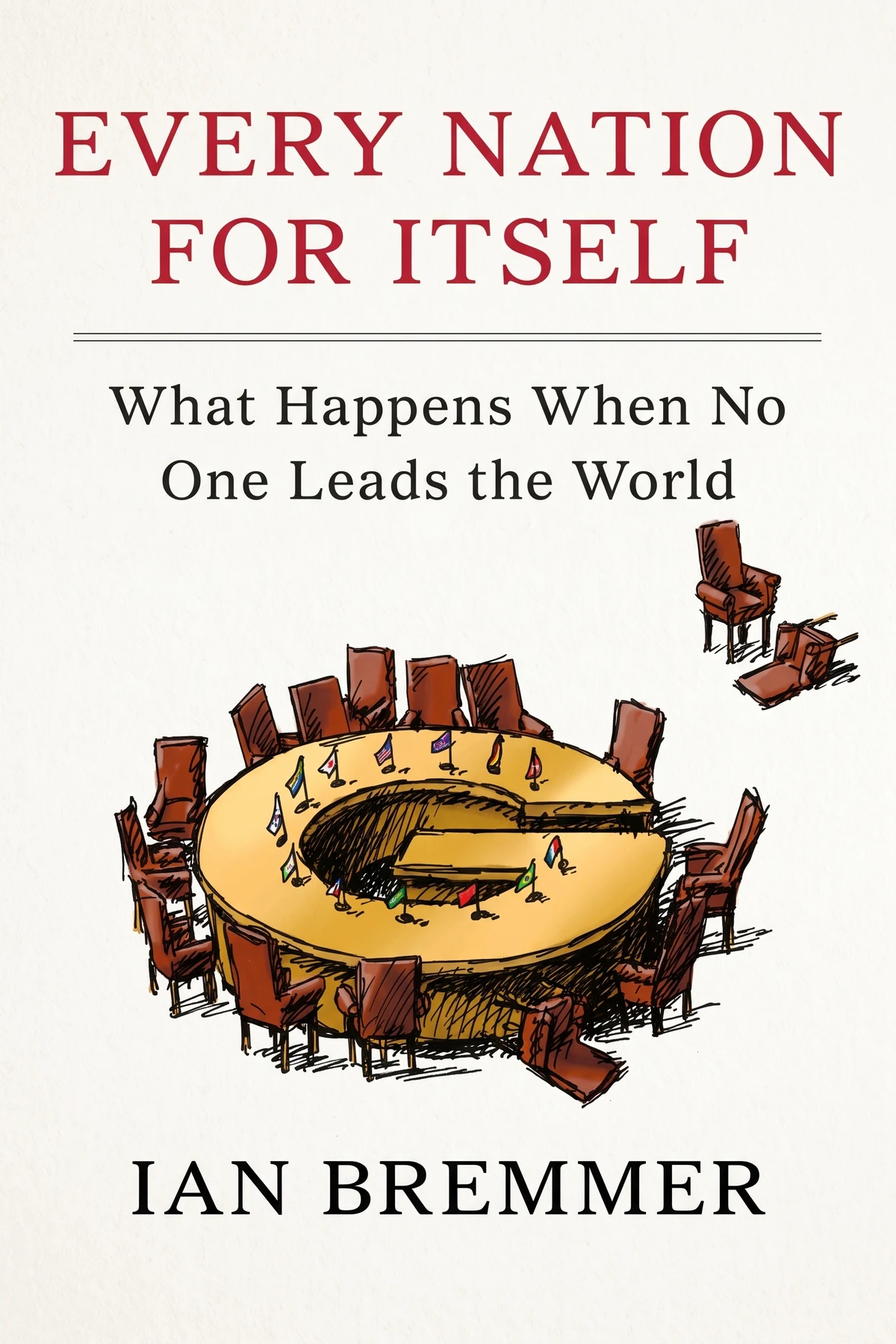
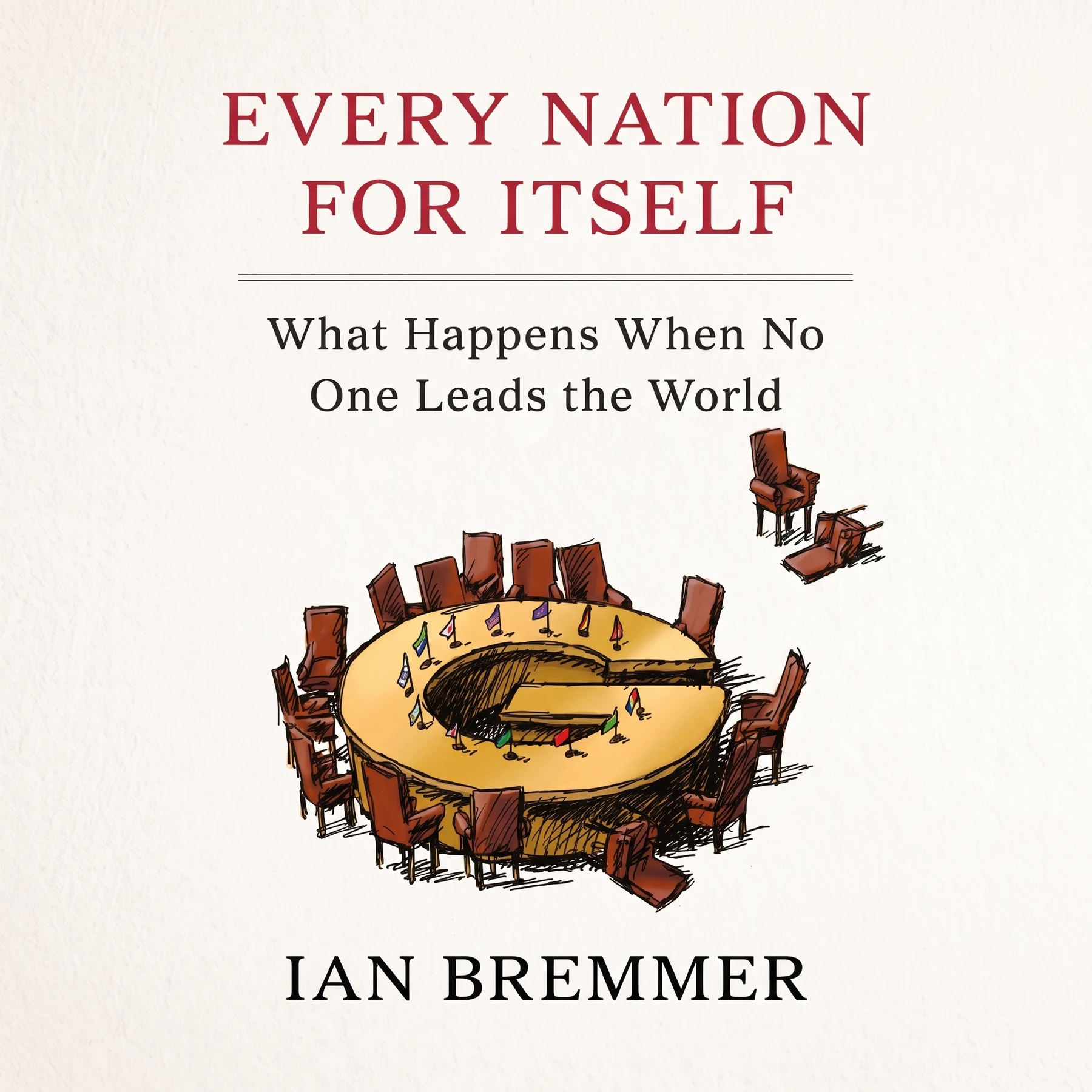
Bremmer’s book is a map of an empty chair. Since the 1990s, the seat at the head of the world’s table has stood vacant, and the reason is that every strong country is busy at home. The vacancy shows up in places that look unrelated: a climate summit that ends in mutual blame, export limits during a food price spike, Russian shops closed to European vegetables because of a false claim about Spanish cucumbers. Each is a nation acting for itself, just as the title says.
The book’s practical gift is a way of reading events. When a global deal stalls, look first at the debts, voters and aging populations behind each delegation. When you judge a country, a supplier or your own position, count how many strong partners there are and how much rides on any single protector, the way Brazil spread its trade while Japan and Mexico stayed tied to one patron. And when you follow news about Washington and Beijing, remember that their choice, together with the strength of everyone else, decides which of four worlds comes next.
The vacuum will not last. What matters is who fills it, and on whose terms.
Global summits end without deals, food prices jump, and governments blame each other. Ian Bremmer argues that these events share one cause. Since the 1990s, no single country or group of countries has been willing and able to lead the world. He calls this a G-Zero world, a play on the G8 and G20 clubs of leading economies. Bremmer, a political scientist who built a firm advising clients on how politics moves markets, traces the vacuum to domestic strain. The United States carries heavy debt, and emerging powers like China still have huge work to do at home. The cost appears in failed climate talks, export bans during food price spikes and a cucumber scare that turned into a trade dispute. He then sorts countries into likely winners and losers. Pivot states such as Brazil and Turkey keep many partners, while Japan and Mexico lean on one protector. Finally he sketches four ways the vacuum could end, depending on whether Washington and Beijing cooperate and how strong everyone else is. Readers get a framework for reading world news and judging the risks around them.
Professionals whose work depends on trade, supply chains or foreign markets and who want to read political risk.
Students of international relations looking for a clear framework for a world without a leader.
Curious news readers puzzled by why global summits keep failing.
Ian Bremmer is an American political scientist, author and entrepreneur who focuses on global political risk. He earned a doctorate in political science from Stanford University in 1994 and created Wall Street's first global political risk index. In 1998 he founded Eurasia Group with $25,000. He is still its president, and the firm advises clients on how politics affects markets. He also founded the digital media company GZERO Media, and his other books include Us vs. Them.
Ian Bremmer
Listeners find the work to be insightful, especially valuing the in-depth examination of contemporary trends. They describe it as a fascinating and excellent listen.
Finally got around to this one, and the concept of a G-Zero world feels more relevant today than ever before. Truth is, Bremmer has a gift for taking dense geopolitical trends and turning them into a narrative that is both interesting and easy to follow. I particularly enjoyed how he outlined the potential winners and losers in a world where flexibility is the ultimate currency. His analysis of how firms and governments must adapt to a leaderless environment is a wake-up call for anyone stuck in a 20th-century mindset. The book is concise, broad in its coverage, and provides a fantastic introductory guide to the shift in global power. It’s rare to find a policy book that is this engaging without being overly dry or academic. Highly recommended for anyone who wants a clear-eyed look at the future of our global order.
Show moreAs someone who follows foreign policy but doesn't have time for 800-page academic tomes, I found this remarkably accessible. Not gonna lie, I was worried it would be another dry lecture on the UN, but Bremmer keeps things moving. He captures the shift from the G7 to a world where every nation is out for itself with great clarity. The section on how countries like Brazil and Kazakhstan are positioning themselves to pivot between the US and China was eye-opening. It is a great and interesting read that helps connect the dots between economic shifts and political instability. Even the parts that feel a little dated now still provide a lot of relevant historical information that makes the current global situation easier to grasp. This is definitely a must-read for anyone with an interest in where the world is headed.
Show moreIan Bremmer’s 'Every Nation for Itself' offers a compelling framework for understanding the messy state of global politics. The central concept of the 'G-Zero' world—a landscape where no single power or alliance provides global leadership—feels incredibly relevant as we watch traditional institutions struggle to address modern crises. Personally, I found his breakdown of 'pivot states' like Vietnam and Indonesia to be the most insightful part of the text, as it explains why certain middle powers are thriving by playing both sides. The writing is punchy and accessible for a general audience, though a bit more data to back up the sweeping trends would have been appreciated. It’s a great read for anyone trying to make sense of why international cooperation seems to be failing. While some of the specific examples from 2012 haven't aged perfectly, the broader logic of a leaderless world remains a very powerful lens for analysis.
Show moreEver wonder what happens when the traditional world powers simply stop cooperating? Bremmer answers this by painting a vivid picture of a world in 'tumultuous transition' where the IMF and World Bank are sliding into irrelevance. In my experience, most political science books are a chore to get through, but this one was surprisingly fast-paced and full of interesting anecdotes. I appreciated the specific scenarios he mapped out regarding flashpoints like a North Korean collapse or cyber warfare between the US and China. Even though the book was written a decade ago, many of the 'hypothetical' tensions he mentions are exactly what we are seeing in the news today. It’s not a perfect crystal ball, and some of the talk about 'shadow states' feels a bit thin, but it provides a very useful structure for discussing current events with friends.
Show moreThe highlight of the book for me was definitely the discussion on 'pivot states' and the necessity of maintaining strategic options. Gotta say, Bremmer’s lesson that 'winners have good options, losers don’t' is a simple but profound way to look at modern diplomacy. He deftly recounts how the proliferation of nuclear weapons and the rise of the 'Asian tigers' have reduced American primacy. The book is a bit light on footnotes, and I noticed he sometimes uses obscure sources for major GDP data, which is a bit strange. However, the overall thesis that we are entering a leaderless age is hard to argue with. It’s an insightful analysis of current trends that manages to stay interesting throughout. If you want to understand why climate change and terrorism are so hard to solve right now, this book gives you a very clear explanation.
Show moreWhile some of the 2012-era specificities regarding North Korea or Iran feel a bit dated, the underlying thesis holds up surprisingly well. In the end, the 'G-Zero' world Bremmer predicted—one defined by regional blocks and a lack of coordination on global threats—is exactly where we've landed. He provides an excellent overview of the possible scenarios for what comes after this vacuum of leadership. The book does have a bit of a pro-US bias toward the end, but he’s realistic about the fact that America can no longer dictate the global agenda. I found the writing to be very clear, though the lack of subject headers within chapters made it a bit of a struggle to get through at times. Overall, it’s a solid 4-star book that offers a lot of food for thought for the politically curious.
Show moreThe core takeaway here is that in a leaderless world, the winners are those with the best options and the greatest ability to adapt. Essentially, Bremmer argues that the world has moved beyond the point where the G7 or G20 can actually get anything done. I found his analysis of the relationships between diverse subjects—like Russian energy dependence and EU sanctions—to be very well-handled. It’s an insightful book that doesn't get mired in details that are better left to specialists, keeping it snappy for the general audience. While I wish there were fewer anecdotes and more hard data, the logic of the 'G-Zero' is hard to deny. It's a great read if you want a broad overview of how international politics is being reshaped by the lack of a global policeman.
Show moreBremmer is undeniably a gifted communicator, but this feels like the 'pop-science' version of international relations theory. Look, the 'G-Zero' concept is a great way to describe our current lack of global leadership, but 195 pages is a bit much to explain a concept that could have been a long magazine article. The book is filled with clever jargon like 'pivot states' and 'American second acts,' but it lacks the rigorous data or references to respected scholars that I was expecting. It relies heavily on newspaper clippings and general trends rather than deep-dive research. That said, it’s a decent starting point for a casual reader or an undergraduate student. It's well-written and well-informed enough to reward a quick read, but don't expect it to change your worldview if you already follow global affairs closely.
Show moreI really wanted to like this, but reading it several years after publication highlights just how precarious geopolitical predictions can be. To be fair, Bremmer is a smart guy, but this book relies way too much on guesswork regarding what 'might' happen in China or North Korea. It often reads like a light overview for someone who has never picked up a newspaper, full of oversimplifications and hand-waving about complex regional dynamics. The 'G-Zero' label is repeated so frequently it starts to feel like a marketing slogan rather than a rigorously defended academic thesis. If you are moderately well-read in international relations, you won't find much new here besides a few catchy phrases. It's essentially pop-science for the Davos set, offering trivial truths while ignoring the deeper historical nuances that explain why the U.S. wasn't always the all-powerful hegemon he portrays it as in the past.
Show moreThis book struck me as incredibly biased, dripping with a sense of American exceptionalism that undermines its supposed objectivity. Frankly, the analysis is quite shallow; Bremmer frequently makes massive accusations—like claiming Iran is hiding nuclear weapons—without citing any evidence beyond 'general assumptions.' He spends more time trying to make his 'G-Zero' branding stick than he does providing a nuanced look at the actual motivations of emerging powers. The writing style is jumpy, hopping from one country to the next without much depth, making it feel like a collection of blog posts rather than a coherent book. By the time I reached the end, I felt like I had learned more about the author's personal commitment to free-market doctrines than about the actual complexities of international relations. If you're looking for an objective, data-driven study of foreign policy, look elsewhere.
Show moreIan Bremmer uses G-Zero to describe a world in which no single country or group of countries, such as the G8 or G20, provides global leadership. He argues the world has been in this state since the 1990s. Governments are absorbed by problems at home, so shared challenges like climate change and food supply go unmanaged and each nation protects its own interests.
Domestic burdens, in his view. The United States borrows close to $4 billion a day for its deficit, and pensions and health insurance take 40 percent of its budget. Emerging powers like China are focused on building a middle class, and China’s income per person is about a third of Portugal’s. The 2009 Copenhagen climate summit showed both old and new powers refusing to take the lead.
A pivot state builds profitable relationships with many countries without depending on any single one. Brazil is his main example: China replaced the United States as its main source of imports in 2009. Turkey is another, prized by the European Union as well as the United States and holding the best trade ties with Israel in the Muslim world. Such flexibility helps countries thrive when nobody leads.
If the United States and China cooperate while others are weak, Bremmer sees a G2. If they cooperate and others are strong, a working G20, which would probably need a shared threat such as a major cyberattack. If they fail to cooperate and others are weak, a Cold War 2.0. If they fail and others are strong, a world of regions led by powers like Brazil and Germany.
Use the book as a lens for news and risk. When a global deal fails, look at each side’s domestic pressures. When judging a country, partner or supplier, ask how many strong relationships it has and how exposed it is to one protector, as Japan and Mexico are to the United States. Treat bad harvests abroad as possible triggers for export bans and diplomatic disputes.

Barack Obama

Masaji Ishikawa

John Rawls



Miles Taylor



Tracy Rosenthal

Jessica Valenti
AUDIO SUMMARY AVAILABLE
Get the key ideas from Every Nation For Itself by Ian Bremmer, plus 5,000+ more nonfiction titles.









