
15 min 37 sec
Available in: English
 ไทย
EnglishไทยEssentialism: The Disciplined Pursuit of Less
By Greg McKeown
Shows how to find the few commitments that truly matter, cut the rest with firm tests, refuse requests without harming relationships and set up routines that make doing less but better the easy path.
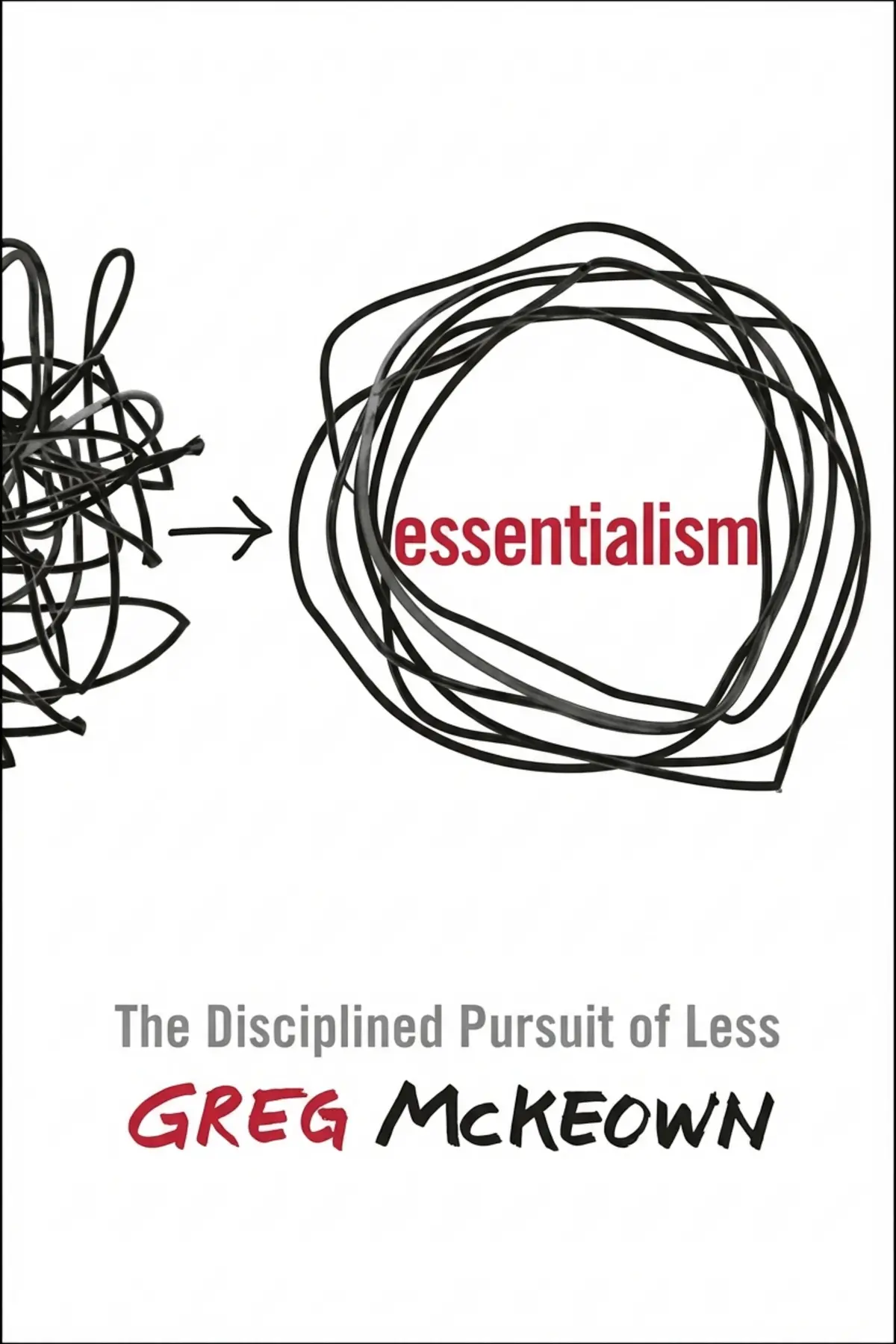
Table of Content
1. Introduction
57 sec
If your calendar is packed and your most important work still waits for a free afternoon that never arrives, more effort will not fix it. In Essentialism, Greg McKeown argues that only a few things in any life truly matter, and that trying to do everything leaves even those few done badly. His remedy is a discipline he calls less but better: find what deserves your energy, cut the rest without apology, and make the remaining work easy to carry out.
The case runs from dogs that stopped trying to escape, to an airline that won by refusing to serve meals, to a scout leader who fixed a slow hike by moving weight between backpacks. Along the way McKeown supplies tests you can use tonight: a scoring rule for anything you own or agree to, a way to refuse without damaging a relationship, and a time buffer that keeps plans intact.
2. Take back the power to choose
1 min 35 sec
Some people stop trying to change their situation even when escape is one step away. An experiment with dogs explains why, and why saying yes to everything can be the same kind of surrender.
3. Win by doing a few things very well
1 min 37 sec
One airline beat its rivals by offering less, and a famous competitor lost millions trying to copy it. The difference between them comes down to a decision most busy people keep avoiding.
4. Protect empty time to see what matters
1 min 29 sec
Constant access to entertainment feels like a win, yet it may be costing you the one thing good choices need. Newton, Einstein and many chief executives guarded it carefully.
5. Use play and sleep to sharpen your judgment
1 min 42 sec
Many ambitious people treat a nap or a playful afternoon as lost hours. The evidence McKeown cites suggests a short night can leave you thinking about as clearly as someone who has been drinking.
6. Keep only what earns a clear yes
1 min 33 sec
A shirt you never wear can teach you why your schedule stays overloaded. Two strict scoring tests make it far harder for the almost important to slip through.
7. Say no without damaging the relationship
1 min 40 sec
Refusing a request can feel like risking a friendship. McKeown offers a way to separate the two, and a goal so concrete that knowing what to refuse becomes much easier.
8. Stop funding failures and draw lines that free you
1 min 36 sec
Two governments kept paying for a famous jet for four decades after it was clearly a loss. A fence around a schoolyard shows the better habit that stops such traps early.
9. Lighten the load, then advance in small steps
2 min 09 sec
A slow scout troop, a police force in Canada and an Olympic swimmer each show how the work actually gets done once you have chosen what matters. None of them needed a dramatic fix.
10. Conclusion
1 min 19 sec
McKeown’s closing image is the editor. Most people treat a better life as a matter of adding: another goal, another course, another yes. His book argues for the opposite move. A good editor makes a piece stronger by cutting, and the same holds for a calendar, a closet or a career. Each trivial thing removed leaves more attention for the few that matter, and those few get done to a higher standard.
That is why the helpless dogs and Continental Lite belong in the same argument. Both show what happens when choice is surrendered, whether to helplessness or to the belief that everything can be kept. The essentialist takes the choice back and then guards it.
The practice can begin with something small. Before you accept the next request, hold it against your essential intent and ask whether it scores 90. If it does not, say no to the request and keep the person. Block a stretch of the week for thinking, protect your sleep as part of the work, and add half again to the time your next important task seems to need.
Then keep editing. The decision about what is worth doing never stays made, and the people who revisit it most often have the least to carry.
About this book
What is this book about?
Many professionals feel they must fit everything into their week: every opportunity, every meeting, every possession that might be useful someday. Greg McKeown argues that this is impossible and counterproductive. Only a few things matter to anyone's goals and well-being, and spreading effort across everything leaves even those few done poorly. His answer is essentialism, the disciplined pursuit of less. McKeown starts with how people lose the power to choose, drawing on the learned helplessness experiments with dogs and the contrast between Southwest Airlines and Continental Lite. He then makes the case for thinking time, play and sleep as conditions for clear judgment. His tools for cutting are sharp: the 90-percent rule, a clear-yes test, a way to say no and the idea of an essential intent. The final stretch is about execution. Readers learn to drop failing projects despite sunk costs, set boundaries that free them, remove the obstacles that slow a group down and build in a 50 percent time buffer. Small wins and routines then carry the work forward, as they did for the police of Richmond, Canada, and for Michael Phelps.
Book Information
Who it's for
Overbooked professionals
Professionals whose calendars are full but whose most important work keeps getting pushed back.
Overstretched managers and founders
Managers and founders torn between too many priorities who need firm tests for what to cut.
Wanting to refuse gracefully
People who say yes out of guilt and want to refuse requests without damaging relationships.
About the Author
Greg McKeown
Greg McKeown was born in London in 1977 and later became an American citizen. He studied communications at Brigham Young University and earned a Master of Business Administration from Stanford University. He hosts the podcast What's Essential, has written for Harvard Business Review and was named a Young Global Leader by the World Economic Forum. Essentialism, published in 2014, and his book Effortless are both New York Times bestsellers.
Ratings & Reviews
Ratings at a glance

What people think
Listeners find this book simple to navigate and comprehend, praising a direct writing approach that makes complicated notions easy to grasp. Furthermore, they value the thoroughly researched observations and useful tips that support both career-based and private advancement. The content motivates listeners to rethink their current priorities and provides concrete tactics for determining what is vital. Additionally, listeners find it intellectually stimulating, with one noting it helped them clarify and express their own life philosophy.
Top reviews
Narong
After hearing about this for years, I finally dove in. The concept of the "disciplined pursuit of less" hit me at exactly the right time in my career. I love the "if it's not a hell yes, it's a no" rule because it removes the agony of indecision that usually drains my energy. McKeown's writing is straightforward and highly researched, which helps ground the more philosophical ideas in reality. I've already started applying the "essential intent" strategy to my daily task list, and the difference in my mental clarity is staggering. It’s not just about doing less; it’s about making a higher contribution by focusing on what truly matters. This book has helped me articulate a life philosophy I've been struggling to define for a decade. Truly life-altering stuff if you're actually willing to cut the dead wood from your schedule.
Show moreDing
Wow. I didn’t realize how much I was holding onto out of pure guilt until I read this. The book helped me realize that saying no to a side project or a social obligation isn't an act of selfishness, but an act of integrity. I actually quit my second job after finishing this because I realized I was only doing it to please others at the expense of my health. McKeown’s logic is inescapable: we have a limited amount of energy, and we can either scatter it or channel it into something meaningful. The writing style is punchy and accessible, making it an easy read over a weekend. It's a provocative look at how we spend our days and a much-needed permission slip to stop trying to "do it all." If you're feeling overwhelmed, this book provides the framework to finally start breathing again.
Show moreManika
Is it possible to be both concrete and inspirational in a business book? Greg McKeown proves it is with this powerful look at how we trade our lives for things that don't matter. The concept of "Essential Intent" is a game-changer for anyone in a leadership position trying to steer a team toward a singular goal. It’s not just about saying no to the bad stuff; it’s about having the courage to say no to the "good" opportunities so you can say yes to the "great" ones. I loved the emphasis on creating a system that makes execution almost effortless once the big decisions are made. Not gonna lie, I was skeptical of the hype, but this is one of those rare books that actually changes the way you operate. It’s highly researched yet remains incredibly easy to understand. Highly recommended for anyone drowning in a sea of "important" tasks.
Show moreNoo
Teams function better when there is a singular, quantifiable purpose, and this book is the best manual I've found for creating that clarity. As a manager, I've often struggled with "priority creep," where every new task feels like the most important thing. McKeown’s framework for identifying the "highest point of contribution" has helped me shield my team from unnecessary distractions. The chapter on the power of "play" and "rest" as essential tools for focus was particularly enlightening, even if hearing about Ariana Huffington’s sleep habits felt a little out of place. This is a must-read for anyone who feels like they are working harder than ever but achieving less. It’s a disciplined approach to life that values quality over quantity. Truly essential reading for the modern professional who wants to make a real impact instead of just being busy.
Show morePop
The structure of this book is ironically quite essentialist itself. McKeown avoids the dense, jargon-heavy prose often found in self-help and instead delivers a potent, well-researched manifesto for modern living. I particularly enjoyed the chapter on the importance of sleep, despite the somewhat odd trend of CEOs like Jeff Bezos suddenly acting like they discovered the eight-hour night. Truth is, we all need the reminder that protecting our primary asset—ourselves—is the only way to sustain high performance over time. While I found some of the "cutesy" graphics a bit unnecessary, the core message about choosing what's important is incredibly sharp. It’s a great companion piece to Stephen Covey’s work, updated for an era where we are constantly bombarded by digital noise. If you feel like you're moving a millimeter in a million directions, read this.
Show morePim
As someone who constantly feels spread too thin, this felt like a cold glass of water. The central premise that if you don't prioritize your life, someone else will, resonated deeply with my current burnout. McKeown provides actionable strategies for identifying what is truly vital versus what is merely "close but not quite" important. Personally, I found the section on the "Brad Pitt" approach to specific mission statements to be a highlight of the book's practical advice. It’s one thing to have vague values, but having a measurable intent changes how you view every single invitation or request. My only gripe is that it feels a bit repetitive toward the end, but maybe that's the point of hammering home a singular message. It’s a solid 4-star read that I plan to revisit every six months to stay on track.
Show moreHazel
Picked this up on Audible and the narration really sells the message. There’s something about the author’s calm delivery that makes the radical idea of "doing less" seem entirely achievable and rational. I’ve read plenty of productivity books, but this one stands out because it focuses on the "why" rather than just the "how." The distinction between a non-essentialist and an essentialist is drawn clearly through various anecdotes and research-backed insights. I particularly liked the focus on "choice" as an active power we often surrender to our bosses or peers. While some of the historical comparisons felt a little stretched, the overall impact on my perspective was positive. It’s a thought-provoking guide that encourages you to re-examine your priorities with a much sharper lens. Definitely worth the time for anyone feeling the weight of the "busy" trap.
Show moreNang
Look, we all know we should sleep more and do less, but McKeown actually makes you feel the weight of your choices. The book acts as a mirror, reflecting all the ways we sabotage our own success by trying to please everyone at once. I appreciated the practical advice on how to gracefully decline commitments without burning bridges. The idea that we should only pursue things that are a "9 or a 10" on a scale of 10 is something I’ve started using in my personal life immediately. However, I do think the author could have spared us some of the cutesy large-text pages that felt like filler. Despite that, the core philosophy is sound and the writing is engaging enough to keep you hooked. It’s a solid guide for anyone looking to reclaim their time from the clutches of the "non-essential" world.
Show moreSuvannee
To be fair, much of the advice here isn't exactly groundbreaking. Most of us already know we should sleep more, focus on one thing at a time, and keep a journal to track our progress. McKeown writes with a British accent on the audiobook that is quite pleasant, but the content itself feels like a collection of common-sense wisdom wrapped in a trendy new package. I found the "Make It Right" foundation example interesting, yet I couldn't help feeling that the book could have been 100 pages shorter without losing any real substance. It’s definitely a helpful reminder for people who have forgotten how to set boundaries, but it’s not a revolutionary text by any means. It’s a decent enough read for professional growth, provided you don't expect a miracle. Sometimes the most essential thing is to just skip the fluff and get back to work.
Show moreOrm
Not what I expected. While I understand the "less is more" philosophy, this book feels like a classic example of a single blog post stretched into 270 pages through large fonts and repetitive anecdotes. Frankly, the author’s decision to use historical figures like Rosa Parks or Nelson Mandela to illustrate his points on "saying no" felt tone-deaf and reductive to their actual struggles. It’s hard to take advice on focus seriously when it’s packaged in such a slick, corporate-speaker vibe that clearly caters to the Silicon Valley elite. To be fair, there are a few decent takeaways about setting boundaries, but they are buried under layers of fluff that contradict the book’s own premise. If you want to learn to say no, start by saying no to this book and just read a summary online instead. You'll save time and money.
Show moreQuestions about this book
What is the main idea of Essentialism by Greg McKeown?
Greg McKeown argues that only a few things truly matter to our goals and well-being, and that trying to do everything leaves even those few done badly. His discipline, less but better, means choosing a direction, cutting what is trivial with strict tests, revisiting those choices regularly and making the essential work easy to carry out. The payoff, he says, is a life that is both more productive and more fulfilling.
What is the 90-percent rule in Essentialism?
The 90-percent rule stops you from keeping things that are only slightly useful. You pick the most important criterion for a decision, such as whether you will ever wear a piece of clothing again, and score each option from zero to 100. Anything below 90, even an 89, counts as zero and goes. The same scoring works for commitments, meetings and projects.
How does Essentialism suggest saying no?
McKeown suggests separating the decision from the relationship, so that turning down a request is a judgment about the request alone. He also compares regrets: a no may sting for ten minutes or so, while an unwise yes can be regretted much longer and may crowd out the opportunity that really counted. A clear essential intent gives you a standard against which to weigh each request.
What is an essential intent?
It is one main objective that is both inspiring and concrete. McKeown contrasts ending world hunger, which inspires but is too vague to act on, with building 150 affordable, storm-resistant, environmentally friendly homes for families in the lower ninth ward. To check that your own goal is clear enough, ask how you will know when you have reached it. If you can answer, the goal works.
Who should read Essentialism?
It suits professionals with overflowing calendars, managers and founders torn between competing priorities, and anyone who agrees to things out of guilt. The tools are concrete and quick to try, from a 90-point scoring rule and a very short nightly journal to a 50 percent time buffer for important tasks and a firm line between work and home.
Readers also enjoyed




AUDIO SUMMARY AVAILABLE
Listen to Essentialism in 15 minutes
Get the key ideas from Essentialism by Greg McKeown, plus 5,000+ more nonfiction titles.
- 5,000+ titles
- Listen as much as you want
- 7-day free trial
- Cancel anytime









