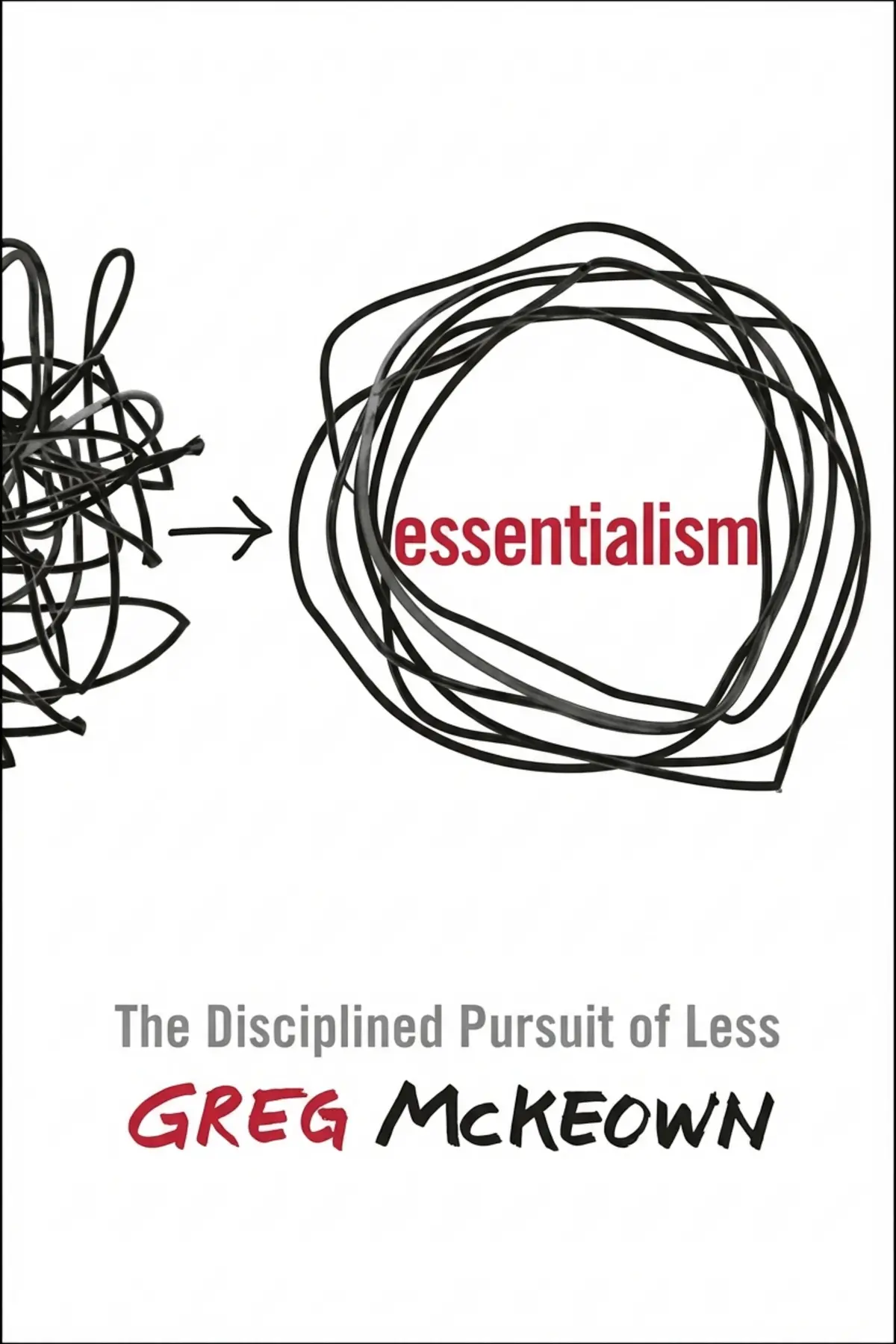
Essentialism: The Disciplined Pursuit of Less
Greg McKeown
 English
 ไทย
Shows how to get important work done without grinding yourself down. You ask what the easy version looks like, take small clear steps, rest on purpose, and build levers that keep paying after the effort stops.
1 min 04 sec
If your days feel like pushing harder and still falling behind, the pushing itself may be the problem. In Effortless, Greg McKeown, author of Essentialism, notes that extra effort stops paying after a point. When he doubles a two-hour writing session to four hours, he gets three pages, not four, and he pays for those hours with exhaustion.
McKeown’s case is that the work that matters most gets done more reliably when you make it easier. Making yourself suffer for it works less well. He builds the argument in three stages. A clear, rested mind assumes a task can be simple. Small, well-defined actions follow. Then levers keep paying long after the work is done.
Along the way there is a designer who turned a semester of filming into a job for one phone, a single DVD dropped in the mail, and a cheap airplane that crashed its way to a prize nobody else could win. Each one becomes a question or habit you can bring to your own heaviest task.
1 min 42 sec
Doubling the hours you put into a task should double what you get out of it. McKeown’s own writing sessions show why that rarely happens, and what the lost hours really cost you.
1 min 32 sec
A designer was told to record a full semester of lectures while already buried in work. She solved it in a single conversation, by questioning something everyone else had taken for granted.
1 min 38 sec
A pile of unanswered voicemails waited for McKeown after a long trip. The way he cleared it, and what his family does after dinner, suggests that tedious tasks can be redesigned.
1 min 41 sec
Before Netflix became a streaming giant, its founder ran one tiny experiment with an envelope. That test holds a lesson for any project that feels too big to begin.
1 min 48 sec
For over 17 years, entrants building expensive, impressive-looking machines failed to claim a prize for human-powered flight. The man who finally won it did so by building something that looked almost careless.
1 min 50 sec
A salary stops the month you stop working, while a book can pay its author for years. McKeown explains how to shift more of your effort into the second kind of result.
1 min 46 sec
Working with others often doubles the effort a goal requires. McKeown borrows a hiring filter from Warren Buffett and a simple written agreement to make shared work run smoothly.
1 min 08 sec
Effortless is a book about where to put the strain. McKeown never claims that the important things in life take no work. His claim is that work goes further when it runs through a clear, rested mind, a defined finish line and levers that keep paying. Kim’s smartphone, the single DVD in the mail and MacCready’s cheap, crashable plane all show the same thing: the people who got furthest refused to make the job harder than it needed to be.
The practice is modest. When something already feels heavy, ask what the easy version would look like and what done really means. Take the smallest step that teaches you something, and keep a pace you could hold for months. When a task or a problem keeps coming back, spend the effort once, on a checklist, a clear agreement with the people involved or a fix at the root, so you stop paying for it again and again.
McKeown’s own writing sessions show the whole argument on a small scale. Two extra hours bought him one extra page. The hours you decide not to spend are often where the better work begins.
Many capable people assume that anything worthwhile has to hurt. They plan big, push long hours and end up exhausted, often with less to show for it than they hoped. Greg McKeown argues that effort has a ceiling. Beyond a certain point, more hours bring smaller returns and a heavier cost in energy. Effortless lays out another route in three stages. First comes the Effortless State: a mind cleared of the assumption that everything must be complicated, and a body that is properly rested. Next comes Effortless Action, which means defining what done looks like, taking the smallest obvious step, starting with a rough version and keeping a steady pace. The last stage is Effortless Results, where knowledge, automation and trust act as levers that multiply a single effort many times. McKeown makes the case with concrete stories. A university designer avoids a semester of video editing, Reed Hastings tests Netflix by mailing one DVD, and Paul MacCready wins a prize for human-powered flight by building planes cheap enough to crash. Readers get a practical set of questions and habits for making the work that matters easier to start, easier to keep up and more likely to last.
Professionals who work long hours and feel they are getting less back for each one.
Managers and founders tired of overplanning projects and patching the same problems.
Anyone close to burnout who wants a gentler, steadier way to get important work done.
Greg McKeown was born in London in 1977 and later became an American citizen. He studied communications at Brigham Young University and holds an MBA from Stanford University. He hosts the podcast What's Essential, has written for Harvard Business Review, and was named a Young Global Leader by the World Economic Forum. His earlier book Essentialism, published in 2014, and Effortless are both New York Times bestsellers.
Greg McKeown

Listeners consider this work perceptive and skillfully composed, mentioning it serves as a quality successor to Essentialism. The content is straightforward and useful, as one listener points out how it offers strategies for navigating difficult scenarios. They value the inspiring material and surprising conclusion, with one listener characterizing the book as a phenomenal guide to living a better life.
This book arrived at exactly the right moment in my life. After struggling through a period of intense burnout where every minor task felt like climbing a mountain, McKeown’s advice on finding the path of least resistance was transformative. While Essentialism was about doing the right things, Effortless is about how to do those things without exhausting your soul in the process. I particularly loved the concept of defining what 'done' looks like before you even start. It prevents that endless cycle of perfectionism that usually leads to procrastination. Truth is, we often overcomplicate our workflows because we think complexity equals value, but this guide proves the opposite. The writing style is crisp, engaging, and filled with contemporary examples from the military and sports that actually make sense. It’s not just a sequel; it’s a necessary companion for anyone feeling overwhelmed by their own ambitions.
Show moreEver wonder why we feel the need to suffer to achieve success? Greg McKeown challenges that toxic 'hustle' culture by showing us that the most effective path is often the easiest one. This book is a phenomenal guide to living a better life without the constant friction we create for ourselves. I was particularly struck by the advice on automating systems so you can forget the goals and just focus on the process. The ending was surprisingly emotional and gave the whole book a deeper meaning that I wasn't expecting from a productivity manual. It’s well-written, easy to follow, and incredibly motivational for those of us who tend to overthink everything. I’ve already recommended it to three colleagues who are on the verge of burnout. It’s rare to find a book that feels both practical and soul-cleansing at the same time.
Show moreFinally got around to finishing this, and wow, it really delivers on its promise. We are so conditioned to believe that if something isn't hard, it isn't worth doing, but this book completely dismantles that myth. The author provides actual tools for approaching challenging situations with a sense of ease rather than dread. I’ve already started redesigning my morning systems to be more automated, and it has cleared up so much mental bandwidth. The truth is, life is already hard enough without us adding extra layers of complexity to our chores and careers. This is one of the best books I’ve read this year because it’s so immediately actionable. It’s a phenomenal guide to living a better, more streamlined life. If you feel like you’re constantly running on a treadmill and getting nowhere, you need to read this immediately.
Show moreAs someone who constantly struggles with over-complicating even the simplest tasks, this was the intervention I needed. McKeown breaks down the process of simplification into three clear stages that actually feel achievable. I loved the emphasis on the 90-minute work sessions—it’s such a manageable way to tackle big projects without burning out. The idea of pairing a tedious task with something enjoyable to make it 'effortless' was a small but brilliant tip that I’ve already used for doing my taxes. It’s a nice follow-up to his previous work and feels like the missing piece of the puzzle for productivity. While some parts might feel familiar to seasoned self-help readers, the presentation is top-tier. I found the ending particularly moving and unexpected for a book of this genre. Strongly recommended for anyone who wants to find an easier way to achieve their goals.
Show moreAfter hearing so much buzz about his first book, I dove into this one expecting a similar punch to the gut. While it didn't quite hit as hard as Essentialism, the practical tools provided are gold for anyone managing a heavy workload. The suggestion to replace the question 'why is this so hard?' with 'how can this be easier?' has become my new daily mantra. It sounds simple, almost too simple, yet it fundamentally shifts your perspective on challenging projects. I’ve started implementing the rule of never doing more than three 90-minute sessions of essential work per day, and the difference in my energy levels is noticeable. Not gonna lie, some of the analogies felt a bit forced and didn't always land for me. However, the summary at the end of each chapter helps bridge those gaps. It’s a very accessible read that encourages you to stop glorifying the struggle.
Show morePicked this up on a whim during a particularly stressful week at the office. I’m glad I did, as it provided some immediate relief and a few 'aha' moments regarding my workflow. The concept of leaving 'something in the tank' instead of working until total exhaustion was a much-needed wake-up call for my work ethic. McKeown has a way of sharing ideas that resonates deeply, even if you've heard similar concepts elsewhere. I especially liked the focus on 'effortless results' and how to make the effects of your work compound over time. My only minor gripe is that some chapters felt a bit repetitive towards the end. That said, the layout is beautiful and the bite-sized chapters make it perfect for reading in short bursts. It’s a great follow-up for fans of Essentialism who are looking for the next logical step.
Show moreMcKeown’s writing style is just so smooth and easy to digest. Even when he’s discussing concepts that aren't necessarily 'new,' the way he frames them makes them feel fresh and applicable. I spent the last few days looking at my routine and wondering how many obstacles I've been putting in my own way. The section on the 'effortless state' helped me realize how much mental clutter I carry into every task. Some of the analogies are a bit hit-or-miss, so I’d suggest reading the summaries at the end of the chapters if a specific story isn't clicking for you. Personally, the most valuable takeaway was the reminder to define a clear finish line for my daily tasks. Without that, work just expands to fill every waking hour. This isn't quite the game-changer his first book was, but it’s still a very worthwhile addition to any bookshelf.
Show moreIs it a revolutionary masterpiece? Not really, but it serves as a polished reminder of principles we often ignore in our frantic daily lives. Much of the advice feels like common sense wrapped in high-quality packaging, though I must admit McKeown presents it far better than most self-help gurus. The book is split into three logical sections: state, action, and results. I found the 'effortless state' part a bit fluffy, but the practical tips on automating systems were genuinely useful for my productivity. To be fair, if you’ve read a lot of habit-forming or time-management literature, you might find yourself nodding along rather than taking notes on anything new. I expected a bit more of a 'wow' factor similar to his previous work. It’s a solid library borrow if you need a quick reset, but don't expect it to completely rewrite your brain.
Show moreNot what I expected, but not bad either. I went into this with very high expectations because Essentialism changed the way I look at my calendar. Effortless feels a bit more like a collection of 'pro-tips' rather than a cohesive philosophy. It’s largely common sense, although it is presented in a very simplified and elegant manner that makes it easy to read in a single sitting. The examples from the military and contemporary business leaders were interesting, though they occasionally felt a bit disconnected from everyday life. I did appreciate the focus on making the essential activities the easiest ones to perform. It’s a decent book for a refresher, but I wanted something that would surprise me more or offer a deeper psychological dive. It’s a solid 3-star read that I would recommend as a light library borrow rather than a must-buy.
Show moreFrankly, I was disappointed by how thin the actual substance felt in this volume. I’m a huge fan of the author’s earlier work, but this felt like it could have been a long-form blog post rather than a full-fledged book. Most of the strategies are things most adults already know, like getting enough sleep or breaking big tasks into smaller steps. Do we really need a whole chapter to tell us to be grateful when we feel like complaining? The tone is pleasant enough, but I kept waiting for a deep insight that never arrived. It felt like a collection of anecdotes about successful people that didn't always translate into actionable advice for the average person. If you are brand new to the world of personal development, you might find some value here. For the rest of us, it’s mostly recycled ideas in a pretty new cover.
Show moreMcKeown argues that extra effort has diminishing returns, so pushing harder past a point only adds exhaustion. He proposes three stages instead. The Effortless State is a clear, rested mind. Effortless Action means doing less but doing the right things. Effortless Results come from levers such as knowledge, automation and trust, which keep producing value after a single effort.
Effortless Inversion means flipping the assumption that a task must be complicated and asking what it would look like if it were easy. McKeown’s example is Kim, a university designer asked to record a semester of lectures. She asked what the videos were for, learned they served one absent student, and suggested a classmate record the lectures on a smartphone.
It is the smallest obvious step that moves a project forward and teaches you something, without overthinking. McKeown cites Reed Hastings, who mailed a single DVD to check whether discs could survive the post before building a rental business. That small test shaped his next decisions, and Netflix later grew into a streaming giant.
Start by defining what done looks like for each project and writing a short Done for the Day list. Work in up to three focused sessions of no more than 90 minutes with breaks. Begin with a rough version, keep a steady daily range, and turn repeated tasks into checklists. If you work with others, agree on roles and standards in writing and fix recurring problems permanently.
AUDIO SUMMARY AVAILABLE
Get the key ideas from Effortless by Greg McKeown, plus 5,000+ more nonfiction titles.