Change Anything: The New Science of Personal Success
Kerry Patterson
 English
A practical method for raising broken promises, missed deadlines and bad behavior without starting a fight. It covers choosing the right issue, dropping blame, making people feel safe and ending with a plan people keep.
1 min 05 sec
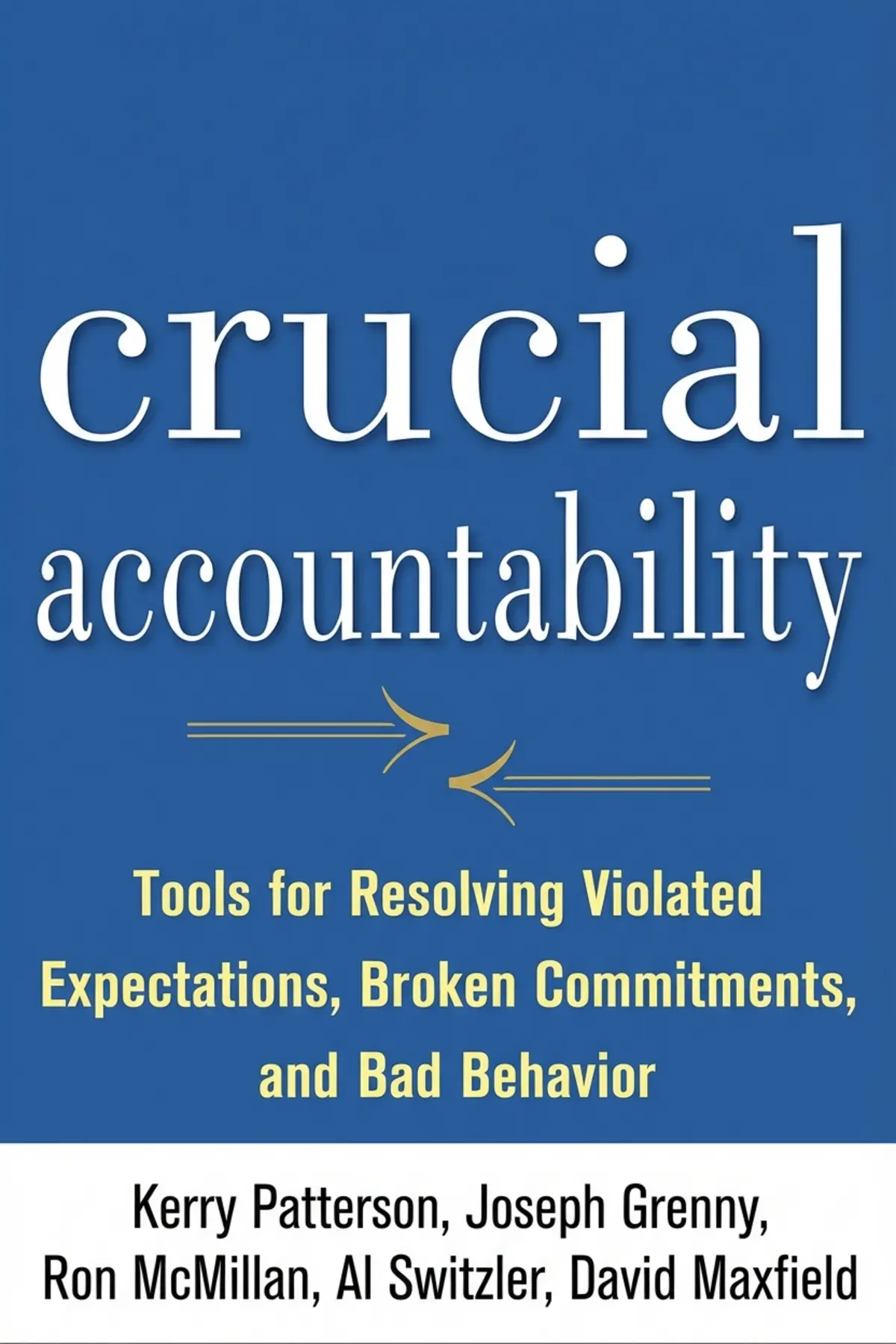
Most people who are let down by a colleague, a partner or a boss say nothing, because they don’t know how to start or they fear making things worse. In Crucial Accountability, Kerry Patterson, Joseph Grenny, Ron McMillan, Al Switzler and David Maxfield argue that these talks are largely won or lost before anyone speaks, by the story you tell yourself about why the other person failed. Assume they are lazy or careless and the exchange turns hostile within seconds. Allow that there may be reasons you cannot see, and you arrive curious.
Everything in their method grows from that starting point: choose the issue that matters, make the other person feel safe, point to real consequences, remove what blocks them and finish with a plan everyone has agreed to. What you gain is a calm way to raise a missed deadline or a broken promise this week. You get words for the opening, ways to handle anger or tears in the middle and a plan that keeps the same problem from coming back.
1 min 35 sec
A boss who breaks a promise, then mocks you for mentioning it, has handed you several problems at once. Grab the wrong one and the talk goes nowhere. A teenager’s curfew shows how to sort them.
1 min 53 sec
A couple’s talk about a broken promise turns into a shouting match within seconds, and the cause was set before either spoke. A woman caught stealing medicine shows how fast our first judgment can mislead us.
1 min 49 sec
Being confronted makes almost anyone go silent or start arguing, even with a good friend. Learn the few moves that lower someone’s guard before you mention the problem, and the exact order for describing what went wrong.
1 min 41 sec
Most people hear the word consequences and think of punishment. The authors point to a different kind, already built into almost every behavior, that persuades better than any warning and leaves the other person free to choose.
1 min 42 sec
An assistant works hard on an important monthly report, yet it keeps arriving late. His manager discovers effort was never the issue. What she does next decides whether the deadline is ever met.
1 min 50 sec
Midway through a talk about skipped piano practice, a father catches his daughter in a lie. Sudden anger, tears or a bigger problem can derail any conversation, unless you know when to switch topics and when to slow down.
1 min 49 sec
A manager holds a respectful, thorough talk with two colleagues, leaves hopeful, and weeks later the report is late again. She skipped one step at the end, and it decides whether any agreement survives.
1 min 06 sec
What the authors offer is a way to be firm without becoming the villain of your own story. Most of the work happens around the hard minute everyone dreads. Before it, you choose the one issue that matters and question the easy belief that the other person is simply bad. During it, you make them safe enough to tell the truth, show them costs they could not see and clear what stands in their way. After it, you leave with a plan precise enough that nobody can remember it differently.
The next time a deadline slips or a promise breaks, write the gap down in plain facts, along with one personal, social and structural reason it might have happened. Open with the outcome you both want, and close on who will do what by when. The authors add one habit for a world where priorities shift overnight: ask people to tell you the moment their circumstances change, so expectations can move before trust breaks.
Seen this way, accountability is an agreement two reasonable people keep rebuilding, one honest conversation at a time.
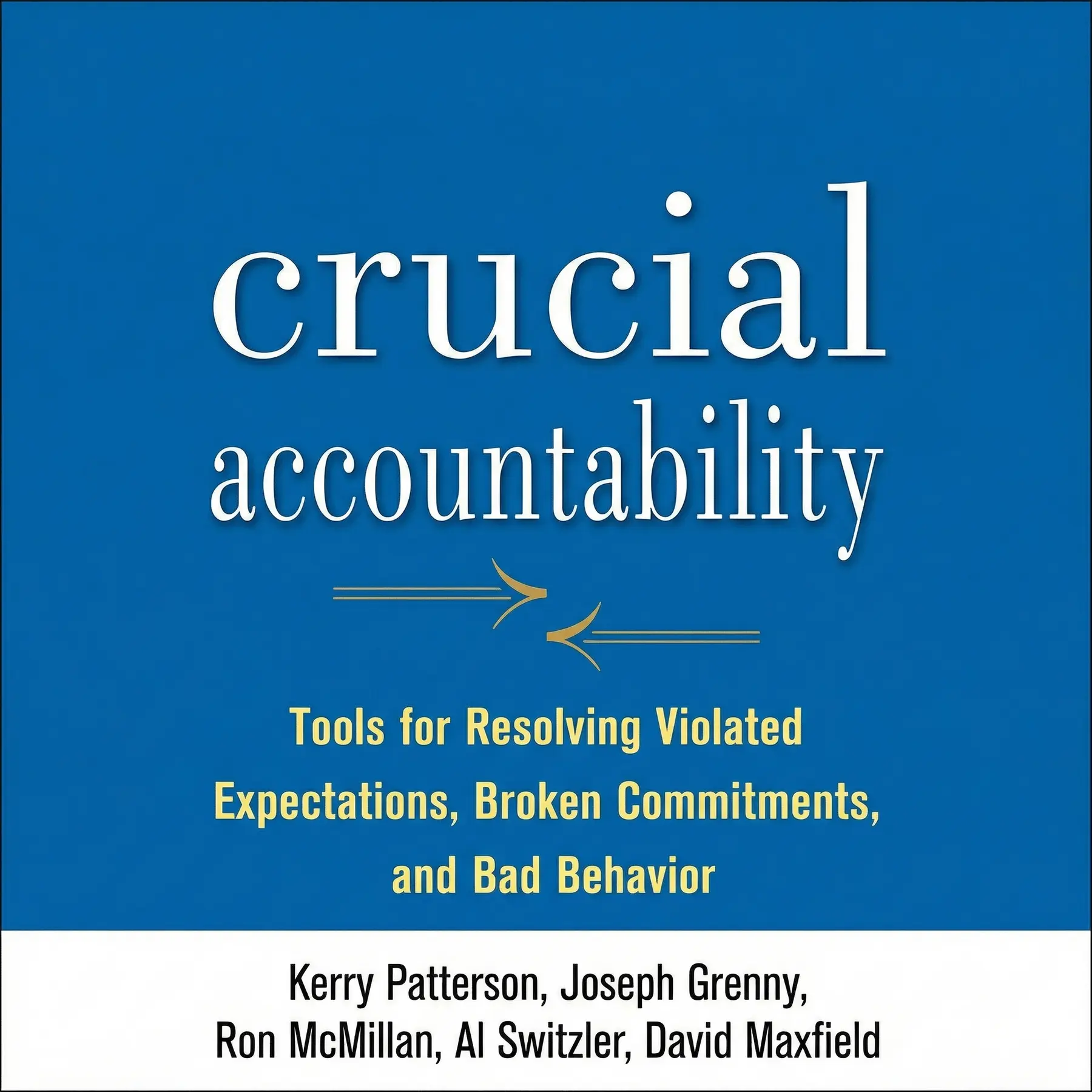
A colleague misses deadline after deadline. A partner ignores a simple request. A boss promises a raise and never delivers. Most people faced with this either swallow their frustration or speak up so angrily that things get worse, usually because they don't know a better way. Kerry Patterson, Joseph Grenny, Ron McMillan, Al Switzler and David Maxfield argue that these conversations are mostly decided before they begin, by the story we tell ourselves about why the other person failed. Their method starts there. First pick the one issue that matters most and question the easy assumption that the other person is simply bad. Then open in a way that feels safe and lay out the facts. From there, point to natural consequences instead of threats, work together to remove whatever is blocking the person, and stay flexible when strong emotions or a bigger problem appear. Readers get a full sequence for a difficult talk, from the first sentence to the last. It ends with a plan that names who will do what by when, and with follow-up that matches how important the task is and how reliable the person has been.
Managers and team leads tired of the same deadlines slipping month after month.
Colleagues and partners who swallow frustration over broken promises because they fear a fight.
Anyone whose attempts to hold people to their word keep ending in arguments.
Kerry Patterson, Joseph Grenny, Ron McMillan, Al Switzler and David Maxfield are leaders of VitalSmarts, a training company Grenny founded, and together they have taught millions of people and worked with more than 300 Fortune 500 companies. Grenny has spent thirty years studying behavior at work and was a protégé of Albert Bandura. Maxfield and Patterson did doctoral work at Stanford, and Maxfield leads research on how silence harms organizations. McMillan has spent thirty years speaking on communication, leadership and change.
Kerry Patterson
Joseph Grenny
Listeners find this guide easy to digest and skillfully authored, praising its hands-on strategies for accountability and resolving conflicts. They appreciate the many practical illustrations and view it as required reading for managers, as one listener points out its particular value for small business owners with employees. Listeners appreciate the direction provided, while one review notes how effectively it develops the concepts from the first book in the series.
Finally got around to reading this after struggling with a difficult hire in my small business. For anyone who owns a shop or manages a tiny team, the struggle with accountability feels personal and exhausting. This book offers a step-by-step roadmap for those awkward moments when someone misses a deadline or ignores a policy. I found the concepts much easier to apply than I expected, mainly because the real-life examples felt so grounded in actual office politics. It’s not just corporate fluff; it’s about having a spine while staying respectful. Frankly, it changed how I approach my Monday morning meetings. I no longer feel like a tyrant when I ask for results, and my employees seem to appreciate the clarity. If you've been avoiding a hard talk, this is your sign to stop waiting.
Show moreThe chapter on identifying the "right" problem was the breakthrough I didn't know I needed. Most of the time, I get angry about a specific event, but I fail to realize that the real issue is the pattern of behavior. This book teaches you how to look past the surface-level mistake and address the underlying relationship strain. It’s riveting and so applicable to my current role as a project manager where I constantly deal with missed milestones. Not gonna lie, I used to just let things fester until I blew up, which is exactly what this book warns against. The authors provide numerous elegant options for holding people accountable without destroying their morale. It’s become a mandatory read for my leadership team. If you want to build a culture of high performance and trust, you need these tools.
Show moreWow. I wish I had read this ten years ago when I first started my small business. It would have saved me hundreds of hours of frustration and at least a dozen failed professional relationships. The authors explain that we can’t fix everyone else, but we can change how we approach the confrontation. It’s about moving from judge and executioner to a curious participant who wants to solve the problem together. The advice on explaining what you "do not" mean to prevent misunderstandings has already saved me from two major arguments this week. It’s practical, direct, and remarkably easy to digest. While some critics find it repetitive, I think the repetition helps cement the skills into your brain. This is a must-have on the shelf for every manager who wants to lead with integrity.
Show moreEver wonder why some teams thrive while others crumble under the weight of unspoken grievances? This book provides the answer. It’s not just about "talking"; it's about the specific art of holding someone accountable without being a demanding tyrant. I love how it emphasizes that people will give you a lot of leeway if they know you value them as a human being. It’s about building that foundation of respect first. The techniques for navigating broken promises are presented in a way that makes them feel accessible to anyone, regardless of their personality type. Whether you are dealing with a spouse who won't help with chores or an employee who is always late, the logic applies perfectly. It’s a riveting read that I’ve already recommended to my entire book discussion group.
Show moreAs someone who already appreciated Crucial Conversations, I was hesitant to dive into what looked like a redundant sequel. However, this volume stands on its own by focusing specifically on the aftermath of broken promises. The "humanizing question"—asking why a rational person would act that way—is a complete game-changer for my temper. It forces you to stop being the judge and jury and start being a collaborator. Truth is, there are some moments that feel slightly dated, like a few weirdly gendered examples, but they don't ruin the core message. The structure is clear-cut and well-organized, making it a quick reference for managers. I’m giving it four stars instead of five because it does rehash a bit of the first book’s DNA. Still, the new layers of strategy for navigating disappointment are worth every penny.
Show morePicked this up because I wanted to improve how I handle confrontations with my staff at the clinic. It’s a very reader-friendly guide that doesn't rely on heavy academic jargon, which I appreciated. The focus on creating "safety" before diving into a difficult topic is something I’ve started using immediately. My favorite part is the emphasis on being curious instead of "boiling mad" when someone fails to deliver. It’s amazing how much more cooperation you get when people don’t feel attacked. One minor gripe is that I wish there were even more practice exercises to hammer home the concepts. It’s easy to read but takes a lot of discipline to actually execute in the heat of the moment. Overall, it's a solid 4-star resource for anyone in a leadership position who hates conflict.
Show moreIn my experience, most business books are 200 pages of fluff surrounding one good idea, but this one actually delivers multiple actionable strategies. It serves as a fantastic follow-on to Crucial Conversations, though it does stand on its own if you haven't read the first one. I specifically liked the distinction between "ability" and "motivation" when analyzing why someone didn't follow through. It stops the blame game. Instead of assuming someone is lazy, you check if they actually had the resources they needed. Personally, I found the tone a bit dry in the middle chapters, but the payoff is worth the slog. The scripts provided for starting a conversation are incredibly helpful for those of us who get tongue-tied under pressure. It’s a solid addition to any professional library.
Show moreAfter hearing so many colleagues rave about this, I finally sat down with a highlighter and a notebook. The core message—that we should ask "Why would a decent person do this?"—is a radical way to defuse workplace anger. It forces a level of empathy that is often missing in high-stakes environments. I’m a supervisor at a manufacturing plant, and the "safety" techniques have helped me address safety violations without causing a revolt. The book is well-written and filled with real-world scenarios that actually feel like things that happen in a real office. To be fair, it’s a lot to take in at once, and I think I’ll need to re-read it to truly master the techniques. Four stars because I think it could have been trimmed down by about thirty pages.
Show moreTo be fair, the business communication ideas here are logically sound and potentially transformative if you can get past the writing style. I found the book a bit unorganized in certain sections, with a tendency to repeat the same points under different acronyms. It often feels more like a long appendix to the original Crucial Conversations rather than a necessary standalone work. While the "how-to" of addressing broken expectations is useful, the authors occasionally use examples that feel stuck in the 1950s. Using terms like "hussy" or describing domestic coercion as a communication mishap is jarring in a modern business context. I kept reading because the practical tools for resolving conflict are genuinely helpful for my role as a supervisor. It’s a bit of a mixed bag. You’ll find some gems, but you’ll have to sift through some outdated sludge.
Show moreLook, the ideas regarding "CPR" (Content, Pattern, Relationship) are actually quite brilliant, but I cannot ignore the blatant misogyny buried in the anecdotes. In one specific example, a woman is referred to as a "hussy," and in another, a husband’s coercive behavior is framed as a communication hurdle. These are not just "outdated" vibes; they are deeply inappropriate for a professional development book published in the 21st century. It’s a shame because the actual framework for accountability is better than almost anything else on the market. If the authors did a complete overhaul of the examples to reflect modern sensibilities, I’d rate it much higher. As it stands, it’s hard to recommend this to my female colleagues without a massive disclaimer. The good ideas are unfortunately lost in a patriarchal fog.
Show moreThe authors argue that holding someone accountable succeeds or fails largely on the story you tell yourself beforehand. If you assume the person is simply bad, the talk turns hostile. If you stay curious about personal, social and structural causes, make the other person feel safe, explain natural consequences, remove barriers together and end with a precise plan, broken commitments can actually be fixed.
CPR stands for content, pattern and relationship, a way to sort a tangle of problems before you speak. A teenager breaking curfew once is a content issue. Breaking it again after promising not to is a pattern. When her father can no longer trust her, the relationship itself becomes the problem. The authors also suggest weighing consequences and intentions, then choosing the issue you care about most.
Show respect and a shared purpose first. Ask permission to raise the issue, and use contrasting: say what you do not mean, such as a judgment on their overall work, then what you do mean. State that the goal is to improve things for both of you. Next, lay out the difference between your expectation and the actual outcome, share your view tentatively and close by asking what happened.
End with a plan that says who will do what by when, with measurable tasks, such as three new ideas a week instead of being more creative, and a specific date and time. Agree on follow-up that matches how important the task is and how reliable the person has been. Everyone must commit out loud, because people can only be held to plans they accepted.
It suits managers dealing with missed deadlines, colleagues who depend on others’ work, and partners or parents frustrated by broken promises. It is especially useful for people who either stay silent or explode, since it gives a step-by-step sequence from choosing the issue to handling strong emotions and agreeing on follow-up.


Margaret Heffernan





Joseph A. Maciariello



AUDIO SUMMARY AVAILABLE
Get the key ideas from Crucial Accountability by Kerry Patterson, plus 5,000+ more nonfiction titles.