


14 min 52 sec
Available in: English
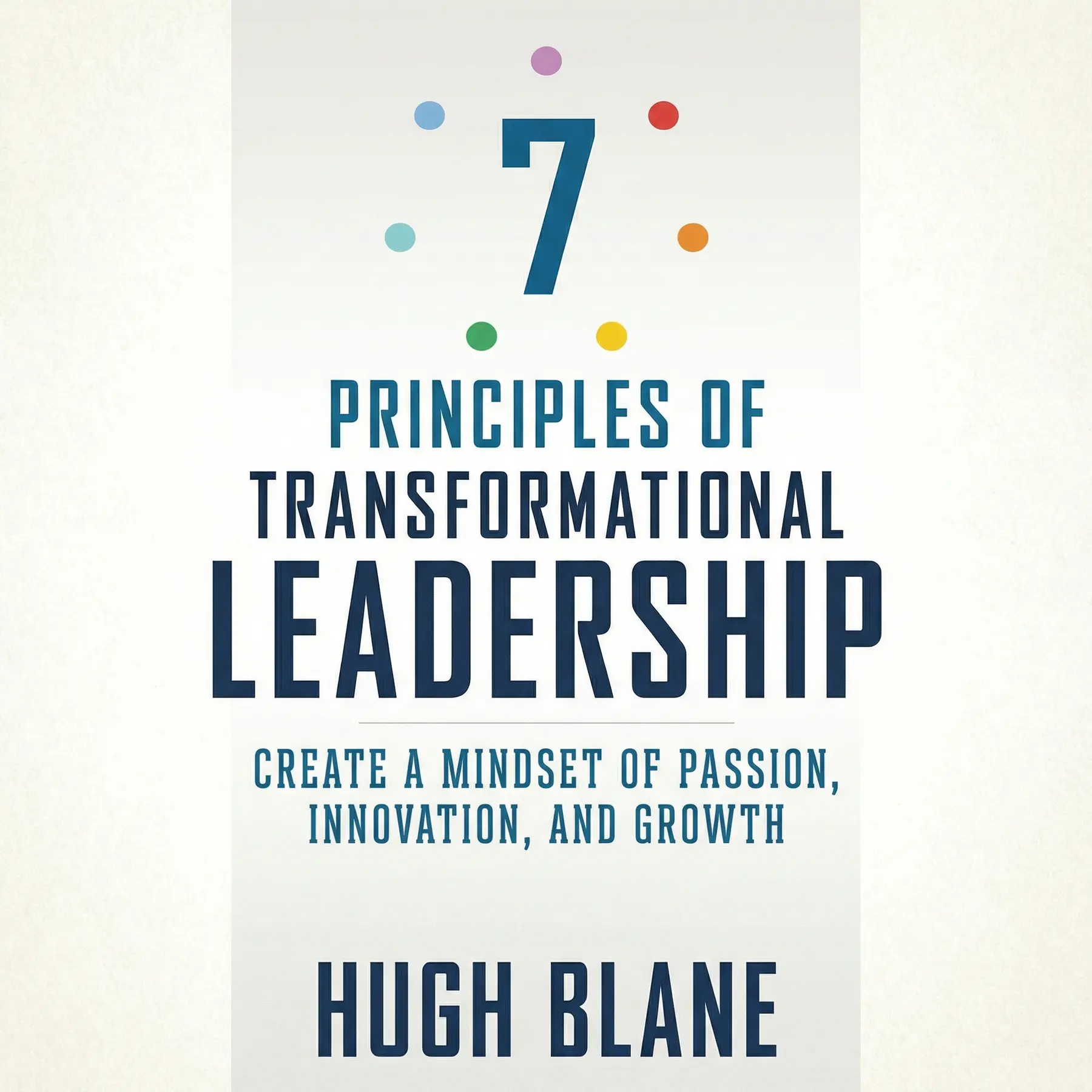
7 Principles of Transformational Leadership: Create a Mindset of Passion, Innovation, and Growth
By Hugh Blane
Shows leaders who work hard but see little progress how to turn a clear purpose, kept promises, specific praise and steady persistence into teams that bring energy and new ideas to their work.

Table of Content
1. Introduction
58 sec
If you lead people, work long hours and still feel your team is standing still, Hugh Blane would say the trouble lies less in your effort than in where it starts. In 7 Principles of Transformational Leadership, the consultant his clients call The Talent Alchemist argues that a team without a clear purpose crawls along as if driving through fog. His whole method runs from the inside out. A leader who is clear, reliable and steady makes room for employees to thrive, and thriving employees are the ones who serve customers well.
Blane builds this into seven principles, each beginning with the letter P, from purpose and promises to persuasion, praise and perseverance. Each comes with something to try this week: a one-sentence purpose, a cap of five priorities, a scale for deciding who decides, and a short set of questions to ask yourself before bed.
2. Write a purpose statement that clears the fog
1 min 48 sec
Fog on a highway changes how you drive before you even think about it. Blane sees teams react the same way when direction is missing, and his remedy fits into a single sentence with a fixed shape.
3. Lead yourself well before you lead anyone else
1 min 48 sec
Most teams groan when a new project lands. Blane turns the word around, and his formula explains why so many efforts to delight customers collapse long before a customer is ever involved.
4. Make fewer promises and keep every one
1 min 47 sec
Employees often stop listening to a leader long before anyone says so out loud. Blane traces that silence to a small, repeated habit, and to the fears it plants across a whole organization.
5. Earn a yes before you ever ask
1 min 39 sec
Colleagues and clients are always deciding whether you are safe to follow. Blane lays out a three-step order for winning agreement, and most people jump straight to the step that belongs last.
6. Praise that makes people perform at their best
1 min 44 sec
The same people who roar for their team every weekend get barely a nod for excellent work on Monday. Blane argues that gap costs companies dearly, and that the cause often lies with the leader.
7. Build the persistence that talent alone cannot supply
1 min 59 sec
Organizations fight hard to hire the most skilled people and then watch those teams stall under pressure. Blane points to the quality hiring rarely tests for, and to four habits that wear it down.
8. A nightly review makes your leadership deliberate
1 min 55 sec
Racing from meeting to email feels productive, yet it can leave a leader steering by accident. Blane’s final principle borrows a lesson from a crisis in space and ends with five questions for each evening.
9. Conclusion
1 min 14 sec
Blane’s seven principles describe one movement, from the inside out. The fog lifts when a leader can say in a single sentence why the work exists. Trust grows from a short list of promises that actually get kept. Influence, recognition and persistence then rest on that base, and the Flourishing Performance Formula explains the order: a leader who thrives makes room for employees to thrive, and they in turn help customers thrive. Each principle props up the others, so neglecting one weakens the rest.
The book supports a few small starts. Write your purpose sentence, naming what you create, for whom and what they gain, and test tomorrow’s calendar against it. Cut your priorities to five and keep your most important promise in view every day. When someone does good work, tell them that day, and tell them precisely what it was. Before bed, give yourself five minutes to ask where you lived your purpose and where you fell short.
None of this asks for a new title or a bigger team. It asks you to become, first, the kind of leader you would want to follow, and to let the people around you take their cue from there.
About this book
What is this book about?
Plenty of leaders put in long hours and still feel their teams are stuck. Hugh Blane, a consultant who coaches senior teams and high-potential employees, argues that more effort is rarely the fix. Change has to start inside the leader and move outward. He sets out seven principles, all beginning with P. Purpose gives a team direction, and it can be written as one sentence built from love, talent and value. Promises build trust when they are few, freely made and kept. Projects carry that purpose into daily work, guided by a formula that puts the leader's own flourishing first, then the employees', then the customers'. Persuasion wins agreement by earning trust and listening before proposing anything. Praise lifts performance when it is sincere, timely and specific. Perseverance carries leaders past inertia and indifference. Preparation turns all of it into a nightly habit of reflection. Readers get concrete tools to try right away: a purpose statement template, a cap of five priorities, a one-to-five scale for deciding who decides, nine questions that build persistence and two short evening reviews that turn each workday into deliberate growth.
Book Information
Who it's for
Managers with stuck teams
Managers who work long hours yet feel their teams are stuck and losing energy.
Hoping to build trust
New and rising leaders who want simple daily tools for building trust and influence.
Founders and talent developers
Founders and HR or training leads looking for a clear framework to grow their people.
About the Author
Hugh Blane
Hugh Blane, known to his clients as The Talent Alchemist, runs Claris Consulting, which has worked for Microsoft, Sony Pictures, Nordstrom, Costco and Stanford University. He specializes in senior teams and high-potential employees, was chosen as the exclusive coach for the Helen M. Young Fellowship at Pepperdine University, and teaches there as adjunct faculty in the School of Law and Entrepreneurship. He has also taught business literacy to homeless men and women with the Union Rescue Mission in Los Angeles. His commitment to organizational change grew out of the turbulent years he saw after his family moved to Birmingham, Alabama, in 1969.
Ratings & Reviews
Ratings at a glance
What people think
Listeners find the book highly accessible and value its leadership development content. They praise its clarity, with one listener noting the deliberately organized framework of the 7 Principles, and another highlighting the practical, grounded explanations.
Top reviews
Thanit
Ever wonder why brilliant strategic plans constantly fall apart during execution? Hugh Blane answers that dilemma by demonstrating that organizational results mirror the internal mindset of the leader. In my experience, most business authors overcomplicate leadership with dense matrices and endless acronyms. In contrast, this book strips away the noise with grounded, plain-English principles that force you to examine your everyday habits. Reframing projects as tangible expressions of personal values was an eye-opening moment for me. My only tiny gripe is that the pacing slows down during the middle chapters, but the closing insights on proactive preparation more than make up for it.
Show moreWillow
Finally got around to finishing this after having it sit on my desk for two months, and I regret not opening it sooner. What sets Blane apart from typical management gurus is his focus on intentionality over bureaucratic hustle. His formula for defining personal purpose—finding the exact intersection where your passion, professional skills, and customer value meet—was worth the price of admission alone. The conversational tone makes the entire book remarkably easy to digest without dumbing down the significance of the mindset shifts required. A fantastic, empowering read for anyone ready to stop merely managing tasks and start truly inspiring their people.
Show moreUbolrat
As someone leading a team of software engineers, I often struggle to bridge technical roadmaps with executive expectations. Hugh Blane's advice on communication hit home immediately. He reminds technical leaders that jargon and acronyms alienate stakeholders, urging us instead to position technology as a direct business enabler. The segmented seven-principle layout makes it easy to dip into specific areas, particularly the sections on alignment and influence. To be fair, some chapters read a bit like transcripts from an executive retreat rather than deeply researched literature. Still, the practical reminders about setting clear boundaries and keeping core commitments provided immediate value for my weekly team syncs.
Show moreSomboon
Picked this up because it was required reading for our quarterly leadership seminar, and it turned out far more practical than typical corporate assignments. The truth is, most management manuals dump abstract theory on you without any implementation mechanics. Blane keeps things down-to-earth by organizing everything around seven distinct focal points. I especially appreciated his take on the Promises Principle. He emphasizes that trust evaporates when managers fail to keep commitments or avoid delivering hard truths. Filling out his fill-in-the-blank purpose exercise helped clarify my team's core objective for the year. It gets slightly repetitive near the end, but the foundational advice is hard to argue with.
Show moreSven
After stepping into a director role last fall, I needed something actionable rather than academic theory. Blane’s seven principles gave me an accessible scaffolding to audit my daily routines and evaluate how I show up for my department. His breakdown of persuasion was particularly enlightening. He makes a compelling case that genuine influence starts with active listening and alignment rather than aggressive negotiation tactics. Down-to-earth explanations keep the pages turning quickly, even if a few client examples felt anonymized to the point of vagueness. It has earned a permanent spot on my reference desk.
Show moreMatteo
The chapter on the Preparation Principle completely altered how I schedule my mornings. Personally, I had fallen into the trap of managing by crisis, constantly reacting to incoming fires instead of intentionally designing my calendar around long-term impact. Blane forces you to slow down and create deliberate thinking space. The readable layout breaks complex executive behaviors into seven bite-sized disciplines that feel genuinely achievable. While a couple of chapters retread familiar ground regarding resilience and positive self-talk, the tactical focus on accountability and clear expectations makes this a worthwhile investment for any rising professional.
Show moreFah
The alliterative framework gives Hugh Blane’s model an orderly facade, yet the execution feels uneven. Dividing personal transformation into Purpose, Promises, Projects, Persuasion, Praise, Perseverance, and Preparation makes the material approachable and tidy. Look, I liked the analogy about designing intentional client touchpoints like Disney does, rather than letting company culture develop by accident. However, the book rarely dives deep enough into the messy realities of corporate politics or structural friction. Many solutions sound deceptively simple on paper, assuming an ideal work environment where everyone behaves rationally. It works reasonably well as a refresher for frontline supervisors, but experienced executives may find the guidance fairly standard.
Show moreWorawit
Decent leadership primer, though not quite the game-changer the title promises. Gotta say, the focus on specific praise really stood out to me. Most bosses only point out mistakes, so his reminder to catch people doing things right and acknowledge the exact impact of their work is valuable. That said, the book leans heavily on broad advice that seasoned managers have encountered dozens of times before. If you have never read a personal growth book, this provides a cohesive, readable summary. If your shelf is already lined with leadership classics, you will encounter few genuine surprises here.
Show moreDylan
Good ideas get drowned out when an executive coach writes a book that should have stayed a keynote. Hugh Blane clearly has deep expertise across boardrooms, but his writing relies far too heavily on standard motivational aphorisms and repetitive slogans. You can tell this material plays well out loud in front of a corporate audience, yet on the page, the lack of granular, named case studies leaves things feeling generic. Frankly, hearing that leaders need purpose and perseverance is hardly revolutionary. The chapters covering deliberate praise and follow-through on promises are solid, but digging through the clunky prose to extract those nuggets was an exhausting slog.
Show moreAhmed
There is an unfortunate gap between coaching charisma and compelling written prose. The core message here is undeniably well-intentioned: start with internal self-mastery so you can genuinely motivate others. But frankly, the delivery lacks analytical rigor. It reads like an extended motivational seminar where common sense is packaged as breakthrough philosophy. Where are the detailed organizational metrics or rigorous post-mortems examining when these principles failed? Without concrete corporate operational details, it feels like an extended lecture filled with familiar platitudes about grit, optimism, and keeping your promises. A disappointing purchase given the promising title.
Show moreQuestions about this book
What is the main idea of 7 Principles of Transformational Leadership?
Hugh Blane argues that real change starts inside the leader and moves outward. He sets out seven principles: purpose, promises, projects, persuasion, praise, perseverance and preparation. His Flourishing Performance Formula explains the order. A leader who lives a clear purpose creates a setting where employees flourish, and engaged employees then give customers experiences that help them flourish too. The principles work as a system, each one supporting the others.
How do you write a purpose statement according to Hugh Blane?
Blane suggests reflecting on three things: which parts of your day energize you, what made your proudest moments meaningful, and what customers would miss if you stopped. Then compress the answers into one sentence: I create something, so that a particular group can gain something. A leadership trainer creates workshops so managers can build stronger teams. The statement then works as a filter for meetings, decisions and how you spend your hours.
What makes praise effective in the workplace?
Blane says effective praise is sincere, timely and specific. It springs from real appreciation, shows up right away and spells out precisely which part was done well and the reason it matters. He pairs praise with purification, which means looking at performance problems with curiosity. A five-minute evening review of where you succeeded, what enabled it, where you fell short and what you learned applies both sides of the idea.
How can I apply the book's ideas this week?
Start small. Write your one-sentence purpose and check tomorrow’s meetings against it. Limit yourself to five priorities and take one daily action toward your most important promise. Use the one-to-five scale to agree with colleagues on who decides what. Block two 15-minute reflection breaks a day, and end each evening with Blane’s questions about where you created value and where you fell short.
Featured in
Readers also enjoyed


A Year with Peter Drucker: 52 Weeks of Coaching for Leadership Effectiveness
Joseph A. Maciariello



Acting with Power: Why We Are More Powerful Than We Believe
Deborah Gruenfeld

All In: How Great Leaders Build Unstoppable Teams
Mike Michalowicz



7 Powers: The Foundations of Business Strategy
Hamilton Helmer
AUDIO SUMMARY AVAILABLE
Listen to 7 Principles of Transformational Leadership in 15 minutes
Get the key ideas from 7 Principles of Transformational Leadership by Hugh Blane, plus 5,000+ more nonfiction titles.
- 5,000+ titles
- Listen as much as you want
- 7-day free trial
- Cancel anytime









