
12 min 07 sec
Available in: English
 ไทย
EnglishไทยThe Element: How Finding Your Passion Changes Everything
Shows how to find the point where your natural talent meets genuine passion, and why attitude, mentors, the right people and a broad view of intelligence matter more than luck, age or a paycheck.
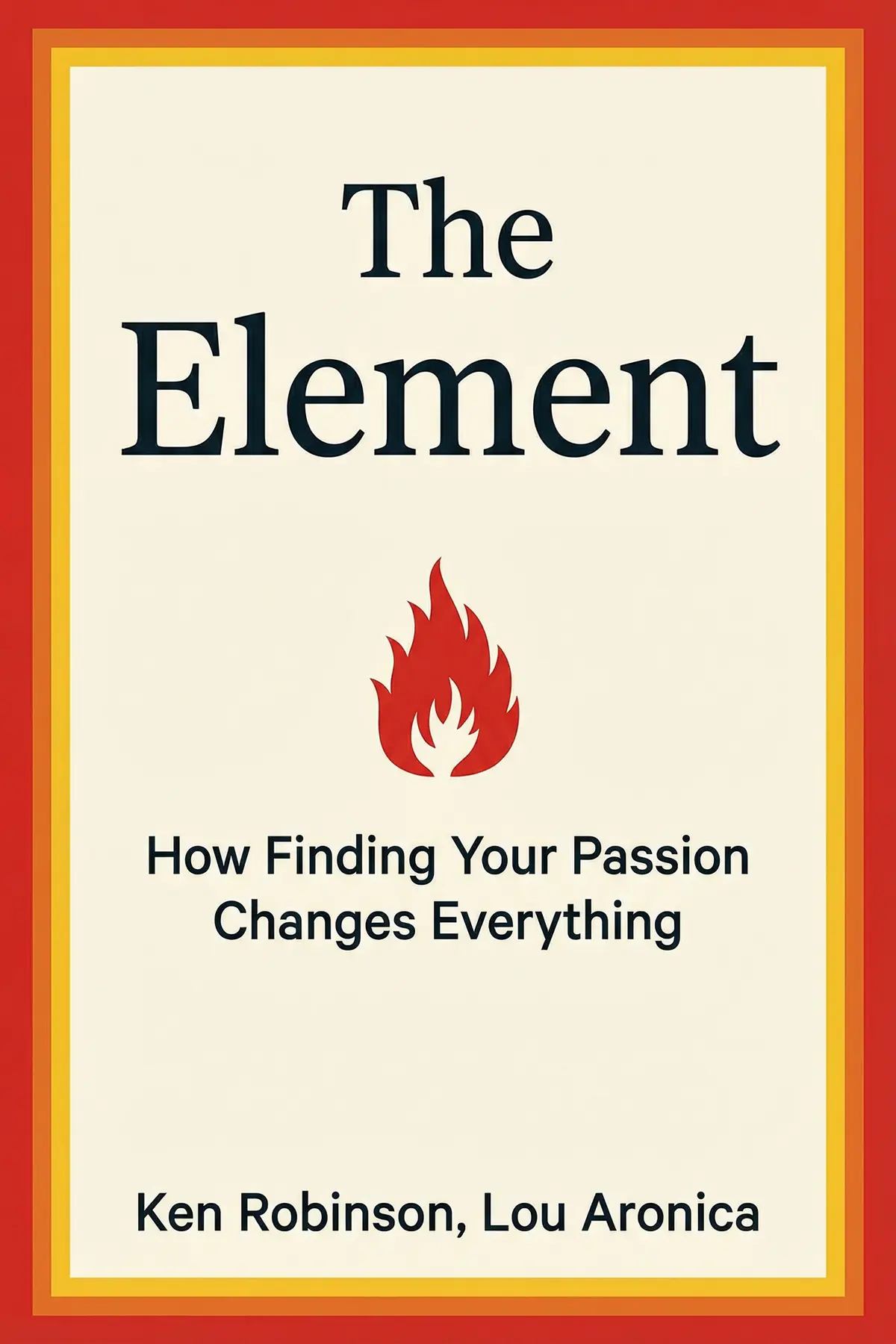
Table of Content
1. Introduction
1 min 02 sec
Being good at something and loving it are two different things, and the gap between them explains why so many capable people feel flat at work. In The Element, education advisor Ken Robinson, writing with Lou Aronica, calls the place where those two meet your element: the point where natural talent and real delight in the work come together. The word love gets thrown around for food, pop stars and colors, yet in their view you only love an activity when you commit to it and put yourself on the line for it.
Their argument is that almost anyone can find this place. It takes the right attitude, a few open doors, a wider idea of intelligence and people who see the world as you do, and neither family doubts nor a late start can close it off. Along the way come a boy blinded at twelve who studied law at Oxford, a painter who held his brush in his teeth and a novelist first published at 72. Each leaves a test you can run on your own life.
2. Separate what you're good at from what you love
1 min 33 sec
A keyboard player once dismissed a compliment with a single blunt sentence about love. His reply is a test most of us would fail, and it reveals why skill alone leaves so many people feeling empty.
3. Turn setbacks into progress with attitude and opportunity
1 min 40 sec
A twelve-year-old lost his sight in a school lab, and a sick boy sat unnoticed in a special school. What changed their lives had little to do with luck, and everything to do with two forces you can work on.
4. Measure your mind by more than test scores
1 min 46 sec
A man with almost no high school education became a photographer, filmmaker, author and composer. A famous physicist reached for a violin when the math stalled. Both point to an idea of intelligence most schools never teach.
5. Find the people who see the world like you
1 min 37 sec
A gifted student and writer could have gone in many directions, yet one setting finally made sense to her. A pool player loses whole afternoons at the table. Both hint at what changes when you are among your own.
6. Keep going when doubt and family push back
1 min 43 sec
One artist lost the use of his hands and refused to stop painting. A future world-renowned writer was put in a psychiatric asylum by his own parents for choosing art. What they did next shows how to answer two very different obstacles.
7. Start late or stay amateur and still thrive
1 min 36 sec
A mother who wrote a little between chores published her first novel decades later. A graduate student became an orchestra’s lead cellist within a year, then chose a different career. Both rewrite the rules about timing and money.
8. Conclusion
1 min 10 sec
The Element adds up to a simple claim with demanding terms. There is a place where what you do well and what you love to do overlap, and Robinson insists it is open to almost everyone. Reaching it is rarely a matter of luck. It takes an outlook that keeps going, a door someone helps to open, a broad sense of your own intelligence and people who share your way of seeing. None of the obstacles in these stories proved final: blindness, polio, paralysis, a family that sent a son to an asylum, a first novel at 72.
The book supports a few concrete moves. Apply Charles’s test to anything you claim to love and see whether you actually do it. Spend time where your tribe gathers, and notice when hours pass like minutes. When doubt arrives, decide whether it is personal or social, and answer it on those terms. If the passion would not pay, let a steadier career carry it, as Trop did with his cello.
Your element does not have to make you rich, famous or professional. It only has to be the work you return to when nobody is asking.
About this book
What is this book about?
Many capable people spend years doing work they are good at without ever feeling much for it. Ken Robinson and Lou Aronica call the missing piece your element: the place where aptitude, your natural feel for something, meets passion, the delight that keeps you at it for hours. The authors argue that finding this place is not a matter of luck. It depends on an outlook that persists, on opportunities such as a mentor who notices you, on a wider idea of intelligence than test scores allow, and on finding a tribe of people who see the world as you do. Their stories range from a keyboard player who practiced for hours unasked, to a boy blinded at twelve who studied law at Oxford, to a painter who held his brush in his teeth. Readers get simple tests for telling talent from love, ways to read their own kind of intelligence, and reasons to keep going when family or self-doubt pushes back. The book also makes the case that a late start or an amateur role can still put you squarely in your element.
Book Information
Who it's for
Skilled yet unfulfilled professionals
Professionals who are good at their jobs but feel little for the work.
Told they're not clever
Students and graduates told they are not clever because of grades or test scores.
Worried it's too late
People in midlife who suspect it is too late to write, play or build what they once dreamed of.
About the Author
Ken Robinson
Sir Ken Robinson, born in Liverpool in 1950 into a working-class family, advised governments, non-profits and education and arts bodies on arts education. He directed the Arts in Schools Project, was Professor of Arts Education at the University of Warwick from 1989 to 2001 and was knighted in 2003 for services to the arts. He died in 2020. Lou Aronica is a longtime publisher, formerly Deputy Publisher of Bantam and Publisher of Avon Books, and a writer of fiction and nonfiction.
Ratings & Reviews
Ratings at a glance
What people think
Listeners regard this work as essential reading, notably for those who homeschool, and value its uplifting message on achieving a sense of purpose and fulfillment. It serves as an educational resource by showcasing various instructional styles, and listeners describe it as profound, with one listener pointing out the meticulous examination of pedagogical ideas. The book also weaves in fascinating tales that challenge conventional views on learning. However, perspectives on its engagement level are split; some deem it enjoyable, while others feel it gets repetitive after the initial pages.
Top reviews
Patcharaporn
Wow, this was exactly the nudge I needed to re-evaluate my career path. Ken Robinson has this incredible way of articulating that internal itch many of us feel—the sense that we are capable of so much more if only we could align our natural talents with our personal passions. The stories he shares, from famous artists to ordinary people who found their 'Element' later in life, are deeply moving. I particularly loved the concept of finding your 'tribe,' that group of people who share your obsession and push you to be better. It’s not just a self-help book; it’s a manifesto for a more creative life. While some might find the anecdotes repetitive, I found them to be necessary evidence that it’s never too late to start over. It’s a breath of fresh air in a world that demands conformity.
Show moreCharles
As a homeschooling parent, I found these chapters to be incredibly validating and insightful. Robinson perfectly describes why so many children feel like failures in a traditional classroom setting: we are assessing them on such a limited spectrum of intelligence. The book does a wonderful job of explaining that creativity isn't a luxury, but a fundamental human need. I loved the story of the hyperactive girl who was told she had a learning disorder, only to become a world-class dancer once she was allowed to move. It’s a call to action for educators and parents to stop demanding conformity and start looking for the unique sparks in every child. This should be required reading for anyone involved in education. It completely changed how I approach my children’s learning journeys and helped me realize that their 'distractions' might actually be their greatest strengths.
Show moreKae
Finally got around to reading this, and it has genuinely shifted my perspective on my own professional life. Robinson offers such a rich version of human ability that goes so far beyond what we were taught in school. I loved the way he describes the 'Element' as the intersection of what you're good at and what you love. It sounds simple, but when you see it applied through the various case studies, you realize how rare it is to actually achieve that balance. The book is educational, emotional, and deeply human. It reminded me that we all have different types of intelligence, and just because I wasn't a math prodigy doesn't mean I lack talent. It’s an empowering read that makes you want to go out and find your tribe immediately. Truly a must-read for anyone feeling stuck in a rut.
Show morePrinya
Ever wonder why you feel drained even when you’re doing something you’re supposedly 'good' at? This book explains exactly why: you might have the aptitude, but you lack the passion. Robinson calls this being out of your Element. I found his insights into the 'tribe' concept particularly helpful, as it explains the energy we get when we surround ourselves with like-minded people. The book is filled with great examples of different approaches to education and life. It's not just for kids or students; it's for anyone who wants to live a life of significance. Robinson’s writing style is warm and witty, making complex psychological notions feel like common sense. I’ve recommended this to several friends who are going through career transitions, and they’ve all found it just as inspiring as I did.
Show moreFatou
Robinson offers a much-needed critique of our current educational hierarchy, and he does so with grace and humor. As someone who always felt 'out of place' in the rigid structures of academia, this book felt like a long-overdue apology. He argues persuasively that we are living through a period of human resources wasted on a massive scale because we don't know how to identify or nurture diverse talents. The stories are fascinating, and while some are about celebrities, many are about everyday individuals who found peace by simply embracing who they were meant to be. It’s an insightful look at how we can rethink our schools and our workplaces to be more human-centric. Whether you're a teacher, a boss, or just someone looking for fulfillment, there's something valuable in these pages. It’s easily one of the most important books I’ve read this decade.
Show moreChee
After hearing Ken Robinson’s legendary TED talk on creativity, I felt compelled to dive deeper into his philosophy. This book provides that depth, exploring how our modern education system systematically crushes individual talent by prioritizing a narrow hierarchy of subjects like math and science over the arts. Robinson’s prose is engaging, though sometimes his tone can feel a bit like an old-fashioned motivational speaker. I appreciated the psychological research sprinkled throughout, which helped ground the more anecdotal sections. The core idea—that being in your Element is where natural aptitude meets personal love—is powerful. It forced me to ask myself not just what I’m good at, but what actually energizes me. It’s a solid read, even if a few chapters felt like they were retreading the same ground.
Show moreJin
Picked this up on a whim and was pleasantly surprised by the storytelling, even if some of it felt a bit overly optimistic. Robinson challenges us to stop asking 'how creative are you?' and start asking 'how are you creative?' That shift in perspective is worth the price of the book alone. I enjoyed the mix of celebrity anecdotes and stories of everyday people who found fulfillment in unexpected places. It’s not a dense academic text, which makes it very accessible, but it still manages to tackle big questions about human potential. My only gripe is that it glosses over the financial realities of pursuing a passion that doesn't pay well. Still, it’s a very motivating read that encouraged me to pick up my old hobbies again. If you need a reminder that your worth isn't defined by your school grades, read this.
Show moreCarlos
Look, the core message here is undeniably beautiful, but the execution is a bit hit-or-miss for me. On one hand, Robinson’s critique of the 'one size fits all' education model is brilliant and much needed in today’s landscape. On the other hand, the book is essentially a collection of success stories that start to feel identical after page fifty. Little Johnny was bad at school, found a guitar, and now he’s a billionaire. It’s inspiring at first, but it lacks a roadmap for the average person who can't just quit their day job to join a circus. I was hoping for more 'how-to' and less 'see what they did.' It’s a decent supplementary read if you’re already a fan of his talks, but don’t expect a life-changing manual. It’s more of a gentle encouragement than a step-by-step guide.
Show moreElise
Frankly, this felt like a massive case of survivor bias that got more exhausting with every chapter. Robinson spends the entire book highlighting the one-in-a-million success stories—people who dropped out of school and somehow became world-renowned rock stars or physicists. What about the millions of others who followed their 'passion' and ended up broke or disillusioned? The book completely ignores privilege and luck. It also offers zero practical advice on *how* to actually find this magical Element; it just keeps repeating that you should find it. If you’ve seen his TED talk, you’ve already heard the best parts. The book is just a long-winded, repetitive expansion that lacks any real substance for people living in the real world. To be fair, his critique of the industrial school system is spot on, but the solution he offers is mostly just 'follow your dreams' fluff.
Show moreFord
The truth is, I’m tired of being told that 'finding my passion' is the magical cure for everything. This book is incredibly privileged and, at times, borderline toxic. There’s a section where Robinson basically tells readers to look at the vastness of the universe and just 'get over' their daily worries. That’s such an insulting thing to say to someone struggling with real, systemic issues or mental health challenges. It feels like he’s shouting from a pedestal of success, ignoring the fact that most people don't have the safety net required to 'leap' into their Element. The writing is repetitive, the examples are cherry-picked, and the advice is vague at best. It’s basically a high-budget version of those 'just think positive' posters. Save your time and just watch the 20-minute TED talk; it covers everything worth knowing without the condescending filler.
Show moreQuestions about this book
What is the main idea of The Element by Ken Robinson?
Robinson and Aronica argue that everyone has an element: the place where natural aptitude meets real passion, leaving you absorbed and fulfilled. Finding it depends on the right attitude, opportunities such as a mentor, a broad view of your own intelligence and a tribe of like-minded people. Personal and social barriers, age and amateur status need not stop you.
What is the difference between aptitude and passion in The Element?
Aptitude is talent, a natural feel for something like code, poetry or singing. Passion is the delight that keeps you at it for hours. The book insists you need both, since you can be very skilled at something and feel nothing. A keyboard player named Charles put it bluntly: if you truly loved playing, you would be doing it.
Is it too late to find your element?
Rarely, according to the book. Robinson accepts obvious physical limits but argues that achievement does not decline in a straight line with age. Harriet Doerr returned to college at 65, joined Stanford’s creative writing program and published her first novel, Stones for Ibarra, at 72. You can also live in your element as an amateur rather than a professional.
How can I apply The Element to my own life?
Start by checking which of the things you say you love you actually make time for. Notice which kind of thinking makes problems feel easy for you, since the book treats intelligence as diverse and individual. Seek out people who share your passion, name the barriers holding you back, and consider funding a low-paying passion with a steadier career, as Gabriel Trop did with the cello.
Readers also enjoyed





A Guide to the Good Life: The Ancient Art of Stoic Joy
William B. Irvine


A High-Performing Mind: Strengthen Your Mind and Live Your Best Life
Andrew D. Thompson


Abundance: The Inner Path to Wealth
Deepak Chopra

AUDIO SUMMARY AVAILABLE
Listen to The Element in 15 minutes
Get the key ideas from The Element by Ken Robinson, plus 5,000+ more nonfiction titles.
- 5,000+ titles
- Listen as much as you want
- 7-day free trial
- Cancel anytime









