
15 min 03 sec
Available in: English
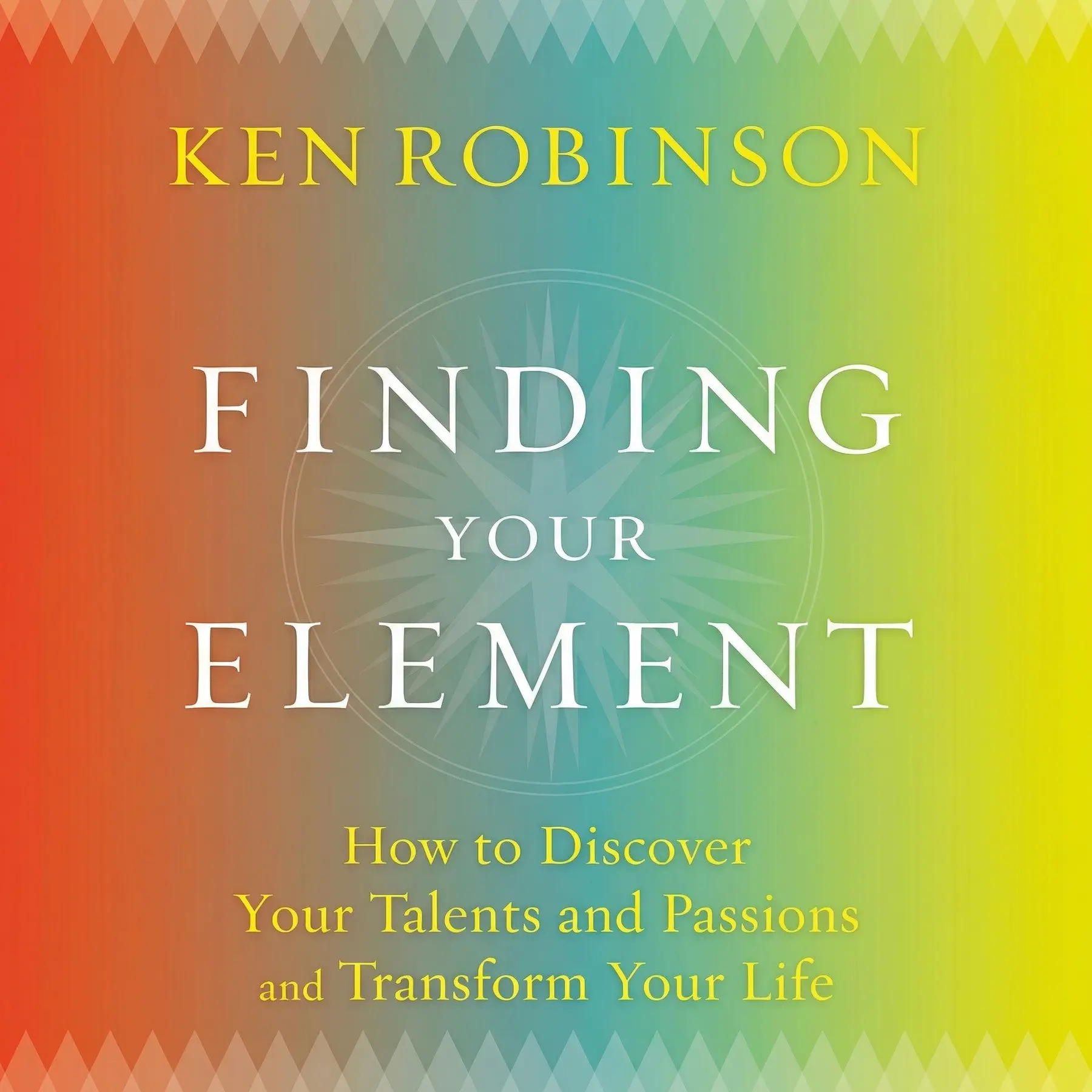
Finding Your Element: How to Discover Your Talents and Passions and Transform Your Life
By Ken Robinson
Shows why school grades, early career choices and cultural expectations are poor guides to what you can do, and how new situations, a growth attitude and like-minded people bring hidden talents and passions to light.
Table of Content
1. Introduction
1 min 06 sec
If you suspect your job uses only a sliver of what you can do, Ken Robinson thinks you are probably right. In Finding Your Element, the education adviser argues that most people’s real talents stay hidden, buried under early career plans, school grades, cultural expectations and their own doubts. His starting point is biological: nobody in the long history of our species has carried your exact mix of genes, and even identical twins can turn out strikingly different in body and mind. Add the particular family, classroom and neighborhood that shaped you, and you are a person who has never existed before.
A one-off person, Robinson reasons, cannot be served by a script written for everyone. His case is that you find your talents and passions by exposure, not by planning: by entering new situations, questioning old verdicts about your ability and seeking out people who care about what you care about. Follow it through and you get a practical way to re-test what you are good at and to make room for what absorbs you.
2. Trade the fixed life plan for open doors
1 min 53 sec
Most of us were asked to choose a whole career before we had finished being children. Robinson’s own unplanned path suggests the detours we fear may be where the real work begins.
3. Test yourself in places you have never been
1 min 53 sec
A gift you have never had the chance to use looks exactly like a gift you do not have. A music school in Venezuela shows what happens when someone finally hands children the chance.
4. Your school grades may be wrong about you
1 min 56 sec
A teenager who loves engines gets nudged toward law, and a future composer fails his classes. Robinson argues the system judging them was measuring the wrong thing, and that the verdict may still be steering you.
5. Stop measuring your talent against Jimi Hendrix
1 min 48 sec
Plenty of promising players put the guitar away the day they realized they would never be the best. Robinson traces that surrender to two attitudes society teaches us early, and shows how to drop them.
6. Follow the hours that seem to vanish
1 min 48 sec
Some people insist they simply have no passions. Robinson disagrees, and offers a test anyone can run on their own week, along with a reason from a long Harvard study to take the results seriously.
7. Make room for joy without quitting your job
1 min 48 sec
You may never earn a living from the thing you love, and Robinson says that is fine. What he questions instead are the two routes to happiness most of us were sold, and the cycle they trap us in.
8. Find the people who share your obsession
1 min 41 sec
A group of Scandinavian chefs made Nordic food more popular across Europe, something none of them could have managed on their own. Their story shows when a passion needs company, and where to look for it.
9. Conclusion
1 min 10 sec
Robinson’s book is finally an argument about evidence. Most of what people believe about their limits rests on thin proof: a grade given at 14, a career chosen at 18, a cultural rule about who cooks and who builds, a comparison with a guitar legend. None of these was ever a fair test of a person who, biologically and socially, has never existed before. The only way to learn what such a person can do is to give them more chances to try.
That points to a few things worth doing soon. Pick one subject a teacher once told you that you were bad at and look at it again with adult eyes. Notice which activities make the hours vanish, and protect a few hours a week for one of them, even if it never pays. When an unexpected invitation arrives, treat the unknown as an opening. And find the people who already share your interest, because some things only get built together.
The children of El Sistema did not know they were musicians until someone gave them instruments. Most of us are still waiting for ours, and Robinson’s advice is to stop waiting and go looking.
About this book
What is this book about?
Many capable adults suspect their work uses only a small part of them. They were sorted early by grades, steered into a career at 18 and taught by their culture which abilities suited someone like them. Ken Robinson argues that none of this was a fair test of a person who, by genes and by upbringing, has never existed before. Drawing on examples such as El Sistema, the music school for children in violent parts of Venezuela, the composer Hans Zimmer, who struggled at school until he learned to see music as patterns, and the chefs behind the New Nordic Cuisine Movement, Robinson shows how talents stay buried and how they come out. Schools reward one kind of intelligence and punish mistakes. Fixed beliefs about ability make people quit. Money and quick pleasures are sold as happiness. His remedy is exposure and permission. Readers learn to question old verdicts about what they are bad at, to notice the activities that make time vanish, to protect a few hours a week for them even when they never pay, and to find the communities where their interests already live.
Book Information
Who it's for
Professionals who feel underused
Professionals who suspect their job uses only a small part of what they can do.
Switchers trusting school grades
Career switchers who still trust old school grades about what they are bad at.
Making room for passion
Stressed, busy people who want to make time for a passion without quitting their job.
About the Author
Ken Robinson
Sir Ken Robinson (1950 to 2020) grew up in a working-class family in Liverpool and spent his career advising governments, non-profits and arts and education bodies on education in the arts. He directed the Arts in Schools Project, was Professor of Arts Education at the University of Warwick from 1989 to 2001, and was knighted in 2003 for services to the arts. He later worked as senior advisor to the president of the J. Paul Getty Trust and became widely known for his TED talks and books on creativity, including The Element and Creative Schools.
Ratings & Reviews
Ratings at a glance
What people think
Listeners find the book perceptive and impactful, featuring hands-on activities and a self-effacing wit that makes for an accessible experience. They appreciate the great value for money, with one listener describing it as an incredible return on investment and another noting it provides a deep look at one's inner self. The narrative quality receives mixed reactions; while some find the stories captivating, others point out that it is not a guaranteed path to happiness.
Top reviews
Phu
Finally got around to reading this after seeing Ken Robinson’s famous TED talk about creativity in schools. I found the investment of time to be incredibly rewarding, offering a massive return on my personal self-reflection. Robinson uses a self-deprecating humor that keeps the tone light, even when he asks you to dive into the deep end of your own psyche. The exercises, while daunting to some, provided a structured way to evaluate where my talents actually intersect with my passions. It isn’t just a feel-good manual; it’s a toolkit for anyone feeling stuck in a career that doesn't fit. While some of the stories feel a bit polished, the core message about life being organic rather than linear is something I really needed to hear. It’s practical, witty, and surprisingly deep for a self-help book. I'll be keeping this on my shelf for a long time.
Show morePatcharaporn
What if your greatest strength is something you’ve been ignoring for decades? Robinson asks the tough questions that force a deep look at one’s inner self and past choices. I found the ROI on this book to be incredible, mostly because it gave me the permission I needed to pursue hobbies I’d long since abandoned. The mix of Jungian concepts and modern success stories creates a balanced narrative that feels both intellectual and accessible. He has this wonderful way of using humor to defuse the fear that often comes with making big life changes. Every page feels like it was written with a genuine desire to help people live more fulfilled, organic lives. It’s a celebration of human diversity and creativity that I think everyone should read at least once. I actually found the exercises quite transformative for my mental clarity.
Show moreEleanor
As someone who has always struggled with the 'jack of all trades' label, I found this remarkably insightful. Robinson argues that our traditional education system often douses our natural creativity in favor of standardized metrics. This book acts as a guide to reigniting that internal spark through a series of introspective prompts and questions. I particularly liked the chapter on finding your tribe and how surrounding yourself with like-minded people is crucial for growth. Some might find the tone a bit too optimistic, and it’s true that finding your element doesn't automatically mean life becomes easy or painless. However, the framework provided is solid enough to help anyone start moving in a more authentic direction. It’s a powerful read if you’re actually willing to do the mental work required by the exercises. The English wit is just a bonus.
Show moreIff
Ever wonder if you're actually doing what you were meant to do with your life? This book hit me at exactly the right moment when I was questioning my entire professional path and feeling a bit lost. Robinson doesn’t promise a guaranteed path to happiness, which I actually found quite refreshing and honest. Instead, he focuses on the intersection of aptitude and passion, helping you identify where you truly belong. I spent several weekends working through the exercises, and while some were a bit woo-woo, they forced me to look at my childhood interests in a new light. The book feels like a warm, encouraging pep talk from a very smart friend who wants the best for you. It’s not groundbreaking philosophy, but it’s a very effective mirror for your own inner self. Definitely worth the price for the perspective shift alone.
Show moreWatcharee
The chapter on the educational system was the most compelling part of the entire experience for me. Robinson’s critique of how schools stifle our natural talents is spot on and really makes you rethink your own history of learning. I picked this up because I wanted to understand why I felt so disconnected from my daily work, and the answer was surprisingly clear. The book is structured like a workbook, which makes it feel like a real investment in yourself rather than just another passive read. Some of the anecdotes are a bit long-winded, but they serve to illustrate that the element is different for everyone. It’s a practical guide that encourages you to take risks, even if those risks are small at first. I’d recommend it to parents and teachers as much as to career-changers. It provides a much-needed look at human potential.
Show moreAiden
Picked this up during a bit of a mid-life career crisis and found the conversational tone to be exactly what I needed. Robinson doesn't pretend to have all the answers, but he provides a very useful set of tools for asking the right questions. I actually enjoyed the mind maps and the focus on visual thinking, as it got me out of my usual logical rut. The stories of people finding their passion later in life were particularly moving and helped reduce my anxiety about starting over. There is a lot of value for money here if you actually commit to the exercises rather than just reading the text passively. It’s a powerful reminder that our lives are unique and that we have the agency to create something meaningful. A solid four-star read for anyone needing a bit of creative direction.
Show moreMax
Look, the truth is that this book is mostly a refined version of things Ken Robinson has said elsewhere in his famous speeches. It's a decent enough read, and his writing style is undeniably charming and conversational. I appreciated the self-deprecating jokes, which made the advice feel less like a sermon and more like a chat at a pub. However, the 'Finding Your Element' process is very much a your-mileage-may-vary situation. I struggled with some of the mind-mapping exercises because they felt a bit dated and abstract for my analytical brain. The stories are definitely the highlight, though they occasionally lean too much into the miracle career change trope. It’s a good starting point for self-discovery, but don't expect it to provide a magic map to your future. It is a bit repetitive in its structure.
Show moreNadia
Not what I expected, but still worth the price of admission for a few key insights. I went in looking for a step-by-step career manual and got a philosophical exploration of human potential instead. The writing is witty and very British, which makes the pages fly by, but the actual how-to parts are a bit thin. I found myself skimming through the parts about vision boards because they just aren't my style and felt a bit childish. That said, the section on the biology of talent and how our brains are wired differently was genuinely fascinating. It’s a light read that offers some good food for thought, but it probably won't change your life overnight. Think of it more as a compass than a GPS. It's pleasant, if not entirely groundbreaking, and Robinson is an affable guide through the material.
Show moreKob
After hearing so much praise for Ken Robinson, I had very high expectations for this particular book. Frankly, it felt a bit like a 'best of' compilation of his previous work and speeches rather than a totally new contribution. The prose is friendly and engaging, but the core concepts are things you've likely heard before if you follow self-improvement media. I also felt the book ignored the reality of economic constraints that prevent many people from simply finding their element in a professional sense. It’s a bit too optimistic and sugary at times, as if passion can overcome any obstacle without fail. Still, for someone who is completely new to these ideas, it’s a solid and encouraging introduction to the concept of self-actualization. It is a quick, light read that doesn't demand too much of the reader.
Show moreKae
To be fair, the first couple of chapters set a good stage, but it quickly devolves into a repetitive slog of endless anecdotes. I felt like I was reading the same success story over and over again, just with different names and hobbies swapped in. The practical exercises like making vision boards and mind maps felt more like busywork for middle schoolers than actual career coaching tools. I wanted a deeper analysis of the obstacles we face, but instead, I got a lot of surface-level pep talks. If you enjoy light, anecdotal inspiration, you might like it, but for me, it lacked the concrete substance required to justify the hype. It felt like a collection of blog posts stretched into a full-length book. I struggled to finish it because the tone felt far too sugary for my taste.
Show moreQuestions about this book
What is the main idea of Finding Your Element?
Ken Robinson argues that every person is biologically and socially unique, yet most people’s talents and passions stay hidden behind early career plans, narrow schooling, cultural expectations and self-doubt. Finding them depends less on planning than on exposure: entering new situations, questioning old verdicts about your ability, making time for what absorbs you and joining people who share your interests.
Why does Ken Robinson say school grades can mislead you?
Robinson says IQ tests and grades measure mainly logical reasoning and ignore other intelligences, such as skill with the hands. Schools also teach mostly through text and punish mistakes, which pushes students away from subjects they find hard. The composer Hans Zimmer did badly at school until he learned to see music as patterns. A poor grade may reflect the school’s limits more than yours.
How do you find your passion according to Finding Your Element?
Robinson suggests noticing the activities in which you lose track of time, as musicians do when they rehearse for hours. Then widen your options: take a class in an unfamiliar field, join a book group or online community, try a new sport or learn a hands-on craft. The more new situations you try, the more chances a hidden passion has to appear.
Do you have to turn your passion into a career?
No. Robinson says it is fine if your talent never becomes your profession. If you love painting watercolors, rearrange your schedule so you can paint for a few hours a week, which he says can make a big difference to your well-being. He also warns against chasing happiness through more money or quick pleasures, favoring long projects and helping others.
Who should read Finding Your Element?
It suits adults who feel underused at work, people considering a career change, students and parents questioning what grades say about ability, and anyone who has dropped a talent out of self-doubt. Its advice is simple and concrete: revisit subjects you were told you were bad at, try unfamiliar activities, and find communities like the Maker movement that share your interests.
Readers also enjoyed





A Guide to the Good Life: The Ancient Art of Stoic Joy
William B. Irvine


A High-Performing Mind: Strengthen Your Mind and Live Your Best Life
Andrew D. Thompson


Abundance: The Inner Path to Wealth
Deepak Chopra
AUDIO SUMMARY AVAILABLE
Listen to Finding Your Element in 15 minutes
Get the key ideas from Finding Your Element by Ken Robinson, plus 5,000+ more nonfiction titles.
- 5,000+ titles
- Listen as much as you want
- 7-day free trial
- Cancel anytime









