

10 min 22 sec
Available in: English
Coined: The Rich Life of Money and How Its History Has Shaped Us
By Kabir Sehgal
Explains where money came from, why a paper note holds value without gold behind it, how cards and phones change spending, and how emotions and culture shape every financial choice we make.
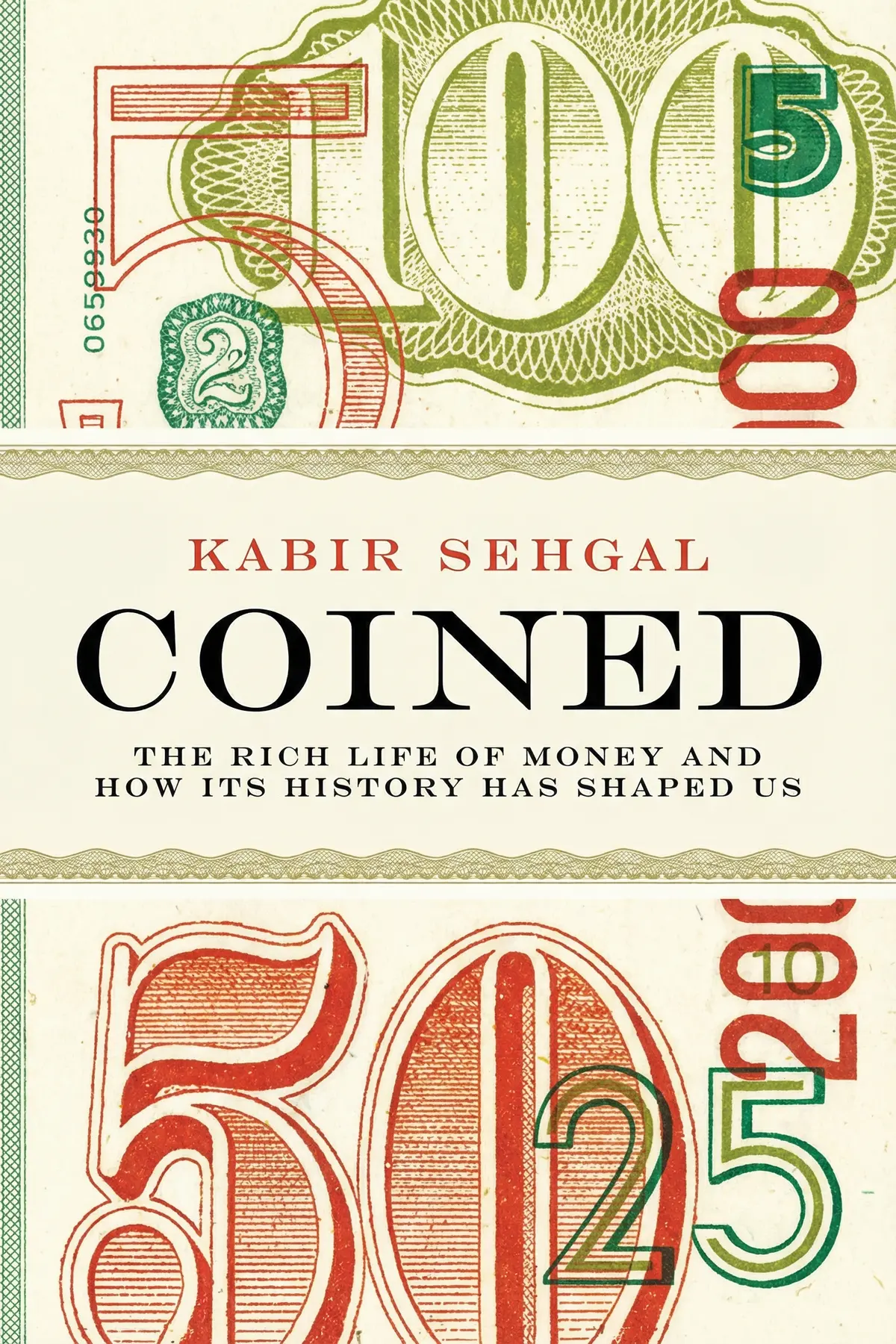
Table of Content
1. Introduction
56 sec
Most of us earn, spend and save money every day without ever asking what it is, which makes it hard to see why it pulls at us the way it does. In Coined, author, musician and former banker Kabir Sehgal starts with a surprising answer: money follows a rule as old as bees and flowers, the rule that two parties survive better by trading.
From there, Sehgal traces how that tool grew from spare food and hand axes into paper notes, credit cards and phones. His argument runs through every stage. Money is a human invention for cooperation, its worth now rests on how much is in circulation rather than on metal, and the way we use it is driven by feeling and reveals what we value.
Follow that thread and a banknote, a sunny afternoon at the shops and an old Vietnamese coin each start to explain something about your own wallet.
2. Trace money back to bees and spare food
1 min 38 sec
A bee and a flower strike a deal that serves them both, and neither side cheats. Sehgal finds in that exchange the first clue to why humans invented money, and what it was really meant to do.
3. Discover how money became worth more than paper
1 min 40 sec
The paper in your wallet costs almost nothing to print, yet it buys real food and rent. Two rival schools of economics explain that gap very differently, and one has been winning since 1971.
4. Read where cash, cards and phones are heading
1 min 42 sec
Most of the world still pays in cash, and one debt-averse nation’s word for debt carries moral weight. Meanwhile, a quiet number shows what happens to your spending when you swipe.
5. Spot the feelings steering your money choices
1 min 41 sec
Economists picture buyers as calm calculators, yet a sunny afternoon can change how much you tip. Brain scans show why a money loss registers as something closer to physical pain.
6. Old coins reveal what a society values
1 min 41 sec
A thousand-year-old coin from Vietnam can tell you whether its country was at war and how well its people could read. Your own spending carries a similar message.
7. Conclusion
1 min 04 sec
Coined treats money as a living habit of our species. It began as a way to share surplus, the same trade-for-survival logic that keeps bees and flowers together. It moved from gold-backed coins to paper that holds value only through the amount in circulation. It has jumped from cash to cards to phones, and cards at least have been shown to make us spend more. Through all of it, our choices have been steered by sunshine, by the sting of loss and by brain regions we never consult.
That picture invites a few habits. When you pay, notice the form: a credit card may nudge you to spend more than notes in your hand would. Before a money decision, check your mood and whether fear of losing is in charge. And now and then, read your own spending the way Sehgal reads a Vietnamese coin, for what it says about your values.
Money will keep changing shape. What it reveals about the people holding it stays the same.
About this book
What is this book about?
Most people spend their lives earning, spending and protecting money without asking what it actually is or why it holds such power over them. Kabir Sehgal, a former banker and musician, sets out to answer that by tracing money from its roots in nature to the phone in your pocket. His angle is that money is a living human habit. It began as a way for cooperating groups to trade their surplus, much as bees and flowers trade nectar for pollination. It moved from coins tied to gold toward soft money whose worth depends on how much of it circulates. It shifted from cash to credit cards and now to mobile payments. And at every stage, emotions such as fear of loss, and even the weather, push our choices away from pure logic. Readers get a short, clear picture of how money works, why they spend the way they do, and how a society's coins, and a person's spending, reveal their values.
Book Information
Who it's for
Curious about money's origins
Curious readers who use money daily but have never asked where it came from or why paper holds value.
Young professionals
Young professionals who want to understand why they overspend on cards or panic over losses.
Curious about cashless payments
Anyone wondering what cashless payments and mobile wallets mean for how we will spend.
About the Author
Kabir Sehgal
Kabir Sehgal is an American author, composer, musician and producer who has served as a navy officer and worked in banking, including a vice president role at JPMorgan Chase and a stint at First Data Corporation. He has written 23 books, some of which reached the bestseller lists of The New York Times and The Wall Street Journal. He has won 14 Grammy Awards and 5 Latin Grammy Awards, plays jazz bass, and studied at Dartmouth College and the London School of Economics.
Ratings & Reviews
Ratings at a glance
What people think
Listeners find this work to be an accessible and pleasant listen that explores the evolution of currency and its influence on society. They also value the broad analysis of financial themes, with one listener observing how the book synthesizes thousands of years of history. The presentation is compelling, as one review mentions how personal narratives create a smooth flow, and listeners consider it intellectually stimulating, with one noting how it focuses on important questions about life.
Top reviews
Patcharaporn
Kabir Sehgal succeeds in weaving together a massive tapestry of human history through the lens of exchange. This isn't just a book about finance; it’s a biography of our civilization. From the gold vaults of the New York Fed to the ruins of ancient Bangladesh, the journey is exhilarating. I loved how he personified money as a living entity that breathes and adapts. The brain scan details were mind-blowing, showing how we are conditioned like Pavlov’s dogs to respond to financial stimuli. The narrative flow is engaging, and the personal stories from his travels add a layer of warmth that most business books lack. It’s a truly thought-provoking masterpiece that reshaped how I view every dollar in my wallet.
Show moreClara
Wow, I wasn't expecting a book about money to touch on my spiritual beliefs and my biological drives all at once. The 'Mind, Body, and Soul' structure is brilliant and makes a very dense subject surprisingly easy to follow. Sehgal takes you on a geographical safari that is as entertaining as it is educational. I especially liked the exploration of how major religions like Hinduism and Christianity provide instructions on handling wealth—the idea of 'enough is enough' is something we often forget in the modern world. This book is a rich, multi-dimensional study that shows money is a symbol of our values. It’s a must-read for anyone who wants to understand the hidden forces guiding our lives. Excellent work!
Show moreHazel
Ever wonder why your brain reacts to the prospect of gaining money exactly the same way it reacts to a hit of cocaine? This book explores that fascinating intersection of neuroscience and finance with real clarity. I particularly enjoyed the chapters on how our subconscious operates during financial decisions—like how the weather can actually change how much you tip. While the author does spend a bit too much time on personal anecdotes, the overall synthesis of thousands of years of history is impressive. It’s a thought-provoking look at how money isn’t just a tool, but something that is hard-wired into our biology. The section on 'Body' and the future of plastic versus metal was especially enlightening for a casual historian like me.
Show moreTee
The chapter on ancient Lydian coins was an absolute highlight for me. Sehgal does a great job of showing how the art on our money reflects our societal values and how the invention of coinage coincided with the rise of major religions. I appreciated the multi-disciplinary approach; it’s rare to find a finance book that discusses both the Federal Reserve and the Gospel of Matthew in the same breath. Some parts are a bit dry, especially when he gets bogged down in the mechanics of soft money, but the personal stories create a nice flow. It makes you realize that money is alive, adapting to our needs even as it shapes our very souls. Definitely recommended for those who want a broad overview.
Show moreBua
Finally got around to reading this, and I must say it is a very well-balanced look at a complex subject. Sehgal manages to make the history of debt and barter feel relevant to the modern world. I was particularly struck by the discussion on 'gift economies' versus 'market economies.' The book moves quickly, and while it doesn't offer a brand-new grand theory, it organizes a massive amount of information into an accessible format. It is an easy and enjoyable read that teaches you things you didn't even know you were curious about. My only gripe is that it occasionally speculates where facts would be more helpful. Still, it’s a solid addition to any bookshelf.
Show morePensri
After hearing about the author's background at J.P. Morgan, I expected a technical manual, but this is much more human. It’s a wide-ranging exploration of monetary concepts that focuses on important questions about how we live. The idea that money is an extension of humankind across the ages is a powerful one. I found the segments on the future of money—moving toward a 'neural wallet'—to be particularly intriguing, even if they felt a bit like science fiction. The book is informative and well-researched, though it does occasionally veer into unimportant territory. Despite a few rambling chapters, the synthesis of biology, history, and theology kept me turning the pages. It’s a refreshing change from typical dry economic texts.
Show moreLily
Why did the author think we needed a grueling biology lesson on how bees pollinate just to understand the concept of exchange? Sehgal speaks in an elementary tone that feels patronizing at times, drawing metaphors that go on for pages when a single sentence would have sufficed. The first half of the book, which focuses on the 'Mind' and neuroeconomics, is actually quite engaging. However, the momentum dies down significantly once he starts rambling about his personal travels. It’s a decent synthesis of existing research, but it doesn't offer a unique perspective. If you are extremely interested in the psychology of money, you might find some value here. Otherwise, it's just okay.
Show moreLook
Personally, I found the interdisciplinary approach to be both the book's greatest strength and its primary weakness. On one hand, seeing money through the lens of biology and anthropology is fresh. On the other hand, the author continually loses focus by wandering into uncharted territories that have almost no import on the actual topic. One moment we are in the Galapagos, and the next we are discussing ancient cave art. It feels like a collection of interesting facts that never quite gel into a cohesive argument. Look, it’s an easy read and the narrative flow is decent, but it’s ultimately a surface-level summary. A very mixed experience for me.
Show moreKoi
Rarely do I find a book so fundamentally disconnected from the economic reality of average people. While the author tries to sound sophisticated by quoting various religions and historical figures, the truth is that his advocacy for fiat currency feels like a corporate press release. He glosses over the dangers of quantitative easing and debasing currency as if they were minor inconveniences. There are some interesting bits about the history of coins, but the narrative is disorganized. To be fair, the writing is clear, but the content is confusing and fails to provide a complete picture of why the global community is currently trying to bypass the dollar. It’s an informative attempt that misses the mark entirely.
Show moreMeen
This book feels less like an expert analysis and more like a vanity project for a J.P. Morgan executive. Sehgal travels to exotic locations only to regurgitate basic theories that any undergraduate economics student would find elementary. Frankly, his dismissive attitude toward the average person’s concern about inflation is grating. He seems to believe that eroding the value of money is a trivial matter because it helps borrowers, but he ignores the retirees watching their life savings evaporate. The book veers into pointless territory, like the unnecessary talk about micro-credit that adds nothing to the central thesis. It is a poor summary of better books. Don’t bother with this one if you want actual substance.
Show moreQuestions about this book
What is the main idea of Coined by Kabir Sehgal?
Sehgal argues that money is a human tool for cooperation. It grew out of the surplus that early groups produced once they divided their labor, much like the exchange between bees and flowers. Its value has shifted from metal backing to belief and circulation, its form has moved from coins to cards and phones, and our use of it is shaped by emotion and reflects our values.
What is the difference between metallism and chartalism?
Metallism holds that money draws its worth from precious materials such as gold or silver, which means a commodity should stand behind banknotes while the market sets their value. Chartalism says money has no worth of its own and that the state can control its value through how much it circulates. Sehgal shows history moving toward the second view, especially after Nixon cut the dollar’s link to gold in 1971.
Why does Coined say our money decisions are not rational?
Sehgal points to cognitive bias and loss aversion. People tip more on sunnier days, and markets tend to do better when it is sunny. Losses feel worse than equal gains. Brain imaging shows emotional areas activating during money choices: the nucleus accumbens when we expect a gain and the anterior insular, linked to pain, when we expect a loss.
How can I apply the ideas in Coined?
Watch how you pay as well as what you buy, since the book reports that a 10 percent rise in card payments lifts consumer spending by 0.5 percent. Before a big financial choice, check whether your mood or fear of loss is driving it. And review where your money goes each month, reading it the way Sehgal reads old coins, as a record of what you value.
Readers also enjoyed

Adults in The Room: My Battle With Europe’s Deep Establishment
Yanis Varoufakis


1929: Inside the Greatest Crash in Wall Street History--and How It
Andrew Ross Sorkin

23 Things They Don’t Tell You About Capitalism
Ha-Joon Chang
A Little History of Economics
Niall Kishtainy


A Splendid Exchange: How Trade Shaped the World
William J. Bernstein

AUDIO SUMMARY AVAILABLE
Listen to Coined in 15 minutes
Get the key ideas from Coined by Kabir Sehgal, plus 5,000+ more nonfiction titles.
- 5,000+ titles
- Listen as much as you want
- 7-day free trial
- Cancel anytime









