
14 min 23 sec
Available in: English
Can’t Even: How Millennials Became the Burnout Generation
Shows why so many millennials feel exhausted and traces the cause to how they were raised, schooled, hired and kept online. It also helps you judge jobs, office perks and screen time more clearly.
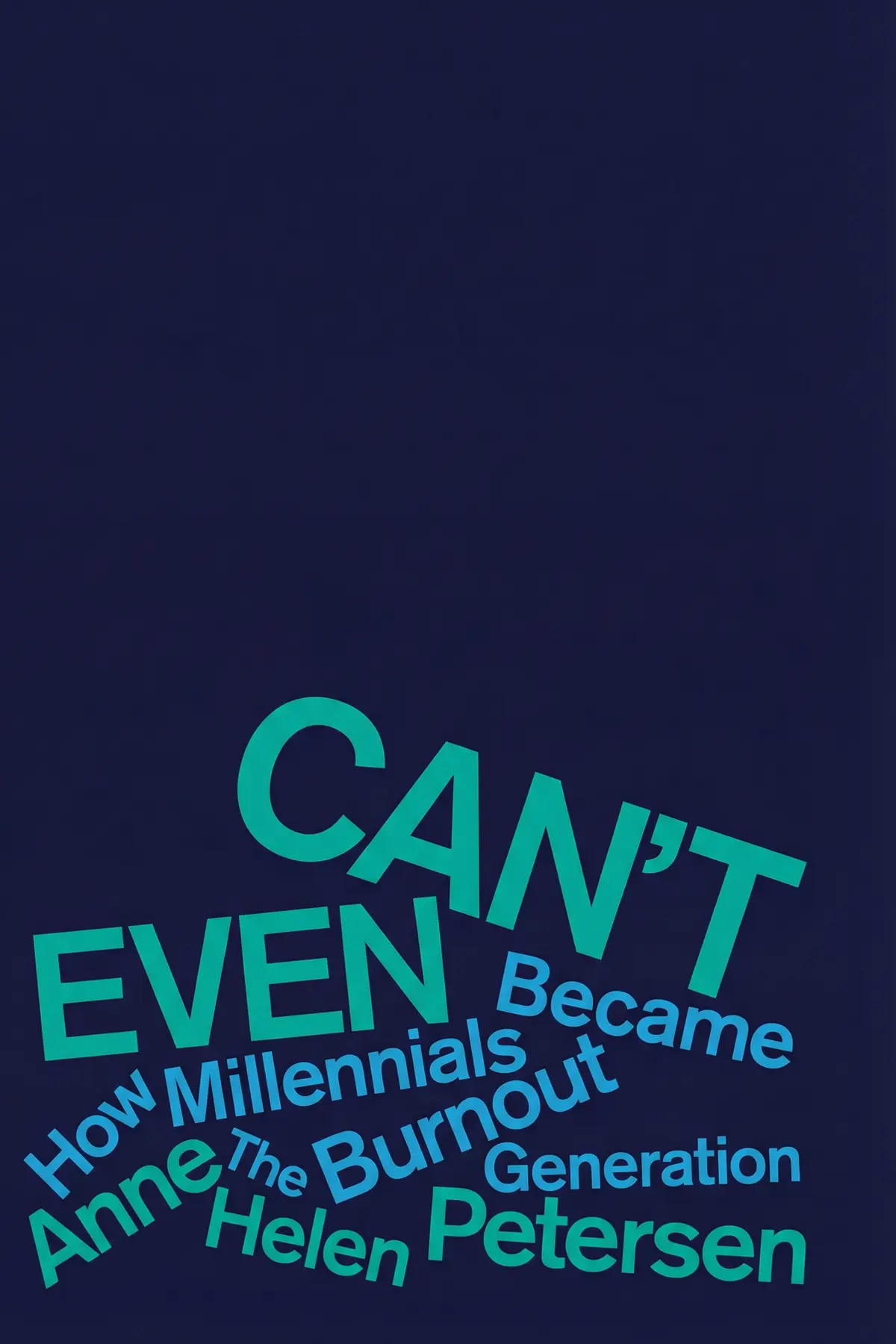
Table of Content
1. Introduction
1 min 06 sec
If you are always tired, behind on bills and told it is your own fault, Anne Helen Petersen offers a different diagnosis. In Can’t Even, she argues that millennials, people born between 1981 and 1996, are burned out, and that their exhaustion is a sensible response to an unfair deal. Using sociology, economics and current affairs, Petersen defends a generation the headlines love to mock, blamed for missing out on mortgages because of brunch, and turns the charge back on society itself.
Her argument is that burnout was built, step by step, by the way this generation was raised, schooled, employed and wired. The chain runs from anxious parenting in the 1980s to degrees that lost their value, from jobs sold as passions to temp work that echoes the 1970s, and on to offices that feed you dinner so you stay. Following that chain changes the question from what is wrong with me to what was done around me, and it shows which choices still belong to you.
2. Understand how an overscheduled childhood shapes your work life
2 min 04 sec
Plenty of adults feel guilty the moment they stop working, and few connect that guilt to the 1980s. Petersen links it to two forces that changed how a whole generation of children spent their afternoons.
3. Weigh a degree by what it actually opens
1 min 55 sec
For millions, college looked like the one safe bet in an uncertain economy. Petersen explains how that promise came apart, and why the lesson many graduates drew from it made their situation even harder.
4. Judge a dream job by its pay
2 min 02 sec
A plowman would have been baffled to hear his work called a passion. Petersen argues that the modern hunger for meaningful work has a cost, and that employers have learned exactly how to collect it.
5. Price in what flexible work leaves out
2 min 09 sec
In the 1970s, employers discovered a worker they could hire without paying for sick days, holidays or benefits. Her story explains why so many people today drive, freelance or lecture with no safety net.
6. See what late-night office perks really cost
1 min 56 sec
Free dinners and paid taxis home sound like generous treatment. An anthropologist’s study of investment banks shows how such perks stretch the working day, and why the deal that suits bankers rarely suits anyone else.
7. Protect your last free hour from your phone
2 min 02 sec
After a 13-hour day, one hour remains before sleep, and most people spend it the same way. Petersen explains why that choice drains more energy than it restores, and which part of it tires us most.
8. Conclusion
1 min 09 sec
Petersen’s verdict on her generation is that it has been unlucky. Each stage of life handed millennials a cost that someone else used to carry: parenting shaped by fear and inequality, advice that oversold degrees, policies that dismantled job security and an economy that shifted without warning. On top of that came overwork, gig contracts and the constant pull of screens. With that history, widespread burnout looks like the expected outcome.
The value of the book lies in that reframing, because it moves the problem out of your character and into conditions you can name. Once named, some of them can be resisted. You can judge a job by its pay, benefits and hours instead of its playful title. You can ask what a late night at the office actually earns you, and whether a free dinner is a fair price for it. You can stop treating rest as lost productivity, and keep the final hour of your day away from the news feed.
The headlines called this generation lazy. Petersen’s reply is that people this tired have been working hard all along, often under rules written against them.
About this book
What is this book about?
Millennials are often described as lazy, oversensitive and too fond of brunch to afford a home. Anne Helen Petersen argues the opposite. The generation born between 1981 and 1996 is burned out, she says, and that exhaustion is a reasonable reaction to the conditions it grew up in. Using sociology, economics and current affairs, Petersen follows the problem through a whole life. Childhoods were tightly scheduled and closely watched, shaped by widening inequality and a media panic about child abductions. College was sold as a sure path, then lost value as degrees became common and debts grew. Work was recast as a passion, which made people easy to underpay. Temp and gig work, foreshadowed by the Kelly Girls of the 1970s, wore away job security. Offices filled with perks that kept people at their desks late, and phones carried comparison and bad news into every spare hour. Readers get a new way to explain their own fatigue, and a sharper eye for the moments where they can push back: judging a job by its pay and benefits, questioning late nights at the office, and protecting their free time from the news feed.
Book Information
Who it's for
Exhausted millennials
Millennials who feel exhausted and keep blaming themselves for it.
Freelancers, gig workers, adjuncts
Freelancers, gig workers and adjunct teachers wondering why security feels out of reach.
Curious about younger generations
Managers and parents who want to understand what drives the younger people around them.
About the Author
Anne Helen Petersen
Anne Helen Petersen holds a doctorate in media studies from the University of Texas, where her research covered the history of the gossip industry. She was a senior culture writer at BuzzFeed until August 2020 and now writes full time for her newsletter Culture Study, which also has a podcast she writes, hosts and produces. Her work has appeared in the opinion section of The New York Times. Her other books include Scandals of Classic Hollywood and Too Fat, Too Slutty, Too Loud.
Ratings & Reviews
Ratings at a glance

What people think
Listeners find the writing accessible and engaging, noting its informal style and polished prose. They also value the thorough research and stimulating perspectives offered, with one listener emphasizing the discussion around leisure activities becoming side hustles. Furthermore, the work is lauded for its genuineness, and one listener pointed to the inclusion of credible sources as a highlight.
Top reviews
Cha
As someone who turns every hobby into a potential side hustle, the chapter on the commodification of leisure hit home. Petersen writes with a conversational flow that makes heavy economic history feel like a chat over coffee with a very smart friend. She backs up her claims with plenty of credible citations, moving beyond just her own life to look at systemic failures. It’s a thought-provoking look at why we feel like we’re running a race that has no finish line. Even if you aren't a millennial, the breakdown of how work has changed since the 1970s is incredibly eye-opening. This isn't a self-help book, and it’s better for it.
Show moreFah
Finally got around to reading this, and it’s basically a mirror for my entire adult life. Petersen argues that our exhaustion isn't a personal failure but a systemic byproduct of late-stage capitalism and the death of the traditional safety net. The research is robust and she uses a variety of sources to show that this isn't just 'whining'—it's a measurable social shift. I especially loved the discussion on how social media has turned our private lives into a performance for others. It’s not a self-help book with quick fixes, which some might find frustrating, but understanding the root cause is a crucial first step toward change.
Show moreBenjamin
Wow, this was an intense read that perfectly captures the 'mood' of our current cultural moment. Petersen’s conversational tone makes you feel like you’re talking to a very smart friend who has spent years researching why your life feels so frantic. She expertly connects the dots between Boomer parenting styles, the rise of the gig economy, and the way we use technology to constantly 'optimize' ourselves. It’s thought-provoking and, honestly, a bit haunting to realize how much of our identity is tied up in our productivity. This is essential reading for anyone who feels like they’re constantly treading water just to stay afloat. Absolutely five stars.
Show moreEvelyn
Ever wonder why you feel guilty whenever you aren't being productive? This book digs into the ways Boomer parenting and the constant drive for middle-class security shaped a generation’s collective psyche. While the author does lean heavily on her own experiences at times, the anecdotes from other millennials add a layer of authenticity that I appreciated. I found the section on 'cool jobs' at startups particularly relatable, as it perfectly captures the trap of trading a high salary for a trendy office culture. My only gripe is that it feels a bit centered on those with college degrees, sometimes leaving out the struggle of the working class.
Show moreMichael
After hearing so much buzz about this, I was surprised by how approachable and fun the writing actually was. Petersen breaks down complex economic trends from the last forty years without ever sounding like a dry, dusty textbook. The stories about adjunct professors and gig workers really highlight the insecurity that defines modern employment. To be fair, she does focus quite a bit on her own career path at Buzzfeed, which might be a turn-off for some readers seeking objective data. However, her core argument—that we are all running on empty because the system demands it—is hard to argue with. A solid four-star read.
Show moreVipawan
Picked this up during a particularly bad week at work, and it was the validation I didn't know I needed. The prose is well-written and flows naturally, making it easy to finish in just a couple of sittings despite the heavy subject matter. I was particularly struck by the analysis of 'lovable work' and how we’ve been conditioned to seek fulfillment in jobs that actually exploit our passion. While she could have spent more time on the lack of affordable healthcare, her points about the pressure of Instagram and curated lives are spot on. It’s an authentic look at the mental toll of the modern American economy.
Show moreFinn
Directly addressing the systemic roots of our collective exhaustion, this book is a powerful antidote to the idea that we just need better planners. The inclusion of credible sources and diverse interview snippets from real people adds a lot of weight to the central thesis. I appreciated how she explored the way even our leisure time has become a form of labor through side hustles and social media branding. Some parts do feel a bit repetitive, and the focus is definitely on the more privileged end of the millennial spectrum. Still, it’s a compelling and highly readable account of how we got to this point of total burnout.
Show moreChanon
Not what I expected, though I did find some of the historical data regarding labor laws quite fascinating. The truth is, the book spends an awful lot of time on the childhoods of middle-class kids and their piano lessons, which didn't resonate with my own upbringing. Petersen is a talented writer with a clear, engaging prose style, but the focus feels very narrow for a book claiming to represent a whole generation. She mentions student debt and the recession, but only through a lens of people striving for 'prestige' roles. If you're looking for a broad study of the entire generation, this might miss the mark, but as a deep dive into white-collar burnout, it succeeds.
Show moreRosa
The chapter on the history of labor was definitely the highlight for me because it provided much-needed context for our current mess. However, Petersen doesn't really offer any solutions, which left me feeling a bit more depressed by the end of the book than when I started. It’s a well-researched ethnography of the middle-class millennial experience, but it feels somewhat repetitive in the middle sections. Look, if you want to understand why you’re tired, this is great. If you want to know how to stop being tired, you won't find those answers here. It's a diagnosis without a prescription.
Show moreSuthida
This book is a mess of contradictions that fails to bridge the gap between different social classes. The author complains about the pressures of being 'gifted and talented' while largely ignoring the literal survival struggles many millennials faced during the 2008 crash. It’s hard to sympathize with forty pages of complaints about over-parenting when healthcare costs and medical bills are what’s actually bankrupting people my age. Frankly, it feels like an elitist take on a universal problem, written primarily for people who already have advanced degrees. I was hoping for a more inclusive, data-driven analysis rather than a collection of personal grievances about childhood piano lessons.
Show moreQuestions about this book
What is the main idea of Can't Even by Anne Helen Petersen?
Petersen argues that millennials, born between 1981 and 1996, are burned out rather than lazy or entitled. She traces their exhaustion to a series of conditions: tightly managed childhoods, degrees that lost their value while debts grew, jobs sold as passions, insecure gig work, offices that keep people late and phones full of comparison and bad news. Burnout, in her view, is a reasonable reaction to that deal.
Why does Can't Even say following your passion can hurt you?
Petersen points out that dream jobs attract far more applicants than they can absorb, so anyone unhappy with conditions can be replaced. Employers then expect passion to stand in for good pay and benefits. She notes job ads for coding ninjas and customer service rockstars, and suggests the trendier the title, the worse the job tends to be. Many millennials are now choosing steady, well-paid work instead.
Who were the Kelly Girls in Can't Even?
Kelly Girls were temporary office workers of the 1970s, marketed as housewives earning extra money. Employers did not have to pay them for sick days or holidays or give them benefits, only an hourly wage. Petersen treats them as a preview of today’s gig economy, where Uber drivers, freelancers and adjunct professors often receive basic pay and little else.
How can I apply the ideas in Can't Even?
The book points to a few habits. Judge a job by its salary, benefits and hours rather than its exciting title. Before taking contract work, account for missing sick pay, holidays and benefits. When office perks make staying late easy, ask what those hours actually earn you. And protect your last free hour of the day from endless scrolling and bad news.
Who should read Can't Even?
It suits millennials who feel worn out and suspect it is their own fault, as well as gig workers and freelancers looking for an explanation of their insecurity. Managers, parents and anyone puzzled by younger colleagues will find a clear account of how parenting, education, labor policy and technology shaped a generation’s relationship with work.
Readers also enjoyed


A Room of One’s Own
Virginia Woolf

Abolish Rent: How Tenants Can End the Housing Crisis
Tracy Rosenthal

Abortion: Our Bodies, Their Lies, and the Truths We Use to
Jessica Valenti



Afropean: Notes From Black Europe
Johny Pitts


All About Love: New Visions
bell hooks

A Bigger Prize: How We Can Do Better Than the Competition
Margaret Heffernan
AUDIO SUMMARY AVAILABLE
Listen to Can’t Even in 15 minutes
Get the key ideas from Can’t Even by Anne Helen Petersen, plus 5,000+ more nonfiction titles.
- 5,000+ titles
- Listen as much as you want
- 7-day free trial
- Cancel anytime









