


14 min 42 sec
Available in: English
 ไทย
EnglishไทยAmusing Ourselves to Death: Public Discourse in the Age of Show Business
By Neil Postman
Shows how the shift from print to television changed what people accept as truth. It explains how news, politics, religion and schooling became entertainment, and why that should change how you weigh what you see.
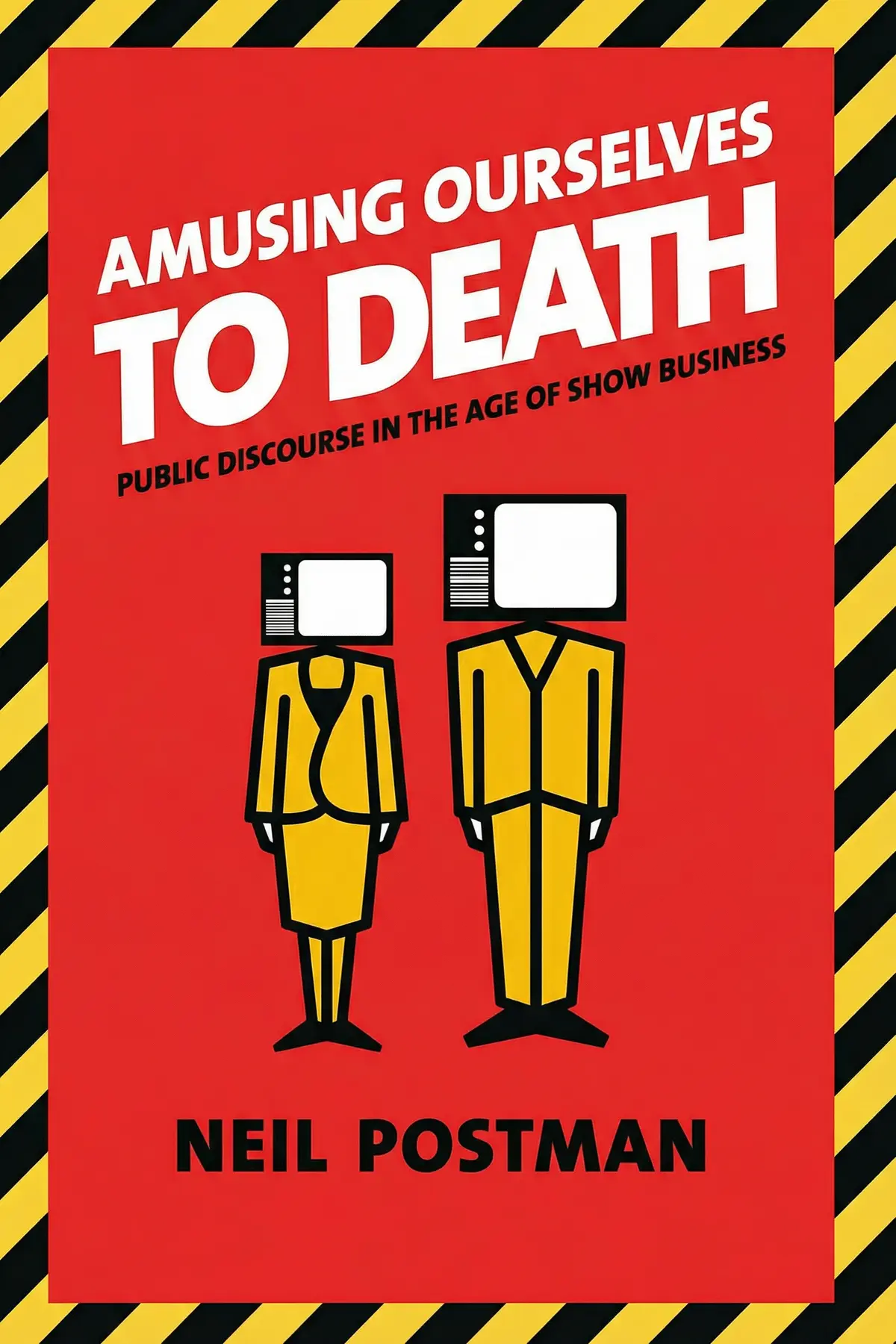
Table of Content
1. Introduction
1 min 00 sec
If most of what you know about the world arrives as headlines, clips and images, the form of that information is shaping your thinking as much as its content. That is the central claim of Amusing Ourselves to Death, in which cultural critic Neil Postman argues that each era’s dominant medium decides what a society accepts as true. In a print culture, a degree is proven by a document. In a television culture, looking the part starts to count for more.
Postman traces how America moved from a nation of readers, who judged leaders by long arguments, to a nation of viewers, who judge them by faces and performances. His throughline is stark: television, built on the fragments of telegraphy and photography, turns news, politics, religion and learning into entertainment. Follow his case and you gain a sharper eye for what any screen does to an argument, and a way to guard your own judgment against it.
2. See how a medium decides what counts as true
1 min 59 sec
A new doctor from Harvard cannot simply announce the degree, and the reason says a lot about how a culture decides what to believe. Postman thinks that standard is shifting under our feet.
3. A nation of readers judged leaders by arguments
2 min 12 sec
Two candidates once spoke for hours at a stretch, and crowds stayed to listen. The average citizen probably could not have recognized the president. Postman uses that strange world to measure what we have lost.
4. Spot the facts that arrive without context
1 min 59 sec
A royal cough became international news the moment wires crossed the ocean. Thoreau saw the joke coming, and Postman argues it shaped every screen that followed.
5. See how the evening news became a show
2 min 02 sec
People once mistook the light bulb for a better candle. Postman thinks we made the same error with television, and a single commercial break shows what that error costs.
6. Faith and politics rebuilt for the camera
2 min 00 sec
Television preachers promised a direct line to God, and a future president said out loud what politics had become. Postman explains what both lost when they moved onto the screen.
7. Real learning needs what television removes
2 min 15 sec
Children spend hours a day in front of a teacher that never sets homework. Postman names the three rules that teacher follows, and the old novel that tells us where they lead.
8. Conclusion
1 min 15 sec
Postman’s warning is about form. A medium is never neutral. Print rewarded long arguments and readers who could follow them for hours. The telegraph and the camera rewarded fragments. Television rewards whatever pleases. Each one changed what a society treats as proof, and Postman fears a public that stops noticing the change while it enjoys the show.
The danger he describes needs no force. In the world Huxley imagined, people give up the habit of thinking while being entertained, and they like it.
The defense Postman offers is attention, and it can start small. When something on a screen convinces you, separate the evidence from the music, the face and the pace. When a striking fact arrives alone, ask the questions nobody asked about Princess Adelaide’s cough: how common it is and what it changes. When a solution fits in thirty seconds, look for what was cut to make it fit. And when you teach or learn, keep the steps and the difficulty that television removes.
Lincoln’s audiences listened for hours because the argument was the event. Postman asks whether we can still make it one.
About this book
What is this book about?
Most people now learn about the world through headlines, clips and images. Neil Postman argues that this format matters more than we think. Each era's dominant medium shapes its standards of truth, and the move from print to television has changed what a public can seriously discuss. Postman starts with a nation of readers. Thomas Paine's Common Sense reached a huge share of colonial America, and Lincoln and Douglas held crowds for hours with speeches that sounded like written prose. He then follows the telegraph and the photograph, which flooded the public with facts cut off from their context. Television, in his view, completed that shift. It turns the evening news, debates, sermons and lessons into shows built to please the eye. Readers get a clear lens for any screen they use: a way to separate evidence from presentation, to ask what context a fact is missing and to notice when a quick answer leaves out the hard parts. Postman closes with Aldous Huxley's Brave New World, a warning about people who come to love the technologies that weaken their ability to think.
Book Information
Who it's for
Professionals reading news onscreen
Professionals who get most of their news from screens and want to judge it more sharply.
Teachers, trainers, team leads
Teachers, trainers and team leads wondering why lessons that feel easy rarely stick.
Curious about television's influence
Voters and students curious how television reshaped politics, religion and public debate.
About the Author
Neil Postman
Neil Postman (1931 to 2003) was an American author, educator and cultural critic, born in New York, who wrote about media, technology and education. For more than four decades he was linked with New York University, where he created and led the Media Ecology program. His other books include Teaching as a Subversive Activity, The Disappearance of Childhood and Technopoly.
Ratings & Reviews
Ratings at a glance
What people think
Listeners find this work to be a fundamental read, especially for college students, and value its distinct viewpoint and stimulating illustrations. They also consider it highly applicable to the modern era, particularly in the age of the internet, and speak highly of the compelling prose and lucid, impactful writing. Additionally, the volume offers significant observations on the evolution of media, and listeners feel the book is a worthwhile investment.
Top reviews
Hang
This book should be required reading in every high school and college curriculum. Postman wrote this in the 80s, yet it feels more urgent in our TikTok-saturated world than it probably did during the Reagan era. He brilliantly explains why Aldous Huxley’s vision of a society numbed by pleasure is a much more accurate prediction of our current reality than Orwell's Big Brother. We aren't being forced to give up our thoughts; we are voluntarily surrendering them for the sake of 15-second sound bites and flashy visuals. Frankly, the chapter on how the telegraph changed the nature of news was a massive eye-opener for me. It transformed information from something local and actionable into a series of disjointed facts that have zero relevance to our actual lives. If you want to understand why our political debates have devolved into shouting matches, you need to read this immediately. It’s worth every penny.
Show moreMia
Wow. This is one of those rare books that completely shifts your perspective on how you consume information. Postman's opening comparison between Orwell and Huxley is easily the most famous part of the book, and for good reason. It perfectly encapsulates the terrifying reality that we are amusing ourselves to death rather than being oppressed by some external force. The truth is, we have become a culture preoccupied with trivialities, much like the "feelies" in Brave New World. His writing is engaging and surprisingly accessible for a work of social theory. I was particularly struck by the discussion of how news programs use "now... this" to transition between tragedies and commercials without any emotional weight. It makes the world feel chaotic and incoherent, just as he predicted. Even though it was written decades ago, it explains the current internet landscape better than most modern pundits ever could.
Show moreTaweesak
The chapter on the Lincoln-Douglas debates haunts me. It is almost impossible to imagine a modern audience sitting for seven hours to listen to complex political arguments without pictures or music. Postman argues that we have traded depth for speed, and the results are disastrous for our democracy. Gotta say, his prediction that we would eventually value a politician’s "image" over their intellect has come true in the most dramatic way possible. We live in a world of thirty-second sound bites where charisma outweighs content every single time. The book provides a vital framework for understanding how the shift from print to screens has fundamentally rewired our brains. It’s an essential purchase for anyone worried about the state of public discourse. Truly, it’s a masterpiece of cultural observation that remains incredibly relevant to our generation.
Show moreNathan
After hearing about the 'Orwell vs. Huxley' intro for years, I finally sat down with the full text. It lived up to the hype and then some. Postman doesn't just complain about TV; he provides a rigorous history of how our tools of communication dictate what we consider "truth." The way he describes the shift from the age of exposition to the age of show business is breathtakingly clear. Not gonna lie, I felt a bit attacked by his descriptions of how we seek out distractions to avoid thinking, but that’s the mark of a great book. It’s an engaging read with sentences that actually mean something, which is ironic considering the subject. For the price of a couple of movie tickets, you get a perspective that will last a lifetime. Absolutely essential for the internet age.
Show moreAkira
Ever wonder why our political discourse feels so hollow and superficial these days? Postman points to the transition from a typographic culture to a visual one as the primary culprit. He uses the Lincoln-Douglas debates—which lasted seven hours—to show how much our attention spans have withered under the influence of television. To be fair, some of his examples feel a bit dated now that we’ve moved past the era of three major networks, but the core logic remains unshakable. The idea that "the medium is the metaphor" helps explain why we care more about a candidate's appearance than their policy positions. I found his analysis of televised religion particularly biting, especially regarding how the medium strips away the sacredness of faith. It’s a dense read at times, but the clarity of his prose keeps you moving through the complex arguments. Highly recommended for anyone trying to navigate the noise of the internet age.
Show moreYongyut
Finally got around to reading this after hearing it cited in dozens of podcasts. It’s a remarkable piece of media history that offers a unique perspective on how we got to this point of total digital saturation. Postman is at his best when he’s deconstructing "show business" in places where it doesn't belong, like education and religion. The analysis of televangelists making "graven images" of themselves was particularly insightful and something I’d never considered before. My only real gripe is that he can be a bit repetitive with his "medium is the metaphor" mantra. However, the sentences are so well-crafted and meaningful that you don't mind the occasional retread of a concept. It’s a quick read but one that stays with you long after you’ve put it down. Every college student should have a copy of this on their shelf to help them navigate the modern media circus.
Show moreWipawan
As someone who spends way too much time on social media, this was a necessary reality check. Postman describes a "peek-a-boo world" where events pop into view and then vanish without context or history. That perfectly describes my Twitter feed. He shows how the telegraph and then television turned news into a commodity of amusement rather than a tool for informed action. In my experience, most of what I read online is just "irrelevant information" that makes me feel busy without actually teaching me anything. The writing style is punchy and direct, making it a relatively easy read despite the heavy subject matter. I wish he had lived to see the smartphone era, as his insights would have been even more devastating. This book is a must-buy for anyone looking to develop a better "bullshit detector" in the 21st century.
Show morePaiboon
Direct and devastatingly accurate. Postman’s critique of "educational" television like Sesame Street was particularly fascinating to me. He argues that such shows don't teach children to love learning, they just teach them to love television. It’s a provocative idea that makes you rethink everything you were told about media as a kid. The book is filled with these kinds of "aha!" moments that challenge your basic assumptions. While he focuses on TV, his logic applies perfectly to how we use apps today. Truth be told, it’s a bit depressing to realize how far we’ve fallen since the days of long-form debate, but awareness is the first step toward change. The writing is sharp, the arguments are logical, and the message is more important now than ever. A solid addition to any library.
Show moreWorawit
Not what I expected, though I can't deny the intellectual weight of the argument. While Postman is undoubtedly a brilliant writer with a sharp "bullshit detector," his disdain for visual media feels a bit elitist and one-sided at points. He champions the written word as the only true vessel for logic and truth, which feels reductive in an age where visual storytelling can be incredibly sophisticated. Look, I agree that television has turned everything into entertainment, but he almost completely ignores the potential for education within the medium. The section on the telegraph was fascinating, yet I found myself disagreeing with his assertion that context-free information is inherently useless. It’s a thought-provoking book that definitely makes you question your screen time, but it lacks the nuance I was hoping for. Still, it’s a foundational text for media studies and worth a look.
Show moreMeen
Picked this up for a media studies class and I have mixed feelings. On one hand, Postman’s core thesis about the "entertainment-ization" of everything is undeniably brilliant and prescient. On the other hand, the book is very much a product of 1985. His focus on network television feels a bit quaint in a world of algorithmic feeds and deepfakes. Personally, I found some of his arguments about the "logic" of the written word to be a bit romanticized. He treats the 18th century like an intellectual utopia, which I think ignores a lot of the propaganda that existed back then. That said, his warning about Huxley’s vision is still incredibly chilling. It’s worth reading for the historical context, but take some of his more extreme claims with a grain of salt. It’s a solid read that offers some great nuggets of wisdom if you can get past the dated examples.
Show moreQuestions about this book
What is the main idea of Amusing Ourselves to Death?
Neil Postman argues that the dominant medium of an era shapes what a society accepts as truth. America was once a print culture that judged leaders by long written arguments. Television, which continues the telegraph’s and photograph’s habit of presenting facts without context, has turned news, politics, religion and education into entertainment. He warns that this pushes society toward the dystopia Aldous Huxley described in Brave New World.
Why does Postman say television news is entertainment?
Postman points out that the news is literally a show. It opens and closes with music, often plays music under reports to set a mood, and has presenters describe killings and disasters in the same even tone as a weather forecast. Commercials then cut in, so a grave report on nuclear war can be followed by a Burger King offer, which makes real seriousness impossible.
What does Postman say about the speeches Lincoln and Douglas gave during the 1860 presidential campaign?
He uses them to show how print shaped public speech. During the 1860 campaign, Abraham Lincoln and Stephen A. Douglas delivered addresses that frequently ran from three to seven hours, packed with elaborate metaphors, irony and complex sentences that resembled writing more than talk. Voters of that era knew politicians through their arguments, and many could not have recognized the president on sight.
What are television's three rules of education according to Postman?
Postman says every program must need no prior knowledge, which removes the sequence learning depends on. It must be understandable to anyone at once, so no study or struggle is required. And it must arrive as a story, leaving no room for argument or reflection. A teaching style with no prerequisites, no difficulty and no reasoning is, in his words, entertainment.
How can I apply the ideas in Amusing Ourselves to Death?
Treat presentation and evidence separately: ask whether a message convinced you through its argument or its polish. When a fact reaches you on its own, ask how common it is and what it changes. Be wary of any political or business fix that fits in a 30-second ad. And when teaching, keep the order of steps and the hard parts that television strips out.
Featured in
Readers also enjoyed





A Biography of Loneliness: The History of an Emotion
Fay Bound Alberti


A Force for Good: The Dalai Lama's Vision for Our World
Daniel Goleman


A Room of One’s Own
Virginia Woolf
AUDIO SUMMARY AVAILABLE
Listen to Amusing Ourselves to Death in 15 minutes
Get the key ideas from Amusing Ourselves to Death by Neil Postman, plus 5,000+ more nonfiction titles.
- 5,000+ titles
- Listen as much as you want
- 7-day free trial
- Cancel anytime









