
14 min 09 sec
Available in: English
Alone Together: Why We Expect More From Technology and Less From Each Other
Shows how caregiving robots, social media and always-on phones end up replacing human relationships instead of improving them. It also explains why stepping away from devices helps people reconnect face to face.
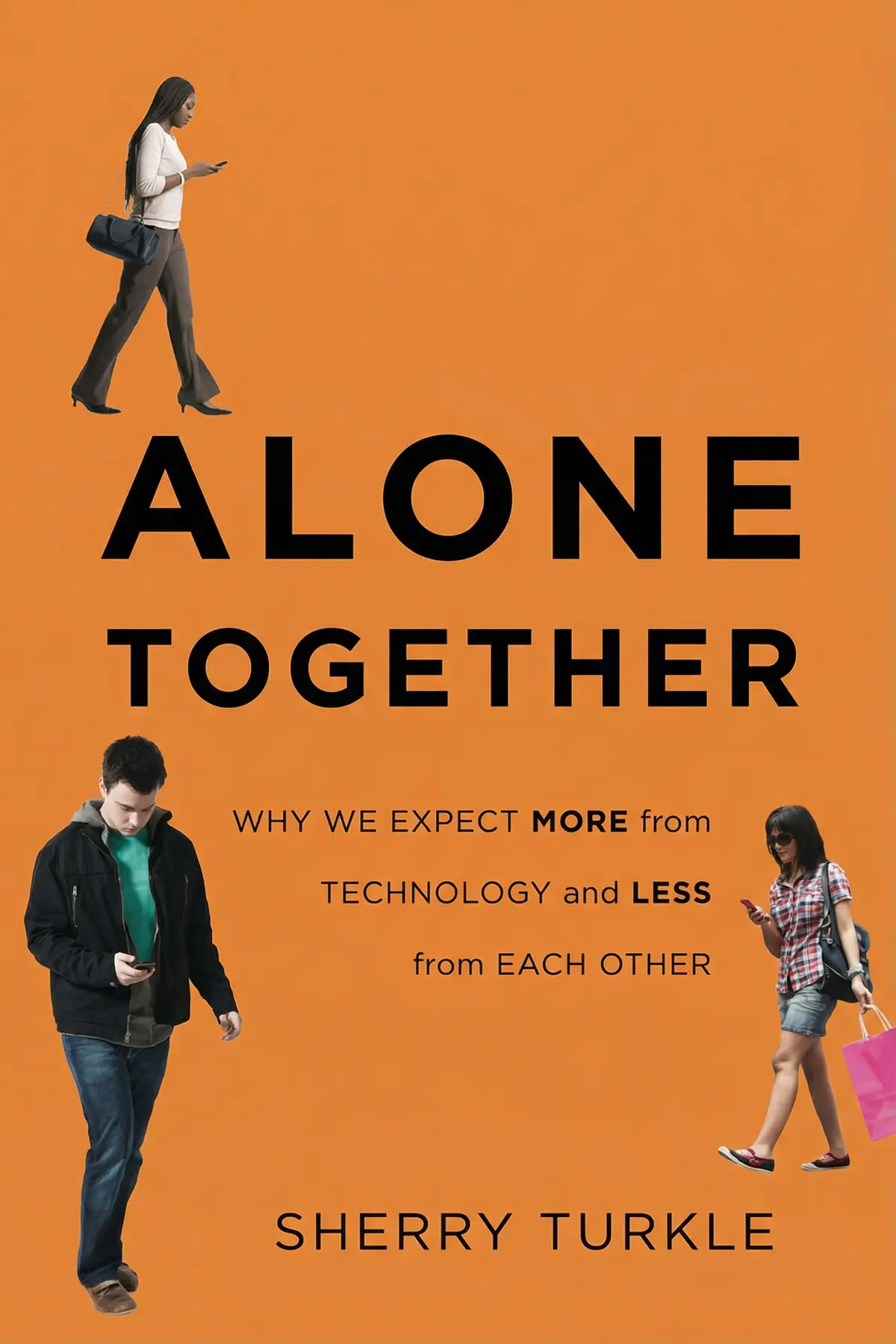
Table of Content
1. Introduction
58 sec
If your phone is always in your hand and you still feel oddly alone, Sherry Turkle has a name for where you are. In Alone Together, the MIT professor and clinical psychologist argues that we now ask machines for comfort and company while asking less and less of the people around us.
Her evidence comes from nursing homes where a robot seal hears residents’ secrets, from children who grieve for digital pets, and from teenagers who edit their lives for an audience that never logs off. Every story points the same way. Technology that offers connection without the demands of real relationships tends to leave people lonelier and more anxious, and the remedy begins when we choose people over devices on purpose.
Along the way you will see the moment a gadget starts standing in for a person, why being reachable at every hour wears you down, and what the people in Turkle’s book did when they decided to unplug.
2. Know what a caring machine cannot give
1 min 45 sec
A fuzzy koala in Japan and a robot seal in a nursing home both comfort lonely people. Yet the word they are changing may matter more than the comfort they bring.
3. See how a needy toy starts to feel alive
1 min 37 sec
Children mourned a pixel creature on a tiny screen, and adults felt guilty turning a toy upside down. The trigger had nothing to do with how clever the machines were.
4. Robot company comforts, and it can also wound
1 min 50 sec
A son feels less guilty, a lonely divorced man finds relief, and a schoolgirl decides a robot no longer likes her. The same attachment produces all three outcomes.
5. Notice when a gadget crowds out a person
1 min 36 sec
A grandmother ignores her granddaughter for a doll, and a thrice-divorced man hopes a machine will spare him the risks of love. Both stories reveal the bargain behind robot companionship.
6. Let an online self rehearse your real life
1 min 57 sec
For one young woman, an avatar helped her accept a body changed by a car crash. For a man of 43, gaming has left his two jobs feeling like they are slipping away. The difference between them is easy to test.
7. Learn how being always reachable wears you down
1 min 35 sec
People call each other less than ever, yet feel more on duty than ever. A real estate broker on a forest trail shows what that combination does to a person.
8. Trade three hollow chats for one real meeting
1 min 36 sec
A teenager who manages his online image with great care found something better than any post. A woman who missed an urgent call was grateful for it. Both point to the same habit.
9. Conclusion
1 min 15 sec
Alone Together describes a trade most of us made without noticing. Robots offer company that never sulks, never needs much and can be switched off. Networks offer friendship that never ends and never quite arrives. Both ask less than a person does, and both, in Turkle’s account, leave people lonelier: the grandmother absorbed in a doll, the gamer who relaxes only inside his game, the teenager who edits her body thinner before anyone sees it.
What the people in her book found was small and physical. Brad closed the apps and met one friend in a cafe. Pattie stopped carrying her phone. Hillary was spared hearing terrible news on her own.
Their moves are easy to borrow. Leave the phone at home for the walk, the dinner or the afternoon you meant to rest, and enjoy being out of reach. When you catch yourself texting because a call or a visit feels like too much, make the call. And if a robot or a screen keeps someone you love company, treat it as help, never as the visit itself.
The hiker who sighed with relief when her signal died was onto something. Connection is worth having, and so is the hour when nothing can reach you except the people actually beside you.
About this book
What is this book about?
We have never been easier to reach, yet many people feel more alone than ever. Sherry Turkle, an MIT professor and clinical psychologist, looks at two forces behind that feeling. Robots are moving into caregiving and companionship, and digital devices keep us connected at every hour. On the robot side, Turkle describes elderly nursing home residents who talk to a seal-like robot, one of them sharing her secrets, and children who believe their digital pets loved them back or think a glitching robot dislikes them. She shows how machines that ask for care start to feel alive, and how some people come to prefer them because they make no demands. On the network side, she follows teenagers polishing profiles, adults who avoid phone calls, and professionals who cannot hike in peace because the phone keeps ringing. The book's argument is that technology often stands in for relationships when it should strengthen them, and the strain falls hardest on children and the elderly. Readers get a clear way to spot when a device is taking a person's place, and the simple moves people in the book used to win back their time and attention.
Book Information
Who it's for
Drained by constant messages
People who feel drained by constant messages and want a reason to put the phone down.
Children of aging parents
Adult children weighing robots or screens as company for an aging parent.
Parents, teachers and managers
Parents, teachers and team leads watching young people perform their lives online.
About the Author
Sherry Turkle
Sherry Turkle is the Abby Rockefeller Mauzé Professor of the Social Studies of Science and Technology at MIT. She holds a Harvard doctorate in sociology and personality psychology and is a licensed clinical psychologist. She has studied how people relate to computers since the early personal computer era of the late 1970s, and in 2001 she founded the MIT Initiative on Technology and Self. Her other books include Reclaiming Conversation and the memoir The Empathy Diaries.
Ratings & Reviews
Ratings at a glance

What people think
Listeners find the book refreshing and intellectually stimulating, offering worthwhile anecdotes and perspectives throughout. Regarding the writing style, reactions are varied; some admire its beauty, yet others describe it as rambling. Listeners also value the work's pertinence, with one person noting its helpfulness for thesis research and another highlighting the exploration of technology's impact on intimacy. However, the tempo draws mixed reviews, as some find it stirring while others mention it tends to jump around too frequently.
Top reviews
Palm
After hearing about Sherry Turkle’s work for years, I finally dove into this 'stone-cold chilling' exploration of our digital souls and I wasn't disappointed. The way she describes us as being 'tethered' to our devices resonated with me on a visceral level, especially her notes on how we use technology to avoid the risks of real-time conversation. Many people dismiss her as a Luddite, but I think she is just being a realist about the things we’ve lost in our rush to be 'always on.' The stories from the teenagers she interviewed are heartbreaking, showing a generation that feels neglected by parents who are constantly checking BlackBerries at the park. Not gonna lie, the Thoreau references and the call to live more intentionally gave me a lot to think about. This is essential reading for anyone trying to understand how our environment molds our very capacity for empathy.
Show moreRatchada
To be fair, I went in skeptical, but Turkle manages to articulate a weird hollowness I’ve felt in my own digital life for years. This isn't just a book about gadgets; it’s a deep dive into the fundamental psychological changes occurring in a generation that has never known a world without a screen. Her writing is engaging and fun to read, even when the subject matter is 'stone-cold chilling' and a bit depressing. I found the stories of elderly people finding companionship in robots to be particularly moving and complex, rather than just being a simple 'technology is bad' argument. She captures the nuances of how we trade bits of our identity for bytes of connection. It’s a brilliant, refreshing look at the slippery slope we are all currently sliding down. I’ll be recommending this to everyone in my circle.
Show moreSara
This book left me staring at my phone for a long time after I closed the back cover. Turkle manages to capture that strange, modern hollowness where we are constantly connected yet feel increasingly isolated from genuine human contact. I found the section on 'sociable robots' like the Furby and Paro particularly unsettling, as it highlights how easily we project emotions onto mindless circuitry. While her writing style is occasionally rambling, the core message about our 'fearful symmetries' is deeply relevant to anyone feeling the digital burnout of the 21st century. To be fair, some of the research feels slightly dated now that social media has evolved even further, but the psychological insights remain sharp. It’s a provocative read that forces you to question if your 'weak connections' on Facebook are actually worth the trade-off. We are trading intimacy for mere simulation, and Turkle’s warning is loud and clear.
Show moreSangduan
The chapter on My Real Baby and robot nannies haunted me more than any horror novel I’ve read this year. Turkle explores the creepy frontier of human-robot interaction with a style that is both analytical and deeply emotional. She asks the hard questions about whether a simulation of love is enough if the person receiving it feels comforted. This book is a refreshing break from the usual 'tech is amazing' hype, offering a necessary critique of how our devices infiltrate our most private moments. I appreciated her observations on how we use multitasking to avoid the messiness of face-to-face interaction. The pacing is a bit slow in the middle, but the overall impact is undeniable. It’s the kind of book that makes you want to delete your apps and go for a long, silent walk in the woods.
Show moreDream
As someone who spends way too much time on social media, reading about our 'fearful symmetries' was a necessary wake-up call. Turkle’s work is deeply researched and provides a fascinating look at the way technology replaces the vulnerabilities of real-life relationships with the safety of a screen. I loved the section on how we 'multi-life'—trying to be present in our physical surroundings while simultaneously maintaining a digital persona. It’s a difficult balance that most of us are failing at, and seeing it laid out in such clear prose was eye-opening. Some parts are definitely repetitive, especially regarding the robot interviews, but the overall message is too important to ignore. We are moving toward a world where we prefer the company of machines because they are easier to control than people. That is a terrifying thought.
Show moreChokdee
Is it possible to be both fascinated and bored by the exact same text? I really wanted to love this, but the structure felt like two disconnected books stitched together with a very thin thread. The first half focuses extensively on robot nannies and toys, which, while interesting, felt incredibly repetitive after the tenth interview about a Tamagotchi. Once she gets to the second half about texting and Second Life, the pace finally picks up and the observations become more relatable to my own life. In my experience, the anecdotal nature of her research makes for a great narrative but a somewhat weak scientific argument. She skips around quite a bit and misses opportunities to dive into the actual brain chemistry of addiction. It’s a mixed bag of brilliant observations and laboured points that could have used a much tighter edit.
Show moreNoppadol
Picked this up for a sociology project, and while the insights are sharp, the execution feels uneven and frequently repetitive. Turkle’s central thesis is that we expect more from technology and less from each other, which is a powerful starting point for any discussion on modern life. However, she spends way too much time on the 'robot as friend' fantasy, which honestly doesn't feel like a widespread concern for most people I know. The footnotes are a mess, often just rambling about unrelated topics instead of citing actual sources for her more dubious claims. To be fair, her analysis of how we 'edit' our identities online is spot on and helped me articulate my own misgivings about social media. It’s a thought-provoking book that unfortunately gets bogged down in its own anecdotal weight, making it a bit of a slog to finish.
Show moreSuthee
Not what I expected given the hype, mostly because the first half focuses so heavily on toys like the Furby and Tamagotchi which feel like relics of the past. Turkle is a gifted writer, but her insistence on using these specific case studies makes the book feel a bit dated and less universal. The second half, where she discusses the 'tethered self' and the pressures of maintaining a Facebook profile, is much more relevant and thought-provoking. I wish she had spent more time on the impact of blogging or the 'weak connections' we form on sites like this one. Personally, I found her tone a bit too alarmist at times, as if every teenager with a phone is destined for a life of isolation. It’s a valuable read for the questions it raises, but don't expect a lot of concrete answers or deep scientific analysis.
Show moreAnucha
Look, the central premise is undeniable—we are definitely alone together—but the evidence presented here is often just a collection of stories. Truth is, I was expecting a more thorough treatment of the topic with more data and less focus on what specific kids said about their robotic dolls. Turkle points out fairly evident phenomena but often fails to analyze them beyond showing the frustrations of a few stereotypical teenagers. The book skips around too much between different types of technology, making the overall argument feel a bit incoherent at times. However, her insights into how we use texting to avoid 'real-time' intimacy are quite valuable for anyone studying modern communication. It’s a decent read for a thesis project, but for a casual reader, it might feel a bit too much like a lecture from a worried parent.
Show moreElias
Frankly, the 'Get off my lawn' energy in these pages was a bit much for me to handle. Turkle is clearly a brilliant academic from MIT, but her anti-technology rhetoric feels tired and heavily biased toward a nostalgic view of the past that probably never existed. She relies almost entirely on anecdotes from a very specific subset of people, like those still obsessed with Second Life, rather than providing any hard statistics or broader data. I felt she pointed out evident phenomena—like people texting more—but failed to show that technology is the actual cause of the psychological distress she describes. For instance, the story of 'Adam' the gamer seemed more like a case of general depression than something uniquely caused by the internet. The writing is beautiful in places, but the logic is often incoherent and lacks the depth I expected from such a buzzy title.
Show moreQuestions about this book
What is the main idea of Alone Together by Sherry Turkle?
Turkle argues that technology meant to enrich our lives often makes us lonelier. Caregiving and companion robots, social media and always-on phones end up replacing parts of our relationships instead of strengthening them. Machines appeal because they ask less of us than people do. The strain falls hardest on children and the elderly, and many people are now pulling back from devices to reconnect in person.
What does Alone Together say about robots caring for the elderly?
Turkle describes robots such as Japan’s Wandakun koala and Paro, a seal-shaped robot used in nursing homes. Residents like Miriam talk to Paro and share secrets with it, and families like Tim’s feel their parent is less alone. Turkle’s concern is that care shifts from caring about someone to simply taking care of them, and a robot cannot care about anyone.
Why does constant connectivity cause stress according to Turkle?
Phones make us reachable at every hour, so we are never truly alone. Hope, a real estate broker, gets a call from her husband every 30 minutes while hiking and feels relief only when the signal drops. Teenagers also worry that anything they post stays online for good, so they watch every word and rarely feel free to be themselves.
How can I apply the ideas in Alone Together?
Turkle’s most direct advice is to leave your phone at home when you want to relax, without feeling guilty. People in her book also took media fasts and swapped several shallow online exchanges for one real meeting, as Brad did by inviting friends to a cafe. You can also notice when you reach for a device because a person feels like too much effort.
Who should read Alone Together?
It suits anyone who feels worn out by being permanently online, parents and teachers of teenagers who build identities on social media, and families thinking about robot companions for an aging relative. Its stories, from children grieving for Tamagotchis to a man gaming 15 hours a day, help readers see their own habits with technology more clearly.
Readers also enjoyed

AI 2041: Ten Visions for Our Future
Kai-Fu Lee







59 Seconds: Change Your Life in Under a Minute
Richard Wiseman


AUDIO SUMMARY AVAILABLE
Listen to Alone Together in 15 minutes
Get the key ideas from Alone Together by Sherry Turkle, plus 5,000+ more nonfiction titles.
- 5,000+ titles
- Listen as much as you want
- 7-day free trial
- Cancel anytime









