

15 min 45 sec
Available in: English
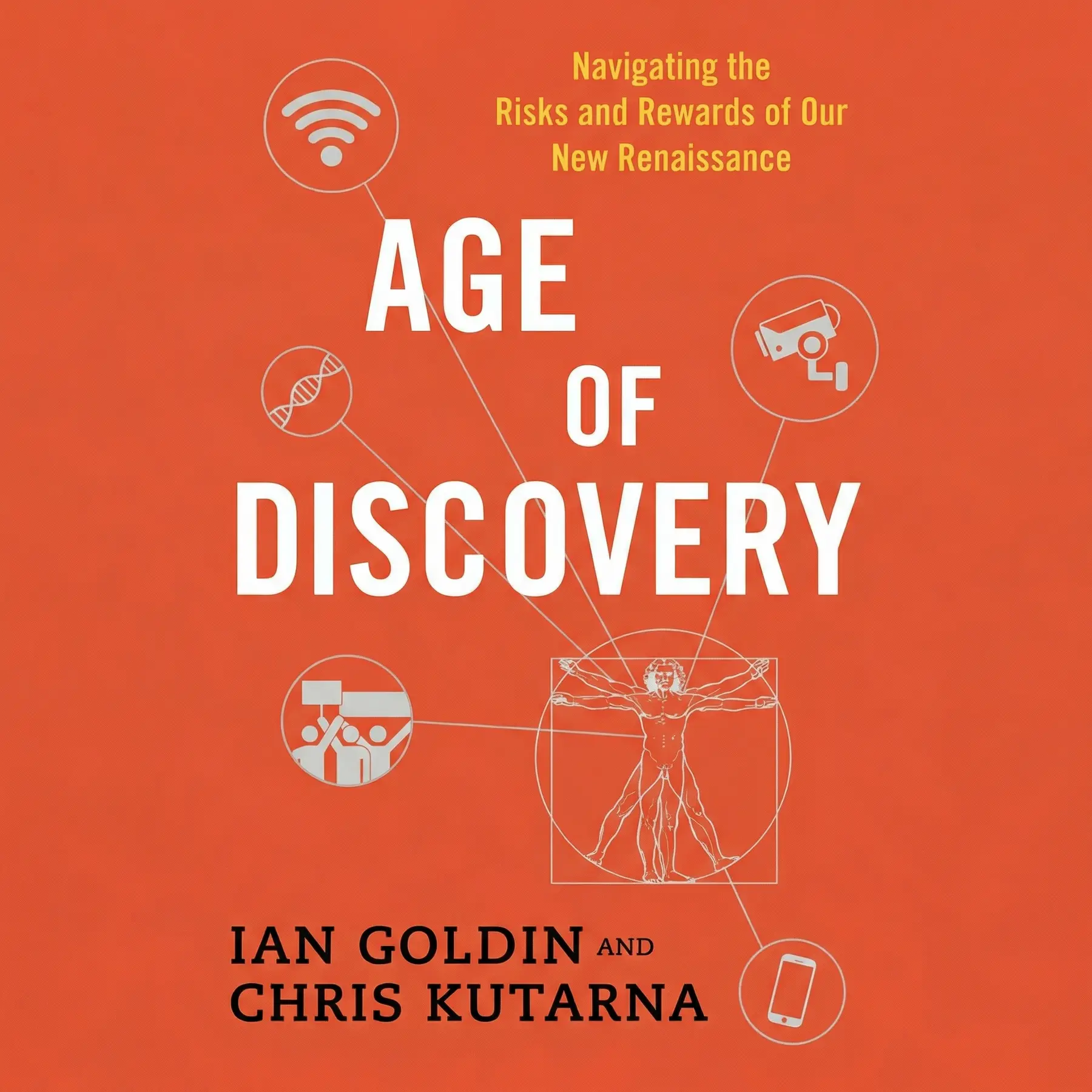
Age of Discovery: Navigating the Risks and Rewards of Our New Renaissance
Ian Goldin and Chris Kutarna compare today's connected world with the Renaissance of 1450 to 1550. They show why record gains in health and wealth arrive together with inequality, contagion and extremism, and how to read both.

Table of Content
1. Introduction
1 min 09 sec
If the news leaves you anxious and unsure where the world is heading, Ian Goldin and Chris Kutarna offer a map. In Age of Discovery, they argue that we are living through the most dynamic stretch of history in 500 years, a second Renaissance that began around 1990. Like the first one, from 1450 to 1550, it brings breathtaking progress and serious danger at the same time, and both flow from one source: a world suddenly far more connected.
Since 1960 people have gained nearly twenty years of life expectancy, and yet a few dozen individuals now hold as much wealth as half of all humanity. The authors hold up the age of Gutenberg, Michelangelo and Columbus as a mirror, and in it today’s disorder starts to make sense: the speed of change, the gaps it opens, the diseases and panics it carries and the anger it stirs. What follows is a steadier way to read the headlines, see where the risks really sit and keep faith in what cooperation and genius can still build.
2. See your era as a second Renaissance
1 min 51 sec
A historical label that sounds purely glorious turns out to hide a darker origin. Placing our own time beside it explains why the present feels both thrilling and unsettling, and what the flattering version leaves out.
3. Change that rewires a world within one lifetime
1 min 53 sec
A woman born in the 1450s grew up in a world her parents would not have recognized. Our generation has lived through something similar, only faster, and the scale of it helps explain why so many feel lost.
4. See the long-run data beyond the headlines
2 min 01 sec
Daily news paints a grim world. A handful of numbers on lifespans, poverty and children’s deaths tell a very different story, and the speed of the change is as striking as its size.
5. Average gains can hide a widening gap
1 min 52 sec
A nanny in Renaissance Europe worked for decades without a raise while her living costs soared. Her story, and a shrinking list of billionaires today, reveal what rising averages can conceal.
6. Expect connection to carry danger as fast as ideas
1 min 53 sec
In 1495 a terrifying illness appeared in Italy and circled the globe within a decade. The same features of modern life that make us prosperous now move viruses, financial panics and cyber attacks at even greater speed.
7. Learn how fear hands power to preachers
1 min 56 sec
A friar in Florence lit a fire in the city square and within a year ran its politics. His rise shows which conditions turn ordinary anxiety into support for extreme movements, then and now.
8. Count the progress that never shows up in GDP
1 min 53 sec
A million people reading an online encyclopedia add nothing to the economy on paper. That accounting blind spot hides some of the biggest gains of our time, from free learning to discoveries about the galaxy.
9. Conclusion
1 min 17 sec
Age of Discovery works less as a forecast than as a pair of glasses. Look at the present through the age of Gutenberg and Savonarola, and the confusion takes on a shape. The same Renaissance that printed 15 to 20 million books in a single lifetime also saw syphilis spread across Europe. The networks that carry Wikipedia also carry Ebola, financial panic and hate. In Goldin and Kutarna’s telling, progress and danger belong to one story about a world more connected than ever before.
Seeing it that way asks for two kinds of attention at once. Check the long trend before trusting the gloomy headline, because by the authors’ figures lifespans and incomes have never been higher. Then ask who is missing from the average, and where in your work or your life a faraway shock could arrive overnight. When someone promises to burn down the new world to save the old one, remember the square in Florence in 1497.
The first Renaissance left us Michelangelo and Leonardo, and it also left smallpox and slavery. Living inside the second, we can see both sides as they happen, and decide which one to feed.
About this book
What is this book about?
The world since 1990 can feel dizzying. Technology changes faster than careers, headlines swing between miracle and disaster, and many people feel overwhelmed and unsure what is really happening. Ian Goldin and Chris Kutarna argue that this feeling has a historical explanation: we are living through a second Renaissance, the most dynamic period in 500 years. Their method is comparison. Gutenberg's printing press is set beside the internet, syphilis spreading through crowded Renaissance cities beside Ebola carried by air travel, and the friar Savonarola's Bonfire of the Vanities beside modern extremist movements. In both eras, the authors show, connection lifted average welfare while pushing rich and poor further apart, and rapid change bred fear that radicals were quick to exploit. Readers get a clear frame for the present. It includes hard numbers on life expectancy, poverty and child deaths that contradict the gloomy news, an honest look at who gets left behind, and a case for the kinds of progress that economic statistics fail to count.
Book Information
Who it's for
Professionals overwhelmed by change
Professionals who feel overwhelmed by the pace of change and want a historical frame for it.
Founders and managers
Founders and managers who need to weigh global opportunity against contagion, financial shocks and cyber risk.
Torn by mixed signals
Readers torn between hopeful data and grim headlines who want to understand both.
About the Author
Ian Goldin
Ian Goldin is Professor of Globalisation and Development at the University of Oxford and a fellow of Balliol College. He was the first director of the Oxford Martin School, a Vice President of the World Bank and an adviser to Nelson Mandela, and he has published 23 books. Chris Kutarna holds an Oxford doctorate in politics, has been a Fellow of the Oxford Martin School and has studied the political values of China's middle class. A former Boston Consulting Group consultant, he teaches on executive programs at Oxford's Saïd Business School.
Ratings & Reviews
Ratings at a glance
What people think
Listeners consider the work both accessible and enlightening, with one individual remarking that it is essential reading for grasping our modern era. The extensive research and historical depth are well-regarded, and one listener specifically noted the captivating details provided about the initial Renaissance period. Opinions regarding the reading speed vary among different listeners.
Top reviews
Yaowares
Ever wonder why the world feels so chaotic right now? Goldin and Kutarna provide a refreshing lens by drawing parallel lines between our current era and the 15th-century Renaissance. It’s not just a history lesson; it's a strategic framework for understanding the radical shifts in technology and globalization that define our lives today. Frankly, the depth of research is staggering, covering everything from Gutenberg’s press to modern-day quantum computing. While the authors don't shy away from the dark side of progress—like the risk of global contagion or political instability—they maintain a contagious sense of optimism. This is the kind of book that makes you look at the news and see opportunities instead of just crises. It’s dense, sure, but the insights are well worth the effort for anyone trying to navigate our 'Renaissance 2.0'.
Show moreSuvannee
Finally got around to finishing this, and I’m still buzzing from the ideas it presents. Goldin and Kutarna manage to weave together history, geography, and cutting-edge science into a narrative that feels both urgent and timeless. I loved the deep dives into how the original Renaissance was plagued by the same types of fundamentalism and warring ideologies we see today. It makes our current political climate feel less like a unique disaster and more like a predictable byproduct of rapid change. Look, the book isn't a light read by any means, but the clarity it brings to the 'Age of Discovery' we're inhabiting is unmatched. It challenges you to stop retreating into isolation and instead reach out to embrace the possibilities of our new era. Highly recommended for leaders and thinkers.
Show moreEmily
Wow. This is a powerful and insightful look at where we are as a species. Goldin and Kutarna have created a masterpiece of synthesis, pulling together disparate threads of human progress to show us the big picture. I particularly enjoyed the comparison between the printing press and the internet—it really puts the 'shocks' we feel today into a manageable context. Not gonna lie, some of the statistics and facts are a bit overwhelming at first, but they build a very convincing case for why this is a 'new golden age.' It's a must-read for anyone in a leadership position who needs to understand the environment in which innovation actually flourishes. This isn't just a book; it's a roadmap for the 21st century. Clear, bold, and ultimately very hopeful.
Show moreAroha
This book is a stunning achievement. Goldin and Kutarna provide a much-needed perspective on the 'shocks' of our time, arguing that they are actually the birth pangs of a new age of discovery. The breadth of the book is incredible, spanning from the voyages of Columbus to the potential of CRISPR and beyond. Unlike many other futurist books, this one is grounded in a deep understanding of the past, which makes its predictions feel much more credible. I was particularly impressed by how they handled the risks of this transition, including the potential for pandemics and extreme inequality. It’s an incisive and fascinating piece of work that deserves to be read by anyone concerned about the future of our global society. It’s definitely a new favorite.
Show moreKan
As someone who struggles to make sense of the constant 'shocks' in our daily news cycle, I found this perspective incredibly grounding. The authors argue that we are currently at a crossroads, much like the one Europe faced 500 years ago, and their analysis of our 'connectedness' is spot on. Truth is, I was particularly struck by their warning about a potential global pandemic; reading that in a post-2020 world feels like looking at a crystal ball from 2016. The book balances these grim possibilities with a real excitement for scientific discovery. My only real gripe is that some chapters feel significantly more researched than others, leading to an uneven flow. Despite that, it’s an essential read for anyone wanting to understand the systemic forces shaping our future.
Show moreLaor
The chapter on nanotechnology alone is worth the price of admission. I’ve always been a bit of a science buff, but the way the authors link these modern leaps to the spirit of the 15th century is genuinely clever. It’s a thought-provoking approach that highlights both the massive rewards and the terrifying risks of our current pace of innovation. Personally, I think the authors do a great job of staying balanced; they aren't just selling 'techno-optimism' but are seriously considering the losers of this new age. The pacing can be a bit sluggish in the middle, and I agree with other reviewers that it gets a bit wordy. However, the insights into quantum physics and its potential impact on society were fascinating. It’s a solid 4-star read that will definitely stay on my mind.
Show moreOm
After hearing so much about the 'pessimism' of the modern world, this book was a breath of fresh air. It offers a way to cut through the noise and see the underlying patterns of discovery that are currently reshaping our planet. As a history buff, I really appreciated the nuanced look at the European Renaissance, especially the parts that aren't just about art. The authors show how that era was just as messy and dangerous as ours, which actually gives me a bit of hope. Gotta say, the ending was a little preachy for my taste, and I think they could have made their points more concisely in the final stretch. Still, the overall framework is very valid and well-researched. It’s a challenging read that rewards the focused reader.
Show moreKae
Picked this up because I’m fascinated by the idea of a modern Renaissance, but the execution was a bit of a slog for me. To be fair, the historical comparisons are brilliant and the sections on nanotechnology and 3D printing are genuinely eye-opening. However, the writing style is incredibly wordy and repetitive at times, making it hard to maintain momentum through the middle chapters. I found myself skimming through the more 'preachy' segments where the authors seemed to lecture the reader on how to live. It’s a solid piece of scholarship, but it desperately needed a more aggressive editor to trim the fat and get to the point. If you have the patience for a slow, academic read, there’s great stuff here, but it wasn't the page-turner I was hoping for based on the premise.
Show morePui
Not what I expected, though I can't say it's a bad book. The central thesis—that we’re in a new Renaissance—is compelling, but the prose is quite dense and often feels like it was written for an academic journal rather than a general audience. In my experience, certain sections felt incredibly clunky, almost as if they were processed through a basic translator, making it hard to grasp the sense of a few key arguments. I appreciated the warnings about the 'self-destruct button' of humanity, but the ending felt a little too much like a sermon. It’s a mixed bag that offers great knowledge if you're willing to fight through the delivery and some occasionally confusing sentence structures.
Show moreRoongsak
This book's ambition is its biggest strength and its greatest weakness. While I loved the premise of comparing our time to the Renaissance, I struggled with the sheer volume of text. It feels like the authors were so enamored with their research that they couldn't bear to leave anything out. Consequently, the progress of the reading felt way too slow for my liking. Frankly, some sections on political economy felt like they were pulled from a textbook, lacking the spark of the earlier historical sections. I did find the discussion on the 'psychic collision' of reality and expectations very relatable, but I wish the writing was more accessible. It’s a serious book for a serious subject, but it lacks the punchiness needed to keep me engaged throughout.
Show moreQuestions about this book
What is the main idea of Age of Discovery by Ian Goldin and Chris Kutarna?
The authors argue that since about 1990 we have been living through a New Renaissance, comparable to the period from 1450 to 1550. Then as now, greater connection brought huge gains in knowledge, health and wealth, while also widening inequality, spreading disease and feeding extremism. Understanding the first Renaissance, they suggest, helps us read the risks and rewards of our own time.
Why do the authors say the New Renaissance started in 1990?
They name three shifts around that year: the Berlin Wall coming down alongside the close of the Cold War, the launch of commercial internet service and China’s re-entry into the world economy. The founding of the World Trade Organization in 1995, which now has 161 members covering every major economy, is their symbol of a radically different period.
Does Age of Discovery say the world is getting better or worse?
Both. The authors show record progress: life expectancy rose from 52 to 71 years since 1960, extreme poverty fell from about two billion to 900 million people, and child deaths from infections dropped from 13 million to 5.9 million. Yet by 2015 just 62 people held more wealth than the poorer half of humanity, and connection also spreads epidemics, financial crises and hate.
What does Savonarola have to do with modern extremism?
In 1497 the friar Girolamo Savonarola had his followers burn books, art and other signs of the new age in Florence, then rose to dominate the city’s politics as many feared the Last Judgment in 1500. Goldin and Kutarna argue that groups like Islamic State and neo-Nazis grow in similar conditions: fast change, deep inequality and widespread disorientation.
How can I apply the ideas in Age of Discovery?
Check long-term trends before reacting to bleak headlines. Ask who benefits from any celebrated growth figure, since averages can hide a widening gap. Map how distant events could reach your work, as Ebola, the 2008 crisis and cyber attacks show. And count the value of free tools like Wikipedia, which GDP ignores but which make you more capable.
Readers also enjoyed




1929: Inside the Greatest Crash in Wall Street History--and How It
Andrew Ross Sorkin

23 Things They Don’t Tell You About Capitalism
Ha-Joon Chang
A Little History of Economics
Niall Kishtainy


A Splendid Exchange: How Trade Shaped the World
William J. Bernstein
AUDIO SUMMARY AVAILABLE
Listen to Age of Discovery in 15 minutes
Get the key ideas from Age of Discovery by Ian Goldin, plus 5,000+ more nonfiction titles.
- 5,000+ titles
- Listen as much as you want
- 7-day free trial
- Cancel anytime









