

15 min 18 sec
Available in: English
Growth: A History and a Reckoning
Explains how economic growth began only two centuries ago, why it now drives climate damage and inequality, and how better measures, more ideas and smarter incentives could steer it without collapsing the economy.
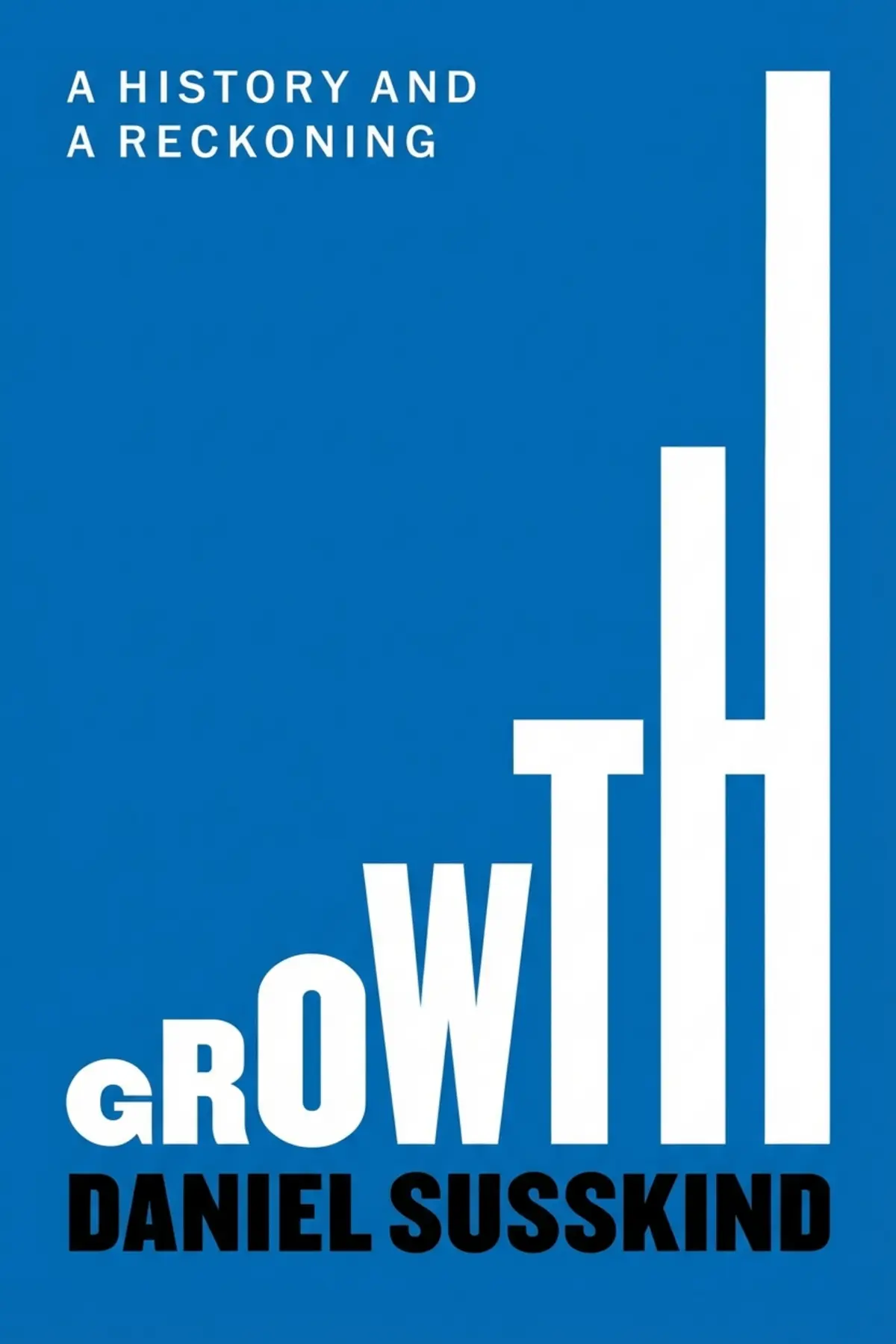
Table of Content
1. Introduction
1 min 05 sec
If the debate about growth leaves you torn between cheering every rising number and wanting to stop the whole machine, start with this: sustained economic growth is only about two hundred years old. In Growth, Daniel Susskind, a research professor at King’s College London who has worked in the Policy Unit at 10 Downing Street, argues that this short burst rescued humanity from millennia of hardship and also brought climate damage, deep inequality and political anger. His answer is neither to worship growth nor to abandon it. He wants growth powered by ideas rather than raw materials, measured by more than one number, and steered by incentives toward what people actually value.
The argument moves from an English wage chart shaped like a hockey stick to the wartime puzzle that gave birth to GDP, and on to patents nobody uses and a protein-folding breakthrough. By the end, any claim about growth, from a politician or an activist, can be tested with a sharper question: growth of what, and paid for by whom?
2. See how recent and rare real growth is
1 min 42 sec
A Stone Age forager and an eighteenth-century laborer lived worlds apart in tools and customs. In one stubborn respect, though, they were nearly identical, and some foragers actually came out ahead.
3. Ideas, not machines, keep an economy growing
1 min 47 sec
Pile up enough factories and equipment and an economy should grow forever. Economists discovered it does not work that way, and the real engine they found changes what a finite planet can support.
4. Learn why a wartime question gave us GDP
1 min 57 sec
The figure that opens every economic news bulletin was invented to answer one narrow question during a world war. Its rise to global dominance brought real gains, and a blind spot that still shapes policy.
5. Trace climate, inequality and anger to one root
2 min 01 sec
Rising temperatures, soaring top incomes and the populist revolt usually get separate experts and separate headlines. Susskind sees a single cause behind all three, and it is the same force that made modern life comfortable.
6. Judge progress with a dashboard, not one number
1 min 50 sec
One camp wants to repair how growth is measured; another wants to stop growing altogether. Susskind takes both seriously, borrows from one, and explains why the other undermines itself from the inside.
7. Grow the economy by multiplying good ideas
2 min 00 sec
Some patent owners never build anything, and some elite universities now employ more administrators than professors. Susskind sees these as brakes on the one resource that never runs out, and he has specific fixes.
8. Bend hard tradeoffs with incentives and rules
1 min 45 sec
Clean energy was once written off as a brake on prosperity. What changed that verdict offers a template for jobs threatened by AI, and for any choice where progress seems to demand a painful sacrifice.
9. Conclusion
1 min 11 sec
Susskind’s book amounts to a wager on human ingenuity. For most of history people lived on the flat handle of the hockey stick. Two centuries ago the line bent upward, and the growth that broke the Malthusian trap is now heating the planet and splitting societies. Abandoning it would throw away the engine that ended the Long Stagnation. Worshipping it would keep the damage coming. His path between the two changes what fuels growth, what we count and what we reward.
For a listener, that wager becomes a way of seeing. When a single figure rules a discussion, whether national GDP or a team’s monthly target, ask what it leaves out and put other measures beside it. When someone claims growth must wreck the planet, or never does, recall that solar power has already weakened that tradeoff, and that ideas, unlike materials, do not run out. And when progress carries a cost, look for the tax, subsidy or rule that could bend it, the way the pandemic pushed whole economies quickly toward remote work.
Growth began as a number designed to plan a war. Susskind’s argument is that we can now decide what it is for.
About this book
What is this book about?
For almost all of human history, living standards barely moved. Then, around 1800, wages in England turned sharply upward, and the modern age of sustained growth began. That growth cut poverty and paid for advances in science and medicine. It has also heated the planet, concentrated income at the very top and fed political anger in richer countries. Daniel Susskind sets out to explain both sides of that story and to find a path between two tempting extremes. One treats GDP, a measure first built to plan for war, as the final score of a society. The other, the degrowth movement, wants to scale the economy back. Susskind argues that neither answer settles the tension, and that degrowth overlooks the role of ideas. In his account, lasting growth rests on ideas, which do not run out, and it can be aimed. Readers get a clear history of how growth and GDP came to dominate policy, a frank tally of the costs, and a set of proposals: a dashboard of measures beside GDP, patent reform, renewed research, AI as a partner in discovery, and taxes, subsidies and rules that bend hard tradeoffs.
Book Information
Who it's for
Professionals torn on growth
Professionals who feel torn between pro-growth and degrowth arguments and want a clear middle position.
Leaders wanting better measures
Founders and managers judged by one headline metric who want a better way to measure progress.
Economics and policy students
Students of economics and policy looking for a readable history of GDP and its costs.
About the Author
Daniel Susskind
Daniel Susskind holds a research professorship at King's College London and has a research role connected to the Institute for Ethics in AI at Oxford University. He worked in UK government, including the Prime Minister's Strategy Unit, the Policy Unit at 10 Downing Street and the Cabinet Office, and was a Kennedy Scholar at Harvard. His book A World Without Work was runner-up for the Financial Times business book prize in 2020, and Growth placed runner-up in 2024 and appeared on Barack Obama's list of favorite books that year. He also co-wrote the best-selling The Future of the Professions.
Ratings & Reviews
Ratings at a glance
What people think
Listeners find this examination of policy and economic history to be a lucid and thorough survey of the development of worldwide living conditions. Although perspectives differ regarding the author’s primary thesis that non-physical concepts can drive unending expansion on a limited world, listeners typically value the perceptive analysis of intricate economic frameworks and the evolution of GDP. Furthermore, they find the exploration of "GDP minimalism" to be a stimulating compromise between the degrowth movement and conventional growth strategies. They also highlight the work's historical range, with one listener remarking that it offers a "pretty comprehensive" recap of economic literature spanning from the Industrial Revolution through current AI progress.
Top reviews
Kae
Susskind takes a massive, daunting topic and makes it remarkably accessible. The core argument—that ideas are 'non-rival' and therefore provide a path to infinite growth—is both puzzling and brilliant. I loved the breakdown of how we escaped the Malthusian trap. Truth be told, I never realized how recently 'growth' became our primary global metric. The book flows well, though the second half gets a bit bogged down in policy specifics that might not appeal to everyone. Still, it’s a vital read for anyone worried about the planet’s future. It challenges the doom-and-gloom narrative with genuine intellectual rigour.
Show moreThanakorn
Finally got around to this, and the historical sweep of the first half is absolutely worth the price of admission alone. Moving from the Stone Age through the Industrial Revolution, Susskind explains the 'hockey stick' graph of human prosperity with such clarity. It’s rare to find an economist who writes this well. I was particularly struck by the transition from physical capital to technological progress as the main driver of wealth. Even if you don't buy the infinite growth argument, the 'GDP minimalism' concept is a game-changer. It’s the most sensible way I’ve seen to balance progress with ecological sanity. Truly thought-provoking stuff that stays with you.
Show moreBook
What if the way we measure progress is the problem, not progress itself? This book fundamentally shifted how I look at the global economy. Susskind’s explanation of why ideas are different from physical goods—that they are 'non-rival'—is a lightbulb moment. It means my knowledge doesn't take away from yours. If we can shift our focus from 'using up' resources to 'arranging' them more intelligently, the possibilities are staggering. The prose is punchy, and the examples, like the culinary metaphor for recipes, make complex theories feel intuitive. It’s the kind of book you want to discuss with friends immediately after finishing. Despite some dry stretches in the policy chapters, it's a masterpiece.
Show moreAnucha
After hearing so much buzz about the 'degrowth' movement, this felt like a necessary counter-perspective. Susskind doesn't just blindly cheerlead for expansion; he acknowledges the environmental and social costs of our obsession with GDP. His critique of how we measure success is sharp. He proposes a 'dashboard approach' that looks at more than just market activity, which makes a lot of sense in our modern, automated world. Not gonna lie, some of the math-heavy sections in the middle required a re-read, but the overall message is hopeful. We need better growth, not necessarily less of it. A solid, comprehensive history of how we got here.
Show morePruet
Look, the debate between growth and sustainability usually feels like a shouting match, but Susskind offers a genuine middle ground. He makes a compelling case for a 'Second Industrial Enlightenment.' This isn't just about making more stuff; it’s about reforming intellectual property laws and investing in R&D to solve the climate crisis. I liked the section on AI and how it might augment human workers rather than just replacing them. It’s an optimistic take on technology that we don't see enough of lately. My only gripe is that the ending feels a bit idealistic regarding political implementation. Still, it’s a refreshing break from the usual gloom.
Show moreRung
The chapter on the history of GDP as a political weapon during the Cold War was eye-opening. It’s wild to think that a metric designed for wartime logistics became the singular yardstick for human flourishing. Susskind does a masterful job of deconstructing this obsession. He argues that we’ve become complacent about the hidden costs of growth, like inequality and cultural erosion. While I struggled with his claim that growth can be infinite, his call for 'GDP minimalism' is something I can get behind. The book is dense but rewarding. Definitely a mandatory read for anyone interested in policy or economic history. It really makes you question the 'more is better' mindset.
Show moreEli
Is it actually possible to have infinite growth on a planet with limited resources? That’s the central question Susskind tackles, and while his prose is elegant, I’m not entirely sold on his answer. He leans heavily on Paul Romer’s idea that the number of ways to combine resources is nearly infinite. This is mathematically true but physically questionable. Every 'new combination' of resources still requires energy and raw materials, even if the idea itself is weightless. I appreciated the discussion on GDP minimalism, though. It’s a smart middle ground for those of us wary of the degrowth movement but concerned about climate change. A bit too optimistic for my taste.
Show moreThanit
As someone who spent their university years pouring over development economics, I found parts of this book a bit redundant. It covers the usual suspects—Malthus, Solow, Kuznets—in a way that’s perfect for a general audience but might feel slow for specialists. Susskind’s focus on ideas as the engine of growth is well-argued, yet he glosses over the power dynamics that dictate who gets to profit from those ideas. I also wished there was more depth on the impact of 'tweakers' in the Industrial Revolution. It’s a great introductory text, just don't expect it to reinvent the wheel if you’ve already read your Piketty or Mokyr. Good, but not groundbreaking.
Show morePrae
To be fair, the writing is clear and the research is clearly extensive, but the policy recommendations in the final section felt a bit thin. I found the historical overview of the Solow-Swan model and the 'Long Stagnation' fascinating. Susskind is a gifted teacher. However, his suggestion of using citizen assemblies to solve deep-seated economic trade-offs felt like a bit of a hand-wave. It’s easy to say we need better ideas, but much harder to implement them when corporate interests are at play. A decent overview of growth literature for a layperson, but it lacks the 'punch' needed to define a truly new paradigm for the 21st century.
Show moreSofia
The author claims that those who disagree with his infinite growth thesis simply lack imagination, which feels incredibly dismissive. While it is true that ideas are non-rival, the physical implementation of those ideas is not. You can have a million 'weightless' recipes for a cake, but you still need flour, eggs, and oven heat to make a single one. Susskind’s insistence that we can decouple growth from material reality felt more like a mathematical trick than a practical solution. The history of GDP was interesting, but the central premise just didn't hold up under scrutiny for me. It ignores the heavy environmental price we are already paying. Frankly, this feels like an economist trying to math his way out of a physical crisis.
Show moreQuestions about this book
What is the main idea of Growth by Daniel Susskind?
Susskind argues that sustained economic growth is only about two hundred years old, that it ended millennia of stagnation, and that it now brings serious costs such as climate change and inequality. He rejects both treating GDP as the final score and the degrowth call to shrink the economy. Instead he wants growth driven by ideas, judged with a wider set of measures and steered by incentives toward what society values.
Why does Susskind criticize the degrowth movement?
He agrees with degrowth that tradeoffs matter, but he sees two problems. Its supporters disagree on whether shrinking GDP means a recession, which makes the movement hard to turn into policy. And he says it lacks imagination, swapping one extreme for another while assuming growth comes only from material resources, when ideas, which never run out, are the real engine.
What is GDP Minimalism?
GDP Minimalism is Susskind’s proposal to keep GDP but reduce its dominance. Because GDP ignores unpaid work, environmental damage and well-being, he suggests a dashboard that places it beside measures of environmental health, inequality and community well-being. He also wants economists to move past technical efficiency and ask broader questions about what people value and why.
How does Susskind think growth can continue without destroying the planet?
He proposes a Second Industrial Enlightenment built on ideas: patent reform such as a use it or lose it rule, more investment in research with less university bureaucracy, wider economic participation, and technology such as DeepMind’s AlphaFold. He pairs this with incentives, pointing to solar power as proof that cutting carbon and growing the economy can go together.
How can I apply the ideas in Growth?
At work, avoid letting one number rule decisions: set a few measures beside it that show what it misses. When weighing a change, name its costs openly and ask which incentive or rule could shrink them, as taxes and subsidies can favor technology that helps workers instead of replacing them. And look for places where good ideas get stuck in approvals or paperwork.
Readers also enjoyed


A Splendid Exchange: How Trade Shaped the World
William J. Bernstein



Adults in The Room: My Battle With Europe’s Deep Establishment
Yanis Varoufakis


1929: Inside the Greatest Crash in Wall Street History--and How It
Andrew Ross Sorkin

23 Things They Don’t Tell You About Capitalism
Ha-Joon Chang
AUDIO SUMMARY AVAILABLE
Listen to Growth in 15 minutes
Get the key ideas from Growth by Daniel Susskind, plus 5,000+ more nonfiction titles.
- 5,000+ titles
- Listen as much as you want
- 7-day free trial
- Cancel anytime









