

15 min 46 sec
Available in: English
Zero to One: Notes on Startups, or How to Build The Future
Peter Thiel argues that great startups avoid competition by creating something new enough to own a small market outright. He shows how an overlooked truth, a narrow start, a close team and deliberate selling get them there.
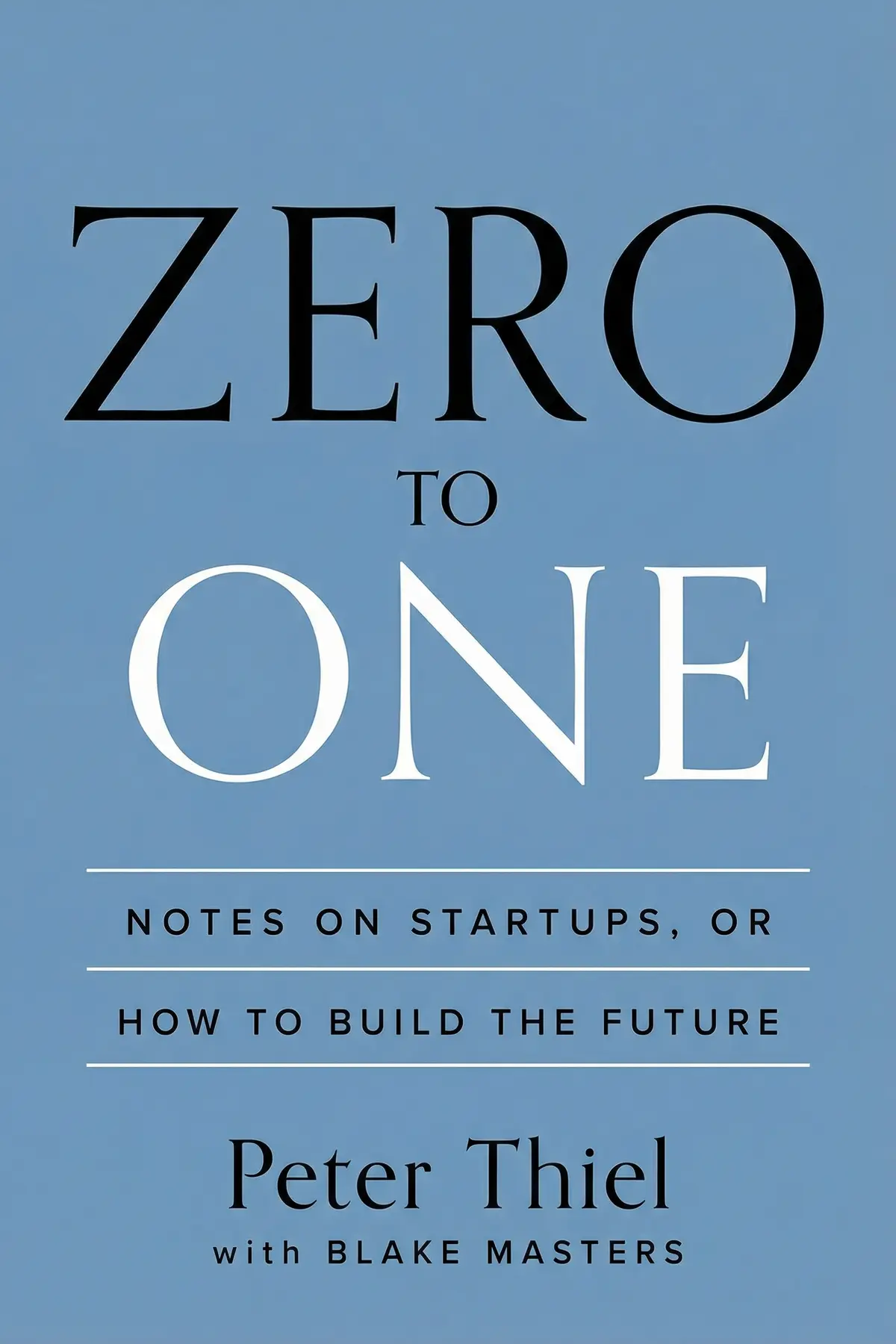
Table of Content
1. Introduction
1 min 01 sec
Most new businesses are built to compete, and Peter Thiel believes that is why so many of them earn so little. In Zero to One, the PayPal cofounder and first outside investor in Facebook, writing with Blake Masters, argues that the companies worth building escape competition by creating something so new that nobody can copy it. He calls that leap going from zero to one, and its reward is a monopoly, a word he wants freed from its bad reputation.
The case running through every idea that follows is that lasting startups own a small market outright. Getting there depends on a truth others miss, a definite plan, a close team and deliberate selling, rather than luck or imitation. The evidence includes Google’s grip on search, airlines earning 37 cents a trip and a cleantech boom that cost investors dearly. What it gives you is a way to judge any business idea, including your own, before you spend years on it.
2. Aim for progress nobody has made yet
1 min 35 sec
Ask people to imagine the next century and they describe today with better parts. Thiel argues that this habit of mind traps founders, and he draws a simple picture to show where real value lies.
3. Own your market instead of fighting for it
1 min 36 sec
Fierce rivalry sounds good for everyone, yet one crowded industry earned pennies per customer while a dominant search company kept a large share of every dollar. The difference changes which markets are worth entering.
4. Spot a lasting business with four tests
1 min 41 sec
Some companies stay on top for decades while others vanish after one hit product. A bakery’s electricity bill and a social network’s guest list help explain which kind you are looking at.
5. Find the truth others refuse to see
1 min 49 sec
Thiel puts one unusual question to job candidates. A famous printer maker’s boardroom fight shows what a company loses when it stops caring about the answer.
6. Win a tiny market before chasing a big one
1 min 36 sec
PayPal’s early numbers showed almost no profit, yet the company was already valuable. The reason, and the way Amazon began, point to a starting move most ambitious founders resist.
7. Build a founding team that holds together
1 min 52 sec
A computer company with excellent managers drifted toward bankruptcy, and a promising startup collapsed over two people who barely knew each other. Both stories turn on who sits at the founding table.
8. Sell your product well, even when it needs help
1 min 30 sec
Many founders believe a great product will find its own buyers. Thiel’s data company shows why the size of each deal should decide who in the company does the selling.
9. Ask seven questions before you launch anything
1 min 58 sec
Thousands of green energy startups raised enormous sums and then failed in the same few ways. Their mistakes became a short set of tests any new venture should pass before spending its first dollar.
10. Conclusion
1 min 08 sec
Thiel’s book adds up to a different idea of what a startup is for. Most founders set out to win a contest, and Thiel wants them to leave it, by building something so new and so much better that the usual rivals stop mattering. Airlines earning 37 cents a passenger show the price of staying in the fight. Google shows the reward of leaving it.
Every part of the method protects that escape. A truth others reject gives you something worth owning, a narrow first market makes owning it possible, a close team keeps the vision alive through the years before profit, and deliberate selling turns a product into a business.
So write down an important belief you hold that most people around you dismiss, and check whether your idea depends on it. Name the smallest market you could win completely. Then put the plan through the seven questions, distribution and durability above all.
Bezos started with books. The future most people imagine is today with better parts; the one worth building begins with something nobody has made yet.
About this book
What is this book about?
Most new companies are built to compete: a slightly better app, a cheaper service, another entry in a crowded field. Peter Thiel, cofounder of PayPal and the first outside investor in Facebook, argues that this is the surest way to earn very little. Writing with Blake Masters, he makes the case that the businesses worth building create something so new that nobody can copy it, and so earn a monopoly over their market. Thiel defends monopolies as engines of innovation, using Google's lead in search and the thin profits of the airline industry to make the point. He then sets out what a would-be monopolist needs: an important truth few others see, a founder's vision, the patience to win a tiny market before a larger one, a close founding team and a deliberate approach to selling. Stories from PayPal, Apple, Amazon, Hewlett-Packard and Palantir carry the argument. Readers get four signs for spotting a durable business. They also get seven questions, drawn from the failures of the cleantech boom, for testing any startup idea before money and years go into it.
Book Information
Who it's for
Current and future founders
Founders and would-be founders deciding which idea deserves the next ten years of their working life.
Product managers and strategists
Product managers and strategists who want a sharper test of whether a business can last.
Investors and curious professionals
Investors and curious professionals who want to understand how companies like Google and PayPal think about competition.
About the Author
Peter Thiel
Peter Thiel cofounded PayPal in 1998 with Max Levchin and Luke Nosek and ran it as chief executive until eBay bought it in 2002. In 2004 he became Facebook's first outside investor, and in 2005 he launched the venture capital firm Founders Fund. Blake Masters took the detailed notes on Thiel's 2012 Stanford startup class that spread online and became the basis of this book. He cofounded the legal research company Judicata, worked at Box and Founders Fund, and served as chief operating officer of Thiel Capital.
Ratings & Reviews
Ratings at a glance
What people think
Listeners view this work as essential for business owners, commending its deep insights and functional guidance for entrepreneurs. The book addresses beneficial concepts and delivers a fresh perspective on achieving success, with one listener mentioning how it reduces complex scenarios to basic facts. Listeners characterize the experience as an absorbing and revelatory one that offers high-quality knowledge.
Top reviews
Giulia
Ever wonder why most tech companies feel like carbon copies of each other? Thiel’s core argument is that real value comes from building something unique rather than just adding to a pile of existing junk. This is a punchy, aggressive read that challenges the 'lean startup' obsession with constant, tiny iterations. I found the chapter on proprietary technology being 10x better particularly eye-opening for evaluating long-term viability. It's not a step-by-step manual, but it provides a necessary mental framework for anyone trying to escape the trap of perfect competition. Truth is, most business books are fluff, but this one actually forces you to think about the 'secrets' you've discovered. It’s an essential guide for founders who want to build a monopoly rather than a commodity.
Show moreNiphon
Wow. This is probably the most influential business book I've read in the last five years. It doesn't waste time on the typical 'be a good leader' platitudes that fill up most airport bookstores. Instead, Thiel focuses on the engineering question and the importance of finding secrets that no one else sees. The idea that 'all happy companies are different' because they achieved a monopoly is a total paradigm shift for most people. I appreciated how the book treats sales as an integral part of product design rather than an afterthought for the marketing department. Personally, I found the analysis of the dot-com bubble to be a fascinating historical lesson on why we became so afraid of big plans. Every page is packed with insights that demand reflection.
Show moreSomsak
Finally got around to reading this and it actually lived up to the massive reputation it has in tech circles. Most entrepreneurs talk about 'disruption,' but Thiel argues that true innovators should avoid competition entirely by creating something brand new. This focus on the '0 to 1' moment is exactly what is missing from a world obsessed with copying existing models and calling it 'innovation.' I loved the section on how great founders are often unusual or even 'extreme' individuals who bring out the best in their teams. The writing is clear, the arguments are provocative, and the advice is surprisingly practical if you are willing to think big. It’s an eye-opening read that will change how you look at every business you encounter. Truly a must-read for anyone who wants to build the future.
Show moreTak
Not what I expected from a business book at all. Instead of a dry list of tasks, it’s a deep dive into the psychology of creation and why certain companies succeed while others fail. Thiel’s obsession with finding 'secrets'—the truths that people haven't yet discovered—is a fascinating way to approach market research. I especially liked the discussion on sales and why even the best technology needs a solid distribution plan to survive in the wild. It’s refreshing to see an author acknowledge that nerds often underestimate the power of persuasion and marketing. The book is short enough to finish in an afternoon, but the ideas will stay with you for months. If you’re serious about entrepreneurship, this belongs on your shelf right next to the classics. It’s a brilliant, challenging, and ultimately hopeful look at what humanity can achieve.
Show moreDen
After hearing so much hype about Thiel's philosophy, I finally sat down with this and came away mostly impressed. The way he breaks down the difference between horizontal and vertical progress is brilliant, even if it feels a bit oversimplified at times. To be fair, his dismissal of luck in the 'You are not a lottery ticket' chapter felt incredibly dismissive of external factors that clearly matter to most successful ventures. However, his insights into how competition actually destroys profits are probably the most valuable parts of the whole book. He doesn’t mince words when describing why startups need to start with small, concentrated markets before expanding. It’s a dense read that demands you argue with the author while you turn the pages. Definitely worth your time if you can handle a bit of arrogance.
Show moreNing
Picked this up during a weekend flight and finished it before we landed because the prose is just so lean and punchy. Thiel and Masters have managed to distill complex economic theories into something that feels like a late-night conversation with a very smart, very cynical mentor. The sections on distribution were a major highlight for me, as most founders ignore sales until it's far too late to fix the business. Look, you won't agree with every single sentence—his take on higher education is especially polarizing—but the 'seven questions' framework at the end is worth the price of admission alone. It serves as a brutal reality check for anyone who thinks a good product is enough to win. This isn't just another 'how-to' book; it's a 'how-to-think' book for the modern era.
Show moreSureerat
The chapter on why 'Thiel’s Law' is so critical—that a startup messed up at its foundation cannot be fixed—really hit home for me. It’s a sobering reminder that the early decisions about co-founders and equity are often the ones that sink a ship years later. Not gonna lie, the tone can be a bit much, especially when he starts acting like he’s the only person who understands the future of technology. But if you can look past the ego, there are incredible lessons here about building a defensible market position. His 'seven questions' provide a high-level checklist that every entrepreneur should be able to answer before asking for a single cent of VC money. It's a short book, yet it packs more punch than most 400-page business tomes I've suffered through. I'm definitely keeping my copy for a second pass.
Show moreSom
In my experience, books by famous investors are usually just ghostwritten ego trips, but this feels like it has real substance behind it. Thiel’s take on the 1999/2000 dot-com boom provides a unique perspective on why the tech world is currently so obsessed with 'lean' and 'incremental' growth. He argues that we’ve overcorrected by becoming too afraid of bold, long-term plans, which is a sentiment I haven't seen expressed so clearly elsewhere. The truth is, building a monopoly sounds evil to some, but he makes a compelling case for why it’s actually the only way to fund sustained innovation. My only real gripe is that he can be a bit repetitive with his disdain for anything that isn't IT. Still, it’s a thought-provoking piece that breaks down complex economic scenarios into basic, understandable facts.
Show moreCooper
As someone who has worked in three different startups, I found this to be a strange mix of profound wisdom and absolute nonsense. Thiel is clearly a brilliant mind, but his obsession with being a contrarian leads him to make some truly bizarre claims about physics and medicine. Gotta say, the chapter on company culture was great—he's right that 'perks' like free lunch aren't actually culture—but then he follows it up with a weirdly aggressive stance on specialists vs generalists. The book flows well and is easy to digest, yet I couldn't help but shake my head at his dismissal of incremental progress. It's a polarizing read that will either make you feel like a genius or a complete fraud. I'd recommend it for the startup mechanics, but take the philosophical rants with a massive grain of salt.
Show moreSaranya
This book is basically a manifesto for a very specific, very narrow type of Silicon Valley elitism. Thiel spends half the time making bold proclamations about history and science that feel like they were pulled out of thin air without a single citation. Frankly, comparing hipsters to the Unabomber on page 96 was where he completely lost me. He has a nasty habit of misstating opposing views just so he can knock them down with his own self-serving anecdotes. While there are some decent points about sales being misunderstood by 'nerds,' they are buried under mountains of condescending pontification. It’s the work of someone who is far too impressed with his own contrarianism to offer practical, grounded advice. If you enjoy being lectured by a billionaire who thinks he has cracked the code to human existence, you'll love it.
Show moreQuestions about this book
What is the main idea of Zero to One?
Peter Thiel argues that the best startups go from zero to one, creating something genuinely new instead of copying and improving what already exists. That newness lets a company escape competition and build a monopoly, which he sees as good for innovation and for customers. The book then explains what it takes: an important truth others miss, a founder’s vision, a narrow first market, a close team and a deliberate sales plan.
Why does Peter Thiel say monopolies are good?
In Thiel’s view, a monopoly earned by building something far better shows that a company is doing something very well. He points to Google, which has dominated search while serving huge numbers of users, and contrasts it with airlines, which in 2012 earned just 37 cents of profit per passenger trip because fierce competition pushed prices down. A clearly better newcomer, he adds, can still enter the market.
What are the four characteristics of a monopoly in Zero to One?
Thiel names four. Proprietary technology usually works at least ten times better than a rival’s, as with Google’s search algorithms. Network effects make a product more useful as more people join, like Facebook. Economies of scale spread fixed costs over more units, which he illustrates with a bakery. And a strong brand, such as Apple’s, proves very hard for imitators to copy.
What are the seven questions every startup should answer according to Thiel?
Drawn from the failures of the cleantech boom, they cover engineering, whether you can make a real technical breakthrough; timing, whether now is the moment; monopoly, whether you start with a big slice of a small market; people, whether your team can do the job; distribution, how the product reaches customers; durability, whether your position holds for ten or 20 years; and whether you have spotted an opening others overlooked.
Featured in
Readers also enjoyed



Alibaba: The House That Jack Ma Built
Duncan Clark



7 Powers: The Foundations of Business Strategy
Hamilton Helmer
Bad Blood: Secrets and Lies in a Silicon Valley Startup
John Carreyrou
AUDIO SUMMARY AVAILABLE
Listen to Zero to One in 15 minutes
Get the key ideas from Zero to One by Peter Thiel, plus 5,000+ more nonfiction titles.
- 5,000+ titles
- Listen as much as you want
- 7-day free trial
- Cancel anytime









