

14 min 22 sec
Available in: English
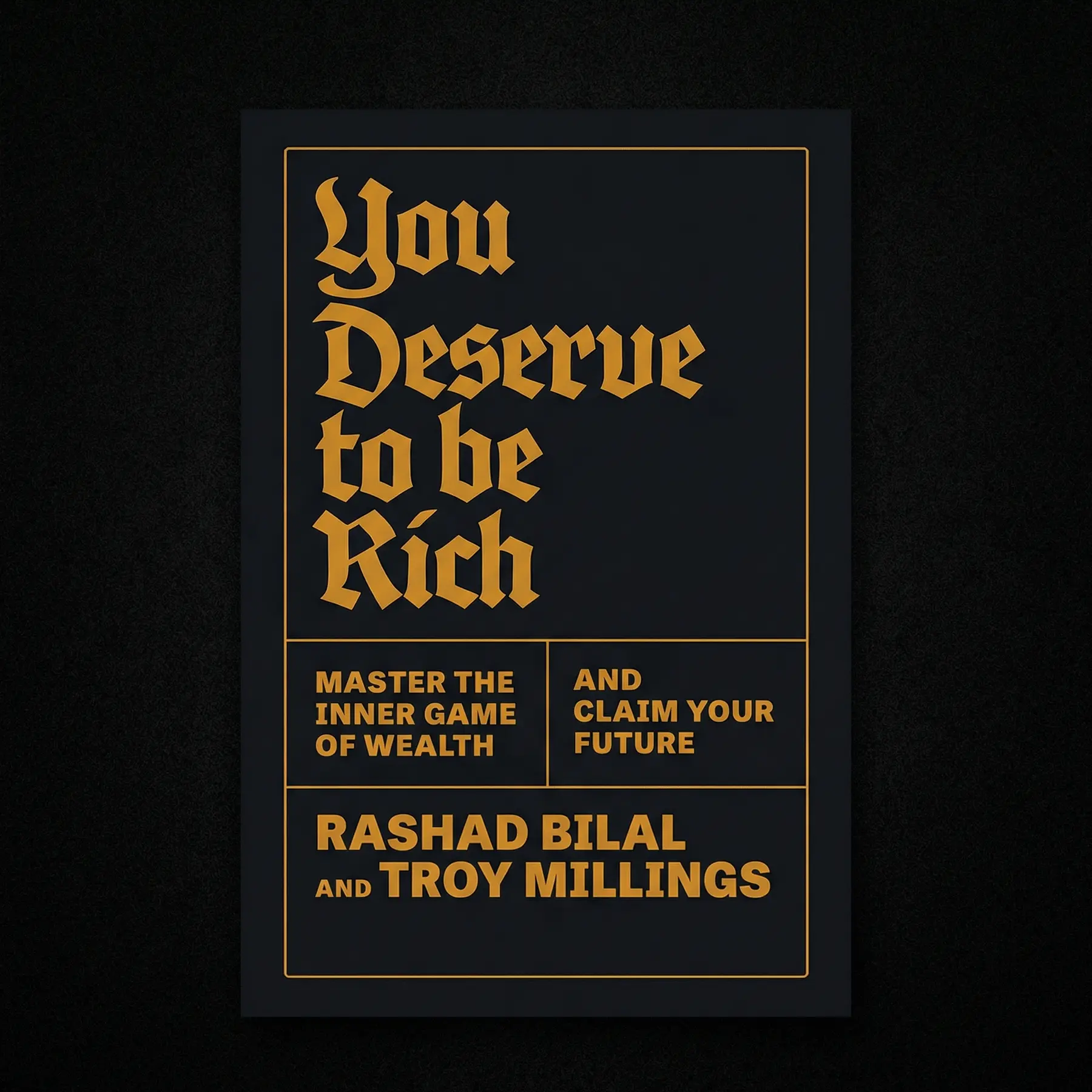
You Deserve to Be Rich: Master the Inner Game of Wealth and Claim Your Future
Shows how to face the money habits you inherited, then build a deliberate system around them: a budget split four ways, income from several tiers, a business, an estate plan and rules for a first million.
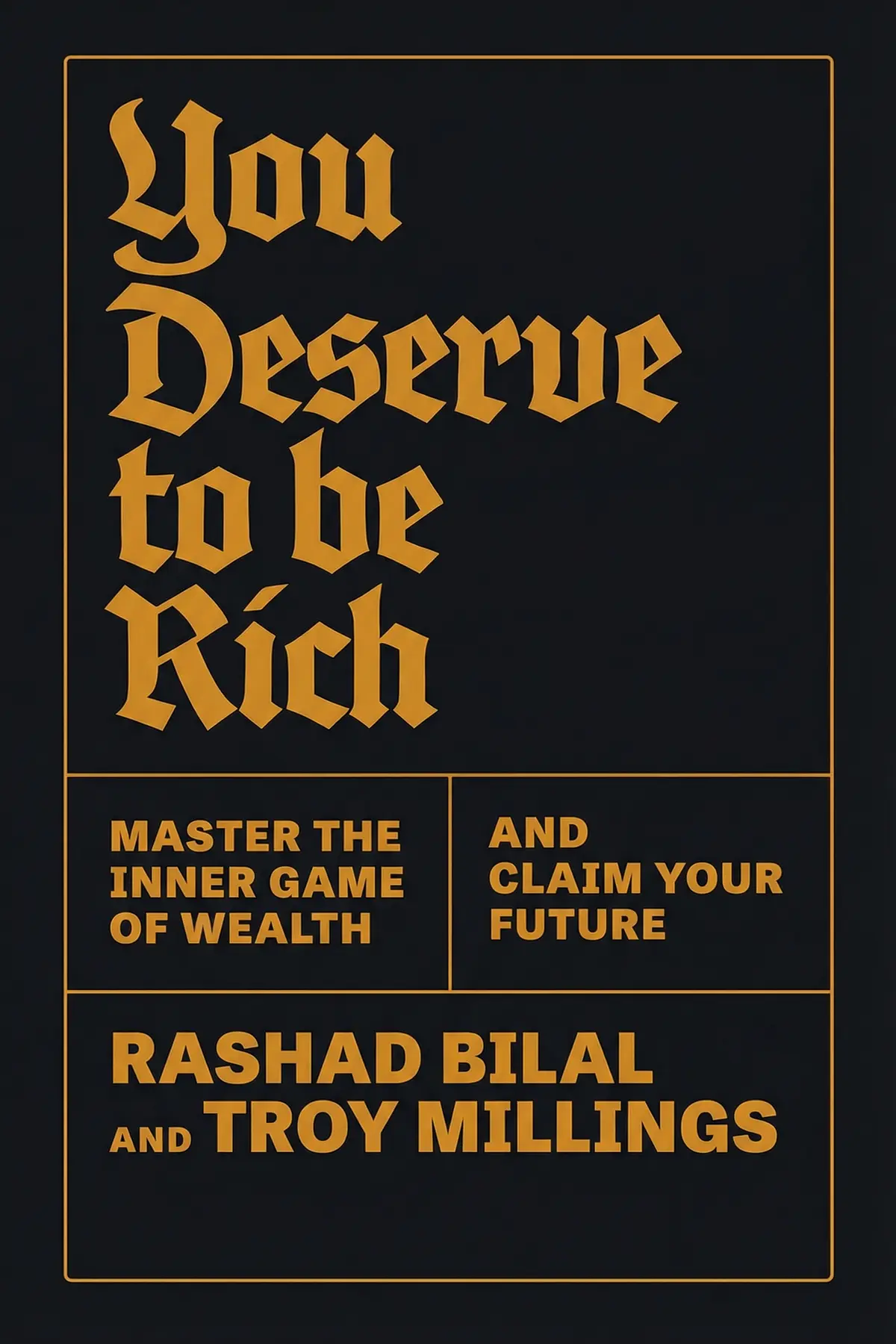
Table of Content
1. Introduction
1 min 00 sec
Living paycheck to paycheck is usually treated as a math problem, yet Rashad Bilal and Troy Millings argue it often starts as a feeling. In You Deserve to Be Rich, the two founders of the business education platform Earn Your Leisure show how fear, guilt and old family stress drive spending, and why wealth rarely arrives by accident.
Their case is that money becomes a tool for designing your life once you treat it with intention. That means facing the habits you inherited, then building deliberate systems on top of them. The authors lay out a budget made for your situation, income from more than one source, a business of your own, plans that outlive you and rules for a large sum when it finally comes. Each step moves you from reacting to money toward directing it.
By the end you will know how to sort three months of spending, split a paycheck four ways and ask the right questions before a windfall disappears.
2. Spot the money habits your past taught you
2 min 03 sec
Hoarding cash and splurging after a hard week look like opposite problems. The authors trace both to the same hidden source, and to a gap in family wealth that most people never connect to their own spending.
3. Give every dollar a job in your budget
1 min 59 sec
Wealthy people rarely enjoy budgeting, yet nearly all of them do it. A four-way split and one small cap on a monthly cost show why the habit buys both control and calm.
4. Stack three tiers of income instead of one
2 min 16 sec
A Nashville duplex bought after three years of credit repair, and a vending machine that pays for its siblings. Both point to a way of earning that does not collapse when one paycheck stops.
5. Turn a setback into a business of your own
1 min 55 sec
A tech executive lost his job after the pandemic and at first refused to consider working for himself. What changed his mind, and what he did in the first weeks, offers a careful route into owning a business.
6. Plan now so your wealth outlives you
1 min 57 sec
One forgotten form can send your savings to a former spouse. A woman’s careful estate plan shows the opposite outcome, and how ordinary savings, insurance and rent can pay for education generations later.
7. Keep your first million from slipping away
1 min 57 sec
A first million is smaller than it sounds the moment taxes arrive. What the authors advise doing in the following weeks decides whether that money keeps growing or disappears.
8. Conclusion
1 min 15 sec
Every part of the book turns on one habit: deciding before the money decides for you. Bilal and Millings begin with the feelings behind a purchase and end with a scholarship fund, built from one woman’s savings, life insurance and rental income, for her great-grandchildren, and the same choice links both ends. The 2019 wealth figures show that people do not start from the same place, and the authors never pretend they do. Their response is to make each dollar carry more weight, with a job, a second and third source, and a future longer than one life.
None of this waits for a million. Sort three months of spending and notice which purchases were really about stress. Set up one automatic transfer into an emergency fund, however small. Find one place to add income, a brokerage account or a business tested on weekends. And check the beneficiary names on your accounts, a short task that protects the people you love.
Wealth, as the authors describe it, is about control over your time and a life that reflects your values. Yolanda spent three years fixing her credit before she bought her duplex. Every fortune in these pages started with a choice that looked small at the time.
About this book
What is this book about?
Many people earn enough to get by yet never get ahead. They are caught between bills, stress and habits they picked up long ago. Rashad Bilal and Troy Millings, founders of Earn Your Leisure, argue that wealth is built on purpose, and that the work begins with how you feel about money, before any spreadsheet. They trace fear-driven spending and hoarding to financial trauma. It is often learned in childhood and made worse by systemic barriers such as banking deserts and a wide racial wealth gap. From there they lay out a practical sequence. It starts with a personal budget that splits income into saving, spending, sharing and investing. Next comes a three-tier investment mix, from reliable base assets to growth and early-stage holdings, spread across property, stocks and business ventures, then a careful route into entrepreneurship. The sequence ends with estate planning through wills, trusts and life insurance, and a plan for a first million after taxes. Readers get concrete numbers and cases to work from. An investor raised her credit score from 500 to 820 before buying a duplex. A laid-off tech executive founded his own firm. A woman's estate became a scholarship fund for her great-grandchildren.
Book Information
Who it's for
Paycheck-to-paycheck young professionals
Young professionals living paycheck to paycheck who want a budget and savings plan that fits their real income.
Employees considering second incomes
Employees considering rental property, stocks or a side business as a second source of income.
Family-minded parents and earners
Parents and earners who want their money to protect and educate the next generation.
About the Author
Rashad Bilal
Rashad Bilal is a financial advisor and Troy Millings is an educator. Together they founded Earn Your Leisure, a media company and platform built around business education and financial literacy that aims to give urban communities the knowledge, tools and connections to build wealth. In 2023 they were nominated at the National Association for the Advancement of Colored People Image Awards for Outstanding Social Media Personality. They have also worked with the New York City Department of Education to bring a financial literacy course into high schools.
Ratings & Reviews
Ratings at a glance
What people think
Listeners describe this work as an essential read that delivers direct insight into building wealth through an easy-to-follow approach. They praise the actionable advice supported by authentic examples, and one listener observes how it successfully integrates financial education with emotional intelligence. Listeners prize the book's effectiveness, specifically for how it addresses the mental toll of scarcity, and find it inspiring, with one review drawing attention to its focus on building wealth within communities. They view it as an excellent resource that reaches further than simple investment tips to help listeners truly respect money.
Top reviews
Jom
After hearing the Earn Your Leisure guys for months, I finally grabbed their book and it’s a game-changer for anyone tired of the scarcity mindset. Rashad and Troy don’t just talk about numbers; they talk about the psychological impact of growing up without resources. They breakdown how to respect your capital and start seeing yourself as an investor rather than just a consumer. I loved the focus on community wealth because it feels more inclusive than the usual "every man for himself" Wall Street vibe. Some of the goals are high—like living on 55% of your income—but the ambition is the point. It’s about shifting your horizon. This is first-hand knowledge delivered in a way that feels like a conversation with friends. Highly recommended for the culture.
Show moreMoon
This book provides a masterclass in respecting money while building community wealth, which is exactly the kind of energy we need right now. I’ve seen some critics complain about the "tithe 10%" or the "55% rule," but you have to look at the intention behind it. They are trying to push us toward a level of discipline that creates real, generational legacy. The real-world examples are grounded in the Black experience, which makes the advice feel much more attainable than a standard textbook. They touch on everything from vineyards to real estate, showing that the path to being wealthy isn't just a straight line through an index fund. If you want to break the cycle of scarcity, this is the blueprint.
Show moreWanida
Truth is, I’ve read a lot of finance books, but Bilal and Millings bring a unique flavor that focuses as much on emotional intelligence as it does on stocks. They don't just tell you to save; they explain why we feel the need to spend "excessively" when we don't have a plan. The section on relationships and money was particularly eye-opening for me and my partner. We’ve started having much more healthy conversations about our long-term legacy because of the prompts in this book. It’s empowering to see people who look like us talking about high-level investing in such an accessible way. It goes beyond the basics and challenges you to think bigger.
Show moreChamlong
Picked this up during a low point and found the real-world examples incredibly empowering for Black and Brown professionals trying to navigate a rigged system. The authors really understand the concept of financial trauma and how it affects our decision-making. I’ve never seen a finance book tackle the emotional side of money so effectively while still providing technical terms like the Treynor ratio. It’s a comprehensive guide that respects the reader's intelligence. Whether you’re learning about option contracts or just trying to get your first budget on paper, there is something here for you. It’s about more than just being "rich"—it’s about having the freedom to own your time and build something that lasts.
Show moreZoe
Wow. This isn't just a guide on saving; it’s a blueprint for anyone who wants to understand how to actually make their money work via multiple income streams. The authors make a compelling case that we all deserve to be wealthy and that the first step is changing our internal narrative about scarcity. I loved the practical content on things like setting up automatic payments and the breakdown of why certain stocks are better for long-term growth. It’s written in plain terms that don't make you feel dumb for not knowing the lingo. This book is an absolute must-read for the next generation of investors. It’s time we all start earning our leisure.
Show moreYaowares
The chapter on financial trauma really hit home for me because it's a conversation most finance experts completely ignore. It’s not just about the math; it’s about why we spend the way we do. Frankly, the authors provide a lot of solid advice on things like paying down high-interest debt and the importance of diversification. I did find the "Jay-Z dinner" debate a bit cliché, and I’m not sure I’d choose a conversation over half a million dollars, regardless of the networking potential! Also, some of the advanced metrics like the Treynor ratio might go over a beginner's head. Still, the core message of building multiple income streams is vital in today’s economy. It’s a great investment in your own education.
Show moreChai
Ever wonder why you're stuck in the same financial cycle even when you're working hard? This book attempts to answer that by blending financial literacy with high-level emotional intelligence. I appreciated the straightforward advice on things like CAGR and the need for more than one income stream. "One income is too close to no income" is a mantra I’ll be repeating to myself from now on. My only gripe is that some strategies, like flipping houses or starting food trucks, require a level of initial capital that the average person simply doesn't have. It feels a bit out of reach for someone making a teacher's salary. However, the mindset shift alone makes it worth the read.
Show moreYulia
Not what I expected from a standard 'get rich' book, as it dives deep into legacy building and the psychological barriers that keep us from investing. I really enjoyed the EYL podcast influence here; you can hear their voices in the writing. The advice on diversification is solid, and I appreciate them bringing up less traditional paths like entrepreneurship. I do think they oversimplify how easy it is to manage multiple income properties, though. Being a landlord isn't "passive" income! But overall, the blend of motivational content and financial strategy is well-balanced. It’s a great tool for anyone looking to step up from "just getting by" to actually building wealth.
Show moreSomporn
To be fair, there's some decent mindset stuff here, but the math on the tax brackets felt a bit sloppy and the 55% budget rule is totally unrealistic for most people. If you’re making $75,000 after tax, sure, you can probably save a ton, but for the average person using public transportation, these examples feel a bit out of touch. I also wasn't a fan of the Bitcoin recommendation given how volatile it is for someone just starting out. The authors have a lot of charisma and their podcast is great, but the book feels like it's trying to do too much at once. It’s a mix of basic budgeting and very high-risk entrepreneurship advice. It’s okay, but take the specific investment tips with a grain of salt.
Show moreChanida
Look, I wanted to love this, but suggesting that a reader should use ChatGPT to build an investment portfolio is dangerously irresponsible. AI hallucinates constantly, and following its "advice" for your life savings is a recipe for disaster. I also noticed some pretty basic errors regarding how marginal tax brackets work—you aren't taxed a flat rate on your entire income! For a book that claims to be a guide to wealth, these technical oversights are hard to ignore. They also suggest using a HELOC to pay off credit cards, which just moves debt around without fixing the underlying behavior. It’s flashy, sure, but the fundamentals are shaky. Run toward Dave Ramsey or the Budgetnista instead if you need actual debt help.
Show moreQuestions about this book
What is the main idea of You Deserve to Be Rich?
Rashad Bilal and Troy Millings argue that wealth is built through intention rather than luck. It starts with spotting the financial trauma behind fear-driven spending or hoarding. It then moves to deliberate systems: a personal budget, income spread across property, stocks and businesses, entrepreneurship and estate planning. The last system covers careful handling of large sums such as a first million, which shrinks to about $630,000 after taxes.
What budget split do Rashad Bilal and Troy Millings recommend?
Their starting framework puts 15 percent of income into savings, 55 percent into spending, 10 percent into sharing and 20 percent into investing. They treat these shares as a guide that can change for irregular income or high living costs. Savings go into two accounts, an emergency fund and a general fund for larger goals. Ideally they arrive through automatic transfers timed to match the days income comes in.
What is financial trauma in You Deserve to Be Rich?
The authors use the term for deep experiences, often from childhood, that shape how you see money, such as growing up in a family that struggled with bills. It shows up as spending from fear, guilt or desperation, or hoarding out of anxiety. They suggest reviewing three months of purchases and changing how you talk about money. They also suggest professional help if needed and saving even $5 a week.
How can I apply the ideas in You Deserve to Be Rich?
Start small. Sort recent spending into needs, treats and stress-driven purchases, set a cap on one variable cost and automate a transfer into an emergency fund. Then list your income sources and add one, perhaps a brokerage account or a business tested on evenings and weekends. Finally, check the beneficiary names on your accounts and write a will so your plans hold after you.
Readers also enjoyed




AUDIO SUMMARY AVAILABLE
Listen to You Deserve to Be Rich in 15 minutes
Get the key ideas from You Deserve to Be Rich by Rashad Bilal, plus 5,000+ more nonfiction titles.
- 5,000+ titles
- Listen as much as you want
- 7-day free trial
- Cancel anytime









