

13 min 37 sec
Available in: English
Breaking Free From Broke: The Ultimate Guide to More Money and Less Stress
By George Kamel
Shows why a good salary can still leave you living paycheck to paycheck. It explains how to drop credit score myths, resist marketing tactics and budget so you spend only money you already have.
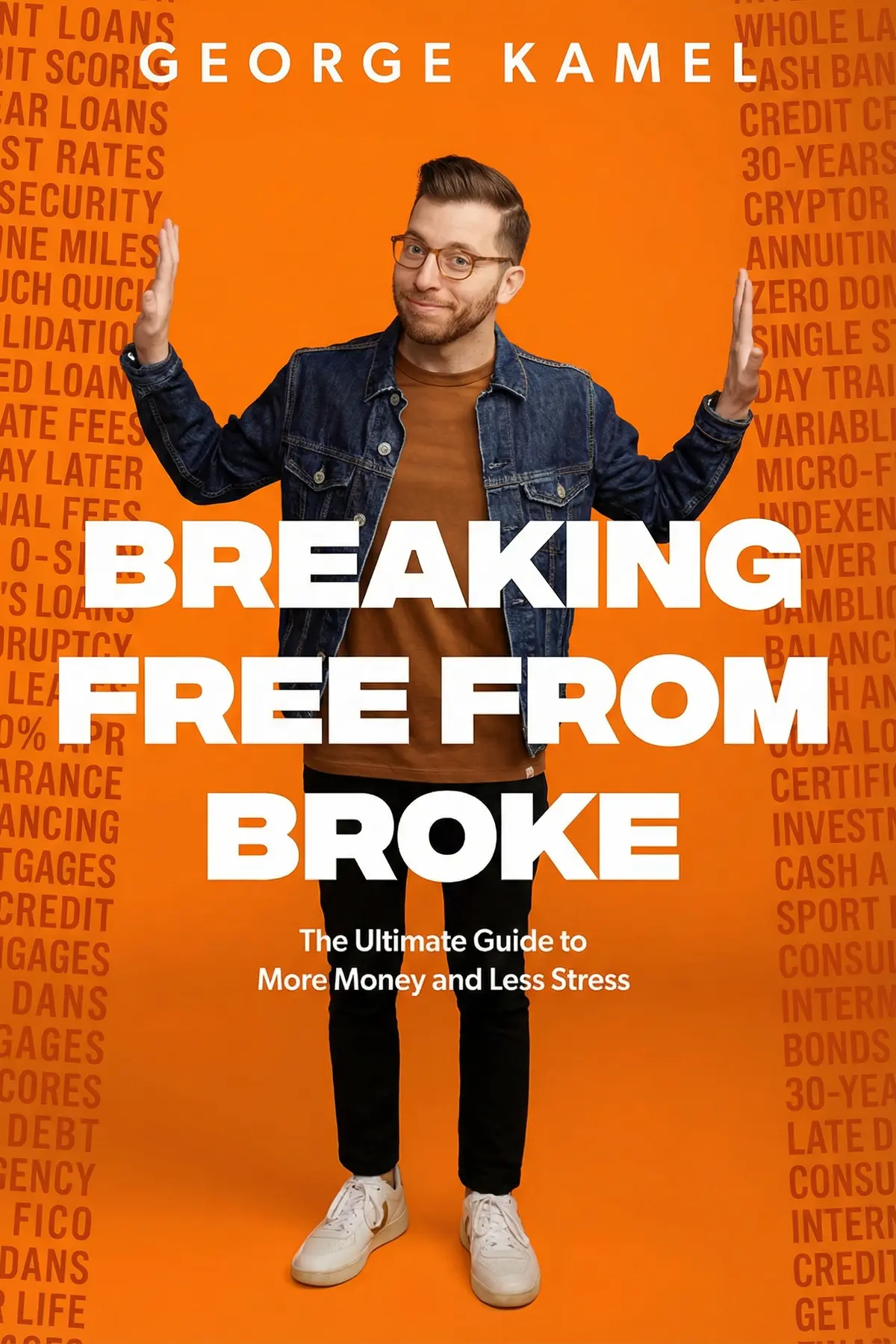
Table of Content
1. Introduction
1 min 06 sec
Plenty of people earn a solid salary and still wait anxiously for payday, and George Kamel argues that the money advice they were taught is often the cause. In Breaking Free From Broke, Kamel, a longtime member of Dave Ramsey’s team, points to a 2023 study by the payments data platform PYMNTS. According to the findings, a little more than 50 percent of those bringing in over $100,000 annually described themselves as living paycheck to paycheck. So a bigger income does not fix the problem by itself.
Kamel’s claim is that the way out starts with what you believe. Drop the ideas that treat debt as normal, see the marketing machine for what it is, and spend only money you already have, on purchases you planned. That approach took him from close to $40,000 in debt to debt-free millionaire in under ten years. What follows is his case against the credit score, a field guide to the tactics sellers use on you, and a five-question test to run before you buy anything.
2. Spot the money rules that keep you broke
2 min 01 sec
He had a degree, a job and a stack of habits everyone called normal. Kamel argues that those ordinary habits, not his paycheck, were what kept him stuck, and that the first fix happens before any spreadsheet.
3. Build wealth without chasing a credit score
1 min 55 sec
You were probably told to open a card to build your credit. Kamel looks at what that number actually measures, and finds that your income and your savings play no part in it at all.
4. Rent, work and buy a home with no score
1 min 49 sec
Landlords, employers and mortgage lenders seem to demand a credit score. Kamel’s own house purchase in 2019 suggests the doors stay open without one, and the interest rate need not punish you.
5. Recognize the tactics designed to make you spend
2 min 04 sec
A store layout, a car brand that sells calm, a sale on something you never wanted. Kamel names the forms marketing takes and the two rules that take away most of their pull.
6. Turn your budget into permission to spend
1 min 40 sec
Many people avoid budgets because they feel like a diet for the wallet. Kamel argues a budget works the other way around, and one small line item keeps it from feeling like a cage.
7. Run every purchase through five quick checks
1 min 47 sec
Fear of missing out, a bad day at work, a coupon that seems too good to waste. Kamel offers a short test that catches each of these before the money leaves your account.
8. Conclusion
1 min 15 sec
Underneath the advice, Kamel’s book is about who writes your money rules. For years his were set by common American wisdom: credit cards, student loans and big mortgages were normal, and so was stress about money. He swapped them for rules he chose, and that swap carried him from close to $40,000 owed to a net worth above a million dollars in under a decade. The finding that just over half of people earning above $100,000 report living paycheck to paycheck shows why the rules matter. Income alone rarely closes the gap.
The practical moves are small. Stop treating your credit score as a measure of financial health, since it tracks only how you borrow. Before your next unplanned purchase, ask whether it is in the budget and whether you could pay for all of it today. Give yourself a modest miscellaneous line so the budget leaves room for ordinary life. When a deal looks irresistible, run it past Self-awareness, Motive, Affordability, Research and Timing before you pay.
The number that matters most is not on any credit report. It is the money you actually have.
About this book
What is this book about?
Plenty of people earn a solid income and still wait anxiously for payday. George Kamel argues that the cause is often the advice they were raised on: that credit cards, student loans, big mortgages and constant money stress are simply normal. Kamel left college close to $40,000 in debt. After he took up Dave Ramsey's Baby Steps program, he became a debt-free millionaire in under ten years. In this book he takes apart the beliefs that kept him stuck, starting with the credit score, which in his view measures only how you handle debt. He then explains how renting, getting hired and even buying a house work without one, and he breaks down the marketing tactics designed to make you spend. Readers get two firm spending rules, a budget that works as permission instead of punishment, and a five-part SMART check to run before any purchase. Together they give a simple way to stop financing today with tomorrow's money.
Book Information
Who it's for
Well paid yet stretched
Professionals with a decent salary who still feel tight before every payday.
Graduates with student loans
Graduates carrying student loans and wondering whether they really need a credit card to build credit.
Shoppers tempted by sales
Shoppers who keep buying on sale or on impulse and want a simple test before they spend.
About the Author
George Kamel
George Kamel has been part of the Ramsey team since 2013. He speaks across the United States and co-hosts The Ramsey Show and the Smart Money Happy Hour podcast. He says he followed the Ramsey money plan from a negative net worth to millionaire in under ten years. He also runs a YouTube channel about money, built around cutting spending, saving more and avoiding financial traps. Breaking Free From Broke is his first book. He lives in Franklin, Tennessee, with his family.
Ratings & Reviews
Ratings at a glance
What people think
Listeners find this money management guide amusing and straightforward to digest, highlighting the witty tone used throughout. It is a well-crafted resource that offers helpful tips, and one listener specifically commended the advice regarding budget planning and wealth accumulation. The audience values its transparency, as one listener mentioned the wide array of statistics provided to validate the author's arguments. Listeners hold the debt-free philosophy in high regard.
Top reviews
Preeda
George Kamel has managed to take the somewhat dry, stoic world of Dave Ramsey and inject it with a heavy dose of snark and pop culture. It’s a refreshing change of pace for anyone who finds traditional finance books about as exciting as watching paint dry. I loved the way he breaks down the math behind why debt is a trap, using actual statistics instead of just 'trust me' rhetoric. However, the constant mentions of EveryDollar and other Ramsey-owned services got a bit repetitive after a while. If you can look past the self-promotion, the core message is incredibly powerful and necessary for our generation. He really makes you rethink every swipe of the credit card. It’s funny, fast-paced, and potentially life-changing if you actually do the work.
Show moreJoe
Ever wonder why you're still living paycheck to paycheck? George Kamel pulls back the curtain on the broken financial systems we’ve all just accepted as normal. I appreciated the deep dive into how credit card companies actually make their money off our 'rewards' obsession. It’s eye-opening to see the statistics laid out so clearly. This isn't just a book about numbers; it's a book about mindset. He writes with a warmth that makes you feel like you’re getting advice from a friend who has been there, done that, and bought the t-shirt (with cash). Even if you don't agree with every single point on mortgages, the budgeting advice is gold.
Show moreStella
Picked this up after seeing George on YouTube, and it’s every bit as entertaining as his videos. He has this way of making you feel silly for your past money mistakes without making you feel like a failure. The 'Breaking Free' aspect isn't just about the money; it's about the psychological freedom of not owing anyone a dime. I’ve already started implementing the budgeting tips, and for the first time, I actually feel like I’m in control of my income. To be fair, if you’re already a 'Dave Ramsey scholar,' you might find some of this redundant, but the updated stats and the more modern tone make it a much easier read than the older books.
Show moreDao
Look, if you want a book that doesn't put you to sleep while talking about 401ks and emergency funds, this is it. George Kamel is genuinely funny, and his writing style is conversational and punchy. He doesn't sugarcoat the truth: being broke is a choice we keep making until we decide to stop. I loved the emphasis on intentionality and the data-driven approach to debunking common money myths. It's refreshing to see someone tackle the 'buy now, pay later' culture that's destroying my generation's savings. Even if you only take away the budgeting advice, you'll be miles ahead of where you started. This belongs on every young professional's shelf.
Show moreNattapong
Not what I expected at all—in a good way! I thought this would be another boring 'save your pennies' lecture, but it's actually a really insightful look at the traps of modern consumerism. George uses a lot of humor to deliver some pretty tough love about our spending habits. Personally, I found the sections on building a 'moat' around your life through an emergency fund to be the most helpful. The book is well-written and flows naturally, though the audio version's sound effects can be a bit jarring if you're not used to that style. Overall, it’s a great roadmap for anyone tired of feeling like they’re running on a financial hamster wheel.
Show moreAstrid
Finally got around to listening to the audio version, and I’ve got to say, the production quality is top-notch. The sound effects and George’s delivery make it feel more like a podcast than a lecture, which helped me stay engaged through the more technical bits. He tackles those 'financial conspiracy theories' with a lot of wit, debunking the idea that you need a credit score to survive. My only gripe is that some of the investment advice seems a bit oversimplified. He ignores the nuance of taxes and specific risk tolerances, treating mutual funds as a one-size-fits-all solution. Still, for someone struggling to save their first thousand dollars, this is exactly the kick in the pants they need.
Show moreWissanu
The chapter on financial conspiracy theories alone makes this worth the price of admission. Kamel has a unique way of calling out the nonsense we’ve been fed about 'leveraging' debt to get ahead. It’s a blunt, honest look at why so many of us are struggling despite making decent salaries. I did find the pop culture references a little heavy-handed at times—sometimes it felt like he was trying too hard to be the 'cool' finance guy. But the underlying message of simplicity and discipline is hard to argue with. It’s a great guide for anyone who wants to stop living for the next paycheck and start building a real legacy. Highly recommended for recent graduates.
Show moreAva
To be fair, I went into this expecting a Dave Ramsey clone, but George definitely brings his own flavor to the table. He's much more relatable to the younger crowd who are dealing with insane housing prices and student loan debt that feels insurmountable. The way he breaks down the 'math' of credit card points versus the interest you're paying was a lightbulb moment for me. Not gonna lie, the constant plugs for Ramsey products like Zander or Churchill Mortgage were a bit distracting, but I guess that's the price you pay for this ecosystem. It's an easy, fast read that provides a solid foundation for anyone looking to fix their financial life.
Show moreDaranee
While the debt-free principles are solid, this book felt like one long advertisement for Ramsey Solutions. Every few chapters, I was being nudged toward their specific insurance partners or budgeting apps, which felt a bit tacky for a book I paid for. George is a great personality and his humor definitely shines through—I laughed out loud at the millennial references—but the actual financial advice is pretty much a carbon copy of the Baby Steps. If you’ve followed the Ramsey Show for any length of time, there isn’t much new information here. Truth is, it’s a great entry point for someone totally lost with money, but for the rest of us, it’s just more of the same with a younger face.
Show moreSakura
As someone who has worked in finance for over a decade, I found the investment sections of this book to be dangerously misleading. George’s blanket dismissal of ETFs and his obsession with high-load mutual funds completely ignores the impact of fees and market volatility. He gives advice with the confidence of a professional without having the licenses or the fiduciary responsibility to back it up. The 'debt is always evil' stance is fine for people with zero self-control, but for disciplined investors, it’s just not accurate. Plus, the book is cluttered with sound-bite phrases and 'Ramsey-isms' that make it feel like a marketing brochure. I'd recommend sticking to more objective sources for long-term wealth building.
Show moreQuestions about this book
What is the main idea of Breaking Free From Broke?
George Kamel argues that many people stay broke because of money beliefs they were taught, such as treating credit cards, student loans and big mortgages as normal. He says the way out is to drop those beliefs, recognize how marketing pushes you to spend, budget deliberately and pay only with money you already have. He followed this approach from about $40,000 in debt to debt-free millionaire in under ten years.
Does George Kamel say you need a credit score?
No. Kamel argues a credit score measures only how you handle debt, not your income or savings. If you go six to twelve months with no open credit cards and no debts, your score can no longer be calculated. He says you can still rent most apartments, get hired, rent cars, buy insurance and even get a no-score mortgage, as he and his wife did in 2019.
What is SMART spending in Breaking Free From Broke?
SMART is Kamel’s five-part check before buying something: Self-awareness, Motive, Affordability, Research and Timing. You ask whether the item adds real value, why you want it, whether you can pay in full today without credit, whether you have compared prices or considered buying used, and whether this purchase should come before other goals. If it passes all five, you can buy it with a clear conscience.
How does Kamel recommend budgeting?
Kamel suggests researching budget methods, picking one and starting it, for example the 50/30/20 split of needs, wants and savings. He frames a budget as permission to spend mindfully, not as restriction. To keep it from feeling tight, he recommends a small miscellaneous line for random expenses and wants, while warning that it should stay a modest share of the total.
Who should read Breaking Free From Broke?
It suits people who earn a reasonable income but still live paycheck to paycheck, people carrying credit card or student debt, and anyone who suspects advertising and sales drive too many of their purchases. It is also useful for readers curious about the Ramsey approach, since Kamel built his own results on Dave Ramsey’s Baby Steps program.
Featured in
Readers also enjoyed


Charlie Munger: The Complete Investor
Tren Griffin
Big Mistakes: The Best Investors and Their Worst Investments
Michael Batnick
AUDIO SUMMARY AVAILABLE
Listen to Breaking Free From Broke in 15 minutes
Get the key ideas from Breaking Free From Broke by George Kamel, plus 5,000+ more nonfiction titles.
- 5,000+ titles
- Listen as much as you want
- 7-day free trial
- Cancel anytime









