

15 min 08 sec
Available in: English
You Are What You Risk: The New Art and Science of Navigating an Uncertain World
Shows that risk means opportunity as well as danger and that each person carries a changeable risk fingerprint. It explains how checking fears against real odds and facing ignored threats leads to better everyday decisions.
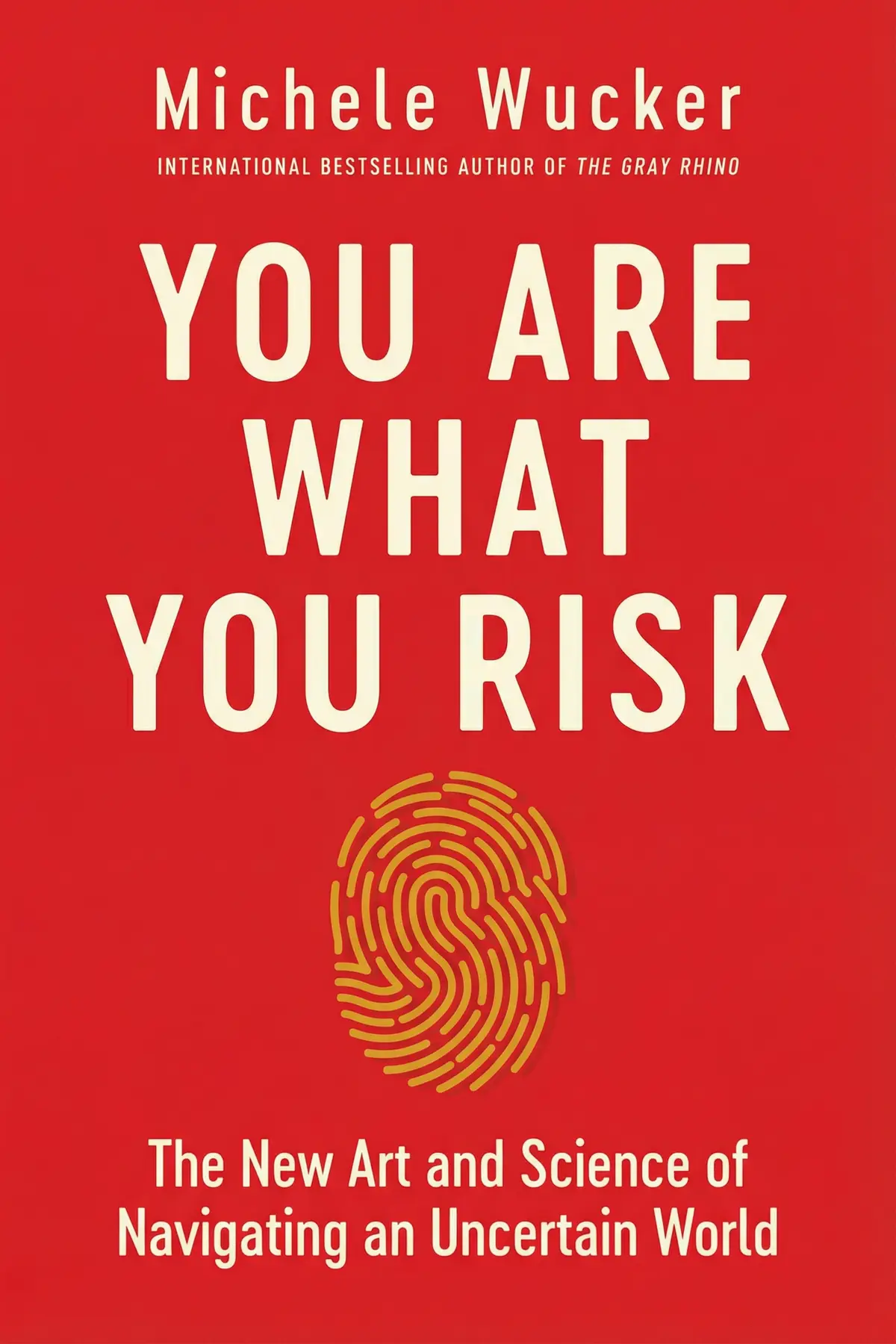
Table of Content
1. Introduction
1 min 02 sec
Most people treat risk as something to avoid, and that habit leaves them blind to half of it. In You Are What You Risk, strategist Michele Wucker argues that risk is value-neutral: the same uncertainty that can hurt you can also open a door. Wucker, who coined the term gray rhino for the obvious dangers people ignore, believes each of us carries a personal risk fingerprint. Genes, experience, appearance and circumstance all shape it, and it changes over a lifetime.
Her argument fits in one line. Know your own fingerprint and test your fears against the real odds. Then every decision becomes a risk decision you can make well. Along the way come a widow in a barrel at Niagara Falls, a war reporter held in Abu Ghraib, and men who gambled more after rubbing on hand cream. The reward is a clearer sense of which risks suit you, and which ones you have been avoiding without noticing.
2. Count the opportunity side of every risk
1 min 42 sec
A refugee fleeing a war zone looks like the boldest gambler imaginable. Wucker argues the opposite, and her reasoning changes how you weigh any frightening choice, from a career move to staying exactly where you are.
3. Spot who is really taking the biggest risk
1 min 45 sec
Three friends jump from the same plane, yet only one of them takes a truly large risk. The answer surprises most people, and so does the reason a careful grandmother refused to visit doctors.
4. Learn what shaped your risk fingerprint
1 min 54 sec
A widow climbed into a barrel above Niagara Falls for money, and a fearless war reporter suddenly stopped going to war zones. Both stories reveal a personal pattern that genes explain far less than you might expect.
5. Labels about risk-takers mislead, so look beyond them
2 min 05 sec
Advisors, employers and friends sort people into bold and cautious types. A dice game involving power drills and hand lotion shows how easily those labels misfire, and who ends up paying for them.
6. Check your fear against the real numbers
1 min 49 sec
Americans badly overestimated how deadly Covid was, yet many still skipped basic precautions. A unit called the micromort helps explain why fearing a danger and handling it well are two different skills.
7. A stake in the outcome sharpens your attention to risk
2 min 01 sec
With a nuclear crisis brewing next door, South Koreans were gripped by a very different story. Their focus points to what makes people notice risk at all, and to a Boston fund built on that insight.
8. Treat every choice as a risk decision
1 min 41 sec
A drug dealer turned prisoner was told he had about five years to live. How he responded, and why a teenage climate activist made a similar calculation, reframes even the most ordinary decisions you make.
9. Conclusion
1 min 09 sec
Wucker’s picture of risk is personal and always shifting. The scared skydiver, the widow in the barrel and the reporter who walked away from war zones each made sense, given who they were at that moment. A choice that looks reckless from outside can be the careful one from inside, as the refugee leaving home shows. A choice that looks safe can hide a gray rhino.
That changes what good judgment means. Since the right temperature of porridge differs for each of us, judgment in her account means knowing your own fingerprint well enough to notice when it is pushing you. Then you check that feeling against the real odds.
So pick the obvious threat you have been stepping around and look at it directly. When a fear feels enormous, find its number, the way a micromort places hang gliding beside a long car trip. Before any big decision, set the cost of doing nothing next to the cost of acting, and ask who else shares the outcome.
You are already choosing which risks to carry, every single day. Wucker only asks that you choose them with your eyes open.
About this book
What is this book about?
Most of us were taught to see risk as a threat to keep small. Michele Wucker, the strategist who coined the term gray rhino, argues that this view hides half the picture. Risk has no built-in sign. Its harmful side is danger, its helpful side is opportunity, and which one you meet depends on your situation and your attitude. Her central idea is the risk fingerprint: a personal mix of genes, experience, appearance, culture and circumstance that decides which chances feel reasonable. It shifts over a lifetime, as it did for a war reporter after 18 days in Abu Ghraib, and even with the music you hear. Wucker separates the risk we feel from the risk that can be measured. She also shows how involvement and a sense of purpose change which risks we notice at all. Readers learn to understand their own tendencies and to spot the obvious threats they keep ignoring. They also learn to check fears against real numbers such as micromorts. Above all, they learn to treat each choice, including doing nothing, as a decision about risk.
Book Information
Who it's for
Professionals facing big decisions
Professionals facing a job change or a big decision who want to know why some risks freeze them.
Looking for risk's upside
Founders and investors who want to treat risk as opportunity as well as danger.
Managers seeking fairer judgments
Managers who label colleagues as too cautious or too bold and want a fairer way to judge.
About the Author
Michele Wucker
Michele Wucker is an American political strategist and author who studies the world economy and how to anticipate crises. She coined the term gray rhino for obvious, probable, high-impact risks that people neglect even though they could act on them. She founded the Chicago advisory firm Gray Rhino & Company. She worked as a financial journalist and held leadership roles at the World Policy Institute, the Chicago Council on Global Affairs and International Financing Review. She is a Guggenheim Fellow and was named a Young Global Leader of the World Economic Forum.
Ratings & Reviews
Ratings at a glance
What people think
Listeners describe the work as thought-provoking, with one review emphasizing its thorough research drawn from multiple disciplines. The informative content also earns high marks, as one listener characterizes it as an indispensable resource for seeing the entire landscape. Furthermore, listeners value the book’s method for developing risk consciousness and its effective integration of compelling narratives.
Top reviews
Lars
Wow, what a comprehensive look at the hidden forces driving our lives. I’ve been interested in risk management for years, but Wucker approaches it from a much more human angle than the typical math-heavy finance books. The story of Coss Marte and his pivot from prison to a successful fitness business was incredibly moving and served as a perfect example of how risk can be harnessed for positive change. I found the idea that every single decision—even what we eat for lunch—is a risk decision to be quite profound. It really makes you stop and evaluate your own 'risk fingerprint' and how it might be holding you back or pushing you forward. The writing is engaging and the research is clearly extensive, pulling from psychology, economics, and history. This is essential reading for anyone who wants to understand the full picture of human behavior. I’ve already recommended it to several colleagues who work in leadership roles.
Show moreSiraporn
Finally finished this and I'm still processing everything. This isn't just a book about finance or safety; it's about how we live our lives. Wucker does a brilliant job of weaving together diverse stories, from teenage activists like Haven Coleman to the first person to survive Niagara Falls in a barrel. It makes the academic concepts feel real and urgent. I was especially struck by the idea that ignoring a risk is itself a risky decision. The 'Gray Rhino' metaphor is so helpful for identifying those obvious problems we all tend to ignore until it's too late. The book is a great mix of engaging stories and rigorous research from various fields. It’s the kind of book that makes you look at your own life and your own choices in a completely different light. It’s an essential tool for understanding the full picture of why we do what we do. Truly excellent work.
Show moreRafael
Ever wonder why some people thrive in chaos while others crumble at the slightest uncertainty? You Are What You Risk dives deep into the 'risk fingerprint,' explaining how our unique blend of genetics, upbringing, and environment shapes our choices. I particularly loved the sections on how physical sensations—like the temperature of a room or even eating spicy food—can temporarily alter our willingness to take chances. It’s a fascinating mix of hard science and social observation. My only real gripe is that Wucker occasionally veers into political territory that feels a bit detached from the core message of the book. The discussion on global inequality and climate change is important, certainly, but it felt shoe-horned in here. Despite that, the practical advice on becoming more 'risk literate' is incredibly valuable for anyone looking to make more intentional decisions in their career or personal life. It’s a solid, thought-provoking read that will definitely change how you view your daily habits.
Show moreChamp
As a manager in a high-stress environment, I found Wucker’s insights on 'risk literacy' to be incredibly practical. We often think of risk as something to be avoided, but this book argues that we should focus on managing it better through empathy and understanding. The concept that our coworkers have different 'risk fingerprints' explains so much about workplace conflict! I’ve already started changing how I approach team meetings based on the ideas about environment and perception. The book is very thorough, maybe a bit too thorough in parts, but the stories are engaging enough to keep the momentum going. I particularly liked the discussion on how cultures and prejudices impact our risk decisions. It’s not just a business book; it’s a tool for understanding human nature. The writing style is accessible, though some chapters definitely require more focus than others. Highly recommended for anyone in a leadership position or anyone interested in behavioral economics.
Show moreEarn
Picked this up because I loved The Gray Rhino, and I wasn't disappointed, though it’s a very different animal. This one is much more personal and philosophical. The truth is, we all have different tolerances for danger, and Wucker explores the 'why' behind that with great detail. I found the connection between physical health and risk-taking especially relevant, particularly the story about the prisoner who turned his life around by getting fit. It shows that we have more power to change our outcomes than we think. My only criticism is the length; it could have been about 50 pages shorter without losing much. Some of the global risk stuff at the end felt a bit like a repeat of every news cycle for the last three years. But the core message about understanding your own risk profile is powerful. It’s a thoughtful, well-researched book that offers a new vocabulary for talking about the challenges we face every day.
Show moreAlejandra
Michele Wucker returns to the themes of her earlier work but expands the scope to include almost everything under the sun. The distinction she makes between calculated risk and total uncertainty is a useful tool, but the narrative often feels scattered. One moment we are learning about 'Death Cafes' and facing our mortality, and the next we are diving into the 2008 financial crash. Truth is, the book tries to be too many things at once: a self-help guide, a business manual, and a sociological critique. I enjoyed the neurobiology chapter the most, especially the parts about how our brains process fear and reward differently based on our surroundings. On the downside, the sections on generational differences felt a bit stereotypical and lacked the nuance I expected from such a researched book. It’s an okay read if you have the patience for it, but it lacks the punchy, immediate impact of The Gray Rhino.
Show moreSarawut
After hearing a lot of buzz about this book, I picked it up hoping for a masterclass in decision-making. What I got was a very dense, often brilliant, but ultimately overstuffed volume. The core idea—that our relationship with risk defines our identity—is fantastic. I loved learning about Annie Edson Taylor and the 'Gray Rhino' concept as a contrast to 'Black Swans.' However, the book loses its way when it starts lecturing the reader on meat consumption and composting as a way to manage global risk. It felt less like an analytical study and more like a platform for the author’s personal politics in the final chapters. To be fair, the research into how smells and music affect our choices was fascinating and something I’ve already started noticing in my own life. It’s a mixed bag. If you can filter out the preachy parts, there is a lot of good information to be found.
Show morePear
This book suffers from a classic case of trying to fit the entire world into a single lens. While Wucker’s previous work on the 'Gray Rhino' was sharp and focused, this sequel feels like a rambling exploration where every human interaction is forced into a risk-based framework. The concept of a 'risk fingerprint' is intriguing at first, but the author drags it out over too many pages with repetitive examples. To be fair, some of the anecdotes, like the woman who went over Niagara Falls in a barrel, are entertaining enough to keep you turning pages. However, the constant shift between neurobiology and broad sociopolitical commentary left me feeling more confused than enlightened. It’s simply way too long for the amount of actual insight provided. If you’re looking for a tight, data-driven analysis of decision-making, you might be better off looking elsewhere. I found myself skimming through the latter half just to reach the conclusion.
Show moreDaranee
I struggled to stay engaged with this one despite my initial excitement for the topic. The author seems to have a hammer, and now every single problem in the world looks like a nail labeled 'risk.' While I appreciate the attempt to understand the human side of the equation, I’m a total skeptic when it comes to using personality profiles to explain complex behaviors. Some of the claims about how different generations perceive risk felt very anecdotal and didn’t align with my own experiences as a Boomer. Also, the commentary on COVID-19 and government responses felt dated and one-sided, ignoring many of the institutional failures that actually increased risk for the most vulnerable. There are some gems buried in here, like the history of risk insurance, but you have to dig through a lot of fluff to find them. It’s much longer than it needs to be and could have used a far more aggressive editor.
Show moreBond
Not what I expected at all. I was looking for a business book on risk assessment, but this is more of a political manifesto disguised as social science. The author spends an inordinate amount of time bashing Milton Friedman and pushing 'Stakeholder Theory' without really engaging with the counterarguments. She claims that the only reason people take risky jobs is because of the welfare state, which is a historical absurdity. What did people do for the last ten thousand years? The tone is often condescending toward anyone who doesn't share a specific worldview. Frankly, it’s disappointing because the neurobiology chapter was actually quite good. But the rest is a litany of standard complaints about climate change and inequality that don't offer any new solutions. It feels like the author is trying to lecture the reader rather than educate them. Save your money and read Peter Bernstein instead; it’s a much better historical sweep of the topic.
Show moreQuestions about this book
What is the main idea of You Are What You Risk?
Michele Wucker argues that risk is value-neutral. It can bring danger or opportunity, depending on the situation and your attitude. Each person has a risk fingerprint shaped by genes, experience, appearance, culture and circumstance, and it changes over time. If you understand your own fingerprint, separate felt risk from measured risk and see every choice as a risk decision, you can decide better.
What is a risk fingerprint?
It is Wucker’s name for the personal mix of influences that makes some risks feel acceptable to you and others unthinkable. Annie Edson Taylor rode a barrel over Niagara Falls partly because she had already lost a fortune and had few options. Unlike a real fingerprint it changes. War reporter Frank Smyth left combat zones after 18 days in Abu Ghraib. Even spicy food or loud music can shift it.
What is a gray rhino in You Are What You Risk?
The gray rhino is an enormous and plainly visible danger that approaches from a long way off, yet people still do not deal with it. Wucker coined the term. Global examples include a fragile financial system and the climate crisis. Personal ones include a doomed relationship or a slowly worsening health problem. She argues that better judgment starts with acknowledging these threats.
How can I apply the ideas in You Are What You Risk?
Start by naming one obvious threat you have been ignoring. When a fear feels large, compare it with objective figures such as micromorts, which put driving 230 miles at one unit and hang gliding at eight. Before a decision, weigh the risk of acting against the risk of doing nothing. Remember that your mood, history and even the music playing can push you.
Who should read You Are What You Risk?
It suits anyone facing an uncertain decision who wants to understand their own reactions: people weighing a career move, founders deciding what to bet on and managers judging how their staff handle risk. Its stories range from New York nurses in the pandemic to a Boston loan fund. They show how personality, circumstance and a sense of involvement shape the risks people take.
Readers also enjoyed


A Liberated Mind: How to Pivot Toward What Matters
Steven C. Hayes


Acting with Power: Why We Are More Powerful Than We Believe
Deborah Gruenfeld


Age of Propaganda: The Everyday Use and Abuse of Persuasion
Anthony Pratkanis



AUDIO SUMMARY AVAILABLE
Listen to You Are What You Risk in 15 minutes
Get the key ideas from You Are What You Risk by Michele Wucker, plus 5,000+ more nonfiction titles.
- 5,000+ titles
- Listen as much as you want
- 7-day free trial
- Cancel anytime









