
15 min
Available in: English
 ไทย
EnglishไทยYou Are Not So Smart: Why Your Memory Is Mostly Fiction, Why You Have Too Many Friends on Facebook, and 46 Other Ways You’re Deluding Yourself
Shows how your mind invents patterns, reasons and flattering stories without your noticing, and how spotting these self-deceptions makes you fairer, quicker to help in a crowd and harder for false authority to push around.
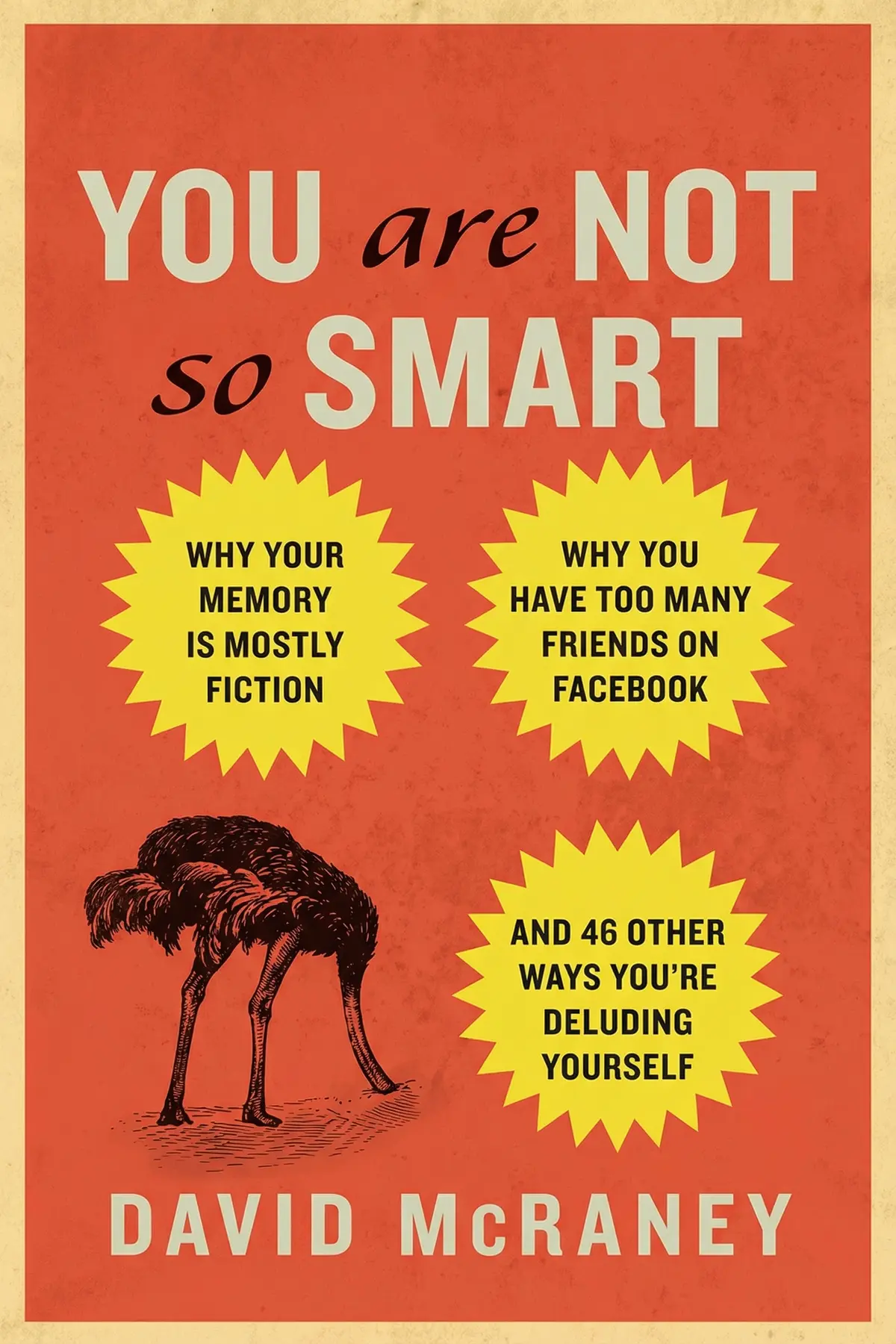
Table of Content
1. Introduction
1 min 01 sec
In one department store study, people shown a row of identical nylon stockings mostly picked the pair on the right, then talked about its texture and swore its position played no part. In You Are Not So Smart, science journalist David McRaney gathers findings like this to argue that we rarely know why we think, choose or remember what we do. The mind fills its own gaps with confident stories, and we take those stories for the truth.
In his account, self-deception keeps us steady and feeling capable. Left unnoticed, though, it also makes us unfair to strangers, slow to help and far too quick to obey. His remedy is awareness. Along the way you will learn to spot the brain’s favorite tricks, from finding patterns in pure chance to taking all the credit for a win, and you will pick up two moves that matter in a crisis: how to get help from a crowd, and when to push back on an order.
2. Catch the meaning you invent in coincidences
1 min 42 sec
A number that keeps appearing all day, a date whose mother shares your mother’s name: it all feels meaningful. An ancient survival skill explains why, and a simple die shows how feeling powerful distorts your sense of control.
3. Stop trusting the reasons you give yourself
1 min 48 sec
Ask people why they chose one item over another and they answer instantly and with confidence. A row of stockings in a department store reveals how much of that answer the mind simply made up on the spot.
4. Read past the evidence that flatters your views
1 min 46 sec
Two groups read the same story about a woman named Jane, then remembered two different people. The difference came down to a single question, and it shows how easily our memories bend toward what we expect.
5. Spotting the hidden cues behind your choices
1 min 56 sec
Washing their hands made people far less willing to do a stranger a favor. That odd result, and a money game rigged with pictures, show how much of your behavior is decided before you notice anything.
6. Spot how your ego rewrites your wins and losses
1 min 53 sec
Almost everyone believes they are smarter, kinder and better at their job than average. Some people go further and deliberately sabotage themselves before a test, and the reason has everything to do with protecting a fragile sense of worth.
7. Get help from a crowd by choosing one person
1 min 52 sec
A broken-down car on a quiet country road may be luckier than one on a crowded street. The reason explains why crowds freeze in emergencies, and what to do so they do not freeze around you.
8. Learn to resist an order that causes harm
1 min 52 sec
A man on the phone claiming to be police got restaurant staff to do shocking things to coworkers. A famous laboratory experiment suggests far more of us would have obeyed than we like to believe.
9. Conclusion
1 min 10 sec
What McRaney offers is a strange kind of comfort. The brain that sees sevens everywhere, prefers the right-hand stocking and remembers Jane as whatever the question required is not broken. Its shortcuts keep us steady and confident enough to get through the day. The harm comes when those same shortcuts run unseen at moments that matter: when we condemn a tired parent, walk past someone in trouble, or obey a voice on the phone because it sounds official.
His remedy is modest. Knowing these habits exist buys you a moment to catch them. When a coincidence feels like a message, ask how often it would happen by chance. When you hear yourself defend a choice with total certainty, treat the reason as a first draft and check what in the setting might have pushed you. If you ever need help in a crowd, point at one person and ask them; if someone else is calling for help, move first. And when an instruction could hurt you or another person, ask whoever gave it for a reason.
The book will not make you smarter. It can make you harder to fool, starting with the person you trust most.
About this book
What is this book about?
Most of us trust our own judgment. We believe our opinions came from careful thought, our memories are accurate records and our reasons are real. Science journalist David McRaney gathers psychology research suggesting otherwise. Much of the time we cannot say why we behave or believe as we do, and the mind covers the gap with convincing stories. McRaney walks through the main forms this takes. We find meaning in coincidence and imagine we can control chance. We invent explanations for choices shaped by details like where an item sits in a row. We notice the facts that suit us, bend memories to fit a question, and protect our self-esteem by taking credit, blaming circumstances and even setting ourselves up to fail. Hidden cues, from washing our hands to glimpsing business images, shift our behavior without our knowledge. The stakes rise when these habits meet other people. They make us slow to help when others are around, quick to judge strangers and dangerously willing to obey anyone who sounds official. Readers get a clear map of their own blind spots and practical moves for the moments that count, from getting help in a crowd to questioning an order.
Book Information
Who it's for
Decision makers at work
Professionals who make hiring, review or planning decisions and want to catch their own blind spots.
Leaders of teams
Managers and team leads who need to understand why people obey, freeze or judge too quickly.
Doubting their own memory
Curious readers who suspect their memories and reasons are less reliable than they feel.
About the Author
David McRaney
David McRaney is a science journalist who writes about brains, minds and culture. He started his career reporting for newspapers in the Deep South, including coverage of Hurricane Katrina, and later worked as an editor, photographer, television host and lecturer. You Are Not So Smart became an international bestseller and gave rise to a podcast of the same name. He followed it with You Are Now Less Dumb and How Minds Change, produced a six-hour audio documentary tracing the history of the word genius, and lectures worldwide on reasoning, belief and decision-making.
Ratings & Reviews
Ratings at a glance

What people think
Listeners find this book highly engaging and skillfully written, featuring perceptive material that delivers broad outlines of psychological fundamentals. It is accessible to follow, containing lucid examples throughout every chapter, and listeners enjoy the sense of humor and cleverness. Scientific content receives varied feedback; while some commend the analysis, others find the research not the best.
Top reviews
Suvannee
David McRaney’s dive into the world of cognitive biases is an eye-opening journey into the messy, irrational reality of the human brain. Each chapter dismantles a specific misconception, like the Dunning-Kruger effect, using sharp wit and clear, relatable examples that make the concepts stick. While the recurring "you are not so smart" refrain might feel a bit cheeky to some, I found it incredibly refreshing to have my ego poked. It’s a fast-paced read that manages to make complex psychological principles feel like casual dinner conversation. My only minor gripe is that a few chapters feel a bit brief, leaving me wanting more depth on the academic studies. Overall, it’s a brilliant wake-up call for anyone who thinks they are a perfectly rational being.
Show moreKru
As someone who prides themselves on being a 'free thinker,' this book was a much-needed reality check for my own inflated ego. The chapter on Confirmation Bias was particularly convicting, showing how we all just curate information that makes us feel right. McRaney’s writing is accessible without being 'dumbed down,' providing a general overview that anyone can grasp regardless of their background. I loved the way he explained 'Learned Helplessness' through the lens of daily life and social structures. Even though the research is summarized for a general audience, the core insights are profound enough to change how you view your own decision-making process. It’s a book that invites you to be a little more humble about your own brain.
Show moreYindee
Imagine discovering that your entire sense of self is mostly a collection of convenient fictions created by your own brain to keep you sane. That is the core takeaway of this brilliant, bite-sized exploration of the glitches in our grey matter. McRaney takes complex ideas like 'Introspection' and 'The Availability Heuristic' and makes them feel urgent and fascinating for the modern reader. I actually found myself laughing out loud at some of the absurd ways our brains try to protect our self-esteem at all costs. While it might be 'pop-science,' it’s high-quality writing that respects the reader's time. It might make you feel a little less special, but you'll definitely leave the experience feeling much more informed.
Show moreMaja
Ever wonder why you keep buying things you don't need or why you're so sure your political opinions are objective facts? David McRaney breaks down these mental glitches in a way that is both entertaining and slightly disturbing for the average reader. The sections on brand loyalty and the 'Just-World Fallacy' really hit home for me. Truth is, if you’ve spent any time listening to shows like Radiolab, some of this material will feel like a retread. However, having all these cognitive biases compiled into one punchy, accessible volume makes for a great reference. It’s a solid introduction to pop-psychology, even if it occasionally sacrifices scientific complexity for the sake of a snappy, humorous punchline.
Show moreKan
Finally got around to reading this, and I must say the humor is what kept me turning the pages until the very end. McRaney has a talent for taking dry academic papers and turning them into vivid stories about why we act so weirdly in everyday places like Wal-mart. I especially appreciated the explanation of 'Apophenia' and how our brains are hard-wired to see patterns in total chaos. Look, the tone is definitely a bit 'tough love,' and I can see why some might find the constant reminders of their own stupidity to be a bit grating. Personally, I took it as a playful nudge rather than a serious insult. It’s an insightful look at the self-delusion we all practice every single day.
Show moreRatchada
Wow, this was a lot more engaging than your average science book, mostly because it doesn't take itself too seriously. It’s structured almost like a series of blog posts, which makes the information feel immediate and relevant to modern life. I found the 'Texas Sharpshooter Fallacy' explanation to be one of the best I've ever read, clearly illustrating how we find meaning in random data after the fact. To be fair, the author does tend to lean into some fairly sweeping conclusions that might not hold up under intense academic scrutiny. But for a casual reader looking to understand why they procrastinate or why they believe in lucky items, this is perfect. It’s witty, fast, and packed with interesting moments.
Show moreOrawan
It turns out that we are essentially strangers to our own motivations, according to McRaney’s fascinating analysis of human behavior. I was particularly interested by the section on 'Priming' and how subtle environmental cues, like the smell of a room, can shift our behavior without us noticing. The author uses a lot of humor to soften the blow of telling you that your memories are probably fake and your choices aren't actually yours. Not gonna lie, some of the specific examples, like the Katrina survival story, felt a bit out of place compared to the more clinical studies mentioned. Still, it’s a very well-written overview of why our brains take so many shortcuts. It is definitely worth a read for the cognitively curious.
Show moreCarlos
Picked this up on a whim after seeing it mentioned on a blog, and I have mixed feelings about the final product. On one hand, the writing is snappy and the 48 short chapters make it very easy to digest in small bursts during a commute. On the other hand, the lack of an index makes it frustrating to find specific experiments after you've finished. Many of the studies—like the classic wine tasting label experiment—are staples in the field, but they are repeated in almost every other pop-psych book on the market. It’s a fun, light read, but don’t expect any groundbreaking new research if you already know the basics of cognitive bias. It serves its purpose as an entry-level text for the curious.
Show moreJack
Despite the hype, this collection of psychological quirks felt a bit more shallow than I had hoped for a full-length book. While the 'Truth vs. Misconception' format is clever, it often feels a bit too 'black and white' for such a complex subject as the human mind. The book is essentially a long list of ways we fail at being rational, but it doesn’t offer much in the way of how to actually overcome these biases. Frankly, it can get a bit repetitive after the twentieth chapter of being told you’re delusional. It’s a great 'bathroom reader' or something to pick up for ten minutes at a time, but it lacks a strong narrative thread to tie everything together into a cohesive argument.
Show moreGun
Absolutely not what I expected from a book that claims to provide scientific 'truth' about human behavior. The author presents these concepts as absolute dogmas, completely ignoring the nuance that defines real social psychology. His chapter on the 'Bystander Effect' is particularly egregious, painting humanity as a monolith of apathy without acknowledging the countless cases of altruistic intervention that occur daily. To make matters worse, the anecdote about Hurricane Katrina felt incredibly smug and hypocritical given the book’s supposed stance on hindsight bias. It’s a collection of cherry-picked studies designed to make the author look clever while insulting the reader’s intelligence. Save your time and listen to a podcast with actual experts instead of this one-sided argument.
Show moreQuestions about this book
What is the main idea of You Are Not So Smart?
David McRaney argues that people are far less rational than they believe. The research he gathers shows we find meaning in random events, invent reasons for choices we do not understand, notice only the facts that suit us and guard our self-esteem with flattering stories. These delusions help us stay confident, but they also make us judgmental, slow to help and too ready to obey. Being aware of them is the main defense.
What does You Are Not So Smart say about the bystander effect?
The bystander effect is the tendency to help less when other witnesses are present. McRaney links research on it to the Kitty Genovese case, while noting that the account has been criticized as sensationalized. The practical upshot is that a stranded driver may do better on a quiet country road than a busy street, and someone needing help in a crowd should point at one person and ask them directly.
What does the book say about obeying authority?
McRaney describes David Stewart, who posed as a police officer in more than 70 calls to fast-food restaurants and got staff to strip and touch coworkers. He also recounts Stanley Milgram’s experiment, in which 65 percent of participants gave shocks they thought would kill when a man in a lab coat urged them on. His advice is to question authority whenever following an order could harm you or someone else.
How can I apply the ideas in You Are Not So Smart?
Start by noticing your own shortcuts. Ask how likely a striking coincidence really is, treat your confident explanations for your choices as guesses, and build the opposite case before deciding. Watch for excuses you prepare ahead of a challenge. In an emergency, single out one person when you need help, and act first when someone else calls out. When an instruction could cause harm, ask the person giving it to explain why.
Who should read You Are Not So Smart?
It suits curious professionals and students who want to understand why their own judgment misleads them, managers who make hiring and review decisions, and anyone who has felt certain about a memory or a reason and later found it wrong. Its examples, from identical stockings to a money game shaped by pictures, make the psychology easy to grasp and easy to test in daily life.
Readers also enjoyed


59 Seconds: Change Your Life in Under a Minute
Richard Wiseman



A Liberated Mind: How to Pivot Toward What Matters
Steven C. Hayes


Acting with Power: Why We Are More Powerful Than We Believe
Deborah Gruenfeld


Age of Propaganda: The Everyday Use and Abuse of Persuasion
Anthony Pratkanis
AUDIO SUMMARY AVAILABLE
Listen to You Are Not So Smart in 15 minutes
Get the key ideas from You Are Not So Smart by David McRaney, plus 5,000+ more nonfiction titles.
- 5,000+ titles
- Listen as much as you want
- 7-day free trial
- Cancel anytime









