A Bigger Prize: How We Can Do Better Than the Competition
Margaret Heffernan
 English
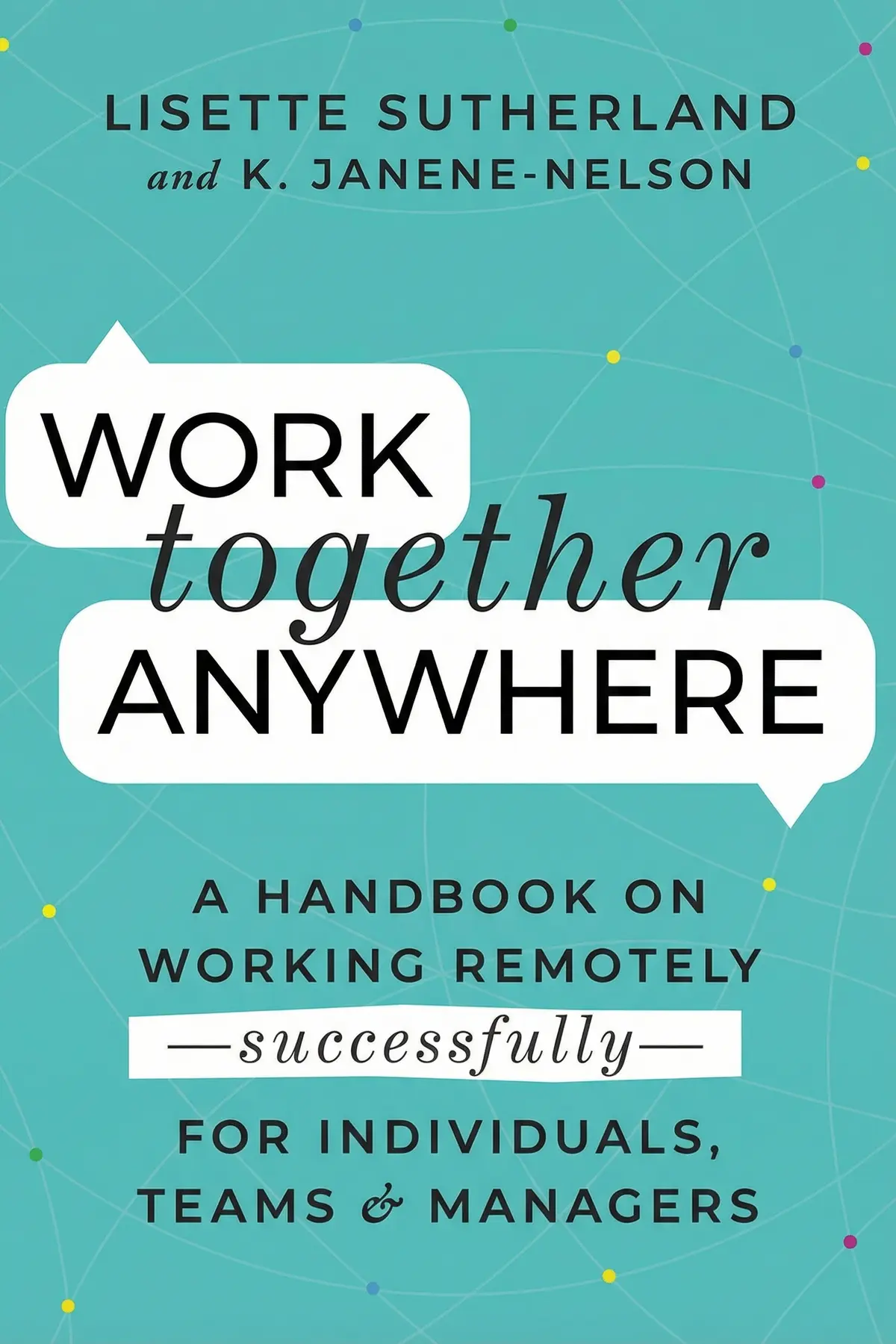
A practical handbook for working well away from the office: how individuals stay focused and visible, and how managers judge results, hire, onboard and move whole teams remote without losing trust or productivity.
1 min 03 sec
Working away from the office still draws misgivings, from employees worried about benefits and job security to employers who struggle to trust staff they cannot see. In Work Together Anywhere, remote work champion Lisette Sutherland and editor Kirsten Janene-Nelson argue that the fix is a set of learnable skills, and that the payoff is real. In one call center study they cite, staff working from home did the equivalent of an extra day of work each week.
The throughline is simple. Remote work succeeds when it is designed on purpose: judged by results, prepared for with the right skills and tools, introduced step by step, and held together by planned communication. Each idea that follows is one piece of that design, aimed at three listeners at once: the person at a kitchen table, the colleague on a distributed team, and the manager still uneasy about people out of sight. By the end, you will know how to show your worth without being watched, and how to run a team that trusts what it cannot see.
1 min 29 sec
A rush-hour drive and a morning lost waiting for a late plumber are rarely blamed for poor output. A nine-month call center study suggests the office costs workers more than most people assume.
1 min 40 sec
When an employee asks to work from home two days a week, a manager may hear a warning sign. Survey answers and rent figures suggest the bigger risk sits on the other side of the decision.
1 min 30 sec
An employee who never leaves her desk can still spend the afternoon sorting her movie list. Watching people more closely looks like the obvious fix, and an entrepreneur explains why it tends to backfire.
1 min 30 sec
Bakers who open their own shop soon learn what their old employer supplied without anyone asking. People leaving the office face the same surprise, and three gaps decide whether the move works.
1 min 34 sec
Working from home can make it harder to stop than to start. A Stanford study set out to explain why multitaskers get so much done, and found something its researchers did not expect.
1 min 33 sec
Managers who fear remote staff usually worry about slacking. After trying it, the same managers named a different problem entirely, and that finding changes how a team should make the move.
1 min 38 sec
Eighty-four out of 85 companies interviewed remote candidates almost exactly as they interviewed office candidates. An orchestra audition and a practice at NASA show what that habit misses.
1 min 22 sec
In one company’s offices, people were away from their own desks most of the working day. That finding turns a common worry about remote teams upside down and points to two simple meetings.
1 min 11 sec
The book’s most useful surprise is how little of this is new. The authors point out that a large share of what people already do in traditional offices is remote work anyway, simply done on site. Going remote mostly exposes the habits a team already depends on, and asks it to build them with intent.
That changes the question a manager or a worker should ask. Instead of wondering whether remote work can be trusted, ask whether your team has agreed what good results look like, whether each person can write clearly and fix a microphone that will not work, and whether there are set times to talk. Companies that get this right keep people longer, save on space and can hire experts wherever they happen to live.
The habit the authors stress most is feedback. Schedule regular feedback sessions with your team, decide their format ahead of time, and use them to review progress, voice criticism and ask questions. The quality of the work depends on it, and so do the relationships behind it. Every honest conversation makes the next one easier, and a team that talks well can work together anywhere.
Many people want to work from anywhere, and many managers still hesitate. Employees worry about benefits and job security. Employers worry about staff they cannot see. Lisette Sutherland and Kirsten Janene-Nelson argue that both fears shrink once remote work is treated as a set of skills that can be named, tested and improved. The authors bring survey data and studies showing that remote staff can be more productive and more loyal, and that companies save on office space while gaining access to experts in other places. They then turn that case into practice. Workers learn what they need before going remote: clear writing, self-discipline, reliable technology and the habits that protect focus at home. Managers learn to measure output instead of desk time, to move a team out of the office gradually, to test remote skills during interviews and to give new hires a real start plan. The result is a handbook for three readers at once: the person working from a kitchen table, the colleague on a distributed team and the manager responsible for people in different places.
Employees who want to work from home and need to prove they can deliver without being watched.
Managers who fear losing control of people they cannot see, or who are moving a team out of the office.
Founders and hiring leads building teams with experts spread across cities and countries.
Lisette Sutherland is a public speaker, workshop leader and entrepreneur who champions remote work. She directs Collaboration Superpowers, which runs online and in-person workshops on collaborating from any location, and she produces a weekly podcast with remote work experts about the challenges and successes of virtual teams. Born in Kiel, Germany, she lives in the Netherlands. Kirsten Janene-Nelson is a freelance editor and consultant with more than twenty-five years in book publishing, including a period as director of Mercury House, a San Francisco publisher.

Listeners offer conflicting perspectives on the book's overall length and redundancy, with some suggesting the information would be more effective if condensed. Nevertheless, many value the deep dive into practical guidance and the specific software suggestions tailored for remote work environments. The authors' functional frameworks are frequently praised, with one listener highlighting that principles like "working out loud" and "assuming positive intent" are superb reminders for fostering strong team communication. Additionally, the checklists and expert interviews provide beneficial support for managers and staff aiming to refine their remote collaboration strategies.
Finally got around to reading this, and I wish I'd had it years ago. Sutherland and Janene-Nelson have compiled an incredibly comprehensive guide that covers everything from individual mindset to corporate policy. What sets this apart is the sheer volume of real-world stories and interviews from people actually doing the work. It’s not just theory; it’s a collection of hard-won wisdom about time zones, team agreements, and conflict resolution. I’ve started implementing the "assume positive intent" framework in my emails, and the change in team morale is already visible. This is essential reading for any modern manager looking to optimize their distributed workforce.
Show moreLisette Sutherland has essentially created the definitive bible for anyone wanting to escape the traditional office grind forever. The book is packed with resources and tools that make the transition to remote work feel manageable rather than overwhelming. I loved the "remote-first" posture the book encourages; it’s a brilliant way to future-proof any organization against sudden shifts in the market. Whether you are a freelancer or a CEO, there is something in here for you. The real-life anecdotes ground the advice in reality, making the strategies feel achievable. It’s an inspiring read that proves collaboration doesn’t need a physical office to thrive.
Show moreAs a team lead who transitioned to remote work during the pandemic, I found this handbook quite grounding. The authors provide a wealth of practical tips that go beyond just "set up a desk." I particularly liked the focus on "working out loud" to keep everyone in the loop without micromanaging. The checklists at the end of the chapters are gold for anyone trying to build a remote-first culture from scratch. While it does get a bit wordy in the middle, the specific tool recommendations and expert interviews make it a valuable resource. It serves as a great reminder that communication must be intentional when you aren't in the same room.
Show morePicked this up specifically for the checklists and the "working out loud" frameworks mentioned by colleagues. It didn’t disappoint in that regard. The book is a bit on the long side, sure, but it acts more like a reference manual than a narrative you read cover-to-cover. I found the sections on managing cross-timezone teams particularly insightful because that’s where my own team struggles most. Being explicit about how we interact and setting clear team agreements has already smoothed out some of our daily friction. It’s a practical, hands-on guide for anyone looking to optimize their distributed workforce without losing their mind.
Show moreLooking back at my team's recent friction, the chapter on assuming positive intent was a total lightbulb moment for me. In a remote setting, it is so easy to misread the tone of a quick message or a missed deadline. This book teaches you how to step back and prioritize the human element of collaboration. The authors provide actionable advice on building trust and maintaining relationships when you can't grab a coffee together. I did find some of the chapters a bit repetitive, but the core message is so important that I didn't mind the reminder. It’s all about being intentional in every interaction.
Show moreThis book covers a staggering amount of ground, ranging from basic home-office setups to complex cross-timezone management strategies. I appreciated the diversity of industries represented in the expert interviews, which showed that remote work isn't just for tech companies. Frankly, it’s a bit long-winded at times, and you’ll definitely notice some ideas being recycled across different chapters. But the actionable frameworks for showing appreciation and handling staff transitions are too good to ignore. It’s a solid resource that provides a roadmap for healthy team communication in a digital world where the old rules no longer apply.
Show moreEver wonder if your home setup is actually hindering your productivity? This book tackles that question and many others, though the results are a mixed bag. On one hand, the specific tools for collaboration mentioned were things I hadn't heard of before. On the other hand, some of the suggestions felt a bit bizarre, like taking heated arguments to a dedicated "pillow-fight" channel on Slack after a failed one-on-one. That seems like a recipe for HR disasters. It’s a decent starting point for beginners, but experienced digital nomads might find it a bit too basic. The redundancy is also quite noticeable if you read it straight through.
Show moreTo be fair, the audiobook narration by Megan Tusing is excellent even if the text itself feels a bit bloated. I listened to this while commuting—ironic, I know—and found some gems among the repetition. The idea of creating a communicative environment through frequent feedback loops is vital for any team's success. However, the audiobook format makes the interactive parts, like the quizzes, a bit clunky to follow without the PDF references. I think this could have been a much stronger book if it were about 100 pages shorter. It’s useful, but you have to dig for the best parts through layers of redundant phrasing.
Show moreNot what I expected from the glowing blurbs. While the core message about remote work being a necessity rather than a luxury is solid, the execution is incredibly repetitive. I felt like the authors were saying the same three things in every chapter just to hit a page count. Honestly, you could probably find most of this information by spending twenty minutes on a decent business blog or doing a quick Google search. It’s not that the advice is bad—it’s just very thin. If you’ve worked remotely for more than a month, you likely already know half of what is written here. I found myself skimming large sections because the anecdotes felt like filler.
Show moreThe truth is that most of this information feels dated in a post-2020 world where everyone has already adapted to Zoom and Slack. While the authors clearly know their stuff, the book suffers from extreme redundancy that makes it a chore to finish. I kept waiting for a deep dive into advanced strategies, but it stayed on the surface level of "use video" and "have meetings." The quotes from interviews were interesting at first, but eventually, they just started to feel like they were padding the length. It’s a lot of common sense dressed up as professional insight. I wouldn’t recommend it unless you are completely new to the concept of working from home.
Show moreLisette Sutherland and Kirsten Janene-Nelson argue that remote work succeeds when it is designed on purpose. Workers need clear writing, self-discipline and reliable technology. Managers need to judge results instead of hours, move teams remote gradually, test remote skills when hiring and replace office contact with planned rituals such as stand-ups and retrospectives. Done this way, the authors say, remote work can raise productivity, loyalty and savings.
The authors cite evidence that it can. In a 2017 FlexJobs survey, 76 percent of respondents expected to be more productive remotely because of fewer interruptions. A 2014 study of Ctrip call center staff, reported in the Harvard Business Review, found home workers did the equivalent of about one extra day of work per week, thanks to quieter surroundings, no commute, shorter breaks and fewer sick days.
Slowly, according to the book. Start with one or two employees, review what worked after each step, and ask office-based colleagues how it went before adding people or remote days. This lets you fix processes and equipment early and see who struggles with written communication. Some teams simply prepare a remote-first setup for emergencies like travel, bad weather or a car that will not start.
Test remote skills during the interview instead of only asking about them. Use the email, video and team apps the job requires, as Zingword cofounder Robert Rogge recommends, and ask about past remote experience. Then follow a concrete onboarding plan: welcome the new hire, introduce the team and provide tools and materials. NASA pairs each new scientist with a support-staff buddy who answers questions.
AUDIO SUMMARY AVAILABLE
Get the key ideas from Work Together Anywhere by Lisette Sutherland, plus 5,000+ more nonfiction titles.