

10 min 06 sec
Available in: English
Work Simply: Embracing the Power of Your Personal Productivity Style
By Carson Tate
Shows why one-size-fits-all productivity advice fails, how to find which of four working styles fits you, and how to organize tasks, attention and daily routines around the way your mind works.
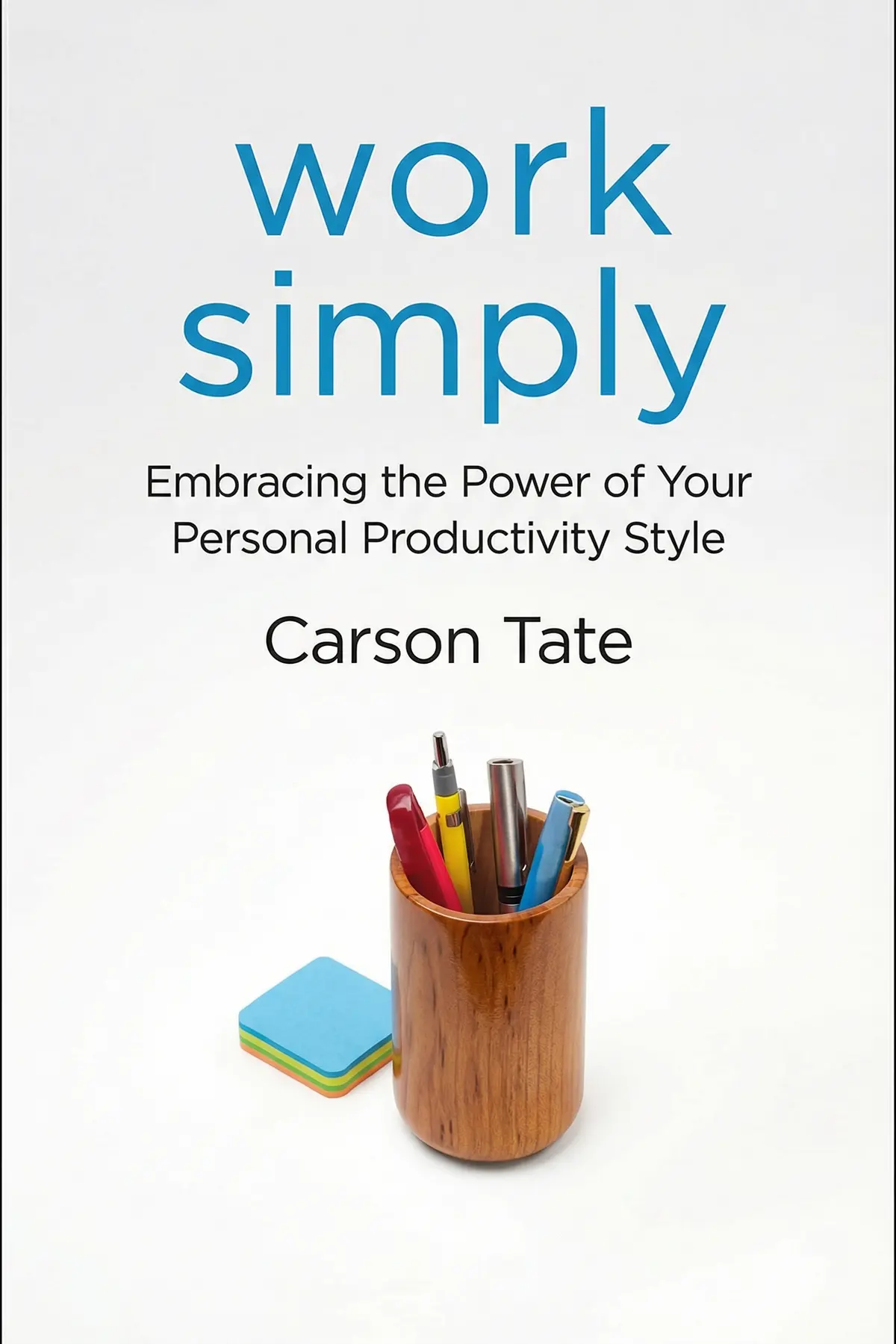
Table of Content
1. Introduction
58 sec
If time-management tricks keep failing you, the fault may lie with the tricks, not with you. In Work Simply, productivity coach and consultant Carson Tate argues that most tools are built for one imaginary worker, so they fit almost nobody. Her alternative starts with a question about your own brain: how do you take in, sort and share information?
Tate sorts the answers into four types of productivity: prioritizers, planners, arrangers and visualizers, and every type accomplishes more by following its own approach. Her throughline is simple. Productivity improves when you stop squeezing yourself into someone else’s system and build your habits around the way you already think.
What follows lets you recognize your own style, empty your head into a single master list, guard your attention at the exact point where your style tends to leak it, and test what suits you over a few ordinary days.
2. Drop generic productivity tricks and find your own style
1 min 24 sec
A new planner feels wonderful for a week, then it gathers dust and you blame your discipline. Tate thinks the real culprit is hiding in the design of the tool itself.
3. Spot which of four work styles is yours
1 min 35 sec
Four colleagues sit in the same meeting, and all four are productive, yet they would drive each other mad if forced to swap routines. One of them probably sounds a lot like you.
4. Get every task out of your head
1 min 38 sec
You can always find ways to earn more money, but a dying professor reminded his students of the one resource nobody can earn. Tate builds her planning method on that hard fact.
5. Protect your attention where your style leaks it
1 min 47 sec
Nearly a third of the working day was already vanishing into interruptions before smartphones arrived. Tate shows that each style loses focus through a different door, and naming yours is the first defense.
6. Work in the shape your mind prefers
1 min 43 sec
Time runs in a straight line, so we assume our work should too. For anyone who is not a planner or prioritizer, that assumption can work against their style.
7. Conclusion
1 min 01 sec
Tate’s book comes down to a change of question. Instead of asking which system the experts use, ask how your own mind takes in and handles work, then shape the system around the answer. The prioritizer who pours her hours into one big task and the visualizer who gathers ideas from everywhere can both be doing it right, as long as each works in her own style.
Begin by deciding which of the four colleagues sounds most like you, and notice where that style tends to lose focus. Get every commitment onto a single master list, sorted into projects and verb-first next actions, so the two or three slots your mind can hold are free for real thinking. Then keep a short note for a few days on how each task served your goal and how much you liked it.
Pausch’s reminder sits underneath all of it. Money can be earned again, hours never can, so the hours you have deserve a method built for you.
About this book
What is this book about?
Many busy professionals have tried a planner, an app or a time-management method that promised big gains, only to drift back to old habits within weeks. Carson Tate argues the fault usually lies with the tool. Most productivity advice assumes everyone works the same way, when in fact each person takes in, sorts and shares information differently. Drawing on the work of Ned Herrmann, who led management education at General Electric, Tate describes four productivity styles: the logical prioritizer, the orderly planner, the people-focused arranger and the big-picture visualizer. Each gets work done in its own way, and each loses focus in its own way too. From there, Tate shows how to treat time as a budget rather than something to control, how a master task list split into project actions and next actions clears your head, how to protect limited attention from distraction, and why linear routines can stifle some styles. Readers get a way to recognize their style and a simple note-taking test for adjusting how they work.
Book Information
Who it's for
Professionals who abandon planners
Professionals who keep abandoning planners and apps and suspect the problem is fit, not discipline.
Curious why colleagues differ
Team leads who want to understand why colleagues organize work so differently.
Students and new professionals
Students and early-career workers looking for a simple way to manage tasks and protect their focus.
About the Author
Carson Tate
Carson Tate is a coach, teacher and consultant who specializes in personal and workplace productivity. She founded Working Simply, a management consultancy whose clients have included Coca-Cola and John Deere. Her views on how people get work done have appeared in The New York Times, Forbes, Fast Company and Bloomberg Businessweek.
Ratings & Reviews
Ratings at a glance

What people think
Listeners find this work successful in helping them pinpoint their individual productivity styles and appreciate the useful strategies and advice included. The writing is straightforward with well-organized chapters, and listeners describe the material as both perceptive and polished. They share that they have become more efficient after consuming it, and one listener highlights its particular value for managing teams.
Top reviews
Ern
Ever wonder why you can't stay organized no matter how many productivity apps you download? Carson Tate answers that perfectly by showing that your tools have to match your brain. This isn't just another 'hustle harder' book; it’s about working with your natural grain instead of against it. After taking the quiz, I realized I’m a Planner, and the specific workflow changes I made based on her suggestions have significantly reduced my daily stress. My output has doubled. I’ve recommended this to my entire office because the 'one-shirt-fits-all' approach to work is clearly broken. It is remarkably effective, easy to read, and provides strategies that you can actually use the same day you read them. Highly recommended!
Show moreSuthida
Not what I expected, but in the best way possible! While this is framed as a professional development book, I found the strategies incredibly useful for managing my household and personal life too. The four productivity styles—Prioritizer, Planner, Arranger, and Visualizer—apply to everything from grocery shopping to planning a major home renovation. It’s refreshing to read something that isn’t just dry corporate jargon or impossible-to-follow systems. The book is insightful and the writing is very engaging. I actually found the author's stories helpful for visualizing how each style functions in the real world. I’m definitely more productive and, more importantly, less stressed since finishing this. It’s a must-read for anyone looking to reclaim their time and sanity.
Show morePor
This book basically debunks the idea that there is one 'right' way to be productive. Most systems fail because they try to force every person into a rigid, boring box. Tate allows you to build a tailored system that actually feels good to use. I especially loved the section on delegation; it provided a framework I hadn't encountered in years of business reading. The book is well-written, clear, and deeply insightful. Some readers might find the stories long, but I thought they provided necessary context to see the styles in action. Not gonna lie, I was skeptical at first, but the results speak for themselves. I finally have a workflow that makes sense for my personality. It’s an awesome book that I’ll be revisiting often.
Show moreDiego
Finally got around to reading this, and I have to say the framework actually sticks. I’ve tried every time management system under the sun, but they always felt like a chore because they forced me to work in a way that felt unnatural. Tate’s approach is different because it respects your inherent tendencies. I’m a Visualizer, and once I stopped fighting my need for color-coding and whiteboards, things just clicked. The strategies are easy to implement without requiring a total life overhaul. A few of the app suggestions are old, which is the danger of writing about tech, but the core principles remain solid. I’ve become significantly more productive by just embracing my style rather than trying to fix it. This is a very helpful resource for professionals.
Show moreWit
The chapter on working with others is worth the price of the book alone. In my experience, most productivity books are solo-focused, but this one actually helps you manage a team by recognizing that one size doesn't fit all. It’s insightful and well-written, even if some of the author’s personal anecdotes feel a bit out of touch with the average worker. We started using the four styles—Prioritizer, Planner, Arranger, and Visualizer—in our weekly team meetings to delegate tasks more effectively. It has helped bridge the gap between our analytical planners and our more creative types. While the digital tool recommendations are a bit behind the times, the interpersonal strategies are timeless. It's a great pick for anyone in a leadership role.
Show moreChai
This book is essentially a roadmap for anyone drowning in a sea of 'to-do' lists. It's broken down into very clear, manageable chapters, making it easy to dip in and out of when you have a specific question. I didn't love the section on office supplies—it felt a bit materialistic—but the concept of the MASTER task list was a genuine revelation for me. It’s a very practical guide that focuses on implementation rather than just lofty theory. To be fair, some sections feel like common sense, yet having them organized into a cohesive system is what makes it work. I feel much more in control of my calendar now. It is a solid, well-constructed book that delivers on its promise to help you work simply.
Show moreRatthapong
After hearing a lot of hype about the 'Productivity Style' quiz, I finally dived in. The results were a bit confusing because I seemed to score equally across three different styles, which made the customized advice hard to follow. Look, the chapter on delegation was actually fantastic and had some fresh angles on how to hand off tasks without losing control. That part alone probably earned the third star. However, the rest of the book focuses heavily on specific office supplies and digital tools. Who has the time to go hunting for aesthetically pleasing folders just because their 'style' demands it? It’s a decent introductory guide for a corporate manager, but it lacks the depth I was hoping for. It’s okay, but not a revelation.
Show moreMarco
As someone who works in a massive corporate environment, I found some of the interpersonal advice quite grounded. Understanding that my 'Arranger' colleagues process information differently than my 'Prioritizer' boss has actually helped reduce some daily friction in the office. That said, the book is quite repetitive in its delivery. Tate stretches simple concepts across way too many pages with anecdotes that lack punch. Frankly, you could get most of the value by taking the quiz online and reading a three-page summary. The MASTER task list isn't exactly a groundbreaking discovery for anyone who has been working for more than a year. It's a well-written book with clear chapters, but it feels like it's trying too hard to make simple concepts sound revolutionary.
Show moreLeo
Maybe I’m just too far along in my career for this one. This book seems to teach time management at a very basic level, almost like it was written for a high school student or someone who has never held a professional job. The author even admits at one point that the book is essentially an expansion of a college paper. If you’ve already read the classics like 'Getting Things Done,' there is absolutely nothing new here. The 'Prioritizer, Planner, Arranger, Visualizer' framework is just a rebranding of basic personality tests. Truth be told, I found the endless stories about her clients to be dull and repetitive. It felt like a lot of filler to justify a book that could have been a short blog post. Stick to the tried and true experts instead.
Show moreValentina
I really struggled to get through the first few chapters because of the author’s tone. To be fair, the writing itself is fine, but the personal anecdotes felt like a collection of extreme 'first world problems' that I just couldn't get past. It’s hard to take productivity advice seriously when it’s wrapped in stories of such immense privilege. I found myself rolling my eyes at her descriptions of being overwhelmed by a high-end consulting lifestyle. Furthermore, the technology recommendations are already incredibly dated. Most of these apps are either defunct or have been surpassed by better tools years ago. I skimmed the rest looking for something practical, but the core 'productivity styles' felt like a forced categorization that didn't fit my reality at all. Not for me.
Show moreQuestions about this book
What is the main idea of Work Simply by Carson Tate?
Tate argues that one-size-fits-all productivity advice fails because people process information in different ways. Building on Ned Herrmann’s research into how the brain handles information, she describes four productivity styles: prioritizer, planner, arranger and visualizer. Her case is that you get more done by learning your own style and shaping your tasks, attention and routines around it, instead of copying someone else’s system.
What are the four productivity styles in Work Simply?
The prioritizer uses data and logic and tackles the most important task first. The planner loves lists, order and a reviewed schedule. The arranger trusts instinct, works well with people, likes visual information and asks how decisions will make others feel. The visualizer pulls scattered input together into new solutions, dislikes heavy data and is willing to break with how things have always been done.
What is a master task list according to Carson Tate?
It is one list holding everything you need to do to reach your goals, at work and in your personal life. Tate splits it into project actions, larger efforts that take days or months, such as planning an off-site workshop, and next actions, single steps that start with a verb, like call Adam. The list frees your mind from holding every task at once.
How can I apply Work Simply to my own work?
Identify which of the four styles fits you and where that style tends to lose focus. Put every task on a master list split into projects and next actions. Build routines that support your attention, such as a walk or a workout before focused work. Then, for a few days, note how each task fits your goal and how much you enjoyed it, and adjust.
Readers also enjoyed





AUDIO SUMMARY AVAILABLE
Listen to Work Simply in 15 minutes
Get the key ideas from Work Simply by Carson Tate, plus 5,000+ more nonfiction titles.
- 5,000+ titles
- Listen as much as you want
- 7-day free trial
- Cancel anytime









