

14 min 30 sec
Available in: English
Why Startups Fail: A New Roadmap for Entrepreneurial Success
Shows founders how to find the weak part of a new venture before it fails, using a four-part health check, tests for scaling safely and a plan for recovering if things go wrong.
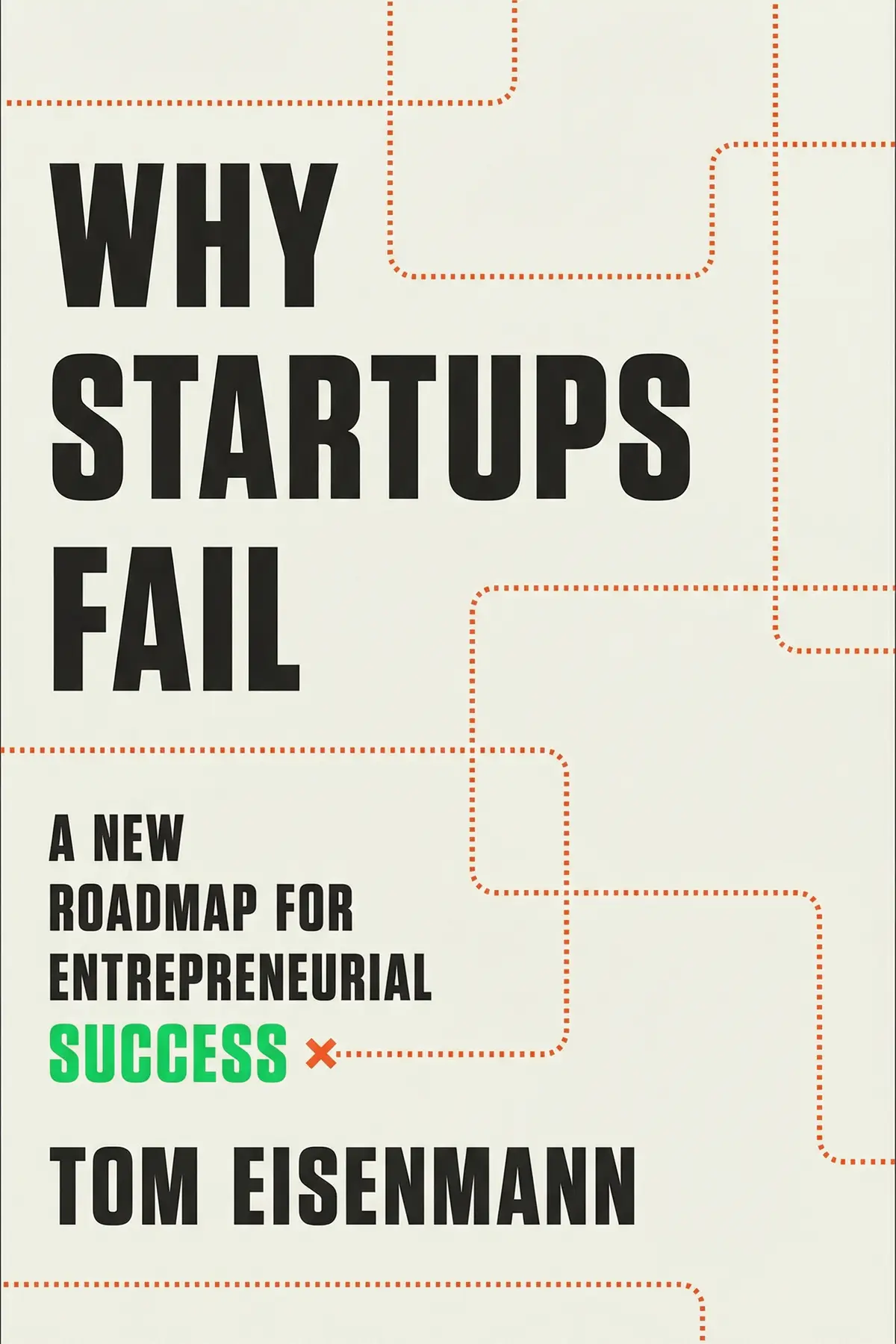
Table of Content
1. Introduction
1 min 04 sec
When a startup fails, it is tempting to reach for an easy excuse, such as blaming the economy. Harvard Business School professor Tom Eisenmann argues in Why Startups Fail that the real cause is usually inside the company, and that it can be found. A startup, in his model, runs on four parts, which he calls opportunities: the idea, its operations, its profit formula and its marketing. People steer all four, and the venture dies when one part breaks or the parts stop working together.
He makes the case through real companies: a clothing brand undone by fit, a pet-care service misled by a film crew, a flash-sale site that grew itself off a cliff and an electric car venture that sold fewer than 1,500 cars on $900 million. Each case comes with a trap to name and a test to run. With them, a founder can find the weak part of a venture while there is still time to fix it, and has a plan for starting over if it fails.
2. Check the four parts every startup runs on
1 min 48 sec
A Harvard professor with two decades of startup research watched two ventures by his own students collapse and could not explain either failure. What he built to answer that question works as a health check for any young company.
3. Learn what customers want before you build
1 min 46 sec
A business school student had a clever plan to match singles using their online habits, and he started engineering it right away. The question he never asked potential users turned out to matter more than the code.
4. Don't let your first fans mislead you
1 min 35 sec
A pet-care service won over seventy percent of the pet owners in its first building, and other buildings lined up to join. The reason behind that early enthusiasm had nothing to do with the service itself.
5. Four questions that tell you when to scale
1 min 47 sec
A flash-sale site with a proven founder, huge investment and $600,000 in sales in its first 12 days still ended up closing at home. Its advertising budget reveals a problem that money alone could not fix.
6. Hire specialists where your own knowledge ends
1 min 58 sec
Two companies had eager customers and rising sales, yet both went under. In each case the trouble started with a gap in know-how that looked minor on paper and turned out to be fatal.
7. Shrink a bold vision until customers can say yes
1 min 41 sec
An electric car venture raised $900 million and had research showing real interest from households. It still fell far short of its sales target, for reasons that had more to do with dependence than with demand.
8. Come back stronger after a failure
1 min 36 sec
One founder left her collapsed company with a broken dream and heavy debt, and could not imagine leading a startup again. The path she followed afterward suggests that failure can be a stage rather than an ending.
9. Conclusion
1 min 15 sec
What Eisenmann offers is a way to treat failure as something you can examine. Baroo did not die of bad luck, and Fab did not die of a bad economy. Each had a weak part that a careful look could have found: an untested idea, unusual first buyers, demand that had already run out, a leader without the right experience or a vision that needed too much to go right.
That is why easy explanations do harm. When around half of failed founders start again, a wrong diagnosis tends to travel with them. The framework that checks a living company also guides an honest review of a dead one.
The habits it supports are simple to begin. Regularly assess the idea, operations, profit formula, marketing and team, and course-correct wherever something is going wrong. Before any expansion, ask whether your first customers look like everyone else, then run the RAWI questions. And because driven founders often stop listening just when they need their team most, Eisenmann suggests working with an executive coach who helps you see how you lead.
A fast horse wins nothing with the wrong rider, and a founder who checks both early gets to keep racing.
About this book
What is this book about?
When a startup collapses, the usual explanations are a weak economy, bad timing or plain bad luck. Tom Eisenmann, who teaches entrepreneurship at Harvard Business School, argues that these excuses hide the real causes. They also leave the many founders who try again likely to repeat their mistakes. After two ventures founded by his own former students failed and he could not say why, Eisenmann began studying failure directly. His framework treats every startup as four opportunities: the idea, technology and operations, the profit formula and marketing. Founders, staff, investors and partners support all four, and a venture breaks when one part is weak or the parts stop fitting together. He illustrates each danger with real companies, from a clothing brand that could not deliver on fit to a pet-care service misled by its first building and an electric car venture that raised $900 million. Readers get named traps to watch for, such as false starts, false positives and the speed trap, along with practical checks: test customer assumptions before building, question early success, run a four-part test before scaling and hire specialists. The book also offers a three-phase path back for founders whose company has already failed.
Book Information
Who it's for
Startup teams before scaling
Founders and early employees who want to check a young company for weak spots before scaling.
Entrepreneurs with untested ideas
Aspiring entrepreneurs about to build a product who have not yet tested it with customers.
Founders after a failure
Founders recovering from a failed venture who want an honest review before trying again.
About the Author
Tom Eisenmann
Tom Eisenmann holds the Howard H. Stevenson chair in business administration at Harvard Business School, where he teaches entrepreneurship. He earned his doctorate, MBA and BA at Harvard and spent eleven years at McKinsey and Company, co-leading its Media and Entertainment Practice. He has coauthored 130 case studies, helped launch 14 MBA electives including one on entrepreneurial failure, invested in dozens of new ventures, served on startup advisory boards and coached thousands of aspiring entrepreneurs.
Ratings & Reviews
Ratings at a glance

What people think
Listeners find the book's perspectives very useful, with one listener remarking that it acts as a manual for constructing a strategy framework. The summary's overall quality is also well-received, and one listener draws attention to the high-quality charts. Furthermore, listeners like how the work methodically breaks down startup failures, particularly for B2C companies. On the other hand, the writing and readability earn conflicting reviews; some describe it as remarkably clear, while others feel differently.
Top reviews
Ding
Professor Eisenmann has managed to turn failure into a science. His deep dive into the 'Six S' framework offers a roadmap that most MBA programs completely miss during their celebratory lectures. It’s not just about the 'False Start' phase; the later-stage analysis of 'Cascading Miracles' was a total eye-opener for me as we plan our Series B. The charts included are incredibly detailed, helping visualize complex operational collapses like the Dot & Bo case study with startling clarity. While some might find the academic tone a bit dry, the precision provided is unmatched in current business literature. Honestly, it feels like sitting in an HBS lecture without the soul-crushing tuition fee. This is the bedrock of my new strategy.
Show moreFon
Ever wonder why a 'perfect' idea with $900 million in funding still crashes and burns? The breakdown of Shai Agassi’s Better Place was absolutely fascinating and served as a stern warning against being overly ambitious. Eisenmann doesn't just list problems; he gives you the 'Six S's' to actually diagnose what's happening in real-time. I especially appreciated the final chapters on 'The Three Rs' of recovery because failing feels so isolating for a founder. Truth is, we don't talk enough about the shame and financial ruin that follows a collapse. This book provides a path forward that feels both empathetic and strategically sound. It's an essential addition to any founder's library and a great teaching tool.
Show moreBig
After hearing Tom Eisenmann speak, I knew I had to grab a copy of this for my entire leadership team. This book is a masterclass in why founder-market fit is the actual bedrock of success in any industry. The tragic story of the electric car company highlights how even the most honorable missions fail without infrastructure. Personally, I found the 'Six S' framework for later-stage failure to be the most helpful part of the entire narrative. It’s rare to find a business book that balances cold, hard strategy with a genuine understanding of the emotional toll of failure. Not gonna lie, I teared up a bit reading the letter to the founder at the very end. Powerful stuff.
Show moreNongnuch
Picking this up was the best decision I've made for my current project this year. The advice to hire an executive coach to avoid 'tunnel vision' is something I implemented immediately after finishing the book. Eisenmann’s 'Cascading Miracles' concept helped me realize that our current roadmap was relying on way too many variables outside of our control. The profit formula breakdown is excellent and helped us restructure our cash flow projections before our next seed round. Frankly, every person currently running a B2C startup needs to read the 'False Positives' chapter before they even think about scaling. It’s a comprehensive guide that actually lives up to the hype surrounding Eisenmann's research at Harvard.
Show moreApichat
Finally got around to reading this after my second venture tanked last year. I wish I’d had this book before I poured my savings into my last project. The section on 'False Starts' perfectly describes my mistake of ignoring customer pain points in favor of a 'build it and they will come' mentality. Eisenmann’s Diamond-and-Square framework provides a systematic way to audit your startup’s health before the money runs out. Look, the book leans heavily toward B2C examples, so B2B founders might feel a bit left out of the narrative. Still, the lessons on 'Bad Bedfellows' are universal truths that every entrepreneur needs to hear. It’s a sobering but necessary reality check for anyone in the trenches.
Show moreRuangrat
This is far more than your typical 'hustle culture' business book that populates the airport bookshelves. Most startup books are just survivorship bias in disguise, but this one actually looks at the wreckage to find the truth. The case study on Quincy Apparel was heartbreakingly relatable for anyone who has struggled with operational scaling and industry knowledge gaps. I found the 'Cascading Miracles' concept particularly haunting because it describes exactly how complex systems fail when you need everything to go right. Frankly, the advice on hiring specialists over generalists during the growth phase is worth the price of the book alone. The writing is clear enough for a non-MBA like me to grasp quickly without a dictionary.
Show moreMason
As someone who has worked in three different startups, I’ve seen these patterns play out in real-time across my career. The 'Help Wanted' chapter resonated with me because I’ve watched many CEOs struggle to transition from a chaotic early team to professional management. Eisenmann’s observation about 'Bad Bedfellows' is spot on; founder conflict is a silent killer that usually starts way before the first pivot. However, I’ve gotta say that some of the later chapters felt a bit repetitive and slightly nostalgic. The information is high-quality, but the delivery becomes a bit of a slog toward the conclusion. Still, the 'False Positives' framework is a brilliant tool for anyone worried about premature scaling and deceptive metrics.
Show moreMai
Wait, why does the author use 'she' almost exclusively when describing founders who mess up? This book has some solid frameworks, but the writing style really grated on me after a few chapters. I noticed a weird pattern where the author uses 'she' for failing founders and 'he' for the success stories, which felt distractingly biased. Beyond that, I was hoping for more raw data and fewer anecdotal stories from his former students. To be fair, the 'Speed Trap' chapter is quite insightful regarding hyper-growth, but the narrative felt monotonous by the end. It's a decent read for the frameworks, but I struggled to stay engaged through the later sections. It's okay, just not the revolution I expected.
Show moreHunter
Not what I expected, but it's certainly thorough for an academic text. There is a lot of meat on the bones here, especially if you love charts and systematic breakdowns of failure. I found the 'Speed Trap' section very relevant to the current VC climate where growth is prioritized over everything else. In my experience, the book is a bit too academic and dry for a casual read on a flight. It feels like a textbook at times, which might turn off people looking for a quick 'how-to' guide or more punchy prose. It’s definitely useful as a reference for a postmortem, but it didn't keep me on the edge of my seat like other business books.
Show moreFelix
The chapter on 'False Starts' is the only reason I’m giving this three stars instead of two. While the customer discovery tips are gold, the rest of the book felt like a collection of stories that didn't always lead to a clear conclusion. I also noticed the author’s tendency to use female pronouns when describing failures, which felt incredibly weird and outdated. In my experience, successful business books should rely more on aggregate data than a few specific case studies from Harvard grads. To be fair, the 'Diamond-and-Square' framework is a decent tool for self-reflection. I just think the execution of the writing could have been much tighter and less monotonous for a general audience.
Show moreQuestions about this book
What is the main idea of Why Startups Fail?
Tom Eisenmann argues that startups usually fail for identifiable reasons inside the company, not because of bad luck or a weak economy. Every venture rests on four opportunities: the idea, technology and operations, the profit formula and marketing. Founders, staff, investors and partners support all four. A startup collapses when one part is weak or the parts stop fitting together, so founders should check each one regularly and fix the weakest.
What is the RAWI test for scaling a startup?
RAWI is Eisenmann’s check before growing fast. Ready asks whether the business model is proven, the customer base can grow and margins could survive slower growth. Able asks whether the company can get the resources and staff it needs and manage them. Willing asks whether the founder accepts more work, stress and diluted ownership. Impelled asks whether competition is driving the rush and whether new customers will cost more than they earn.
What are false starts and false positives in startups?
A false start is building a product before learning whether customers want it, as Sunil Nagaraj did with his dating software, Triangulate. A false positive is misreading early success as proof of mainstream demand. Baroo’s first building in South Boston was brand-new and full of a busy, well-paid film crew with pets, so its seventy percent take-up did not repeat elsewhere.
How can founders recover after a startup fails?
Eisenmann describes three phases. Recovery means looking after yourself through debt, strained relationships and painful emotions, with healthy habits, therapy and enjoyable activities. Reflection means honestly examining what went wrong without blaming others. Reentry means starting again and showing investors how those lessons shaped the new plan. Christina Wallace followed a path like this after Quincy Apparel closed, later founding another company and teaching at Harvard Business School.
Readers also enjoyed


7 Powers: The Foundations of Business Strategy
Hamilton Helmer



Alibaba: The House That Jack Ma Built
Duncan Clark

Bad Blood: Secrets and Lies in a Silicon Valley Startup
John Carreyrou
AUDIO SUMMARY AVAILABLE
Listen to Why Startups Fail in 15 minutes
Get the key ideas from Why Startups Fail by Tom Eisenmann, plus 5,000+ more nonfiction titles.
- 5,000+ titles
- Listen as much as you want
- 7-day free trial
- Cancel anytime









