

14 min 02 sec
Available in: English
Weird: The Power of Being an Outsider in an Insider World
By Olga Khazan
Explains why people who don't fit in are treated with suspicion and pay for it with their health. It then shows how outsiders can use their difference for creativity, conviction and a community that suits them.
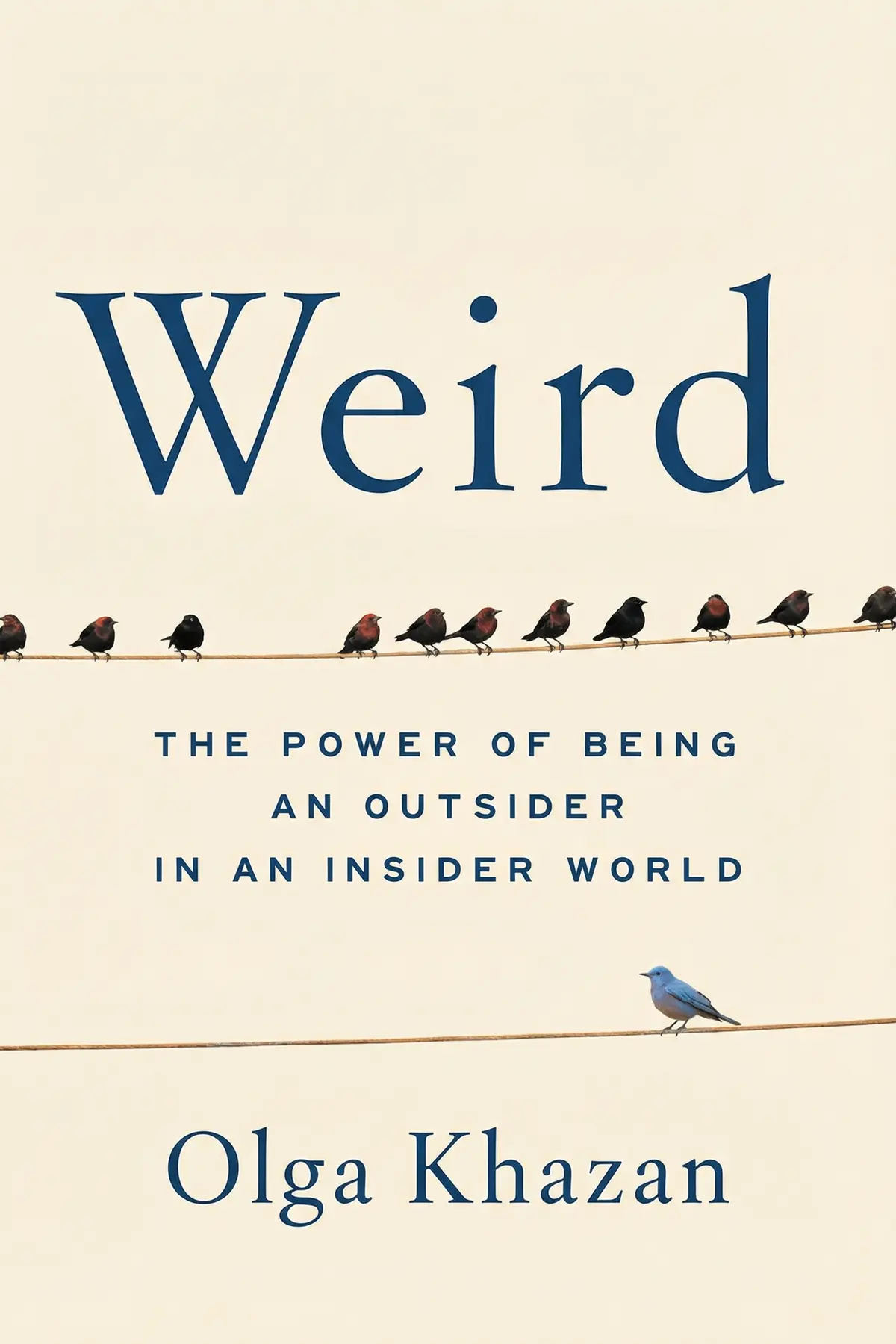
Table of Content
1. Introduction
58 sec
If you have ever been the only one in the room who looks, sounds or thinks differently, you probably treat that difference as something to hide. In Weird, Atlantic staff writer Olga Khazan argues that the same difference that makes outsiders lonely can also make them more creative and harder to bend. Khazan, born in the Soviet Union and raised in a small city in West Texas, knows the cost firsthand. She interviewed more than three dozen nonconformists, from a male preschool teacher to a surgeon with dwarfism, to learn how they live with it.
Her case comes down to one claim. Being different is painful and can even harm your health, but with the right strategies and the right community, it becomes an advantage. Along the way, a box of raisins gets a four-year-old in trouble, loneliness turns out to rival a heavy smoking habit, and one woman’s trust in her own doubts saves her life and her son’s.
2. Feeling like an outsider puts you in the majority
1 min 46 sec
A man in West Texas came to a Russian class with one question and never came back. His visit captures a feeling that more than half of Americans share, the sense that nobody really knows them very well.
3. Understand how difference sets off alarms in other people
1 min 58 sec
A preschool teacher punished a four-year-old over a box of raisins, and a teacher’s career nearly ended over one online post. Behind both lies something much older than either of them.
4. Protect your health from the hidden cost of exclusion
2 min 01 sec
Three minutes of being ignored by strangers is enough to start hurting. Over months and years, the harm moves from mood into the body, and the comparison one researcher found is hard to forget.
5. Turn life on the edge into creative fuel
2 min 09 sec
A breakup on the eve of a big scholarship interview should have been a disaster. Instead it points to an advantage outsiders hold, and to the day one woman’s doubts kept her and her son alive.
6. Tell yourself a kinder story about being different
1 min 53 sec
A teacher wrongly accused of the worst crime in his field found a way to face suspicion without being crushed by it. His methods, and a few others, work for anyone who stands out.
7. Find a community where your difference can show
2 min 02 sec
One surgeon was turned away by 59 medical schools and still refused to make himself smaller. Another man moved across the country to find his people. Their opposite choices share one lesson.
8. Conclusion
1 min 15 sec
Khazan’s book makes a double claim and keeps both halves in view. Being different has real costs, from a stranger’s racing heart to inflammation in your own body. It also builds creativity and a steadiness of values that people who always fit in may never need. Leslie Wagner-Wilson is the sharpest image of that second half: years as the odd one out taught her to trust her own doubts, and on the worst day that habit saved two lives.
What you do with your difference is partly a matter of skill. Tell yourself the generous version of your story. Study the psychology of the people who judge you, as Daniel did, so their reactions land at a distance. Lean on the people who already back you, and look for at least one place where your strangeness is normal.
Khazan adds a test for anyone who feels like a fraud and overworks to avoid being found out. Choose a minor task and deliberately give it less time than usual. If that goes fine, try it on something bigger. If you cannot bring yourself to do it even on the small task, that resistance is worth examining.
The weirdness stays. What can change is which side it works for.
About this book
What is this book about?
Most people know the feeling of being the only one in the room who looks, sounds or thinks differently. Journalist Olga Khazan, a Soviet-born immigrant who grew up in a small West Texas city, wanted to know why society handles difference so badly and what outsiders can do about it. She interviewed more than three dozen nonconformists, among them a male preschool teacher, a female NASCAR driver, a surgeon with dwarfism and a woman who escaped Jonestown. Drawing on their stories and on research in psychology and health, she traces how the brain treats difference as a threat, how exclusion and loneliness damage the body, and why the outsider's position can also fuel creativity and the courage to stick to one's convictions. Readers get a clear account of why being different hurts and a set of practical strategies drawn from people who have lived it: a kinder story about your own difference, distance from other people's suspicion, deliberate personality change, a support network, and a community where your weirdness can show.
Book Information
Who it's for
Strained by standing out
Professionals who are the only one of their kind on a team and feel the strain.
Outsiders in their field
Immigrants, career switchers and anyone in a field where few people look or sound like them.
Lonely or doubting themselves
People battling loneliness or impostor feelings who want concrete ways to turn difference into strength.
About the Author
Olga Khazan
Olga Khazan is a journalist born in the Soviet Union who works in the United States, covering health, science and social science. She has been at The Atlantic since 2013, where she is a staff writer, and her work has won several awards, including the 2017 National Headliner Award for Magazine Online Writing. Weird, published in 2020, was her first book. She later wrote Me, But Better: The Science and Promise of Personality Change (2025).
Ratings & Reviews
Ratings at a glance
What people think
Listeners find the book thought-provoking, with one review noting how it breaks down psychological and sociological concepts. Furthermore, the writing is well-researched and engaging, as one listener describes it as a captivating study of human individuality. The narrative effectively blends personal stories, and listeners enjoy the book's dry sense of humor.
Top reviews
Ding
Not gonna lie, this book felt like a warm hug for my brain. I’ve always been the person who felt 'off-kilter' in social situations, and reading Khazan’s take on 'weirdness' as a superpower was exactly what I needed. Her droll sense of humor makes the psychological research feel alive and relevant. She doesn't just say 'it’s okay to be different'; she explains the structural reasons why we feel the pressure to conform and the tangible benefits of resisting it. The story of the plus-sized model was particularly striking to me. It showed how leaning into your 'otherness' can actually lead to a more authentic and successful life. This is a brilliant piece of non-fiction that manages to be both intellectually stimulating and deeply personal. I loved every page.
Show moreWin
What a compelling investigation into the human psyche! I found myself highlighting so many passages about the mechanics of social alienation and the 'optimal distinctiveness' we all crave. Khazan is a fantastic writer who knows how to balance heavy data with lighthearted, droll commentary. The book is an absolute joy for anyone who loves social science. It effectively melds personal narratives with broad sociological trends, creating a roadmap for anyone navigating life on the fringe. I especially appreciated her honesty about her own anxiety and her struggle to fit in. It made the research feel grounded in reality. This is a must-read for the 'weirdos' who are tired of trying to fit into a mold that wasn't built for them. Absolutely top-tier reporting and a beautiful celebration of individuality.
Show moreChanon
Picked this up on a whim and found Khazan’s wry wit to be the absolute highlight. She manages to take what could have been a dry sociological text and turn it into a riveting exploration of human individuality. The way she blends her personal history—growing up as an atheist Russian Jew in Midland, Texas—with broader psychological theories is seamless. I particularly liked the chapter on cognitive reappraisal. The idea that we can view our social rejection as a source of strength rather than a weakness is a powerful mental shift. While some of the profiles felt a little surface-level, the overall message about the advantages of being unconventional really resonated with me. It’s a thought-provoking look at how to turn life’s lemons into a very strange, yet satisfying, lemonade.
Show moreSombat
As an academic who appreciates social psychology, I really enjoyed the way Khazan unpacks complex theories about group dynamics. This isn't just a collection of anecdotes; it’s a meticulously documented investigation into why humans punish difference and how we can survive that scrutiny. The author’s reporting is top-notch. She clearly spent a lot of time finding people who demonstrate various types of social friction. My only minor gripe is that the sheer volume of profiles can be a bit dizzying. Sometimes I wanted her to stay with one person longer to really get under their skin. Still, the book is a compelling argument for the power of the outsider. It’s a great reminder that the 'norms' we kill ourselves to follow are often arbitrary and confining. Definitely worth a read.
Show morePaiboon
Finally got around to finishing this investigation into individuality, and it’s a solid read for anyone who has ever felt like they didn't belong. Khazan has a droll sense of humor that keeps the tone from becoming too academic or heavy. I found the stories of the successful 'outsiders' to be quite inspiring, even if their struggles were painful to read about at times. It’s not a self-help book in the traditional sense, but there is plenty of wisdom here about developing resiliency. The author’s own story of growing up in a place where she was fundamentally 'other' provides a necessary emotional anchor for the data. It’s well-researched, entertaining, and makes a strong case for why the world actually needs its weirdos. I'll be recommending this to my fellow non-conformist friends.
Show moreJin
Ever wonder why you feel like an outsider even when you’re doing everything 'right'? Khazan’s book tackles this head-on. She explores the subtle feeling of exclusion that so many of us carry, even those who look perfectly 'normal' on the outside. The writing flows beautifully, and the connection she builds with the reader is immediate. I found the section on how 'tight' versus 'loose' cultures react to outsiders particularly illuminating. To be fair, not every profile was a home run—some felt a bit repetitive—but the cumulative effect of the book is very moving. It reminds us that being unconventional never equates to being inferior. It’s a smart, savvy look at the social ties that bind us and the ones that occasionally trip us up.
Show moreNannapat
After hearing so much about this as a 'Quiet' for weirdos, I jumped in with high expectations. It’s an interesting read, though it suffers from a lack of focus. Khazan is clearly a talented reporter, and her ability to weave in complex behavioral science and sociological theories is impressive. However, the definition of 'weird' is stretched so thin that it starts to lose all meaning. When everyone is an outsider, is anyone actually an outsider? The section on 'optimal distinctiveness theory' was fascinating, but it only received a paragraph or two. I wish the book had spent more time on the internal mechanics of alienation rather than just listing obvious markers of difference. It’s a decent investigation, but it didn't quite stick the landing for me.
Show moreJulian
Look, I appreciate the research that went into this, but the narrative felt a bit disjointed. The book is structured as a collection of stories about people living on the fringes, yet many of these 'outliers' didn't actually feel that unique. Is it weird to be a man working in childcare? Or a polyamorous person? In 2024, these feel like fairly standard examples of non-conformity. I did enjoy the author’s droll sense of humor; she has a way of making dense academic studies feel accessible and even funny. But the lack of a strong summary at the end left me hanging. I was craving a final distillation of everything she learned. It’s a solid 3-star effort—informative and well-documented, but ultimately lacking the 'wow' factor I wanted from such a provocative title.
Show moreIngrid
Truth is, I was hoping for something more hopeful than what I actually found in these pages. As a summer selection for my book club, the hype was high, but the execution left me feeling bleak. The author, a Russian native who admits to struggling with her own integration into American culture, never seems comfortable in her own skin. This restlessness permeates the entire narrative. Every person she interviews seems unhappy or trapped in an environment that rejects them. I wanted to learn how to celebrate being an outsider, but the book mostly suggests that 'weird' people are just perpetually misunderstood or lonely. If you're looking for an empowering 'why fit in when you were born to stand out' vibe, you won't find it here. It was a discouraging read.
Show moreOmar
The title is a complete misnomer. I found the premise deeply flawed because the author attempts to categorize marginalized experiences—like racism, sexism, and transphobia—under the umbrella of 'weirdness.' Being a person of color or a female NASCAR driver facing harassment isn't a personality quirk; it is a systemic reality. Khazan’s advice to simply not get 'triggered' by insults felt incredibly tone-deaf and dismissive of actual social struggles. Furthermore, the inclusion of introversion as a 'weird' trait that might require therapy is just bizarre. It felt like a pointless mashup of mini-biographies that failed to find a cohesive or respectful center. I was expecting a deep dive into genuine eccentricity, but instead, I got a book that muddles important social issues with a catch-all label that doesn't fit.
Show moreQuestions about this book
What is the main idea of Weird by Olga Khazan?
Khazan argues that feeling like an outsider is extremely common and can be harmful, since the brain reads difference as a threat and exclusion damages health. Yet the outsider’s position also fuels creativity and makes it easier to stay true to one’s values. With deliberate strategies and a community where they can be themselves, she concludes, people who feel weird can turn their difference into an advantage.
How does loneliness affect your health according to Weird?
Khazan describes loneliness as involuntary introversion, the gap between the contact you want and the contact you get. The body reacts as if fighting bacteria, triggering inflammation that can lead to plaque and heart attacks. Lonely people have worse cancer outcomes and catch viral infections more easily, and one researcher found that lacking social connection is as harmful as smoking fifteen cigarettes a day.
What strategies does Weird suggest for people who feel like outsiders?
Her interviewees point to several. Tell yourself a flattering story about your difference. Learn the psychology behind other people’s suspicion, as the teacher Daniel did, so it stings less. Help others in the same position. Change the personality traits you dislike, which experts say can happen fairly fast. Lean on supportive family and friends, and find a community where you can be yourself.
Who should read Weird?
It suits anyone who has felt out of place: immigrants, people in fields dominated by another gender or group, those who were bullied, and anyone struggling with loneliness. Its stories range from a male preschool teacher and a female NASCAR driver to a surgeon with dwarfism, so readers in many situations will find someone whose experience resembles their own.
What does Weird say about impostor syndrome?
Khazan offers a practical test for people who fear they don’t deserve their success and overwork to avoid being exposed. Pick a task that isn’t central to your job and deliberately spend less time on it than usual. If that goes fine, do the same with a project that matters more. If you find you can’t cut back even on a minor task, she suggests asking yourself why.
Readers also enjoyed

59 Seconds: Change Your Life in Under a Minute
Richard Wiseman




A Liberated Mind: How to Pivot Toward What Matters
Steven C. Hayes


Acting with Power: Why We Are More Powerful Than We Believe
Deborah Gruenfeld


Age of Propaganda: The Everyday Use and Abuse of Persuasion
Anthony Pratkanis
AUDIO SUMMARY AVAILABLE
Listen to Weird in 15 minutes
Get the key ideas from Weird by Olga Khazan, plus 5,000+ more nonfiction titles.
- 5,000+ titles
- Listen as much as you want
- 7-day free trial
- Cancel anytime









