

14 min 04 sec
Available in: English
Wait: The Art and Science of Delay
Shows why reacting fast often loses, and how to use the right amount of delay in sport, trading, judging people, dating and everyday choices to decide better without letting procrastination cost you.
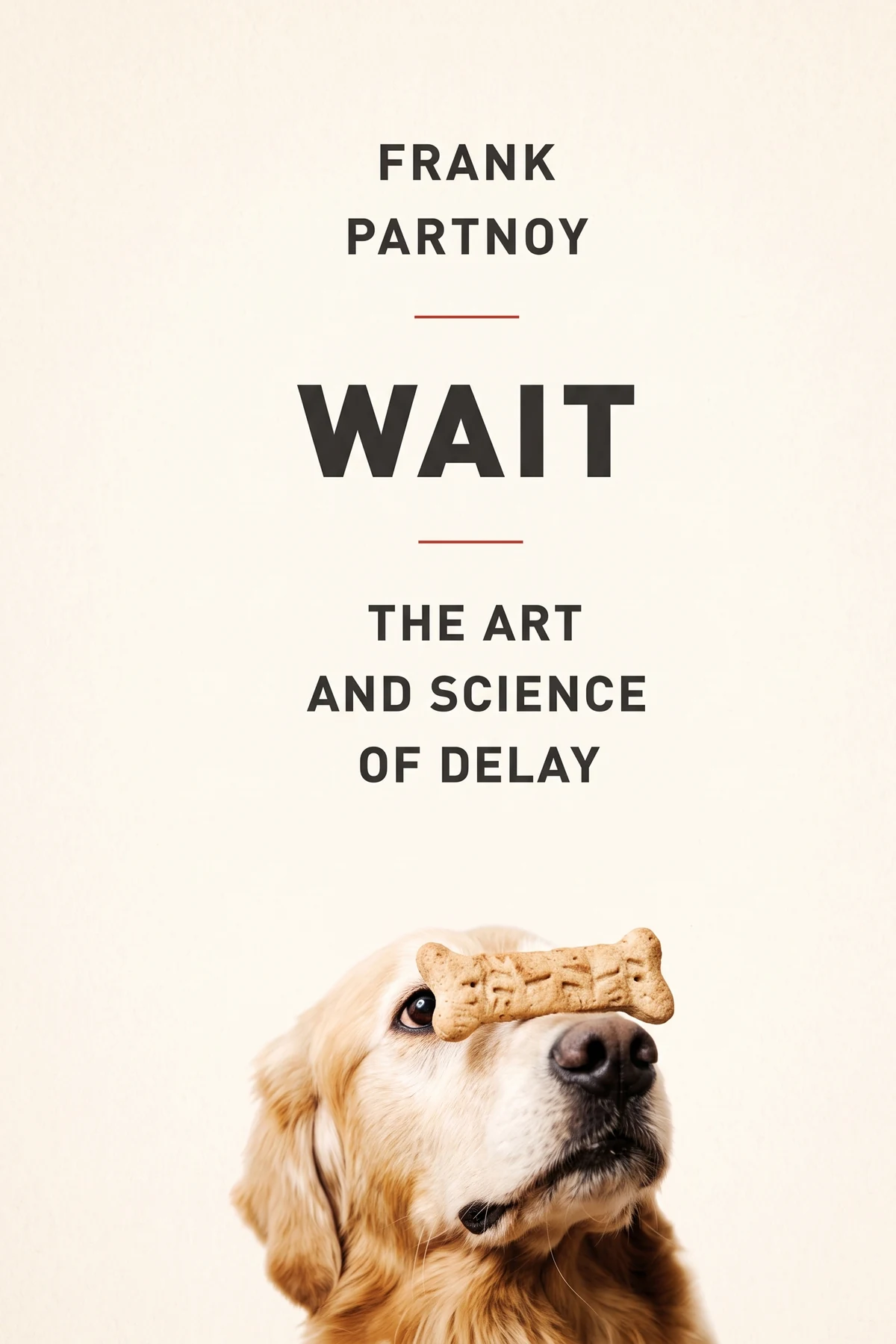
Table of Content
1. Introduction
52 sec
Most of us were raised to believe that faster is better and that putting things off is a flaw. In Wait, law professor and former Wall Street derivatives specialist Frank Partnoy argues the opposite, starting with a surprising fact: the best tennis players win by holding back for up to a fifth of a second before they swing.
Success, in Partnoy’s account, is about timing. That means being able to wait for the right moment as much as moving fast once it arrives. His examples run from trading floors and fire scenes to doctors’ offices, first dates and unfiled tax returns, and they point to one pattern. Find out how long a situation allows you to wait, then use that time well.
Along the way you get a question to ask before any quick decision, a test for when your instincts deserve your trust, and a better way to plan a first date.
2. Win the point by waiting a split second longer
1 min 26 sec
Great tennis players don’t see the ball any sooner than you do, and their reflexes aren’t the full story either. What they do with a fifth of a second shows what pressure really calls for.
3. Find the speed that keeps your errors cheap
1 min 38 sec
A trading firm moved across the country to make its trades faster, and then watched its profits shrink. Its fix sounds backwards, and a market crash lasting 18 minutes helps explain it.
4. Messages too fast to see can still change you
1 min 33 sec
A famous 1950s experiment claimed hidden flashes sold popcorn, and then its author confessed. Decades later, researchers returned to the question with logos and words, and found something stranger.
5. Trust your gut only where you've earned it
1 min 45 sec
Fire commanders decide in seconds and get it right. A navy captain trusted his judgment too and made a deadly mistake. The difference between them is a question you can ask yourself in a moment.
6. Give first impressions five minutes to change
1 min 31 sec
Over a hundred studies point to a bias in medical care that most of the doctors involved would deny having. The fix one psychologist found takes about as long as a coffee break.
7. Plan a first date that leaves room to decide
1 min 24 sec
One dating service refuses to show clients a single photo of their match, and it has a reason. The first date that best protects your judgment is shorter and plainer than most people would plan.
8. Put things off wisely and avoid the cost
1 min 23 sec
Most people take $50 today over $100 later, yet reverse their choice when the same deal moves five years out. That inconsistency explains your unfiled taxes, and when delay is actually the smarter call.
9. Stay ready while you wait, like Buffett
1 min 24 sec
Warren Buffett’s patience looks like doing nothing, and a president’s pause in a tense interview looked like hesitation. Both were something more deliberate, and you can borrow the move in your next hard meeting.
10. Conclusion
1 min 08 sec
Wait sets out to correct a habit most of us were trained into: the belief that the quickest response is the best one. Partnoy’s examples, from a tennis return to a trading desk to a doctor’s prescription, all lead to the same place. Good outcomes come from knowing how much time a moment allows, spending that time on information, and then moving decisively. Bad waiting, like ignoring a rattling engine for too long, is really a mistake in accounting. Good waiting is a skill.
That skill can start small. Before a fast call, ask whether you are truly an expert here or a beginner, and slow down when the ground is new. Before you settle your view of a candidate, a colleague or a date, give it five minutes, and an unhurried hour over lunch when you can. When you put something off, be honest about what the delay will cost later, and stay prepared while you wait, the way Buffett reads the news every day.
The player who wins the point is not the one who moves first. That player waits until the last useful instant, sees the ball clearly, and only then swings.
About this book
What is this book about?
Most of us learned early that a quick response is a good response and that putting things off is a weakness. Frank Partnoy, a law professor who once structured derivatives on Wall Street, argues that this gets timing backwards. Success depends on waiting for the right moment as much as on acting fast once it comes. Partnoy follows that idea from a tennis return measured in milliseconds to a trading firm that made more money once it slowed down. He looks at hidden images that shape behavior, at fire commanders and medical students judging under pressure, at doctors whose snap judgments affect patient care, and at a dating service that refuses to show photos. He ends with procrastination itself, explaining why we put things off and when that delay pays. Readers get a practical way to think about any decision: ask how much time it really allows, whether you have earned the right to trust your instincts here, and what a delay buys you now versus what it costs later.
Book Information
Who it's for
Rushed founders and managers
Managers and founders under pressure to decide instantly who suspect speed is costing them.
Team leads and recruiters
Recruiters and team leads who want to catch snap judgments about people before they harden.
Daters and chronic procrastinators
Chronic procrastinators and daters who want to know when waiting helps and when it hurts.
About the Author
Frank Partnoy
Frank Partnoy is a law professor at the University of California Berkeley School of Law and a Yale Law School graduate. Earlier he taught for 21 years at the University of San Diego, where he founded and directed the Center on Corporate and Securities Law. In the mid-1990s he structured derivatives at Morgan Stanley and CS First Boston, a period he described in F.I.A.S.C.O. He has also worked as a corporate lawyer, written Infectious Greed and The Match King, and comments often in the Financial Times and The New York Times.
Ratings & Reviews
Ratings at a glance
What people think
Listeners consider the work engaging and well-researched, with one listener highlighting the way it incorporates scientific studies. Additionally, the book examines the benefits of pausing before acting through examples of elite athletes, and listeners value the stimulating ideas presented. However, feedback on the writing quality is varied; while some listeners find it skillfully written, others describe the prose as tedious.
Top reviews
Surasit
This volume completely changed my perspective on my own procrastination. Instead of viewing every delay as a moral failing, Partnoy teaches us that 'waiting' can be a strategic, high-level skill. I loved the mix of hard science and fun stories, especially the parts about how we should approach decisions by asking, 'When is the latest I can decide?' It’s a powerful shift in mindset. I've started taking more intentional pauses during my workday and even when playing with my kids. The book is well-researched and manages to weave complex neuroscience into a narrative that feels accessible. Truly one of the best things I’ve read this year for personal growth. It rewards the patient reader.
Show moreHenry
To be fair, I went into this expecting a dry business manual, but Partnoy surprised me with a deep dive into the biology of timing. The discussion on how our nerve cells and brain systems manage gut responses was fascinating. I’m a bit of a pokey person myself, so seeing a scientific defense of a patient approach was incredibly validating. I particularly enjoyed the chapter on how 3M fostered innovation by allowing for unstructured, 'delayed' time. It’s an insightful look at how the long view almost always beats the short-term rush. If you enjoyed the storytelling style of Malcolm Gladwell, you will likely find this to be a nice antidote to the idea of rapid-fire intuition.
Show moreMalee
As someone who has always felt guilty about not making split-second choices, this was the validation I needed. This book is a great mix of hard science and meaningful suggestions for daily life. Partnoy’s discussion of the 'first date' tension compared to a fighter pilot's stress was both hilarious and informative. I’ve started applying his 'wait' philosophy to my emails—giving myself a few extra minutes before hitting send—and it has already saved me from several headaches. The writing is clear, the research is top-notch, and the stories are genuinely engaging. It’s easily one of the most thought-provoking books I’ve picked up in a long time. Highly recommended for anyone feeling rushed by modern life.
Show moreChon
Ever wonder why the best athletes seem to have all the time in the world? Partnoy explains that it isn't just reflexes; it's the art of waiting until the absolute last millisecond to act. I found the sections on professional tennis players and baseball batters particularly enlightening. It’s a great counterpoint to the 'go with your gut' mentality popularized by Malcolm Gladwell’s Blink. My only gripe is that it gets a bit heavy on the financial jargon in the middle chapters. Some of the high-frequency trading talk went over my head, but the general psychological insights remained strong. It makes you reconsider the value of a well-timed pause in a world that demands instant responses. Definitely worth a look for the sports analogies alone.
Show moreNarongrit
Picked this up because I’m a fan of pop-psychology, and it definitely fits that 'Blink' or 'Outliers' mold. The core idea—that waiting as long as possible is often the optimal strategy—is a refreshing take in our current hustle culture. Partnoy pulls together diverse threads from military strategy, biology, and sports to show how experts master the clock. I especially appreciated the section on 'thin-slicing' and its inherent hazards. While the book can be a bit dry during the financial deep dives, the sections on how we can control our subconscious reactions are worth the price of admission. It’s a thought-provoking read that encourages you to just breathe before jumping into a major life choice. Very well-researched.
Show morePaiboon
Finally got around to reading this, and frankly, it's a fascinating look at how we process urgency. One of my favorite takeaways was the bit about McDonald's and how the colors red and orange can actually make us feel physiologically energized to rush. It’s those little moments of insight that make the book worthwhile. Partnoy does a great job of showing how we can manage our time better by understanding when to cram and when to wait. While some of the political interpretations in the middle were a bit distracting, the overall message about the Art and Science of Delay is convincing. It’s a well-written piece that rewards a patient reader with genuine, thought-provoking takeaways.
Show moreWipawan
Partnoy’s writing is a bit of a mixed bag; he has a knack for technical clarity, but the overall structure feels scattered and clinical. He introduces the fascinating world of high-frequency trading and the millions spent to shave milliseconds off a trade, yet he fails to explain why certain executions failed when speed increased. It’s frustrating! The book is a collection of moderately interesting facts that are only loosely tied together. You’ll learn about everything from fighter pilots to dating services, but you might walk away feeling like you didn’t actually gain a cohesive system for decision-making. It’s a decent read for the occasional 'ah-ha' moments, though they are few and far between. It works as a coffee table book but lacks depth.
Show moreSven
After hearing Partnoy on the radio, I was excited to dive into this, but the book itself just didn't deliver the same punch. He was articulate and engaging in the interview, yet his writing feels cluttered with data that obscures his main points rather than supporting them. Do we really need an entire chapter on why tennis players wait for a serve? It felt like he was stretching a magazine article into a full-length book. Truth is, the clinical tone made it a struggle to finish. While the premise is intriguing, the execution is a sleeper. I was looking for actionable advice on how to use delay in my daily life, but instead, I got a series of disconnected case studies that never quite proved a central thesis.
Show moreWeera
The premise is solid. Delaying action can be a competitive advantage. However, the execution is buried under a mountain of unconnected anecdotes that never quite coalesce into a meaningful point. Partnoy often hedges his advice to the point where it becomes useless. He tells us it's better to go slowly, except when it's better to go fast. Well, obviously! There’s no real depth here, just a lot of magazine-style stories that don't add up to a coherent argument. I found the concluding chapters on time and trade-offs to be extremely slow and devoid of the psychological elements promised in the introduction. It’s a bummer because the topic is great. This one just missed the mark.
Show moreGabriel
Boredom is the primary emotion I felt while trudging through these chapters. This is essentially a business essay masquerading as a pop-psychology book. Partnoy comes from a financial background, and it shows in the stiff, clinical prose. The text is missing that exciting pace you find in authors like Gladwell or Michael Lewis. Most of the citations are secondary, and the 'experiments' are really just case studies that don't prove his hypothesis regarding delay. Bluntly, it’s a disappointing read that misses its target audience by focusing too much on niche economic situations. Save your time and skip this one; it’s far too slow-moving and fails to be memorable or educational. I gained nothing from it.
Show moreQuestions about this book
What is the main idea of Wait by Frank Partnoy?
Partnoy argues that delay is not automatically bad. Success depends on timing, which means waiting for the right moment as much as acting fast once it arrives. His examples include tennis players who hold back up to 200 milliseconds before hitting, a trading firm whose profits recovered when it slowed its trades, and investors and leaders who use patience deliberately while staying ready to act.
When should you trust your gut, according to Wait?
Only when you are an expert in that exact situation. Gary Klein found that fire commanders decide well on instinct from experience, and in his CPR video study 90 percent of paramedics spotted the real professional against 30 percent of medical students. But expertise doesn’t travel: when Captain William Rogers lost his ship’s data in 1988, a rushed decision killed 290 civilians. In unfamiliar situations, slow down.
Does Wait say procrastination is good?
Partly. Drawing on George Ainslie’s research, Partnoy explains that we overvalue short-term rewards, which is why we postpone unpleasant tasks. Delay is only harmful when you underestimate its future cost. Putting off a rattling engine for one evening brings rest and time to compare repair shops, but ignoring it too long leads to a breakdown, a tow truck and a bigger bill.
How can I apply the ideas in Wait?
Ask how long a decision can wait before delay costs you, and act near the end of that window. Check whether you are an expert or a beginner before trusting instinct. Give first impressions of people at least five minutes, as Dana Carney’s study suggests. For dating, choose a lunch first date, which gives enough time to judge and an easy exit to think it over.
Who should read Wait?
It suits professionals who feel pushed to react instantly, including traders, managers, recruiters and anyone making calls under pressure. It also helps people who judge others quickly, such as hiring managers or doctors, and anyone wondering whether their habit of putting things off is a flaw or a tool. Its examples span sport, finance, medicine, advertising, dating and politics.
Readers also enjoyed


A Liberated Mind: How to Pivot Toward What Matters
Steven C. Hayes


Acting with Power: Why We Are More Powerful Than We Believe
Deborah Gruenfeld


Age of Propaganda: The Everyday Use and Abuse of Persuasion
Anthony Pratkanis



AUDIO SUMMARY AVAILABLE
Listen to Wait in 15 minutes
Get the key ideas from Wait by Frank Partnoy, plus 5,000+ more nonfiction titles.
- 5,000+ titles
- Listen as much as you want
- 7-day free trial
- Cancel anytime









