

15 min 48 sec
Available in: English
Visual Thinking: The Hidden Gifts of People Who Think in Pictures, Patterns, and Abstractions
Shows that people think in words, pictures or patterns. It explains how schools and workplaces centered on words sideline visual minds, and how pairing different thinkers leads to better inventions and fewer disasters.
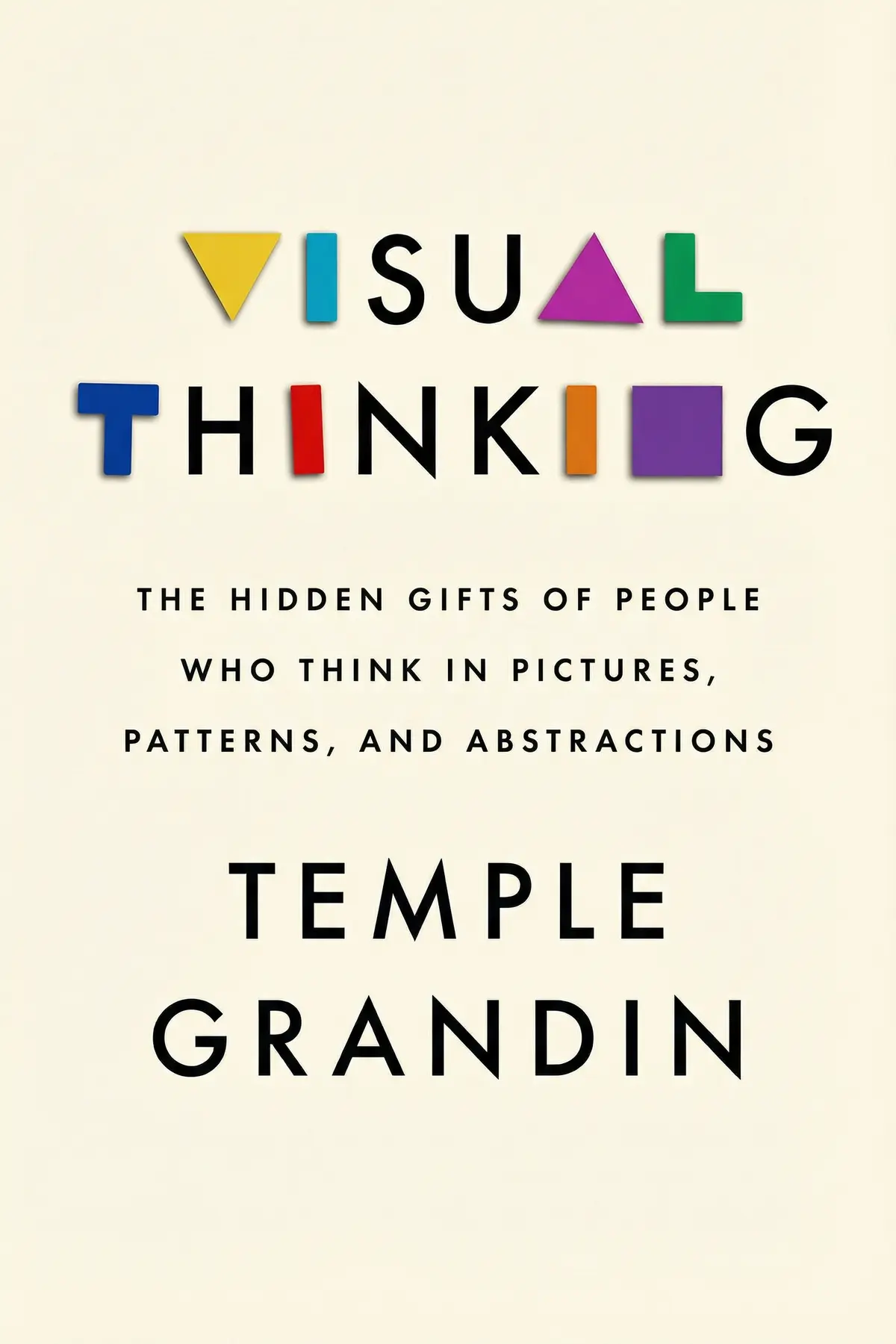
Table of Content
1. Introduction
1 min 04 sec
Many capable people grow up believing they are poor students, when in fact they think in a way school never tests. In Visual Thinking, animal scientist Temple Grandin argues that minds sit on a spectrum, from people who reason in words to people who reason in pictures or in patterns. Grandin, who is autistic, assumed for years that everyone saw the world as images, the way she does. Finding out she was wrong is where this book begins.
Her argument is simple. A society organized around verbal thinkers screens out its visual ones, and it pays in lost engineers, weaker teams and avoidable disasters. Recognize the different kinds of thinkers, put them to work together, and both people and projects do better. Along the way she visits the Eiffel Tower, a Broadway partnership, a space telescope with a problem in its bolts and a printshop in Maine. By the end you will be able to name your own thinking style, spot it in others and build a team that uses all three.
2. Find out which of three thinkers you are
2 min 03 sec
A woman who thinks entirely in pictures assumed everyone else did too, until she discovered how wrong she was. Her discovery reveals a hidden source of friction in every office, classroom and family conversation.
3. Spot the talent that standardized tests miss
1 min 55 sec
The child who drifts off in class and comes alive in the workshop is often sent to special education. Grandin thinks the label lands on the wrong party, and she names what schools threw away.
4. Sidelined builders are costing a whole economy
2 min 00 sec
Much of the machinery in American factories is designed far away in Europe. Grandin traces that gap back to the classroom, and she meets a car dealer and a printer who show what the system almost lost.
5. Pair opposite minds to build better things
1 min 56 sec
One man got the fame for a world-famous tower, yet he said its shape belonged largely to someone else. Two Broadway legends barely spent time together. Both stories point to the best way to staff a team.
6. Genius often arrives with a price attached
2 min 02 sec
Many famous innovators did badly at school, and one celebrated genius lived in squalor. Grandin explains why sharp gifts and real struggles so often travel together in the same person.
7. Put a detail-spotter on every risky project
1 min 51 sec
A space telescope’s launch was delayed by something as small as bolts. Grandin argues that a certain kind of mind is good at spotting these flaws, and that projects work best with a balance of thinking styles.
8. See how word-bound thinking hid animal feelings
1 min 42 sec
Some thinkers of the past saw creatures without language as little more than machines. Grandin, who has spent her career with animals, argues that this view says more about how humans think than about animals.
9. Conclusion
1 min 15 sec
Visual Thinking makes a case for counting more than one kind of intelligence. Schools reward words, so people who think in pictures or patterns get treated as problems, and the losses spread outward: engineers who never trained, teams made of one kind of mind, a telescope delayed by its bolts, even a cold view of what animals feel. Grandin’s point is that the visual minds a word-based system pushes aside are often the very ones it needs.
The useful response starts small. Work out where you fall among verbal, object and spatial thinkers, and notice the people around you who fall somewhere else. When someone stumbles on a test or in a meeting, look at what they can build, recall or fix, the way the car salesman could reel off the differences between every model. When a plan really matters, seat a picture thinker beside the pattern thinkers and ask them to look for the loose bolt. And if you are raising a child who thinks this way, give them real tools and real independence.
Gustave Eiffel got the fame, but he knew the tower’s shape came from a different kind of mind. Good work often depends on leaving room for both.
About this book
What is this book about?
Most of us assume other people think the way we do. Temple Grandin made that assumption for years. She took it for granted that everyone thought in pictures, the way she does. Then she learned that many people think mainly in words, and that visual thinking itself comes in two forms: object visualizers, who think in images, and spatial visualizers, whose minds work with patterns and abstractions. From there she makes a pointed argument. Schools that reward verbal, test-friendly students have cut shop classes and field trips and labeled many visual learners as weak. Grandin links that to fewer homegrown engineers, weaker innovation and avoidable failures, from the delayed James Webb Space Telescope to Flint and Fukushima. The book also celebrates what happens when different minds meet, from Gustave Eiffel and Stephen Sauvestre to Rodgers and Hammerstein. It looks at the gifts and costs of genius, and at how a verbal bias shaped the way people have judged animal minds. Readers learn to recognize their own thinking style, see hidden talent in others and build teams that use all three kinds of thinking.
Book Information
Who it's for
Leaders wanting varied thinkers
Managers and team leads who want to build teams that mix different thinking styles.
Worried tests miss talent
Parents, teachers and students who suspect a talent for building or drawing is being missed by tests.
Visual thinkers
Engineers, designers and career switchers who think in pictures and want to know where that ability is valued.
About the Author
Temple Grandin
Temple Grandin is an academic, inventor and ethologist on the animal sciences faculty at Colorado State University, with a doctorate in animal science from the University of Illinois. She has written more than 60 scientific papers on animal behavior and advises the livestock industry. She was one of the first autistic people to write about what living with autism taught her, and she speaks up for neurodiversity. In 2010 Time named her to the Heroes category of its Time 100 list.
Ratings & Reviews
Ratings at a glance
What people think
Listeners find this book insightful for its examination of diverse learning styles and visual processing, with one listener pointing out how visual and verbal thinkers can benefit from working together. The work also receives praise for its readability, sturdiness, and overall importance, with listeners valuing its creative approach and engaging subject matter. However, the quality of the information is met with mixed reviews.
Top reviews
Darius
Wow, this book completely shifted how I view my neurodivergent son's future potential and his unique way of seeing the world. Instead of focusing on what he can’t do, Grandin highlights the 'hidden gifts' that come with a non-verbal brain. The stories about Einstein and Tesla were perfectly placed to show that traditional schooling isn't the only path to high-level success. It’s a readable, sturdy book that manages to make complex concepts feel very user-friendly for a general audience. I feel much more optimistic about the contributions visual thinkers can make to society after finishing this. Every teacher in this country should have a copy of this book on their desk.
Show moreEye
In my experience, few books manage to be both this practical and this eye-opening regarding workplace collaboration. The distinction she makes between 'object visualizers' and 'spatial visualizers' changed how I interact with my engineering team immediately. We often miss the brilliance of people who think in pictures because we are so obsessed with verbal communication and testing. Grandin’s call to bring back vocational training and shop classes is something I wholeheartedly support for the next generation. This is an essential read for anyone managing teams or working in creative fields. It’s an important, innovative look at the human mind that we desperately needed to see in print.
Show moreWanphen
The chapter on the 'caste of woebegones' who are marginalized in schools but find their creative legs later in life was incredibly moving. As someone who always felt 'stupid' because of my low SAT scores, finding myself in these pages was a revelation. Grandin fills her work with innumerable examples of how the visual mind has literally built the modern world from nothing. It’s an empowering, important book that challenges the binary view of intelligence we've lived with for decades. I love how she connects everything from animal behavior to high-level engineering. You’ll be glad you chose this if you’ve ever felt like a square peg in a round hole.
Show moreBo
Finally got around to reading this and it’s a vital wake-up call for our outdated school boards and policymakers. Grandin argues convincingly that our focus on standardized testing is crushing the types of geniuses who build our physical world. I loved the references to inventors like Edison and Da Vinci who didn't fit the typical academic mold. Frankly, it’s refreshing to see someone champion the 'tinkers' and 'makers' who are often marginalized in a verbal-centric classroom. While it does get a bit wordy in the middle, the core message about fixing our infrastructure through visual minds is too important to ignore. It’s a great book for parents who feel their children aren't thriving.
Show moreWit
After hearing Temple speak years ago, I knew this would be insightful, and she definitely delivers on a more innovative approach to learning. The book provides new insights for parents whose children might be outside the typical education path for verbal thinkers. I particularly enjoyed the discussion on how visual thinkers are essential for maintaining our crumbling national infrastructure. Got to say, I didn’t expect so much focus on the meat industry, but it works to illustrate her points about practical design. There are some repetitive moments where she talks about her own specific league of thinking, but the overall message is very empowering for neurodiverse families. It's a solid addition to any library.
Show moreWissanu
To be fair, the distinction between object visualizers and spatial visualizers is a total game-changer for understanding human intelligence. This book explores the different toolkits we all bring to the table, even if the author’s bias toward visual thinking is quite obvious. I appreciated the specific examples of how different minds can prevent disasters by visualizing failures before they actually happen. It’s a fascinating look at how we can all work together more effectively if we just recognize these diverse patterns. Even though some of the research felt a bit anecdotal, the logic behind her arguments for vocational training is very sound. It definitely opened my extra senses toward my colleagues' unique strengths.
Show morePridi
Ever wonder why some people struggle with basic algebra but can intuitively understand how a complex engine functions? This book does a decent job exploring that divide, though it gets repetitive after the first few chapters. Personally, I found the author’s tone a bit self-congratulatory at times as she frequently mentions her own aced tests. While the insights on how our education system fails neurodivergent kids are incredibly important, I wish there was more recent scientific data to back up her claims. It’s an interesting topic, but the execution feels a little bit dated for today’s psychology standards. It is a sturdy book with an important message that just needed more nuance.
Show moreClara
Picked this up because I’m a visual learner, but I have mixed feelings about the final execution. On one hand, the central argument about the need for different kinds of minds in our workforce is absolutely spot on. On the other hand, the writing style is a bit disjointed and leans too heavily on the author's past experiences in animal behavior. One point I did like is about how smart crows are, specifically how they make hook-like tools to get food. However, the meat packing industry examples felt somewhat bizarre in a book about human cognition. Still, the message about how visual and verbal thinkers can benefit from working together is a valuable takeaway.
Show moreMason
As a professional writer and editor, I felt completely excluded by Grandin's narrow definitions of what constitutes a 'verbal thinker.' She basically claims that if you work with words, you lack the ability to visualize, which is just objectively wrong in my case. I rely on vivid mental images to construct every single sentence I write for my clients. The lack of hard research and the reliance on anecdotal 'evidence' made it very difficult to take her arguments seriously. Look, I agree that schools need to change, but the binary way she categorizes people is too simplistic. It felt more like a memoir where she justifies her own brilliance than a scientific study.
Show moreRatthapong
The truth is, this was just incredibly dry and quite a letdown for someone who loves brain science. I expected a deep dive into neurology, but instead, I got a lot of rambling stories about the meat industry and old school systems. Frankly, it made me feel pretty hopeless about the state of education because the problems seem too big for one person to ever fix. I skimmed through the last half once I realized the tone wasn't going to get any more engaging. Also, the constant praise for Elon Musk felt really out of place and skewed the author's credibility for me personally. It just didn't make me feel good about the world.
Show moreQuestions about this book
What is the main idea of Visual Thinking by Temple Grandin?
Grandin argues that people think along a spectrum: verbal thinkers use words, object visualizers think in pictures and spatial visualizers think in patterns and abstractions. Society, and US schools in particular, favors verbal thinkers and screens out visual ones. She links this to lost engineering talent, weaker innovation and avoidable failures, and she argues that teams mixing these styles invent more and spot risks earlier.
What is the difference between object visualizers and spatial visualizers?
Drawing on researcher Maria Kozhevnikov, Grandin explains that object visualizers think in detailed pictures and are common among architects, inventors, artists and mechanical engineers. Spatial visualizers think in patterns and abstractions and are common among statisticians, physicists and scientists. Grandin herself is an object visualizer. Many people mix visual and verbal tendencies in their own proportions.
Why does Grandin criticize standardized testing?
She argues that the move toward testing, reinforced by the No Child Left Behind Act of 2001, pushed out shop, welding, mechanics and field trips, which suited visual learners. Many such students now get labeled poor performers and placed in special education. She also questions requiring intermediate algebra for everyone, noting that a California pilot with more flexible math options improved completion rates.
How can I apply Visual Thinking at work?
Identify whether you and your colleagues think mainly in words, pictures or patterns, then staff projects with a mix. Grandin cites research showing that teams combining object and spatial visualizers outperform teams of one kind. On risky projects, include a detail-focused object visualizer who can picture what might physically fail, the kind of mind she believes could have caught the loose bolts that delayed the James Webb Space Telescope.
Who should read Visual Thinking?
It suits parents and teachers of children who struggle with tests but excel with their hands, managers building teams, and anyone who thinks in pictures and has felt out of step with word-focused settings. Readers interested in autism, dyslexia and neurodiversity will find Grandin’s first-person view useful, as will those curious about how verbal bias has shaped the way people judge animal minds.
Readers also enjoyed


A Liberated Mind: How to Pivot Toward What Matters
Steven C. Hayes


Acting with Power: Why We Are More Powerful Than We Believe
Deborah Gruenfeld


Age of Propaganda: The Everyday Use and Abuse of Persuasion
Anthony Pratkanis


AUDIO SUMMARY AVAILABLE
Listen to Visual Thinking in 15 minutes
Get the key ideas from Visual Thinking by Temple Grandin, plus 5,000+ more nonfiction titles.
- 5,000+ titles
- Listen as much as you want
- 7-day free trial
- Cancel anytime









