

13 min 49 sec
Available in: English
University of Berkshire Hathaway: 30 Years of Lessons Learned from Warren Buffett & Charlie Munger at the Annual Shareholders Meeting
Thirty years of Buffett and Munger's shareholder-meeting lessons on judging what a business is worth, buying it at a discount, funding growth cheaply and keeping calm when markets panic or celebrate.
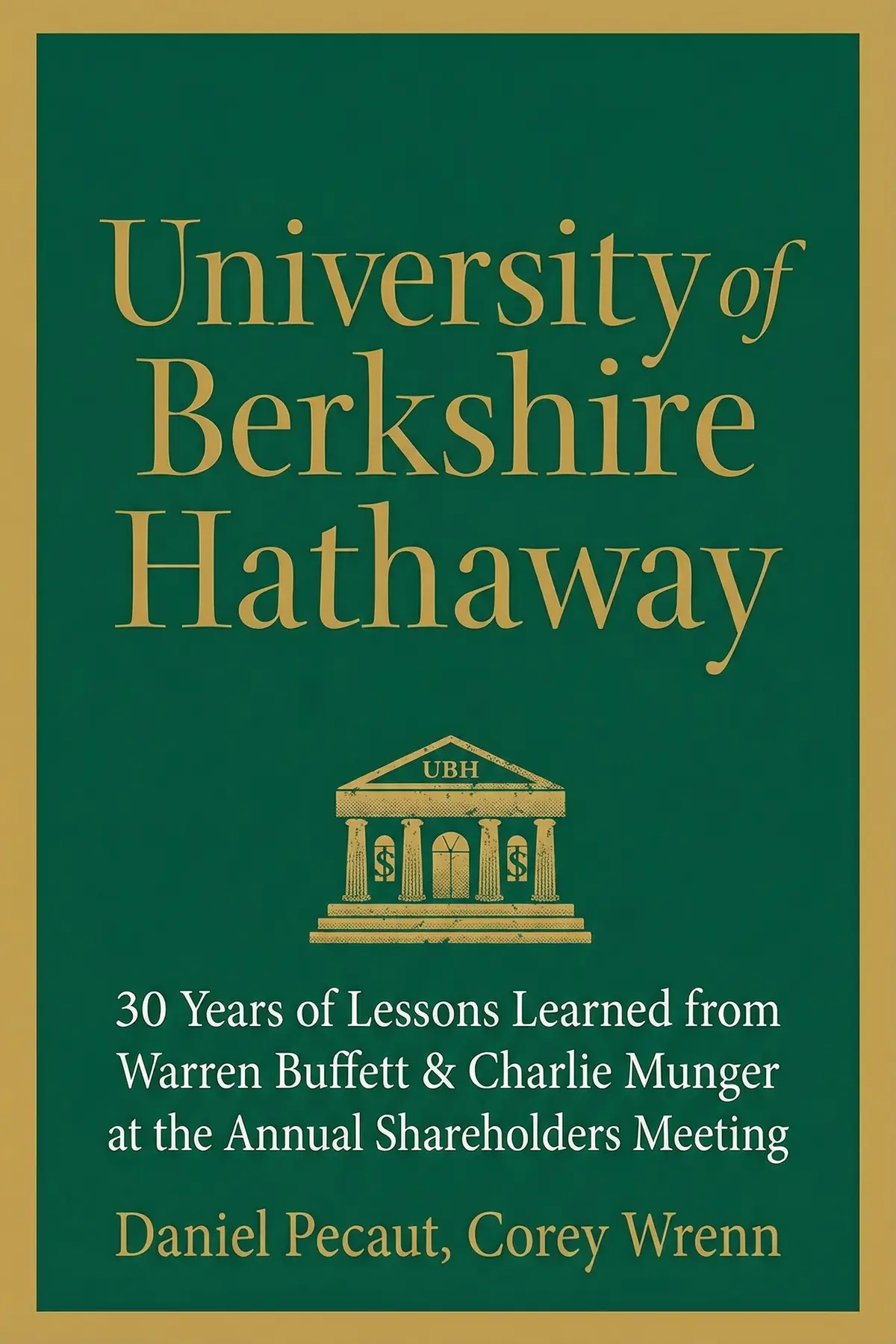
Table of Content
1. Introduction
1 min 11 sec
Most people who buy shares react to the price on the screen, buying as it climbs and selling as it falls, without asking what the business underneath is worth. Warren Buffett and Charlie Munger built Berkshire Hathaway on the opposite habit: work out what a company is worth, then buy only at a clear discount.
In University of Berkshire Hathaway, investors Daniel Pecaut and Corey Wrenn draw out 30 years of lessons from Berkshire’s annual shareholder meetings, which they treat as a classroom with two famous professors. Their case is that the company’s record came from a handful of simple principles kept with unusual discipline. Pay less than value, own excellent businesses, fund them with cheap insurance money, and stay calm when markets lose their minds.
Each lesson below comes with the real deal that tested it, from a candy brand with fiercely loyal California customers to a $5 billion bet placed in the panic of 2008. Together they give you a way to judge what something is worth, and a way to behave when everyone around you is either panicking or celebrating.
2. Pay less than the business is worth
1 min 40 sec
Two numbers sit behind every share you could buy, and most investors only ever look at one of them. A bridge engineer’s habit explains why the gap between them protects you from your own mistakes.
3. Turn the market's moods into your servant
1 min 45 sec
An imaginary partner knocks on your door every day with a new offer, sometimes absurdly generous, sometimes insulting. Graham’s character shows why the smartest investors are often not the most successful ones.
4. Trade cheap leftovers for wonderful companies
1 min 59 sec
Buffett’s early bargains made money but could never build anything great. A purchase in 1972 changed what he looked for, and it later led him to one of his most famous investments.
5. Fund growth with money you hold for others
2 min 10 sec
A bank pays interest to use its customers’ money. Berkshire found a way to be paid for holding other people’s money instead, and a small Omaha purchase in 1967 started it.
6. Stay out of games you cannot read
1 min 50 sec
In the late 1990s, Buffett and Munger were mocked for missing the biggest boom in years. Their reasons for staying out, and the warnings they issued afterward, look very different in hindsight.
7. Be the buyer when everyone else panics
1 min 56 sec
In the fall of 2008 almost every financial institution needed help, and one company in Omaha had what they lacked. The deals that followed show what decades of patience are actually for.
8. Conclusion
1 min 18 sec
What looks like genius from the outside turns out, in Pecaut and Wrenn’s telling, to be a few plain rules kept for decades. Graham supplied the first: the market serves you, and you never pay full value. Munger supplied the second: own a small number of excellent companies that keep producing cash. Insurance float supplied the fuel, money that often cost nothing, and temperament held everything together through the dot-com mania and the crash of 2008.
Each rule protects the others. Cheap capital gave them the freedom to ignore the market’s noise and stay disciplined. Staying inside your circle keeps you away from things you cannot judge. A margin of safety means a mistake costs you a little, not everything.
You do not need an insurance company to use this. Before buying anything, set down what it is worth and insist on a gap. When prices swing, check whether the business changed or only the mood. Know what your own money costs you, and keep a reserve so that the next panic finds you able to act.
The bridge Buffett describes was built to carry far more than any truck it would meet. Berkshire was built the same way, which is why it was still standing, and buying, when others fell.
About this book
What is this book about?
Most investors watch the price on the screen and let it set their mood. Warren Buffett and Charlie Munger built Berkshire Hathaway by doing the opposite: deciding what a business is worth, buying only at a clear discount and ignoring the market's daily swings. For three decades they explained this thinking at Berkshire's annual shareholder meeting, a gathering Daniel Pecaut and Corey Wrenn treat as a university with two professors. The authors trace how the philosophy grew. It began with Benjamin Graham's margin of safety and his allegory of Mr. Market. Munger then pushed Buffett from cheap, dying companies toward wonderful businesses like See's Candies, and insurance float turned into a source of capital that often cost less than nothing. Along the way come the dot-com mania the partners refused to join, their early warnings about derivatives, and the deals they struck when the 2008 crisis left them as the buyer everyone called. Readers get a compact map of how Berkshire works and a set of habits they can use with their own money: estimate value before price, stay inside what you understand, know what your capital costs and keep reserves for the moment others panic.
Book Information
Who it's for
Investors trading on headlines
Individual investors who buy and sell on headlines and want a calmer way to judge value.
Choosing businesses worth owning
Founders and managers deciding how to fund growth and which businesses are worth owning.
Curious about Berkshire's deals
Readers curious how Buffett and Munger built Berkshire Hathaway deal by deal.
About the Author
Daniel Pecaut
Daniel Pecaut is a Harvard graduate with more than 30 years in investing. He is Chairman and Chief Investment Officer of Pecaut and Company, and his views have appeared in Outstanding Investor Digest, the Omaha World-Herald, Money Magazine, the New York Times and Grant's Interest Rate Observer. Corey Wrenn worked as an internal auditor at Berkshire Hathaway from 1983 to 1992, holds an MBA from the University of Nebraska at Omaha and is now president and chief executive of Pecaut and Company.
Ratings & Reviews
Ratings at a glance
What people think
Listeners find this book highly engaging for studying Berkshire Hathaway and value the excellent assembly of notes and insights. Additionally, the work provides practical lessons on business and investing, with one listener highlighting the thoughtful curation of the material. Listeners also describe it as easy to follow, featuring dry and humorous banter, and feel it offers good value. However, several listeners mention its repetitive nature, resulting in mixed reviews regarding the redundancy found throughout the chapters.
Top reviews
Wachira
Ever wonder what it would be like to sit in the front row of the 'Woodstock of Capitalism' for three decades? Pecaut and Wrenn have done the hard work of distilling thirty years of Berkshire meetings into a single, cohesive volume. The wisdom from Buffett and Munger is timeless, especially the sections regarding market fluctuations and business valuation. I loved the dry humor and the folksy advice that somehow remains profoundly relevant in our modern digital world. While the formatting is essentially a collection of notes, the insights into their thought processes are incomparable. It feels like a masterclass in pragmatism and temperament, two things sorely lacking in today’s volatile trading environment. This is more than just a finance book; it’s a study of character and discipline. Highly recommended for any serious student of value investing.
Show moreKatya
The chapter on the 2014 meeting alone is worth the price of admission for its deep dive into the inner workings of Berkshire Hathaway. Pecaut and Wrenn provide a service to the investing community by archiving these moments that might otherwise be lost to time. I found the 'Ovarian Lottery' concept to be a profound way of looking at success and luck in the markets. The book is brimming with actionable advice disguised as simple common sense. It’s rare to find a business book that balances technical valuation tips with genuine life philosophy so effectively. Charlie Munger’s pragmatism shines through every page, urging readers to go to sleep a little smarter than they woke up. This really does feel like a university-level education in how the world actually works. If you want to understand the 'Omaha magic,' start here.
Show moreWoravit
Picked this up because I wanted a summary of the Berkshire meetings without watching hundreds of hours of grainy YouTube footage. This book delivered exactly what I needed. It’s a wonderful collection of notes that captures the essence of the Buffett-Munger partnership. Their 'enlightened common sense' approach is so refreshing compared to the complex algorithms used by Wall Street today. I loved the story about the 103-year-old owner of Nebraska Furniture Mart and her lack of 'peer pressure.' It's these little anecdotes that make the book so enjoyable to read. The authors have clearly put their hearts into this project, and it shows in how elegantly the information is presented. Whether you’re a seasoned pro or just starting out, there’s something here for you. It’s an investment in your own education that will likely pay dividends for years to come.
Show moreGame
Wow, what a goldmine of investment wisdom and life lessons! I didn't expect to find so much humor in a book about annual meetings, but the banter between Buffett and Munger is genuinely funny. The 'Newspaper Standard' is a rule I plan to live by from now on. This book truly earns its title; it really is like a university education packed into 300-something pages. The authors have a way of making complex topics like intrinsic value and margin of safety feel intuitive. I also found the physical quality of the book and the layout to be quite elegant. It’s the kind of book you can open to any random page and find a piece of advice that makes you think. For the price, you're getting decades of experience from the world's best. Absolutely great value for the money.
Show moreSue
Truth is, I wasn't expecting this to be such an easy read given the dense subject matter. The authors manage to capture the witty banter between Warren and Charlie perfectly, making the investment lessons feel like stories from a wise grandfather rather than a lecture. I particularly enjoyed the specific case studies on 'the good, the bad, and the ugly' investments, like the Dexter Shoes blunder. It’s fascinating to see how their strategy evolved while their core principles remained rock solid. My only gripe is that because the meetings happen annually, the book does get quite repetitive toward the middle sections. You can only hear the 'be greedy when others are fearful' mantra so many times before it loses its punch. Still, the curated nature of these notes makes it a valuable addition to any investor's shelf.
Show moreJiraporn
Looking back at thirty years of history through the lens of two of the world's greatest investors is a unique experience. This book isn't just about stocks; it’s about the evolution of the American economy from the mid-80s through the mid-2010s. The authors do a great job of highlighting the 'gems' while skipping over the more mundane corporate formalities of the meetings. I appreciated the inclusion of their failures, as hearing about their mistakes with airlines or Dexter Shoes makes the duo feel more human and relatable. However, the book does suffer from some minor typos and name misquotes that occasionally pulled me out of the narrative. Despite those small editorial slips, the content remains top-tier. It is a thoughtful, comprehensive guide that serves as a great companion to the official shareholder letters. Definitely worth the time for any fan of value investing.
Show moreRatchada
As someone who has followed Ajit Jain's career, I was thrilled to see so much focus on his contribution to Berkshire's success. The authors capture the high praise Buffett heaps on him, including the 'sinking boat' analogy, which was a highlight for me. The book serves as an excellent historical record, tracking the growth of the company from a few hundred attendees to the massive stadium event it is today. The dry humor is present on almost every page, particularly Charlie's short, punchy retorts. While the information on reinsurance and CDS might be a bit technical for some, the overall tone remains accessible. It’s a very practical book for those who want to understand the 'circle of competence' and how to stay within it. A few minor errors in CEO names didn't ruin the experience for me.
Show morePhimwan
After hearing so much about the 'Woodstock of Capitalism' for years, I finally got around to reading this summary. It’s a fantastic way to digest thirty years of wisdom without feeling overwhelmed. The authors did a great job of organizing the notes into chronological chapters, allowing you to see how the duo’s perspective changed over time. The advice on temperament being more important than intellect really hit home for me. We often get caught up in the math, but the psychology of the market is where the real battles are won. Not gonna lie, the middle section does feel a bit like a repeat of the first hundred pages, but that's the nature of these meetings. If you can push through the repetition, there are some incredible insights into how to build a business with integrity. It's a solid 4-star read for any aspiring capitalist.
Show moreTim
To be fair, this is a solid compilation of notes, but the repetitive nature of the meetings becomes a bit taxing after a few chapters. Because it covers thirty years of annual meetings, you hear the same stories about the Nebraska Furniture Mart and the importance of reading more times than necessary. Frankly, if you have already read Buffett’s letters to shareholders, a lot of this material will feel like a redundant retread of familiar ground. There are definitely some hidden gems and specific anecdotes about Ajit Jain that were new to me, but the editing could have been tighter to avoid the constant deja-vu effect. It is a decent reference for a library, though not necessarily a page-turner you’d want to read cover-to-cover in one sitting. It's okay, just a bit dry.
Show moreKwame
Look, I appreciate the effort it took to compile thirty years of notes, but this book feels a bit like reading someone else’s diary. While there are certainly some high-quality tidbits scattered throughout, the lack of a 'secret formula' might disappoint some readers looking for a shortcut to wealth. The reality is that Buffett and Munger succeed because they read all day and invest to the exclusion of everything else, which isn't exactly a replicable strategy for most people. The book is also incredibly repetitive, as the duo tends to answer the same questions year after year. To be honest, I think you could get the same value by reading a summary blog post or a shorter highlights reel. It’s a nice tribute to Berkshire, but it’s a bit of a slog to get through the whole thing.
Show moreQuestions about this book
What is University of Berkshire Hathaway about?
Daniel Pecaut and Corey Wrenn gather 30 years of lessons from Berkshire Hathaway’s annual shareholder meetings. They show how Buffett and Munger’s philosophy grew from Benjamin Graham’s margin of safety into owning wonderful businesses, funded by low-cost insurance float and protected by a calm temperament. The story runs from the cigar butt era and See’s Candies through the dot-com bubble to the deals Berkshire struck during the 2008 crisis.
What is insurance float and why did it matter to Berkshire?
Float is the money an insurer holds between collecting premiums and paying claims, which it can invest meanwhile. Berkshire bought National Indemnity for $8.4 million in 1967, and its float grew from $17 million to $70 billion by 2012. Because Berkshire only wrote policies priced correctly, its cost of float was often below zero, giving it cheap capital for buying stocks and whole companies.
What is the cigar butt approach versus buying wonderful companies?
Early on, Buffett bought ugly businesses trading below their cash, hoping for one last puff of profit, like a discarded cigar. It worked but could not build anything lasting. Munger steered him toward wonderful companies at fair prices. The 1972 purchase of See’s Candies showed the value of a loyal brand and a business needing little reinvestment, lessons Buffett later applied to Coca-Cola.
How can I apply Buffett and Munger's lessons to my own investing?
Estimate what something is worth before looking at its price, and buy only with a margin of safety. Treat market swings as offers you may ignore. Stick to businesses you can genuinely understand, and resist envy when others profit from fads. Watch what your capital costs, distrust earnings figures that look too smooth, and keep cash ready for the moment others panic.
Who should read University of Berkshire Hathaway?
It suits individual investors who want a disciplined, value-based approach, and business owners interested in how cheap capital and strong culture build lasting companies. Readers already curious about Buffett and Munger get a single account of how their thinking developed across three decades of meetings, tested by real deals such as See’s Candies, National Indemnity and the $5 billion Goldman Sachs investment.
Readers also enjoyed



AUDIO SUMMARY AVAILABLE
Listen to University of Berkshire Hathaway in 15 minutes
Get the key ideas from University of Berkshire Hathaway by Daniel Pecaut, plus 5,000+ more nonfiction titles.
- 5,000+ titles
- Listen as much as you want
- 7-day free trial
- Cancel anytime









