

12 min 43 sec
Available in: English
Two and Twenty: How the Masters of Private Equity Always Win
Explains how private equity firms buy failing companies, rebuild them with tiny, intense teams and sell them at large profits, who carries the risk, and why the two and twenty pay model makes partners so rich.
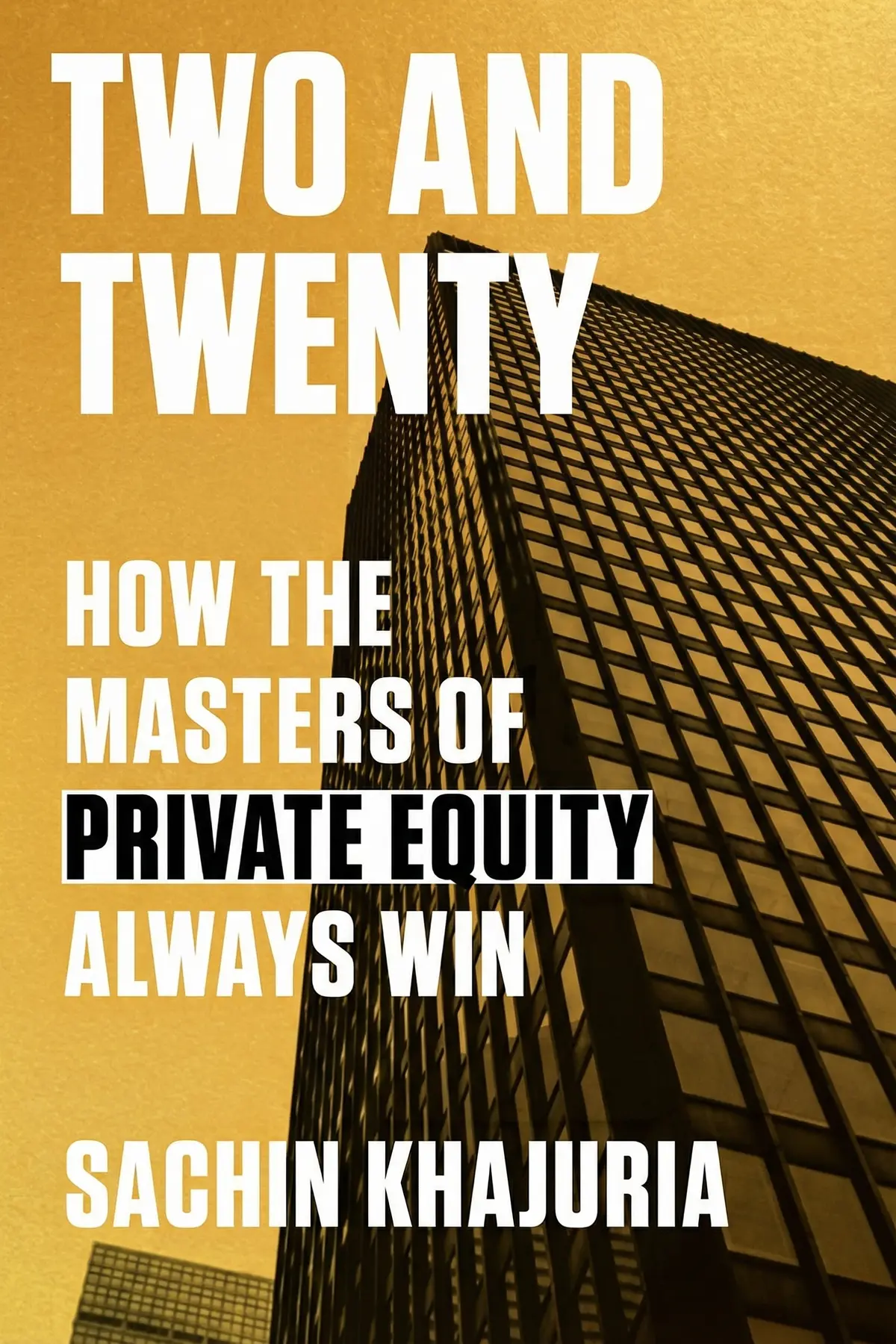
Table of Content
1. Introduction
59 sec
Private equity is often described as a club of the very rich growing richer on other people’s money, yet most people who resent it could not say what its firms actually do. In Two and Twenty, former Apollo partner Sachin Khajuria opens that closed door, and his first point is simple. These firms make money by buying companies in trouble, nursing them back to health and selling them for two or three times the price.
Many of us already take part through our pensions without knowing it. Khajuria sets out what success in the industry demands: heavy risk, small confidential teams, years of relentless work and a duty to protect investments that millions of pensioners rely on.
Follow him through one deal, from a grocery chain beaten by online delivery to a sale at a large profit, and you will be able to explain where the money comes from, who carries the risk and what it takes to work inside.
2. Picture private equity as a house flip with companies
1 min 41 sec
TV renovation shows offer a surprisingly accurate picture of a trillion-dollar industry. The twist is what gets bought: businesses close to collapse, which turn out to be exactly what these firms are hunting for.
3. Know the three risks behind every big return
1 min 37 sec
Returns that double or triple an investment sound perfect for anyone living on savings. Khajuria explains the catch, and why the people whose money is at stake often cannot walk away when they want.
4. See how two percent of a fortune makes partners rich
1 min 50 sec
A fee that sounds tiny on paper turns into one of the largest paychecks in modern business. The arithmetic shows why the firms behind your supermarket or dating app may be richer than you imagine.
5. Small, silent teams move faster than big ones
1 min 51 sec
Firms that control billions might be expected to run vast offices. Inside, Khajuria finds closed doors at the entrance, open doors upstairs, and teams so small that one mistake has nowhere to hide.
6. Learn what it takes to join a deal team
1 min 53 sec
A top degree and a job at Goldman Sachs are only the entry ticket. A fictional associate shows what the hiring process and the first assignment demand, and the price paid in nights and weekends.
7. Attack your own plan before your bosses do
1 min 47 sec
Four people take a grocery chain that lost to online delivery and sell it two years later for several times the price. The habit that made it possible works in almost any job.
8. Conclusion
1 min 05 sec
Khajuria’s case rests on who is relying on the result. A private equity firm charges a premium, and the money it puts at risk often belongs to millions of pensioners who need it to live on. Protecting that money matters for the firm’s name and profits, he argues, but most of all for them. A firm that cannot promise success, in his view, should not be holding their savings.
That standard shapes the people the field attracts. They are determined, willing to take risks that are both calculated and imaginative, and ready to give years of their lives to hard work. Money draws them in. What keeps them working long after they are millionaires, Khajuria says, is the satisfaction of finding opportunity where everyone else sees a failing business, and turning it into a gain shared by all.
So the next time a headline mentions a private equity buyout, look past the private jets. Ask what was broken, who is fixing it, how long the money is locked up, and whose retirement is waiting at the other end.
About this book
What is this book about?
Private equity has a poor reputation. People hear about partners with private planes and pay in the hundreds of millions, earned on money that is not theirs, and it feels unfair. Yet few of those critics know what these firms actually do, or how closely their own savings may already be tied to them. Sachin Khajuria, a former partner at Apollo, explains the business from the inside. He describes private equity as flipping on a giant scale: firms buy companies in crisis, rebuild them over several years and sell them for two or three times the price. He sets out the risks for investors whose money is locked away, the size of an industry now worth 12 trillion dollars, and the fee structure that gives the book its name. Readers then step inside a typical firm and follow a fictional associate through one deal, from the grueling hiring process to the rescue of a struggling supermarket chain. The result is a clear picture of how the money is made, who carries the risk, and what kind of person thrives in a field Khajuria believes cannot afford to lose.
Book Information
Who it's for
Curious where pensions go
Professionals with a pension who want to know how private equity uses their savings.
Weighing a finance career
Graduates and career switchers weighing a move into finance and its punishing hours.
Skeptical of buyout headlines
Readers who distrust buyout headlines and want to understand how a deal is actually run.
About the Author
Sachin Khajuria
Sachin Khajuria has worked in investment and finance for more than 25 years. He was a partner at Apollo, a major alternative asset manager, and later founded his own private investment business, Achilles Management. He also invests in funds run by firms such as Blackstone and Carlyle, which gives him a view of private equity from both sides of the table. He holds two economics degrees from the University of Cambridge.
Ratings & Reviews
Ratings at a glance
What people think
Listeners find the writing style accessible and easy to consume. That said, perspectives on the depth of information are split, with some considering it quite insightful while others disagree.
Top reviews
Cooper
Wow, what an incredible deep dive into the engine room of global finance. Sachin Khajuria has written a masterful guide to an industry that most people completely misunderstand. The book successfully demystifies private equity, showing that it’s not about raiding companies, but about the hard work of transformation. I loved the 'backstage pass' feel of the writing, especially the descriptions of the intense collaboration within deal teams. It’s inspiring to see how much detail goes into protecting investor capital and creating value. Some might find the tone 'cheerleading,' but it’s refreshing to see someone proud of the expertise and rigor required in this field. If you want to understand how the world’s biggest deals are actually made, this is the book for you. It’s an absolute must-read for any serious investor or finance professional. The insights into the 'Two and Twenty' model are particularly well-delivered.
Show moreWacharapol
Not what I expected at all, in the best way possible. I thought this would be a dry finance book, but it’s actually a compelling narrative about strategy and execution. Khajuria busts the myth that PE is just 'passive' investment. Instead, he shows the hands-on, grit-heavy process of turning around failing businesses. The 'Two and Twenty' title perfectly encapsulates the high-stakes nature of the game. I found the fictionalized case studies to be extremely helpful in visualizing the complex steps of a buyout. The book is easy to read and very well-paced, making it accessible even if you aren't a math whiz. It clearly explains why these firms are so elite and why the partners earn what they do. Truly a five-star effort that provides a perspective you won't find in the mainstream news. This is a vital read for anyone who wants to know who really pulls the levers of the economy.
Show moreRungtip
Finally got around to reading this, and it’s a fascinating look at the 'masters of the universe' in the modern age. Coming from a former partner at Apollo, the insights into deal-making and portfolio management feel authentic and lived-in. I particularly enjoyed the breakdown of how a firm evaluates an ailing company like a run-down supermarket chain. It’s not just about the money; it’s about the obsessive scenario planning and downside protection. The book is clearly tilted in favor of the industry, but that’s to be expected from an insider. You have to read between the lines to see the potential downsides, but the mechanics of the 'Two and Twenty' model are explained well. It’s an energizing read that made me want to brush up on my accounting and capital structures. Definitely worth it for the unique perspective, even if the tone is a bit too flattering at times.
Show moreSudarat
The world of private equity has always been a bit of a black box to me. This book does a great job of shining a light on how these massive firms actually operate day-to-day. Khajuria explains the 'Two and Twenty' structure in a way that makes sense, even if you don't agree with the high costs. I found the section on how partners transition from 'buying low' to 'selling high' particularly illuminating. While some reviews complain about the pro-industry bias, I think it’s valuable to hear the best-case argument for PE. The writing style is engaging and the chapters move quickly. My only real gripe is that the fictionalized examples can feel a bit like a sales pitch at times. Overall, it’s a solid 4-star read for anyone looking to understand the forces shaping the global economy. It helped me realize how much of our world is actually managed by these specialized firms.
Show moreWin
As someone who just finished their MBA, I found this to be a refreshing change of pace from standard textbooks. Khajuria brings the theories of capital management to life through his 'sketches' of deal teams and investment committees. The way he describes the internal culture of these firms—the secrecy, the elite talent, and the high stakes—is gripping. It really highlights the level of financial literacy required to succeed at the highest levels of the industry. I appreciate that he addresses the fees head-on, even if he defends them vigorously. To be fair, the book could have used more actual data to back up the 30% return claims. However, the prose is crisp and the narrative flow is excellent. It’s a great primer for anyone considering a career in alternative assets or just curious about the news headlines. It’s not perfectly balanced, but the insider expertise is undeniable.
Show moreElena
Ever wonder what actually happens in those high-rise boardrooms overlooking Central Park? Khajuria gives you a seat at the table, explaining the intense vetting process and the 'always-on' culture of the industry. The book is accessible and avoids the densest jargon, making it a quick read for the curious layperson. However, you have to take everything with a massive grain of salt. The author is an unabashed advocate for private equity, portraying it as a socially beneficial force that rescues dying companies. It’s informative regarding the 'Two and Twenty' fee model and the mindset of an investment committee. Yet, the reliance on idealized case studies prevents it from being a truly great business book. It’s a useful peek behind the curtain, even if that curtain is made of very expensive silk. I wish there was more talk about the math and less about the 'magic' of these managers.
Show morePakpoom
After hearing so much buzz about this title, I expected more meat on the bones. The book does provide a clear window into the grueling life of a PE professional, from the 12-month interview gauntlet to the midnight oil. If you are an aspiring analyst, you will find the career trajectory details quite helpful. On the other hand, the narrative 'sketches' are so heavily sanitized that they lose their impact. Khajuria presents the decision-making process as entirely emotionless and data-driven, which feels a bit hyperbolic. The truth is likely much messier than these 'perfect' scenarios suggest. It’s a decent introductory text that explains why institutional investors keep pouring money into these funds despite the high fees. I just wish there was more critical analysis regarding the risks and the potential for conflicts of interest. It's a quick, energizing read, but one that lacks the depth of a truly objective financial study.
Show moreThanit
Is it too much to ask for a balanced perspective on such a controversial industry? Khajuria clearly knows his stuff, but he’s far too close to the subject matter to be objective. The book is structured around these semi-fictional 'sketches' that always seem to end with the PE firm saving the day and making a 300% profit. It’s a bit repetitive and, frankly, quite arrogant in its tone. He talks about the 'Two and Twenty' fee structure as if it’s a divine right rather than a massive drain on capital. While the writing is easy to follow, the lack of actual data or any mention of failed deals makes it feel like a fairy tale. I learned a bit about the day-to-day life of an associate, but the constant lionizing of 'The Founder' got old very quickly. It misses the opportunity to discuss real risks like rising interest rates or supply chain disruptions.
Show moreHannah
Picked this up hoping for a 'Barbarians at the Gate' style expose, but it’s more like an extended recruitment pamphlet. The author describes the elite world of private equity with a level of breathlessness that is hard to take seriously. He portrays the firms as quiet, focused hubs of genius where everyone works until midnight and only drinks the finest office coffee. To be fair, he does a decent job explaining the hierarchy from analyst to partner. However, the substance is lacking because everything is 'fictionalized' to ensure the PE firms look like heroes. It completely ignores the social costs of aggressive cost-cutting and job losses. The prose is okay, but it needed a much more rigorous editor to prune the repetitive praise. It’s an okay primer for someone who knows absolutely nothing, but it won’t satisfy anyone with a real interest in finance. It feels like the industry is just genuflecting to itself.
Show moreWilliam
This was a massive letdown from start to finish. I expected a hard-hitting look at the mechanics of private equity, but what I got was a glossy brochure for the industry. Sachin Khajuria spends the entire book patting himself and his former colleagues at Apollo on the back. It feels like every chapter is just a fictionalized story where the private equity guys are 'masters of the universe' who never fail. Where are the actual numbers? Where is the talk about the debt-laden companies that go under after a buyout? Instead of a balanced analysis, we get 'business babble' and a plea to let everyday investors into these risky funds. If you want a real education in finance, look elsewhere. I genuinely feel like I need a refund for the time wasted on this cheerleader routine. It is simply a one-sided pitch for a fee structure that enriches a few at the expense of everyone else.
Show moreQuestions about this book
What is the main idea of Two and Twenty by Sachin Khajuria?
Khajuria explains private equity as company flipping on a huge scale. Firms buy struggling businesses cheaply, rebuild them over several years with small expert teams and sell them for two or three times the price. He argues that the generous two and twenty pay model reflects the risk involved, the intense workload and the duty owed to the pensioners whose savings are invested.
What does two and twenty mean in private equity?
It is how partners at private equity firms are paid. Clients pay a yearly fee worth 2 percent of the capital they invest, and the firm also takes 20 percent of the profits. Applied to a firm like Blackstone, which manages around 875 billion dollars, the fee alone is enormous, and Khajuria says the profit share is why senior partners reach 100 million dollars by their forties.
Why is private equity risky for investors?
Khajuria points to three things. Taking part requires very large sums, enough to buy a failing company and fund years of recovery. The money is locked away for an agreed period of years, unlike shares that can be sold at any time. And the rebuilt company may never sell for a high price, leaving investors only breaking even or taking a loss.
What does it take to work in private equity?
Through a fictional associate, Khajuria shows an elite path: top of the class at Wharton, an analyst job at Goldman Sachs, then a 12-month interview process with 20 senior partners. The work runs to midnight most nights and through most weekends. Deal teams have just four people, so each member carries huge responsibility, with nobody to rescue them from a costly mistake.
How can I apply the ideas in Two and Twenty?
If your pension uses private equity, find out how much is committed, how long it is locked away and what happens if a turnaround fails. Split any fund’s fees into what is paid regardless of results and what is paid for profit. At work, copy the deal team’s habit of having colleagues attack a plan before you present it.
Readers also enjoyed


Adults in The Room: My Battle With Europe’s Deep Establishment
Yanis Varoufakis


1929: Inside the Greatest Crash in Wall Street History--and How It
Andrew Ross Sorkin

23 Things They Don’t Tell You About Capitalism
Ha-Joon Chang
A Little History of Economics
Niall Kishtainy


A Splendid Exchange: How Trade Shaped the World
William J. Bernstein
AUDIO SUMMARY AVAILABLE
Listen to Two and Twenty in 15 minutes
Get the key ideas from Two and Twenty by Sachin Khajuria, plus 5,000+ more nonfiction titles.
- 5,000+ titles
- Listen as much as you want
- 7-day free trial
- Cancel anytime









