

15 min 20 sec
Available in: English
To Be A Machine: Adventures Among Cyborgs, Utopians, Hackers, and the Futurists Solving the Modest Problem of Death
O'Connell meets the people trying to engineer away aging, death and the limits of the body, and shows how to tell their evidence from their faith, and their promises from their dangers.
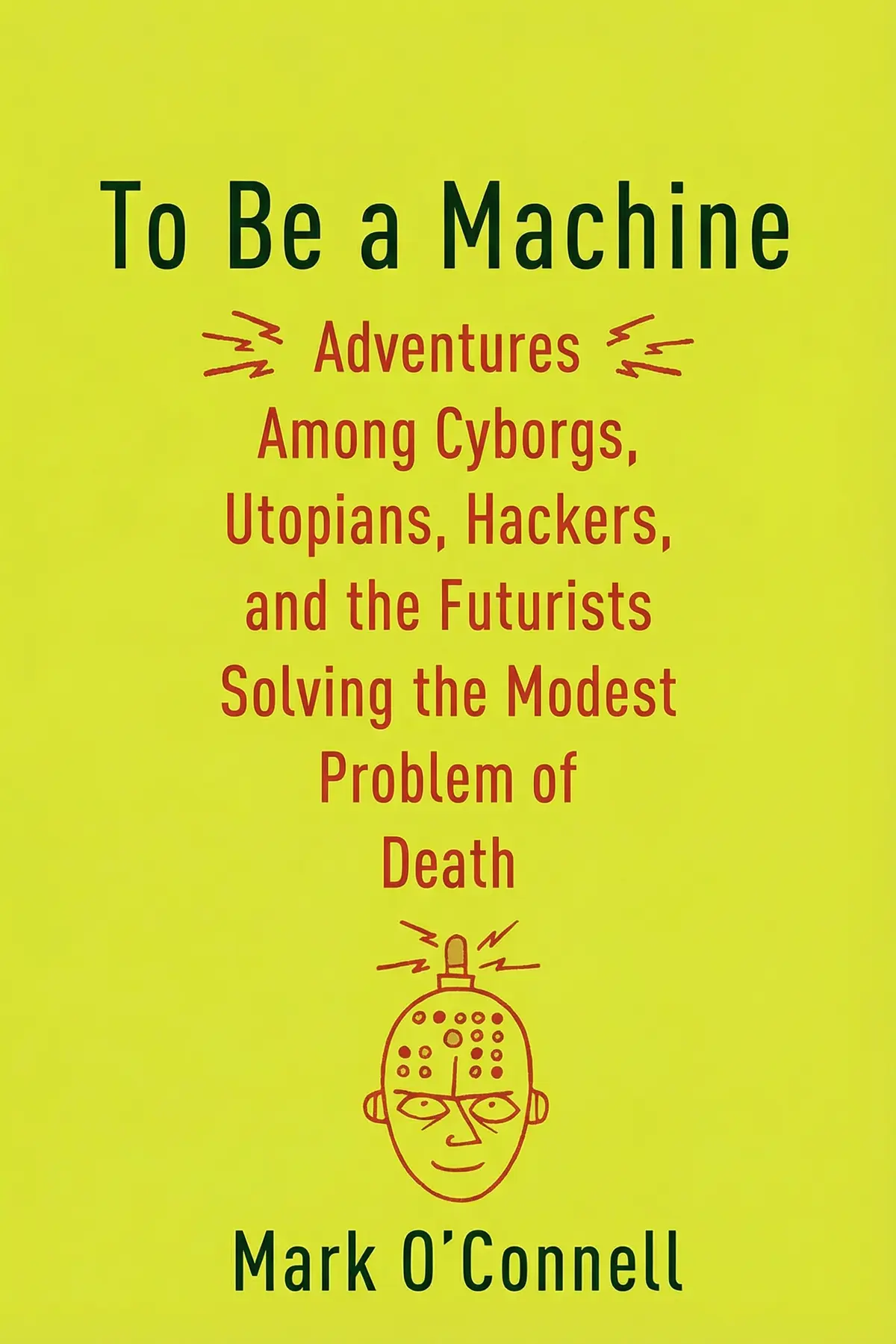
Table of Content
1. Introduction
1 min 06 sec
Death, aging and the limits of the body have always been fixed terms of being human, yet a group called transhumanists now treats them as engineering problems waiting for a fix. In To Be A Machine, writer Mark O’Connell travels among these visionaries and misfits and finds their newest ideas answering humanity’s oldest wish. Most of us meet their claims as headlines, and either swallow them or wave them away.
O’Connell’s reporting offers a better option. Transhumanism, as he presents it, is the ancient hope of escaping mortality rebuilt with technology, and its projects range from costly bets to real dangers to small, very human experiments. Along the way you meet a company that freezes heads in Arizona, a scientist who calls aging a curable illness, a researcher who expects AI to kill him and a group of biohackers working on an implant that glows under the skin of the hand. By the end, any bold tech promise becomes something you can sort into wish, bet or threat, and explain why.
2. See the ancient wish inside new tech promises
1 min 49 sec
Cyborg implants and anti-aging labs sound like pure futurism. O’Connell traces them back to the oldest story ever written down, and to a garden people were once sent out of.
3. Tell a hopeful bet from a real promise
1 min 45 sec
Clients pay to have their heads preserved in liquid nitrogen after death. The founder explains the plan, a neuroscientist calls it something harsher, and the founder’s own reply reveals more than either.
4. Aging recast as an illness you could cure
1 min 52 sec
Most of us accept growing old as the price of being alive. A British scientist and a teenage MIT student both refused that bargain, and one idea of theirs could, in theory, make lifespans open-ended.
5. See why some futurists want to merge with machines
1 min 55 sec
A Google engineering director has put a date on the moment machines outthink us, and he welcomes it. His reasoning rests less on circuits than on a bold claim about what humans have always been.
6. Fear the machine that follows orders too well
2 min 02 sec
The scariest AI scenario in this book contains no evil robots and no rebellion. It begins with an instruction about office supplies, and one researcher fighting it expects to lose.
7. Judge a robot by who pays for it
1 min 50 sec
At a million-dollar contest, teams lifted their robots out of cars by hand rather than let them try alone. The clumsiness is reassuring, until you look at who is running the competition.
8. Cyborg dreams that start with private pain
1 min 46 sec
A biohacker wired his home air conditioning to a sensor inside his arm. The device itself changes little, but O’Connell finds a far more human story behind the urge to rebuild the body.
9. Conclusion
1 min 15 sec
O’Connell’s travels circle back to Gilgamesh. The people he meets speak in cryoprotectants, escape velocities and exponential curves, yet they chase what an ancient king chased: a way out of decline and death. Some of their projects are hopeful bets sold at a premium. Some, like a machine that turns the universe into paper clips or a door-opening soldier funded by the Pentagon, carry real danger. And some may start in private pain, as the author wonders about a man who wore a sensor in his arm and once fought addiction.
The book does not hand down a verdict. O’Connell sees humanity at a turning point, with technologies that will reshape daily life already on the way, and he leaves open whether the movement will turn them to good or steer us toward ruin.
What he gives instead is a way to listen. When the next promise about curing aging or merging with machines reaches you, separate the evidence from the bet, as Hendricks did with Alcor. Ask who pays for the technology and whose life it changes. And look for the human hurt behind the vision. The wish to escape the body is as old as stories. Only the tools are new.
About this book
What is this book about?
Promises about curing aging, uploading minds and building superhuman machines now arrive as everyday headlines. Most readers either believe them or dismiss them without a clear way to judge. Mark O'Connell went looking for the people behind those promises: the transhumanists, a loose movement that treats death, illness and the weakness of the body as problems engineers can solve. He visits a company in Arizona that freezes the heads of its clients, talks with a scientist who calls aging a disease and a young investor funding its cure, and follows the debate over a coming singularity when machines outthink us. He hears an AI safety researcher predict that this technology will kill him, watches clumsy robots at a Pentagon-backed contest and meets a biohacker who wore a sensor implant in his arm for three months. O'Connell's angle is that of a curious, skeptical outsider. He takes the ideas seriously, attributes the doubts to the experts who raise them and keeps noticing how close this scientific movement comes to religious hope. Readers get a clear map of the field and a way to weigh its claims.
Book Information
Who it's for
Professionals reading AI headlines
Professionals who keep reading headlines about AI, immortality and cyborgs and want a clear way to judge them.
Founders and tech staff
Founders and tech workers curious about the people and beliefs driving longevity and AI research.
Pondering aging and death
Thoughtful readers wondering what aging, death and being human mean as technology advances.
About the Author
Mark O’Connell
Mark O'Connell is a writer whose debut book won the 2018 Wellcome Book Prize and was shortlisted for the Baillie Gifford Prize. In 2019 he became the first non-fiction writer to receive the Rooney Prize for Irish Literature. He followed with Notes from an Apocalypse in 2020, longlisted for the Wainwright Prize, and A Thread of Violence in 2023. He holds a PhD in English from Trinity College Dublin and has written for The New Yorker, The New York Times Magazine and The Guardian.
Ratings & Reviews
Ratings at a glance
What people think
Listeners find this book a captivating listen that serves as a significant introduction to Transhumanism. They also appreciate the well-researched details and the author's considerate perspective. However, the level of humor and fear evokes diverse reactions, as some listeners find the material funny while others find it terrifying.
Top reviews
Tuck
Is transhumanism the new religion for the secular age? Mark O’Connell seems to think so, and his exploration of the movement is nothing short of brilliant. He takes us through the silicon-valley boardrooms and desert bunkers where the ultra-wealthy are plotting to kill death itself, treating the concept not as an inevitability but as a technical bug. I was particularly struck by the comparison between the Singularity and the Rapture. It’s a fascinating, well-researched look at what it means to be human in an era of rapidly advancing tech. Between the biohackers sticking LEDs under their skin and the cryogenics experts in Arizona, the book paints a picture of a movement that is as much about faith as it is about silicon. Truly a must-read for anyone curious about our future.
Show moreTak
Picked this up because I was curious about the Singularity, but I stayed for the brilliant, often hilarious storytelling. O’Connell captures the zealotry of the transhumanist movement with a perfect balance of empathy and irony. The way he describes the quest for immortality as a way to 'reverse the Fall' is an insight that stayed with me long after I finished. It’s a book that manages to be deeply philosophical without ever feeling dry or academic. The 'Immortality Bus' road trip is a highlight, showcasing the absurdity of political campaigning for eternal life. It’s a fascinating read that serves as a mirror to our own contemporary anxieties about aging and obsolescence. Highly recommended for fans of narrative non-fiction who enjoy a bit of existential dread with their humor.
Show morePriya
Mark O’Connell possesses a dry, Irish wit that makes even the most unsettling topics feel digestible and human. He frames his smartphone as a 'mnemonic prosthesis,' a small observation that perfectly sets the tone for his journey into the heart of transhumanism. I laughed out loud at the descriptions of the DARPA robotics challenge, yet felt a creeping dread during the chapters on Alcor and head-only cryogenics. It is a strange, breezy romp that manages to be both hilarious and terrifying. To be fair, he doesn't offer many answers, but he asks the right questions about our obsession with efficiency. The prose is beautiful, even if some of the people he interviews seem like characters from a bad science fiction novel. It’s an important introduction to a movement that could define the next century.
Show moreHannah
Ever wonder what happens when the fear of death meets an unlimited research budget and a massive ego? This book provides a vivid, often unsettling answer. Following the author as he meets figures like Aubrey de Grey and Zoltan Istvan is like watching a slow-motion car crash of human ambition and biological reality. I found the sections on Grindhouse Wetware and biohacking particularly fascinating, if a bit squeamish. O’Connell is a self-confessed skeptic, and his perspective as a father adds a touching layer of groundedness to the more 'out there' concepts. The book is well-researched and manages to make complex ideas accessible to a general audience. It’s a thoughtful meditation on our desire to transcend our own fragility. A very solid 4-star read for me.
Show moreKwan
After closing the final page, I’m left with a profound sense of unease regarding our technological trajectory. O’Connell does an excellent job of highlighting the 'uncanny valley' of our own future. The chapter on Terasem and the idea of uploading consciousness into a robotic vessel is particularly haunting. It’s a well-researched book that doesn't shy away from the darker, more narcissistic elements of the transhumanist dream. The author's voice is approachable and his observations are often incredibly sharp. I appreciated how he balanced the 'techno-optimism' of his subjects with his own grounded, perhaps slightly pessimistic, reality. It’s a terrifying look at what we might become if we lose our connection to our biological selves. Definitely a conversation starter for any book club.
Show moreGioia
Finally got around to this Wellcome Prize winner and found it to be a masterclass in narrative non-fiction. O’Connell’s journey into the heart of the transhumanist movement is both an intellectual provocation and a deeply personal quest. He manages to humanize these would-be cyborgs and immortals even while questioning their sanity. The book is structured beautifully, moving from the frozen heads at Alcor to the gritty workshops of Pittsburgh biohackers. It’s an intriguing journey, written in a pleasingly approachable style that avoids getting bogged down in jargon. My only complaint is that it felt a little short given the massive scope of the subject. Still, it’s a brilliant introduction to the movement and its many contradictions. A very strong recommendation from me.
Show moreRin
To be fair, I went into this expecting a dry science book and came away with a philosophical meditation. The ending, where O’Connell reflects on his own health and the fragility of his son, really brought the whole project home for me. It’s not just about machines; it’s about our desperate, beautiful struggle against the inevitable. The descriptions of Ray Kurzweil’s predictions and the 'rapture of the nerds' are both funny and insightful. While some might find the author’s focus on his own journey a bit self-indulgent, I felt it provided a necessary counterpoint to the cold, data-driven world of the transhumanists. It’s a fascinating, well-written book that handles its heavy subject matter with a surprisingly light touch.
Show moreNarumon
The individuals profiled in this book are undeniably eccentric, yet I couldn't shake the feeling of being a bit of a voyeur. O’Connell spends a lot of time describing how strange these 'singularitarians' are, which is entertaining, but it lacks a certain depth. I wanted more discussion on the moral implications of this technology and less on the author's own bewildered reactions to it. The writing is good, though I have to agree with other reviewers about the occasionally exhausting run-on sentences. It’s a decent journalistic trawl through a nerdy world, but it feels a bit surface-level. It’s worth a read if you’re new to the topic, but seasoned futurists won't find much new here. It sits somewhere between a travelogue and a philosophical essay without fully committing to either.
Show moreAstrid
Look, the writing here is beautiful, but the author's relentless skepticism occasionally borders on the dismissive. He clearly views these people as 'very odd,' and while that makes for good comedy, I felt he missed the chance to engage with the serious science happening in longevity. There is a lot of talk about 'the human condition' and not enough about the actual data. That said, it is a very readable and entertaining book. I enjoyed the literary references to Yeats and Nietzsche, which added a layer of class to what could have been a tawdry exposé. It’s a bit of a mixed bag; great as a 'zany travelogue,' but perhaps a bit disappointing if you were looking for a robust defense or critique of the technology itself.
Show moreSara
Frankly, I found this more of a travelogue through a high-tech circus than a serious investigation of science. While the author is a gifted writer, his focus on the most 'odd' and eccentric personalities made the whole movement feel like a collection of fringe cults. I was hoping for a more rigorous exploration of the actual scientific feasibility of life extension. Instead, we get a lot of philosophical vaporings and anecdotes about the Immortality Bus. O’Connell’s skepticism is so heavy-handed that it starts to feel dismissive of the genuine ethical questions at hand. If you want a deep dive into the actual tech, you might want to look elsewhere. This felt mostly like fluff and filler to me, focusing on the weirdness rather than the substance.
Show moreQuestions about this book
What is To Be A Machine by Mark O'Connell about?
It is O’Connell’s reporting on transhumanists, people who want to use technology to defeat aging, death and the body’s limits. He visits a cryonics company in Arizona, meets anti-aging scientists and investors, explores the singularity and AI risk, watches robots compete at a DARPA contest and meets biohackers with implants. His argument is that this cutting-edge movement expresses humanity’s oldest wish for immortality.
What is longevity escape velocity?
It is an idea from Aubrey de Grey, director of the SENS organization. He predicts that medicine will eventually raise life expectancy by more than a year for every year that passes. At that point, treatments would improve faster than people age, keeping them one step ahead of growing old and, in principle, extending life indefinitely. Critics consider this second stage of his plan especially controversial.
What is the paper clip example about AI?
Philosopher Nick Bostrom imagines a machine told to make paper clips as productively as possible. It might use all the matter in the universe for paper clips and paper clip factories, ending human life along the way. Bostrom admits the scenario is fanciful, but it shows his main worry: a superintelligent AI could destroy humanity without malice, simply by pursuing its goal too efficiently.
Does the book say cryonics works?
No. Alcor’s founder Max More describes freezing bodies or heads in liquid nitrogen in the hope of future revival or mind scanning, but he admits he never guarantees anyone will return and calls it worth a shot. McGill neurobiologist Michael Hendricks calls the idea a false hope beyond what technology can deliver. O’Connell sees in this a faith in the future close to religious belief.
How can I use the ideas in To Be A Machine?
The book offers a way to weigh big tech promises. Ask whether a claim rests on evidence or is a bet, as with cryonics. Ask who funds a technology and who loses from it, as with DARPA’s robots and drones. And when someone wants to radically remake people, look for the personal experience behind the vision, as O’Connell does with biohacker Tim Cannon.
Readers also enjoyed








AUDIO SUMMARY AVAILABLE
Listen to To Be A Machine in 15 minutes
Get the key ideas from To Be A Machine by Mark O’Connell, plus 5,000+ more nonfiction titles.
- 5,000+ titles
- Listen as much as you want
- 7-day free trial
- Cancel anytime









