

15 min 16 sec
Available in: English
Thoughts Without a Thinker: Psychotherapy from a Buddhist Perspective
By Mark Epstein
A psychiatrist shows how Buddhist teaching and Freudian therapy trace pain to a mistaken idea of the self, and how meditation, compassion and plain attention to feelings and the body can ease that pain.
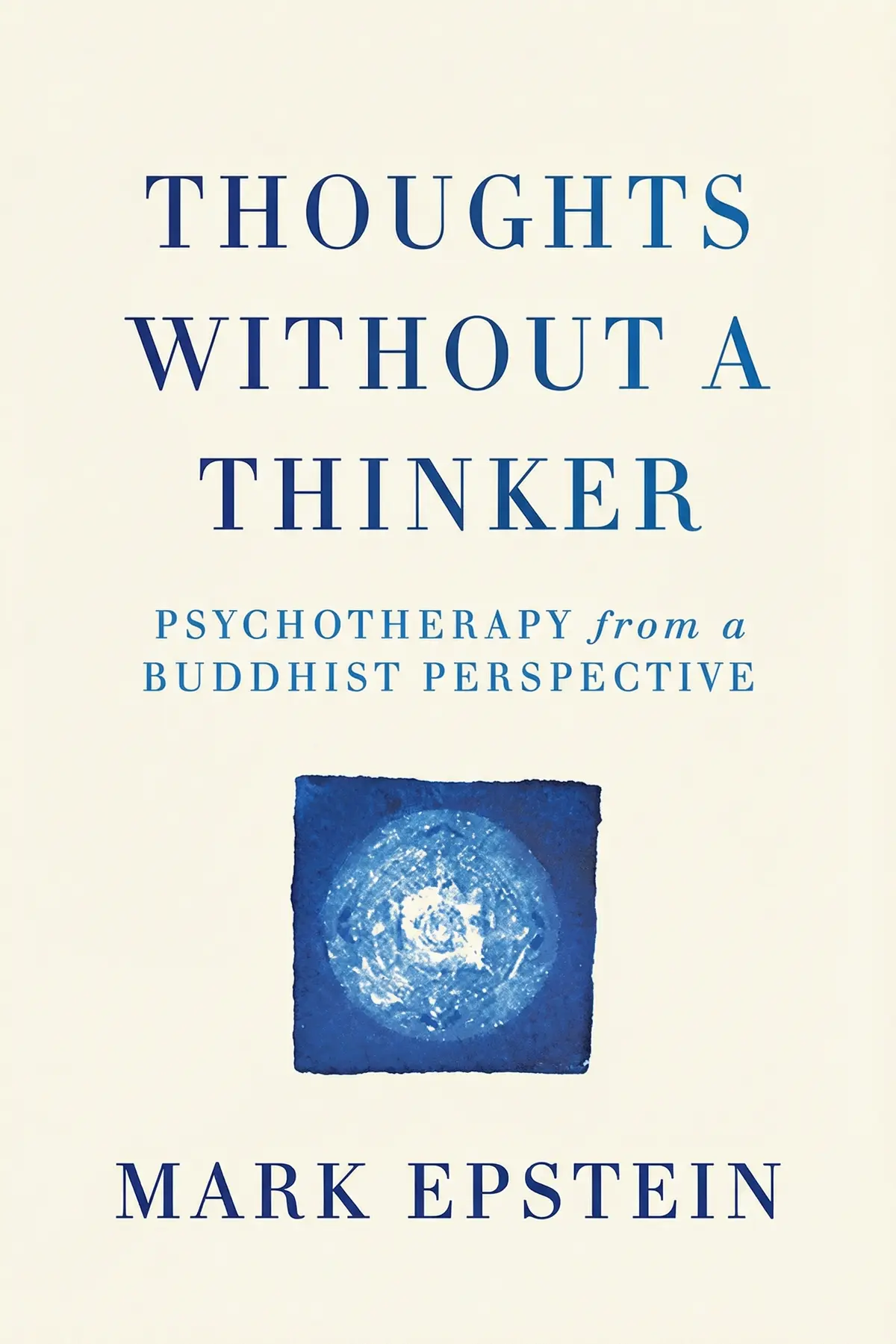
Table of Content
1. Introduction
1 min 06 sec
If your mind keeps swinging between feeling too important and feeling worthless, Mark Epstein suggests the trouble may lie in the very self you are trying to fix. In Thoughts Without a Thinker, the New York psychiatrist argues that Buddhism and Freud’s psychoanalysis reached a similar diagnosis: much mental suffering grows from a mistaken idea of who we are. Psychoanalysis tends to search for a true self buried under a false one. The Buddha went further and taught that the solid self we hold onto is itself the delusion.
Epstein’s case is that loosening that grip, through meditation, compassion and plain attention to the present, eases the pain of both the swollen and the shrunken self. Along the way come a wheel guarded by a snake, a rooster and a hog, ghosts with pinhole mouths, a composer who learned to love irritating noise and a patient who spent a whole night not making a phone call. What remains is a small set of practices for meeting painful feelings without being run by them.
2. Name the three forces behind everyday misery
1 min 55 sec
A snake, a rooster and a hog sit at the center of an ancient Buddhist painting. Centuries later, Freud, who had no interest in Buddhism, described almost the same forces and saw holding them down as the main source of psychological suffering.
3. The self you defend may be a story
1 min 54 sec
Enlightenment, in Buddhist terms, depends on understanding something that sounds impossible. Psychoanalysis offers a surprising account of how the confusion starts, and it begins in the first months of life.
4. Spot the two ways a warped self hurts
1 min 47 sec
The arrogant colleague and the friend who feels worthless seem to have nothing in common. Epstein traces both to the same childhood lesson about what it takes to be accepted.
5. Hold the self lightly, and emptiness too
1 min 56 sec
Asked point blank whether the self exists, the Buddha said nothing at all. His silence points to a way out of suffering, along with a trap that catches many people who try it.
6. Quiet the hungry ghost that always wants more
1 min 53 sec
Buddhist art shows ghosts with huge bellies and tiny mouths, forever starving. Epstein believes many modern adults live exactly like them, and he traces the hunger back to the nursery.
7. Sit with a painful feeling instead of fixing it
1 min 51 sec
A famous composer could not stand certain noises, and a heartbroken patient could not stop dialing one number. The same simple practice changed both of them, and it asks you to do almost nothing.
8. Anchor yourself in the present through breath and toothpaste
1 min 45 sec
Most mornings your mind is already at work while your hands are still at the sink. Epstein draws on the Buddha’s view that this split between mind and body leaves us feeling alienated, and that staying present makes things feel less alien.
9. Conclusion
1 min 09 sec
The title names where all this leads: thoughts that arrive and leave with nobody inside who needs to own, defend or fix them. Even the Buddha declined to say whether a self exists, and Epstein follows that lead with something practical. Notice when the self you guard swells into pride or shrinks into worthlessness, and see both as the same grip, held too tight.
What loosens it is ordinary. The next time sadness comes, let it stay instead of pushing it away. Epstein holds that painful moments show you most clearly how you cling to the idea of a self, and how that clinging creates suffering. When an urge pulls at you, treat it as Sid did, as weather to wait out until morning. When the mind races ahead, return to something the body is doing right now, a breath or the taste of toothpaste. And when the ego wants the center of the room, put someone else’s need first.
None of this needs a monastery or a therapist’s couch. Cage did not silence the noises that bothered him. He listened until they became music.
About this book
What is this book about?
Modern culture tells people to find and fulfill themselves. Mark Epstein, a New York psychiatrist, asks what happens if the self we are chasing is misunderstood from the start. He finds that two very different traditions, the Buddha's teaching and Freud's psychoanalysis, reached a similar diagnosis. Desire, anger and delusion drive human suffering, and delusion shows up as a false picture of who we are. Epstein follows that false self from early childhood into adult life. In some people it swells into narcissism. In others it shrinks into depression. In some cultures it shows up as endless hunger for more, and in others as smothered pride. Psychoanalysis tries to dig out a true self. Buddhism goes further and questions whether a fixed self exists at all. The book's practical side comes from that Buddhist angle. Readers meet meditation, compassion, bare attention to feelings and mindfulness of breath and body, through stories such as a composer who learned to enjoy irritating sounds and a patient who stayed with his pain for a whole night instead of making a phone call.
Book Information
Who it's for
At odds with themselves
People caught between feeling arrogant and feeling worthless who want a calmer relationship with themselves.
Meditators curious about psychotherapy
Meditators curious how Buddhist ideas line up with Freud and modern therapy.
Stuck in painful urges
Anyone stuck in craving, loneliness or obsessive urges who wants a way to feel pain without acting on it.
About the Author
Mark Epstein
Mark Epstein, born in 1953, is an American psychiatrist with a private practice in New York City. He earned both his undergraduate and medical degrees at Harvard University. His writing explores where Buddhist teaching and psychotherapy meet, bringing the Buddha's ideas together with Sigmund Freud's approach to trauma. His other books include Advice Not Given and The Trauma of Everyday Life, which reads the Buddha's spiritual path in light of childhood trauma.
Ratings & Reviews
Ratings at a glance

What people think
Listeners find this work profoundly enlightening, especially valuing the way it merges psychoanalytic concepts with Buddhist psychological principles. Additionally, the writing is clear and easy to grasp, leading listeners to view it as a helpful resource for self-reflection; one listener even remarks that it functions as an excellent primer on Winnicott. Nevertheless, opinions on its clarity are varied, as some perceive the text as simple to digest while others find the material difficult to track.
Top reviews
Pla
Picked this up hoping for a casual intro to meditation, but it turned into a much deeper dive into the architecture of the mind. Mark Epstein manages to bridge the gap between Western psychoanalysis and Eastern philosophy without making it feel like a forced marriage. I particularly enjoyed how he brings in Donald Winnicott’s ideas to ground the more abstract Buddhist concepts. The prose is surprisingly clear, avoiding the dense jargon that usually bogs down these types of academic crossovers. While some parts felt a bit abstract, the overall impact on my self-examination has been profound. Truth is, I hadn't realized how much my Western upbringing colored my view of 'selfhood' until reading this. It's a rare book that makes you rethink your entire internal dialogue. It offers a level of intellectual rigor that is often missing from the current mindfulness trend.
Show moreGioia
This book fell into my hands during a particularly dark period of depression, and it served as a lifeline when I felt trapped in my own head. For years, I had tried to 'think' my way out of my problems, only to realize through Epstein’s writing that the thinker was the problem itself. His explanation of sunyata, or emptiness, was the first time that concept actually clicked for me in a way that felt practical rather than mystical. It’s not just a book for clinicians; it’s a manual for any soul looking to bridge the gap between knowing their demons and actually dealing with them. I will say, you probably need at least a passing interest in psychology to stay engaged. Otherwise, the references to Bion and Freud might feel a bit alienating. This is a profound, life-changing work.
Show moreYongyut
As someone who has spent years on the therapist's couch, this book provided the missing piece of the puzzle. I’ve always felt like I understood my childhood trauma intellectually, but I didn't know how to move past the 'story' of myself. Epstein’s focus on the capacity to 'be' rather than 'do' shifted my entire perspective on what healing actually looks like. The integration of Winnicott’s 'holding environment' with the practice of meditation is nothing short of brilliant. It’s a deep, challenging read that requires you to slow down and sit with your own thoughts. Not gonna lie, I had to reread several sections to really grasp the nuances of his arguments. It is easily one of the most important books I’ve read on the nature of the human mind and its capacity for liberation.
Show moreAurora
This book is a masterclass in clarity. It’s rare to find a psychiatrist who can speak so eloquently about the spiritual path without losing their clinical edge. Epstein takes a 'true north' approach, guiding the reader through the nightmare of the egoic mind toward a place of sustained, non-judgmental awareness. I especially appreciated his take on narcissism and how it serves as a barrier to genuine connection. By treating the ego as a process rather than a static thing, he opens up a door for real, lasting change. It’s a beautiful, intelligent piece of writing that feels like a warm conversation with a very wise mentor. Highly recommended for any seeker who wants more than just superficial self-help and is willing to do the hard work of introspection.
Show moreAna
Honestly, the chapter on the analogies of the wheel of life was a bit too arcane for my taste. I almost put the book down there, but I'm glad I pushed through to the sections on vipassana and insight meditation. Epstein makes a compelling case for why therapists need to develop the capacity to sit in silence with their patients. It’s an insightful guide for self-examination, though it definitely leans heavily on a psychodynamic framework. If you’re into cognitive-behavioral therapy, you might find his approach a bit esoteric or even outdated. Overall, it’s a thoughtful exploration of how we can use mindfulness to dismantle the rigid structures of the personality. It’s a must-read for anyone who is serious about integrating a meditation practice into their daily life.
Show moreYuwadee
Finally got around to reading this classic, and I was struck by how ahead of its time it must have been when first published. Epstein writes with a certain grace and aplomb that makes even the most difficult concepts, like the lack of a permanent self, feel accessible. He avoids the breathless, 'new-agey' tone that ruins so many books on mindfulness, opting instead for a sober and clinical perspective. The case studies he includes are particularly helpful because they show patients who are still struggling, which feels much more authentic than a perfect success story. My only gripe is that the first few chapters are a bit slow as he sets the historical stage. Once he gets into the meat of the meditative techniques, though, it’s quite hard to put down.
Show moreTantipat
Look, this is an important work, but I think it’s specifically geared toward a very narrow audience. If you aren't already familiar with both Freud and basic Buddhist tenets, you might be lost within the first fifty pages. I found the author's attempt to reconcile the 'strong ego' of psychology with the 'no-self' of Buddhism to be fascinating but ultimately a bit circular in its reasoning. It’s a bit of an intellectual exercise that requires patience. That said, his writing is mercifully low on jargon compared to other books in this niche. It serves as a decent introduction to how ancient philosophy can fill the gaps left by Western medicine. I would recommend it to anyone who feels like their current therapy has hit a plateau.
Show moreThitiwan
After hearing so many people recommend this in my meditation circle, I finally decided to see what the hype was about. Epstein offers a brilliant synthesis of the 'empty' self and the functional ego, arguing that we don't need to destroy the ego but simply understand its fluid nature. The chapter on the Wheel of Life was a bit dense for me, yet it provided a fascinating framework for understanding my own neurotic patterns. I appreciated that he didn't promise a 'miracle cure' for suffering. Instead, he presents a sober, intellectual road map for those of us who have found traditional Western therapy slightly lacking. Personally, I think you need a strong background in psychology to really appreciate his arguments, otherwise, it feels a bit out of reach.
Show moreAiden
Ever wonder why your years of talk therapy haven't quite reached that deepest level of internal peace? Epstein argues that Western psychology is great at identifying the 'I,' but it often stops short of showing us how to live without being enslaved by it. While I found the sections on Buddhist psychology incredibly enlightening, the author’s obsession with psychoanalysis made several chapters feel like a chore. Look, I found the tone a bit too academic at times, which made it hard to stay focused during a long commute. It’s a solid 3-star read for me because the insights are definitely there, but you have to dig through a lot of dense, specialized theory to find them. It is certainly not for the casual reader looking for a quick self-help fix.
Show moreWacharapol
I simply could not get into this. It was way too steeped in old-school Freudianism for my liking, and although clearly well-researched, the parallels between the two ideologies seemed entirely forced. To be fair, if you are a die-hard fan of Freud or currently in psychodynamic therapy, this might be your holy grail. However, for a modern reader looking for practical mindfulness insight, the approach feels incredibly arcane and far too dense. Reading this felt like a massive, uphill slog. I was hoping for something about the actual practice of meditation, not a repetitive lecture on the id and the ego. It just felt like the author was trying too hard to make two very different worlds fit together.
Show moreQuestions about this book
What is the main idea of Thoughts Without a Thinker?
Mark Epstein argues that Buddhism and psychoanalysis both trace much mental suffering to a mistaken idea of the self. Desire, anger and delusion, called the three poisons, sit in the hub of the Wheel of Life in Buddhism, and Freud described comparable forces as Eros and Thanatos. Where psychoanalysis looks for a true self, Buddhism questions whether any fixed self exists, and its practices loosen that attachment.
How does Mark Epstein connect narcissism and depression?
Epstein sees both as problems of a self that is the wrong size. Children often learn to act as someone better or more confident than they feel, which warps their sense of self. Narcissism reflects an inflated self, with grandiosity, arrogance and a hunger for admiration. Depression reflects a deflated self, with thoughts of not mattering, plus emptiness, alienation and guilt. Buddhist practice addresses both by easing attachment to the self.
What is bare attention in Buddhism?
Bare attention means noticing sounds, sensations or emotions openly, without judging them. The composer John Cage used it to accept and even enjoy noises he once found irritating. Epstein applied it with a patient named Sid, who was obsessively calling a woman named Rachel. Sid spent a night feeling his pain without picking up the phone, and that became his first step toward recovery.
Who are the hungry ghosts in Thoughts Without a Thinker?
Hungry ghosts are figures from the Buddhist Wheel of Life with huge bellies and tiny mouths, so they crave constantly and are never satisfied. Epstein uses them to describe a restless wanting he finds common in the West, driven by pressure to keep acquiring and by loneliness that often traces back to childhood feelings of abandonment in small, isolated families.
How can I apply the ideas in Thoughts Without a Thinker?
Epstein’s advice is to let painful feelings stay instead of pushing them away, since those moments reveal how you cling to the idea of a self. Practice bare attention by naming an urge and letting it pass without acting. Use mindfulness in ordinary routines, such as noticing the brush and the taste of toothpaste in the morning, and follow your breath. Compassion, putting others’ needs first, keeps the ego in check.
Readers also enjoyed




Alcoholics Anonymous
Alcoholics Anonymous World Services

A New Earth: Awakening to Your Life’s Purpose
Eckhart Tolle

A Liberated Mind: How to Pivot Toward What Matters
Steven C. Hayes

Aflame: Learning from Silence
Pico Iyer
AUDIO SUMMARY AVAILABLE
Listen to Thoughts Without a Thinker in 15 minutes
Get the key ideas from Thoughts Without a Thinker by Mark Epstein, plus 5,000+ more nonfiction titles.
- 5,000+ titles
- Listen as much as you want
- 7-day free trial
- Cancel anytime









