
14 min
Available in: English
 ไทย
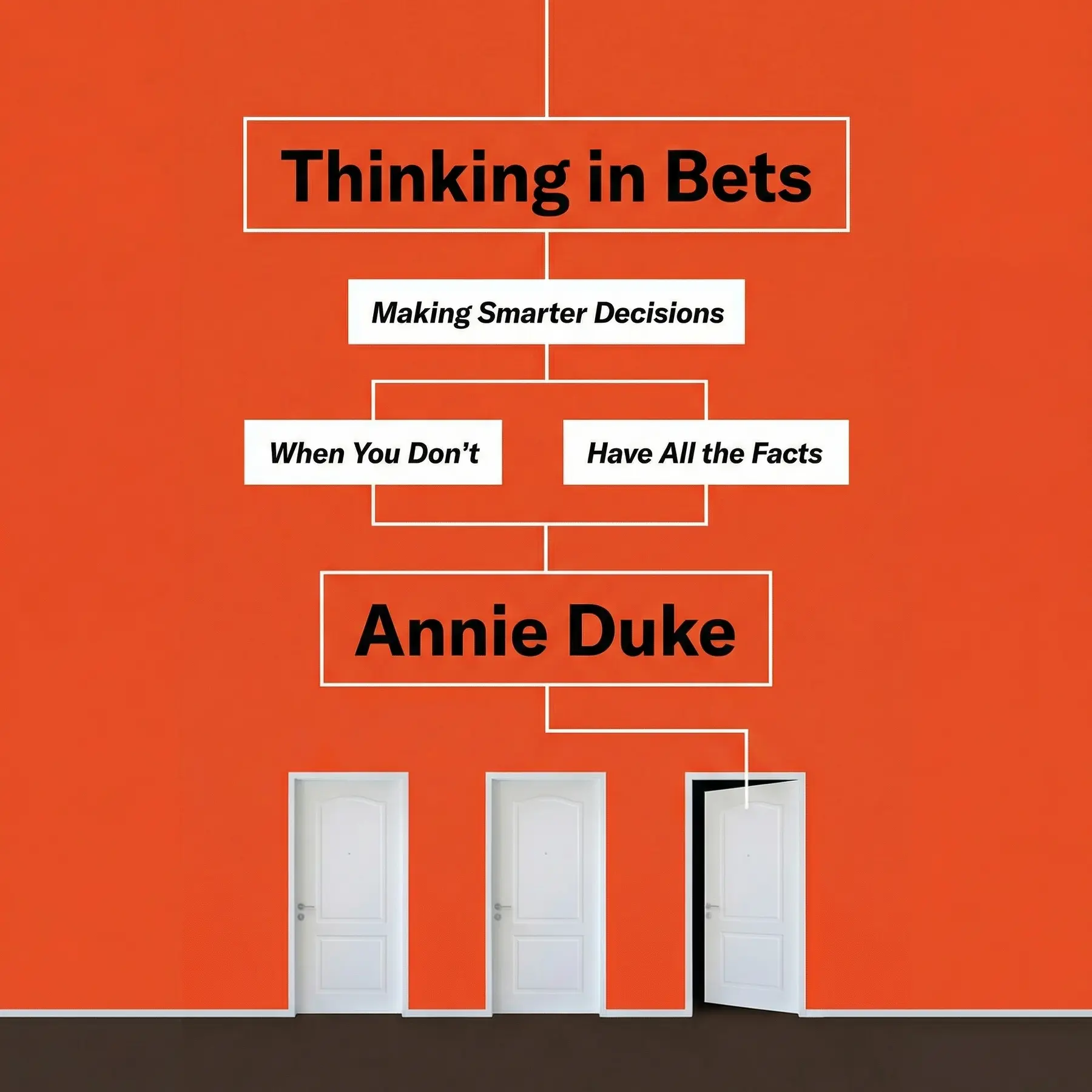
EnglishไทยThinking in Bets: Making Smarter Decisions When You Don’t Have All the Facts
By Annie Duke
Annie Duke shows how to judge decisions by their quality instead of their luck, test your beliefs before acting, learn honestly from results and plan around uncertainty, using lessons drawn from professional poker.
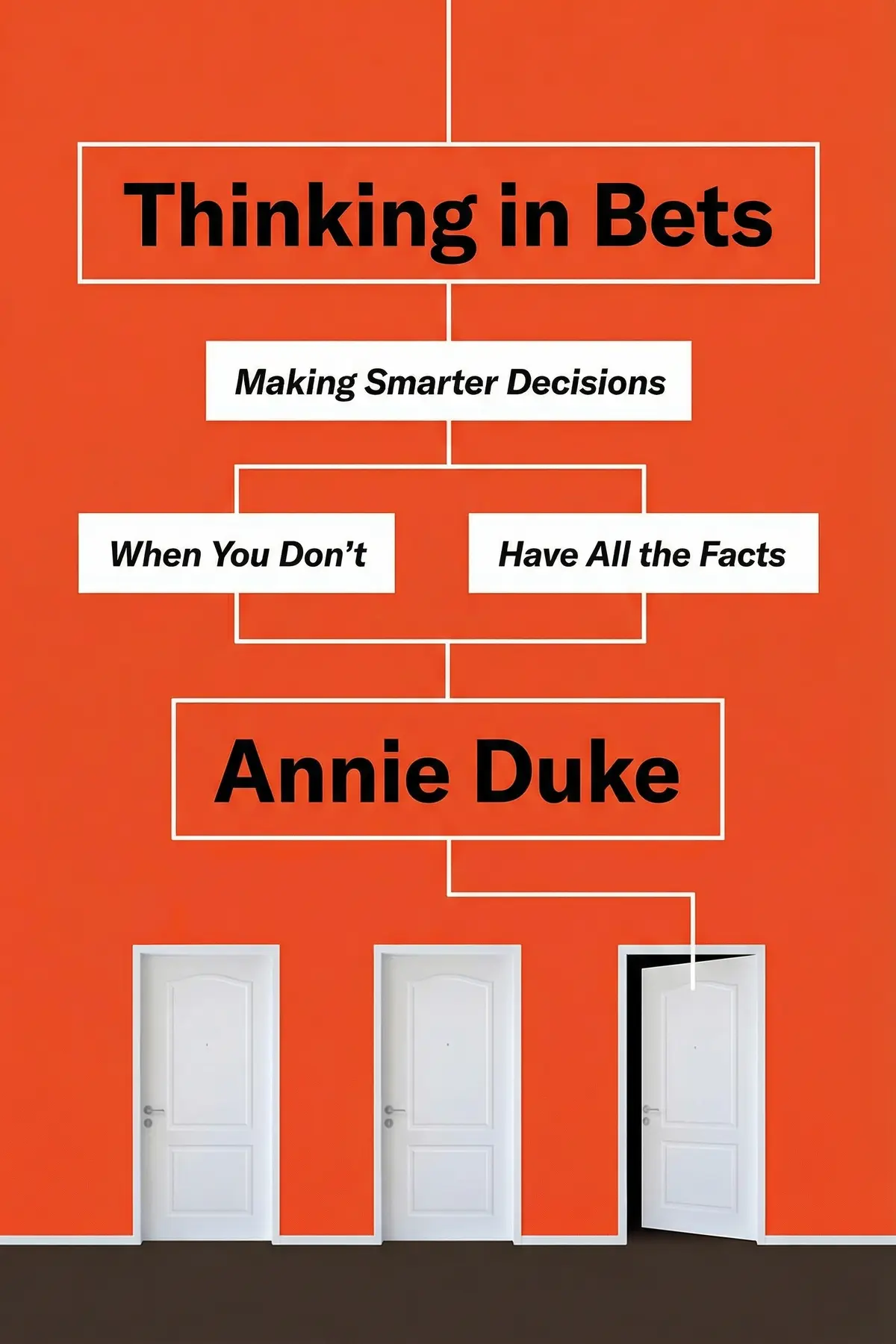
Table of Content
1. Introduction
58 sec
If you replay every bad result and call yourself a fool, or every good one and call yourself clever, you are grading the wrong thing. In Thinking in Bets, former professional poker player Annie Duke argues that a decision and its outcome are separate, and most of us blur them. Life, in her view, works like a poker table: you never see every card, and luck always plays a part.
That makes each choice, from a job offer to a house, a bet on how the future will unfold. Duke’s throughline is simple. Once you treat decisions as bets instead of right or wrong calls, you can check your beliefs before you act, learn honestly from what follows and plan around uncertainty instead of pretending it away.
Her examples run from a famous Super Bowl play call to a poker champion who spent his victory dinner hunting for his own mistakes. Each one ends in a habit you can try the next time a choice matters.
2. Judge a decision by its quality, not its result
1 min 37 sec
One play call turned a respected coach into a national punchline overnight. Duke argues the critics were judging something else entirely, and the same error shapes how you rate your own choices at work.
3. Test any belief by asking if you'd bet
1 min 44 sec
Your brain signs off on new ideas long before it checks them, and a Harvard experiment caught it in the act. Duke’s fix takes two words and works whether or not money is involved.
4. Spot when you blame luck and claim credit
1 min 43 sec
In multi-car crashes, 91 percent of drivers pointed the finger at another party, and a single baseball fan endured harassment for more than ten years over a ball that many other people had also reached for. The pattern explains why reviews so often teach the wrong lesson.
5. Turn every win into a lesson
1 min 43 sec
One of poker’s greatest players celebrated a crushing victory by listing what he did wrong. Duke explains how that odd habit keeps your pride intact while stripping away the stories that flatter you.
6. Build a circle that refuses bad-luck stories
1 min 49 sec
A poker legend shut down Duke’s complaint mid-sentence, and it changed how she thought for good. The right group can do the same for you, but only if it agrees on a few unusual rules.
7. Four rules that keep a group honest
1 min 42 sec
Scientists, poker players and the Catholic church all found ways to stop a group from fooling itself. Duke gathers their methods into one short code any team can adopt at its next review.
8. Make your future self an ally
1 min 40 sec
A comedian’s running feud with his own morning self describes a mistake almost everyone makes. Duke offers simple ways to bring tomorrow into today, including one that works by picturing failure first.
9. Conclusion
1 min 04 sec
Duke’s most lasting image may be that spectator at the charity table, shouting that she had been wrong when the 24 percent hand came in. Most of us play that spectator more often than we admit, about our own choices and about everyone else’s. Thinking in bets replaces the scoreboard with a better test: given what I knew and the odds I faced, was this a sound wager? You don’t need to gamble to use it. A stake of any kind, money or pride, pushes us to check what we believe, weigh other explanations and stay ready to change our minds.
The practice can start small. Before you argue for a view, ask yourself what you would put on it and at what odds. After a result, good or bad, split it into luck and choice before drawing a lesson, and keep the outcome out of the room when others judge your reasoning. Before a plan begins, imagine it has already failed and write down what broke.
Uncertainty never leaves the table. What you control is the quality of the bet you place on it.
About this book
What is this book about?
Most people grade their choices by how things turned out. A lucky result feels like proof of good judgment, and an unlucky one feels like proof of failure. Former professional poker player Annie Duke argues that this habit makes it almost impossible to see our real mistakes. Her alternative is to treat every decision as a bet. Life, like poker, deals in incomplete information and luck, so a choice can be sound and still lose. Duke shows how our brains accept beliefs too easily, how self-serving bias distorts the lessons we take from results, and how a simple wager changes the way we think. She draws on experiments by Daniel Gilbert, accident reports studied by Robert MacCoun, a famous Super Bowl play call and her own years at the poker table. Readers get practical tools: asking whether they would bet on a belief, splitting results into luck and skill, building a truth-seeking group with clear rules, and using 10-10-10, backcasting and premortems to protect their future selves.
Book Information
Who it's for
Making big uncertain calls
Managers and founders who make big calls with incomplete information and want to judge them fairly.
Stuck replaying bad results
Professionals who replay bad results for weeks and want a clearer way to learn from them.
Team leads running reviews
Team leads who run project reviews and want honest discussion instead of blame.
About the Author
Annie Duke
Annie Duke studied cognitive psychology at the University of Pennsylvania on a National Science Foundation fellowship, then became a professional poker player. She won the National Heads-Up Poker Championship in 2010 and has since retired from the game. She now writes, coaches and speaks on decision-making, and her books include How to Decide. She co-founded The Alliance for Decision Education, which teaches decision skills to students, and helped start the non-profit Ante Up for Africa with actor Don Cheadle.
Ratings & Reviews
Ratings at a glance
What people think
Listeners describe the content as captivating and clear, highlighting the in-depth psychological perspectives and functional strategies for making choices. They also value the book's utility for individuals in decision-making roles and its intellectually stimulating themes. Opinions differ regarding the total length, as some listeners find it too short while others consider it too long.
Top reviews
Priya
Ever wonder why you make a 'good' decision and still end up with a terrible outcome? This book finally explains that phenomenon in a way that clicked for me. Not gonna lie, the section on the 2016 election pollsters changed how I view data and predictions forever. Duke explains that a 30% chance of an event happening isn't a failure of the model if that event actually occurs; it’s just the nature of probability. I’ve started applying the 'Thinking in Bets' framework to my own career moves and even small daily choices. It’s incredibly freeing to realize that you can only control the process, not the results. This is an engaging, thought-provoking resource that provides actual mental frameworks instead of just vague self-help advice. It’s easily one of the most useful books on my shelf for navigating an uncertain world.
Show moreKwame
As someone who manages a large team, I found the strategies for group decision-making to be the most valuable part of the book. We often fall into the trap of 'groupthink' or following the loudest voice in the room. Duke’s suggestion to conduct 'pre-mortems'—imagining a project has failed before it even starts—has already saved us from a few major blunders. I’ll be blunt: it’s hard to look at your own mistakes objectively. We are all biased. But by adopting a probabilistic mindset and viewing every choice as a bet, it becomes much easier to trade ego for accuracy. The prose is sharp and the concepts are immediately applicable to real-world scenarios. I’ve already recommended this to three of my colleagues. It’s a game-changer for anyone who has to make tough calls under pressure.
Show moreAmelia
Annie Duke brings a fascinating perspective from the high-stakes world of professional poker to the mundane decisions we face daily. In my experience, most business books try to simplify success into a series of 'right' moves, but Duke correctly identifies that life is more like poker than chess. There is hidden information and a massive element of luck that we usually ignore to protect our egos. I loved the deep dive into 'resulting'—the tendency to equate the quality of a decision with the quality of the outcome. The writing is conversational and accessible, even when she’s discussing statistical probability and cognitive biases. My only minor gripe is that the book could have been tightened up by about fifty pages. Still, the practical techniques for creating a 'decision pod' and acting as each other’s bullshit detectors are worth the price of admission for any serious leader.
Show moreAir
After hearing about Duke's career as a poker champion, I expected more 'tells' and 'bluffs,' but I was pleasantly surprised by the deep dive into cognitive science. The distinction between luck and skill is a fraught endeavor for most of us, especially when our pride is on the line. Personally, I found the chapter on 'hindsight bias' and how we rewrite our own history to be incredibly convicting. We tend to attribute our wins to skill and our losses to bad luck, which is a recipe for stagnation. Duke’s advice on how to build a support network that challenges your biases rather than affirming them is pure gold. While the book is a bit repetitive in the latter half, the quality of the core insights makes it a must-read for anyone in a high-stakes environment.
Show moreOrathai
Picked this up on a whim and ended up highlighting half the pages. The way Duke breaks down the 'resulting' fallacy is eye-opening. We are so conditioned to look at the scoreboard to tell us if we did a good job, but in reality, the scoreboard can be a liar. Gotta say, the narrative style is very engaging, and I enjoyed the glimpses into the poker world even if I wish there were more of them. It’s a very well-written book that manages to make complex behavioral economics feel intuitive. My only complaint is that the author sometimes summarizes other researchers' work in a way that feels a bit redundant if you've read much in this space. However, for a general audience, this is an excellent and practical guide to better thinking.
Show moreMontri
Finally got around to reading this after seeing it on every 'must-read' list for business leaders. Bottom line: it lives up to the hype for the most part. The central takeaway—that a 90% probability of success still means you will lose 10% of the time—is something we intellectually know but emotionally refuse to accept. Duke teaches you how to embrace that uncertainty rather than fear it. The writing is punchy, though some of the examples feel a bit dated now. I appreciated the step-by-step plan for assessing risk before making a move. It’s a solid resource for decision makers, even if it does repeat its primary thesis a few too many times across the six chapters. Definitely worth a spot on your nightstand if you're looking to sharpen your mental frameworks.
Show moreMaria
The distinction between chess and poker as a metaphor for life is worth the price of admission alone. In chess, all the pieces are on the board and the game is theoretically solvable. Life isn't like that. Life is messy, full of hidden information, and driven by luck. For what it's worth, I think Annie Duke does a masterful job of bridging the gap between academic psychology and the 'street wisdom' of the poker table. Some reviews mention the repetition, and while it’s there, I think it helps solidify the concepts for readers who aren't used to thinking in percentages. It’s a delightful, refreshing vantage point on how we often sabotage our own growth by fearing the 'bad' outcome of a 'good' decision. A very solid 4-star read.
Show moreKoi
If you’ve already spent time with Kahneman or Thaler, you might find a lot of this material redundant. Look, the central takeaway is solid: make decisions based on the facts you have, and don't beat yourself up if luck goes against you. However, the author spends a significant amount of time paraphrasing existing psychological research without adding enough of her own unique poker-earned wisdom to make it feel fresh. The poker stories are the best part, but they are surprisingly sparse compared to the academic summaries. It’s a decent introductory text for someone brand new to decision science, but for a seasoned reader of the genre, there isn't much new information here. It’s a well-written book, but it lacks the depth of the 'street wisdom' I was hoping for based on Duke’s impressive professional background.
Show moreBunyarit
The core concept is brilliant, but it feels like it was stretched out to meet a publisher's page requirement. Truth is, this book could have been a tweetstorm or a very effective 30-page white paper. I found myself skipping ahead several pages at a time only to find the author still hammering home the same point about the Pete Carroll play or the difference between poker and chess. It’s not a bad book, but the signal-to-noise ratio is a bit off. To be fair, the conversational tone makes it a quick read, and the scientific concepts are explained in a way that anyone can understand. It just lacks the 'meat' I expected from a professional gambler. If you want a light introduction to probabilistic thinking, this is a safe bet, but don't expect a masterclass in strategy.
Show moreJong
This book should have been a long-form essay rather than a full-length publication. The core premise—that we shouldn't judge a decision solely by its outcome—is powerful, but it's repeated ad nauseam until it loses its impact. Frankly, the middle section felt like a shallow literature review of behavioral economics that I’ve already encountered in much better books like 'Thinking, Fast and Slow.' The author leans heavily on the Pete Carroll Superbowl call, which is a fine anecdote, but it doesn't justify the filler that pads out the remaining chapters. I was disappointed to find that nearly 40% of the page count is just notes and references. It feels like a word-count quota was the primary driver here. If you’ve spent any time on productivity Twitter, you've likely already absorbed the best parts of this book without having to trudge through the repetitive prose.
Show moreQuestions about this book
What is the main idea of Thinking in Bets?
Annie Duke argues that decisions are bets made with incomplete information and some luck, so a good choice can still produce a bad result. Judging decisions only by outcomes, a habit poker players call resulting, hides our real mistakes. Thinking in probabilities helps us test beliefs, learn accurately from what happens and plan for uncertainty instead of pretending we can remove it.
What is resulting in Thinking in Bets?
Resulting is the poker term for judging a decision by its outcome. Duke’s main example is Pete Carroll’s pass call at the end of Super Bowl XLIX, widely mocked after it was intercepted even though she considers it a fairly reasonable call. She also notes that nobody who drives home drunk and arrives safely should conclude it was a smart choice.
How can I apply Thinking in Bets at work?
Ask whether you would bet on a belief before defending it. After a result, estimate how much came from luck and how much from your choices. When a team reviews a decision, describe the reasoning and information first and withhold the outcome, as Duke did with her poker students. For new plans, run a premortem by imagining failure and listing what went wrong.
What does CUDOS mean in Thinking in Bets?
CUDOS is a set of norms from sociologist Merton R. Schkolnick that Duke uses for truth-seeking groups. Communism means sharing all relevant information. Universalism means applying one standard to every source. Disinterestedness means keeping the outcome from biasing the analysis. Organized skepticism means friendly, open questioning of what the group really knows, much like a devil’s advocate.
Who should read Thinking in Bets?
It suits anyone who makes important choices without full information: managers, founders, investors, students choosing what to study and people weighing a job or a house. It is especially useful for those who dwell on bad results or blame luck, and for teams that want reviews focused on reasoning. No poker knowledge is needed, since Duke explains every example from the table.
Readers also enjoyed


Acting with Power: Why We Are More Powerful Than We Believe
Deborah Gruenfeld


Age of Propaganda: The Everyday Use and Abuse of Persuasion
Anthony Pratkanis




59 Seconds: Change Your Life in Under a Minute
Richard Wiseman


AUDIO SUMMARY AVAILABLE
Listen to Thinking in Bets in 15 minutes
Get the key ideas from Thinking in Bets by Annie Duke, plus 5,000+ more nonfiction titles.
- 5,000+ titles
- Listen as much as you want
- 7-day free trial
- Cancel anytime









