

Acting with Power: Why We Are More Powerful Than We Believe
Deborah Gruenfeld
 English
Shows why capable people keep making predictable decision errors, from trusting their own plan's story to mistaking luck for skill, and gives simple checks for catching each trap before a big call.
1 min 08 sec
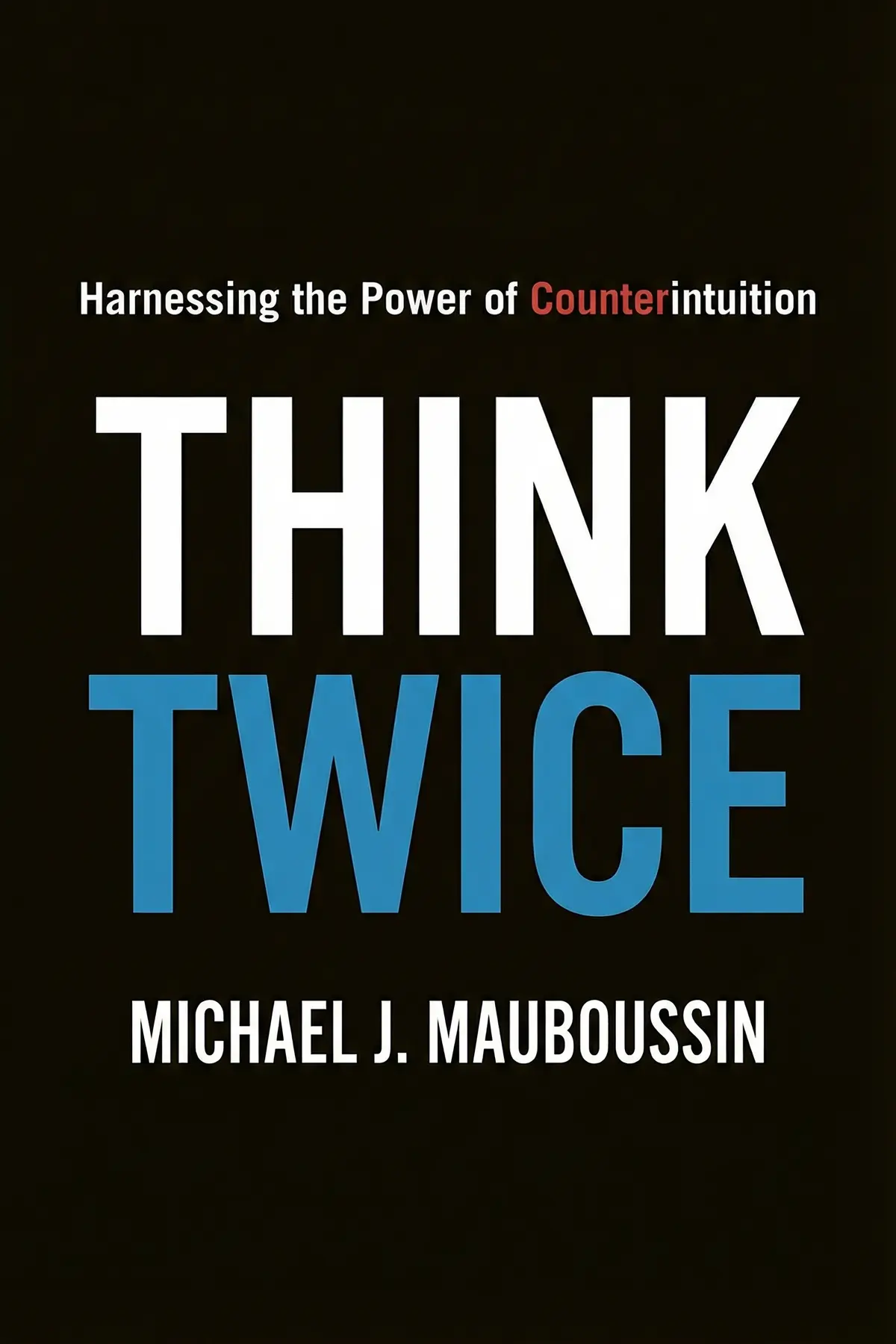
Smart people make bad decisions all the time, and rarely because they lack information. In Think Twice, investment strategist Michael J. Mauboussin argues that they fail because the mind leans on simple default routines, and those routines break down in exactly the situations that matter most. Long Term Capital Management, a hedge fund with two Nobel laureates in economics among its senior executives, lost billions in the late 1990s because its elegant models made no room for big swings in asset prices.
Mauboussin calls the book almost a complete homage to Daniel Kahneman, and the title is the method: notice the moments when fast, automatic thinking will mislead you, then slow down and analyze. The errors are predictable, which makes them preventable. Six traps follow, from trusting the inside story of your own plan to mistaking a lucky streak for skill, each paired with the tool Mauboussin offers against it. The reward is a short set of questions to ask before any big call, at work or with your own money.
2 min 00 sec
A racehorse won two of the sport’s biggest races with ease, and the betting market made him a heavy favorite for the third. One overlooked question would have told everyone what was about to happen.
1 min 57 sec
A random string of digits, with no connection to the question, can drag a careful person’s estimate up or down. Even professionals who swear they were not influenced turn out to be wrong about themselves.
2 min 00 sec
Shoppers in a wine store swore they chose their bottle for its taste and the dinner they planned. Something playing in the background told a very different story, and it works on bigger choices too.
2 min 07 sec
A formula judges fine wine better than seasoned tasters, and the most quoted political pundits turn out to be the worst forecasters. Yet in some settings an expert’s gut still deserves the final word.
2 min 02 sec
Markets can look calm and rational right up to the moment they fall apart. The warning signs appear earlier than most people think, and they often look like success.
1 min 55 sec
The companies business magazines celebrate tend to disappoint their shareholders afterward, while the ones they criticize do better. The reason has nothing to do with bad journalism and everything to do with luck.
1 min 16 sec
Think Twice makes a modest and useful claim: most bad decisions are not failures of intelligence. They are sensible routines used in the wrong place. The inside view, the first anchor, the ticked default box, the confident pundit, the simple story about a complex market and the hero story about a lucky firm all feel reasonable at the moment of choosing. That is why Nobel laureates and experienced bettors fall for them.
Mauboussin never asks anyone to become smarter. Checklists improve results in medicine, aviation and investing without raising anyone’s skill, and his tools work the same way, by making you better organized. Before a big call, find the reference class and ask what usually happens. Run a pre-mortem: imagine the decision has already failed and write down why, a habit he says surfaces about 30 percent more problems. Keep the decision journal, so the record of your reasoning outlives the result. And when an outcome surprises you, good or bad, ask how much of it was luck before you change course.
From the inside, Big Brown looked unbeatable. From the outside, he belonged to a group that had won the Belmont about 15 percent of the time. Good judgment is mostly the habit of taking that second look.
Nobody sets out to make a bad decision, yet capable people in business, medicine, law and government make them all the time. Michael J. Mauboussin, an investment strategist who also teaches finance, argues that the cause is rarely a lack of intelligence or data. The mind relies on simplified routines that work well enough in daily life and then fail in the complex, uncertain situations where the stakes are highest. Think Twice sorts these failures into recognizable traps: judging a plan only from the inside, settling on the first number you hear, ignoring the pull of the setting and of incentives, deferring to experts where models and crowds do better, treating complex systems such as markets as if they were simple, and confusing luck with skill. Mauboussin illustrates each with cases from horse racing, wine shops, football scouting, organ donation and corporate performance. The book's promise is practical. Because the errors are predictable, they can be prevented, and Mauboussin pairs each trap with a tool: reference classes, decision journals, pre-mortems, checklists and feedback that judges process rather than results.
Managers and analysts who make high-stakes forecasts and want fewer expensive surprises.
Investors who suspect they confuse lucky streaks with skill or trust experts too readily.
Team leads who review other people's work and want feedback that separates good process from good luck.
Michael J. Mauboussin leads Consilient Research at Counterpoint Global in New York and has taught finance as an adjunct professor at Columbia Business School since 1993, winning its teaching excellence award in 2009. He joined Credit Suisse in 1992 as a packaged food analyst, later became its Chief US Investment Strategist, and moved to Legg Mason Capital Management in 2004. He is affiliated with the Santa Fe Institute, a research center focused on complex systems.
Listeners consider the work exceptionally clear and accessible, with one listener mentioning that it offers a structured approach for sharpening decision-making abilities. Furthermore, they value the stimulating material, with one listener pointing out the effective explanation of typical psychological patterns. The book also earns praise for its engaging storytelling, easy-to-follow style, and overall cost-effectiveness.
Ever wonder why smart people make such consistently terrible choices? Mauboussin tackles this head-on by exploring the "thin ice" we skate on when we rely purely on intuition in complex systems. The example of the Best Buy prediction market was a total eye-opener for me regarding the "wisdom of crowds." The book is exceptionally well-written and serves as a vital bridge between theoretical psychology and real-world application. I’ve read a lot in this space, but the way he synthesizes ideas from Charlie Munger and James Surowiecki feels fresh. It’s the kind of book you’ll want to keep on your desk to reference whenever you’re feeling overly confident in a project timeline.
Show moreFinally got around to this after seeing it cited in dozens of finance blogs, and it lives up to the hype for the most part. What I appreciated most was the balance between theory and application. He doesn't just tell you that you're biased; he gives you a roadmap to mitigate those biases using "decision hygiene." The discussion on how Easterners and Westerners perceive causes of behavior was a fascinating detour I didn't expect. This is a must-read if you want to understand the patterns behind why groups often outperform experts. It's dense enough to be meaningful but light enough to read on a flight. Definitely worth the investment.
Show moreThink Twice serves as a much-needed reality check for the "follow your intuition" narrative that is so prevalent in modern management. Mauboussin explains common mental tendencies—like our obsession with anecdotes over hard statistics—in a way that is both convicting and helpful. The specific focus on how subconscious cues affect our choices, like the scent of cleaner making study participants act tidier, was absolutely fascinating. It’s a very thought-provoking book that justifies its place on any professional's bookshelf. The narrative quality is top-notch, and the value you get from the frameworks provided is well worth the price.
Show moreMauboussin has a knack for distilling complex psychological theories into something you can actually use on a Monday morning. The book focuses on why our internal "default settings" fail us when we face modern, high-stakes decisions. I particularly liked the summary checklists at the end of each chapter; they turn abstract concepts into a practical framework. While some of the research on behavioral biases feels a bit like a "greatest hits" album of Daniel Kahneman’s work, the narrative quality remains high. It’s a thought-provoking read that challenges the "go with your gut" advice you see in books like Blink. For the price, it’s excellent value for money for any professional. Just don't expect it to reinvent the wheel if you’ve already spent a lot of time in the behavioral finance world.
Show moreFrankly, I found the section on the "outside view" to be the most valuable part of this entire book. Most of us are trapped in our own heads, thinking our specific situation is unique when, in reality, there’s usually a statistical pattern we could follow instead. Mauboussin explains these mental tendencies with a clarity that makes the medicine go down easy. The writing style is punchy and accessible, avoiding the dry, academic tone that usually plagues this genre. I did feel that some of the anecdotes were a bit long-winded, but they generally served to illustrate his points well. It's a solid 4-star read that will definitely make you pause before making your next big move.
Show moreThe chapter on the planning fallacy hit way too close to home for my current project management role. Seeing the data on how often we underestimate costs and timelines—and why we do it—was both painful and enlightening. Mauboussin does a great job of explaining how our brains are essentially wired for a world that no longer exists. He uses a mix of anecdotes and research that keeps the pages turning without feeling like a textbook. My only minor gripe is that he occasionally oversimplifies the "man vs. machine" debate in decision making. Still, it’s a very readable guide that provides a much-needed framework for anyone trying to avoid systematic errors in judgement.
Show moreAs someone who works in data analysis, I found the discussion on reverting to the mean particularly compelling. The story about the Israeli flight instructors and why they thought yelling worked was a perfect illustration of how we misinterpret feedback. Mauboussin is excellent at showing how we confuse luck with skill, especially in fields like investing. The book is well-written and provides a strong argument for why we should "think twice" before trusting our gut in complex environments. It offers a lot of food for thought regarding how we structure our organizations and decision processes. It's a great companion piece to any of the more technical books on judgement and decision-making.
Show moreTo be fair, if you haven't read "More Than You Know" yet, you’ll probably find this significantly more insightful than I did. Having already finished Mauboussin's previous work, I felt like a lot of "Think Twice" was covering the same ground, just with slightly different flavoring. It’s certainly easier to digest than something like "Thinking, Fast and Slow," but it lacks some of that deep, rigorous analysis. The checklists are helpful, but some of the action items felt a little vague or familiar to me. It's not a bad book by any means—the narrative flows well and the examples are interesting—but it might feel repetitive for seasoned fans of behavioral economics.
Show moreLook, this is a solid entry-level text for anyone looking to understand behavioral economics without getting bogged down in academic jargon. It’s essentially "Black Swan-light," taking some of Taleb's and Kahneman's heavier concepts and making them palatable for a general business audience. However, if you’re already familiar with the "usual suspects" like the Milgram experiment or the sunk-cost fallacy, you might find yourself skimming. The book is well-structured, but the conclusions sometimes feel like common sense dressed up in fancy psychological terms. It's a quick, easy read, but it lacks the "wow" factor I was hoping for based on the reviews.
Show moreNot what I expected based on the glowing recommendations from my colleagues. I found the content to be largely recycled from other popular psychology books, offering very little that felt truly original or groundbreaking. It feels like the author is just trying to temper the popularity of Malcolm Gladwell by taking the opposite stance, but without providing much depth. The examples are fine, but I’ve seen most of them in dozens of other blog posts and TED talks over the last decade. You are better off just reading "Thinking, Fast and Slow" if you want the real deal. This felt like a surface-level summary of much better books.
Show moreMauboussin argues that capable people make poor decisions because the mind relies on simplified default routines that fail in complex, uncertain situations. He groups these failures into recognizable traps, such as the inside view, anchoring, deferring to experts, oversimplifying complex systems and confusing luck with skill. Because the errors are predictable, he says they are preventable, and he pairs each with a practical tool.
The inside view forecasts from the details of your own case and your own experience. The outside view treats the case as one of many and asks what happened to similar ones before. Big Brown’s backers took the inside view after two easy wins, yet since 1950 only three of 40 Triple Crown contenders had won the Belmont. He finished last.
Start with a reference class and check what usually happens in similar situations. Write out alternatives explicitly and invite someone to argue against you. Keep a decision journal recording your reasoning, expectations and mood. Run a pre-mortem by imagining the decision failed and listing why, which Mauboussin says surfaces about 30 percent more issues. Judge results by the process, not only the outcome.
Not entirely. Mauboussin describes an expert squeeze: models and well-built crowds increasingly beat experts on uncertain problems with many possible outcomes, as with Orley Ashenfelter’s Bordeaux model and Philip Tetlock’s poor-scoring pundits. But he says intuition still works in stable settings with clear feedback, such as chess. Crowds also need diversity, a way to combine views and rewards for accuracy.
It suits professionals who make consequential judgment calls under uncertainty, especially in investing, business strategy and management. Investors gain warnings about phase transitions, reversion to the mean and misleading business press. Managers gain a sharper way to give feedback that separates skill from luck. Anyone who estimates projects, hires people or negotiates prices will recognize the anchoring and inside-view traps.
Deborah Gruenfeld


Anthony Pratkanis




Richard Wiseman



AUDIO SUMMARY AVAILABLE
Get the key ideas from Think Twice by Michael J. Mauboussin, plus 5,000+ more nonfiction titles.









