

11 min 39 sec
Available in: English
The Winner Effect: The Science of Success and How to Use It
Shows how an inner drive, realistic goals and small cues in your surroundings help you succeed, and how to handle the power and need for approval that success brings without letting them cloud your judgment.
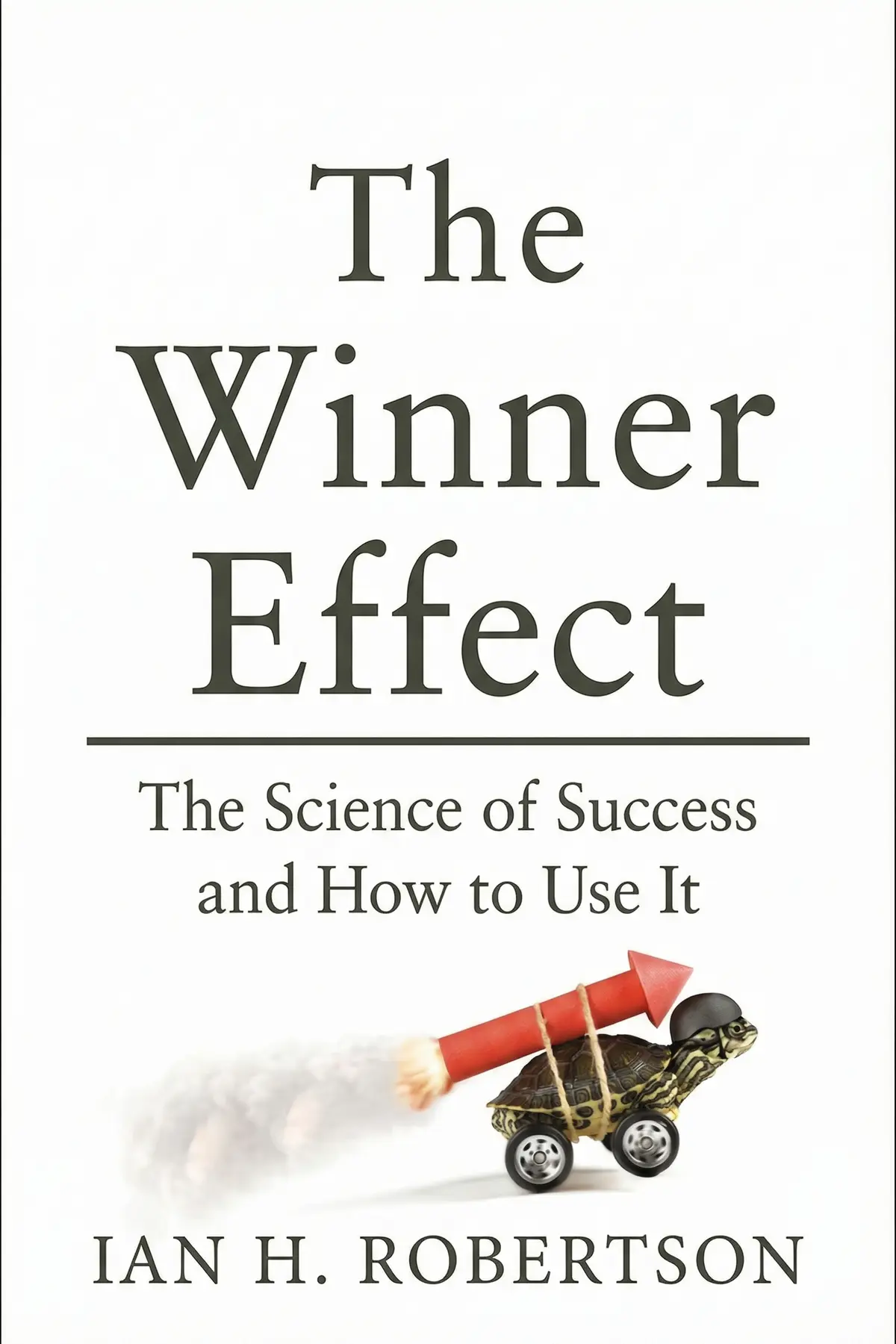
Table of Content
1. Introduction
1 min 00 sec
Success can look like something other people were simply born with. In The Winner Effect, neuropsychologist Ian H. Robertson argues against that view: the urge to achieve is built from the inside, and even the body keeps score, with London traders’ morning testosterone tracking how much money they made that day.
Robertson’s case runs in two directions. On the way up, winning depends on a drive that belongs to you, goals you can actually reach, and surroundings that you can tilt in your favor. Once you arrive, power and the need for approval start working on your mind, and they can help or harm depending on how you handle them.
The illustrations range from a chief executive who grew up poor to a fish that changes color within hours and Oscar winners who tend to outlive their rivals. What the listener gets is a way to build drive without blaming their genes, and a set of checks for the moment success begins to go to their head.
2. Build a drive to succeed that genes cannot cap
1 min 27 sec
Plenty of people quietly decide they lack the winning type of personality before they have tested it. Robertson says that belief has a name, and that one executive’s rise from hardship shows what it costs to accept it.
3. Set goals that stretch you and still let you win
1 min 35 sec
A man at the very top of his profession still felt he had not arrived. His problem was not laziness or doubt, and the fix Robertson suggests is surprisingly modest.
4. Make your surroundings work for your performance
1 min 51 sec
A fish can transform its color and personality in a single afternoon, and traders’ profits track a hormone they never think about. Robertson finds small, everyday levers hidden in both stories.
5. Get the truth from the people who report to you
1 min 34 sec
The higher you rise, the less bad news reaches you, and it is not only because people are polite. Robertson traces the silence to hierarchy and to hormones on both sides of it.
6. Handle power the way you would handle strong drink
1 min 35 sec
The confidence that wins promotions is the same quality that power inflates. Robertson compares the danger to something most people already know how to respect, and the comparison suggests its own safeguards.
7. Become your own source of approval
1 min 34 sec
People who win an Oscar tend to outlive those who don’t, and Robertson thinks he knows why. His explanation reaches back to how humans once lived, and it points to a protection you can build yourself.
8. Conclusion
1 min 03 sec
Robertson’s picture of winning has two halves. The first is about getting there: a drive that belongs to you and not to your genes, aimed at goals with a real finish line, in surroundings that tilt body and mind toward performing well. The second is about what winning does once it arrives. Power lifts confidence and can blur judgment like drink, the people beneath you go silent, and the hunger for approval rarely switches off.
The book supports a few small moves. Praise effort, your own and other people’s, in plain words. Give your next goal a clear end point so the win can register. Pay attention to the cues around you, from the way you stand to the stereotypes you may have absorbed. And if you lead, ask for disagreement before you need it.
Ursula Burns did not inherit her seat at the top of Xerox. And what an Oscar seems to give its winners, a signal that they are safe from judgment, is something Robertson believes you can learn to give yourself.
About this book
What is this book about?
Many people believe success belongs to those born with the right genes or the right start. Neuropsychologist Ian H. Robertson rejects that idea, which he calls genetic fatalism. In his view, the drive to achieve comes from within and can grow in anyone, as Ursula Burns showed when she rose from poverty to lead Xerox. Robertson then looks at the forces around that drive. Goals that keep expanding can leave even top performers restless. Small cues such as posture and the color red, and the hormones that respond to winning and losing, shape how people perform. He draws on African cichlid fish, London traders and World Cup fans to make the point. The book also follows what happens after success. Power raises confidence but can impair judgment much as alcohol does, while the people below a leader tend to keep bad news to themselves. And the need for approval, which Robertson links to an Oscar's possible effect on lifespan, drives much of our urge to win. Readers get practical ways to build drive, set goals they can reach, lead without losing perspective and become less dependent on outside praise.
Book Information
Who it's for
Early-career professionals with doubts
Ambitious early-career professionals who suspect they lack the winning type of personality.
Managers wary of power
New and experienced managers who want honest feedback and worry about how power changes them.
Restless high achievers
High achievers who keep raising the bar and never feel they have arrived.
About the Author
Ian H. Robertson
Ian H. Robertson, born in 1951, studied at Glasgow University and went on to earn a master's in clinical psychology and a doctorate in neuropsychology at the University of London. He has been a professor of psychology at Trinity College Dublin, where he was founding director of the Trinity College Institute of Neuroscience, and he was founding director of the Global Brain Health Institute. A member of the Royal Irish Academy, he has published hundreds of scientific papers and written for The Times and The Daily Telegraph.
Ratings & Reviews
Ratings at a glance
What people think
Listeners find the book offers valuable perspectives on the neuroscience of achievement and defeat, and one listener particularly mentions its deep look at power's influence on brain function. The material is compelling, yet listeners find the reading experience needlessly challenging. Feedback on the writing is divided; some appreciate the style, while others view it as lackluster. Listeners also hold conflicting views on whether the book is truly engaging.
Top reviews
Komsan
Finally got around to reading Robertson's take on the neural pathways of power, and it is a total game-changer for how I view competition. The central concept—that winning actually changes your brain chemistry to make future victories more likely—is supported by fascinating data on testosterone and cortisol levels. I found the section on how skilled winners react less to stress molecules particularly illuminating because it explains why some people thrive under pressure while others crumble. While the writing occasionally meanders into dense academic territory, the core message about the 'winner effect' loop is worth the effort. It is not just a self-help book; it is a biological deep dive into why success breeds success. This should be required reading for anyone in a leadership position who wants to understand the physical reality of authority.
Show moreOat
Ever wonder why Oscar winners outlive their nominated peers by an average of four years? Robertson answers this by diving into the biological impact of status and how it mitigates the killing effects of chronic stress. This book is a masterclass in connecting the dots between sociology, history, and hard neuroscience. I was particularly struck by the research showing how powerlessness can actually cause parts of the brain to shrink and reduce connections. It makes you realize that our environments are far more deterministic than we like to admit. The writing is sophisticated and expects a lot from the reader, but the intellectual reward is immense. If you want to understand the hidden forces shaping your ambition, look no further.
Show moreYulia
I've been fascinated by how power corrupts, and this book breaks it down to a cellular level in a way few others have managed. Robertson dismantles the myth of genetic fatalism, proving that our destinies are shaped more by our beliefs and our environment than our DNA. The stories, like that of Ursula Burns, are genuinely inspiring and provide a necessary balance to the more technical neurological data. I loved the deep dive into 'intrinsic achievement motivation' and how it differs from the mere desire for power over others. It is an in-depth analysis that manages to be both academic and deeply human. This book didn't just teach me about winners; it taught me about the very nature of human agency.
Show moreNam
As someone who works in management, I found the analysis of how winning primes our neurocircuitry for risk-taking absolutely riveting. Robertson does a brilliant job explaining the 'Cichlid fish' experiments and transposing those findings onto human behavior in the corporate world. To be fair, the book does jump from topic to topic quite quickly, which can be jarring if you are looking for a linear narrative. One minute you are reading about Tony Blair’s speeches, and the next, you are looking at the life expectancy of Oscar winners. However, the insights into how power can narrow our focus and increase egocentricity are too important to ignore. It is a dense read, but the payoff for your understanding of human dynamics is massive.
Show moreSoontorn
Robertson provides an incredible look at the neuroscience behind success, but be prepared for a bit of a slog through the technical bits. In my experience, the most valuable takeaway was the discussion on 'power addiction' and how unchecked authority leads to a total disconnect from public opinion. He uses the Enron scandal to illustrate how winners can become blinded by their own neurochemistry, which is a terrifying thought. The book is chock-full of anecdotes from history and social experiments that keep things grounded, even when the science gets heavy. My only real gripe is that the author’s own political biases occasionally bleed into the text. Still, for a deep dive into how power rewrites our brains for better or worse, this is top-tier.
Show moreVera
Look, the science here is top-notch if you can look past the occasionally superior tone and the scattered structure. Robertson explains how winning increases testosterone, which then increases risk-tolerance, creating a feedback loop that can lead to incredible success or total hubris. Personally, I found the section on how Chinese people perceive their mothers versus themselves in the brain to be one of the most unique insights in the book. It highlights how much our culture shapes our very biology. While the book could have used a much more aggressive editor to trim the fat, the content is too fascinating to dismiss. It is a solid 4-star read for anyone who enjoys books like 'The Power of Habit' but wants something with more neurological grit.
Show moreDiego
The truth is, most 'self-help' books ignore the biological reality of our brains, but Robertson leans right into it with refreshing honesty. He explores the insidious effects of power and how it can literally rewrite our neural pathways to make us more egocentric and less empathetic. While the hopping between cichlid fish and Enron executives can be a bit dizzying, the overarching argument is incredibly cohesive. He makes a compelling case for why we need to balance confidence with humility and accountability. It is not an easy read, and the author does occasionally get lost in his own 'mystery' framework, but the insights into the science of success are invaluable. I came away with a much better understanding of my own reactions to both victory and defeat.
Show moreVipawan
The chapter on Bill Clinton and Tony Blair's friendship was easily the most engaging part of an otherwise uneven read. Robertson offers some great insights into the neuroscience of success, but the presentation really suffers from a lack of focus. It feels like a weird collection of abstract anecdotes told in pieces, with each section separated by unrelated fragments of other stories. Not gonna lie, I found myself getting lost in the 's-power' versus 'p-power' definitions because the book hops around so much. Is it interesting? Yes, the data on how power affects the brain is fascinating. Is it usable? Not really. It is more of a theoretical exploration than a guide on how to actually apply these principles to your own life.
Show morePierre
Like swimming through treacle, this book was a massive struggle for me despite my interest in the subject matter. I really wanted to like it, but Robertson’s writing style is unnecessarily wordy and frequently feels superior for no apparent reason. He uses this weird 'five mysteries' frame for concepts that are actually quite self-evident to anyone with a basic grasp of psychology. The chapter on Bill Clinton and Tony Blair felt more like a political critique than a scientific analysis, which was disappointing. Frankly, the book is just too long-winded and circuitous to be practical for a lay reader. There is good information buried in here somewhere, but you have to dig through way too many abstract anecdotes to find it. I would skip this one.
Show moreSatit
This book feels like a weird collection of abstract anecdotes that never quite land a punch. Robertson attempts to use biological reductionism to explain complex human relationships, but it often comes across as a pseudo-scientific excuse for his own progressive philosophy. The way he frames every single human interaction as a power struggle is both depressing and incredibly simplistic. To be honest, I found the 'fascist utopia' vibe of the concluding chapters—where everyone is a winner but also secretly bigoted against themselves—to be utterly bizarre. The writing jumps in rhetorical circles and overestimates the attention span of anyone looking for actual substance. It is a long-winded, circuitous mess that fails to deliver on the promise of its title. Save your money.
Show moreQuestions about this book
What is the main idea of The Winner Effect by Ian H. Robertson?
Robertson argues that success is built rather than inherited. An inner drive to achieve, which he calls intrinsic achievement motivation, matters more than genes or background. That drive works best with realistic goals and supportive surroundings. Once people succeed, power and the need for approval change how they think, so leaders need accountability, reflection and humility to keep their judgment clear.
What is the mum effect in The Winner Effect?
Robertson points to the mum effect, which describes how people lower in a hierarchy often hold back disagreement or critical information from those above them. It grows stronger when the hierarchy is steep and speaking up is punished. Robertson links it partly to hormones: power raises a leader’s testosterone, while subordinates show lower levels and become less confrontational. Leaders can counter it by inviting dissent openly.
How does Robertson say power affects leaders?
Robertson compares unchecked power to alcohol. Both can dominate the mind, impair judgment and lead to poor decisions, and people who crave power risk something like addiction. He does not say to avoid power. He recommends using it responsibly, with accountability and regular reflection, and balancing confidence with humility and assertiveness with empathy.
What practical advice does The Winner Effect give?
Robertson suggests praising effort and process over natural ability, and setting goals that stretch you but stay within reach so wins can be celebrated. He recommends an expansive posture, dominant colors such as red and surroundings that reduce stress. He also advises watching for internalized stereotypes, inviting honest feedback as a leader, and building self-approval so you rely less on outside praise.
Who should read The Winner Effect?
It suits people who doubt they have what it takes to succeed, high achievers whose goals keep receding, and managers who want to understand how power shapes them and the people around them. Readers interested in how hormones, surroundings and the need for recognition influence performance will also find its examples, from cichlid fish to London traders and Oscar winners, useful.
Readers also enjoyed


A Liberated Mind: How to Pivot Toward What Matters
Steven C. Hayes


Acting with Power: Why We Are More Powerful Than We Believe
Deborah Gruenfeld


Age of Propaganda: The Everyday Use and Abuse of Persuasion
Anthony Pratkanis



AUDIO SUMMARY AVAILABLE
Listen to The Winner Effect in 15 minutes
Get the key ideas from The Winner Effect by Ian H. Robertson, plus 5,000+ more nonfiction titles.
- 5,000+ titles
- Listen as much as you want
- 7-day free trial
- Cancel anytime









