
14 min 37 sec
Available in: English
 ไทย
EnglishไทยThe Willpower Instinct: How Self-Control Works, Why it Matters and What You Can Do to Get More of It
Explains self-control as an instinct of the brain and body that stress, distraction and fatigue wear down. Shows practical ways to restore and train it, from five-minute breathing to keeping temptations out of sight.
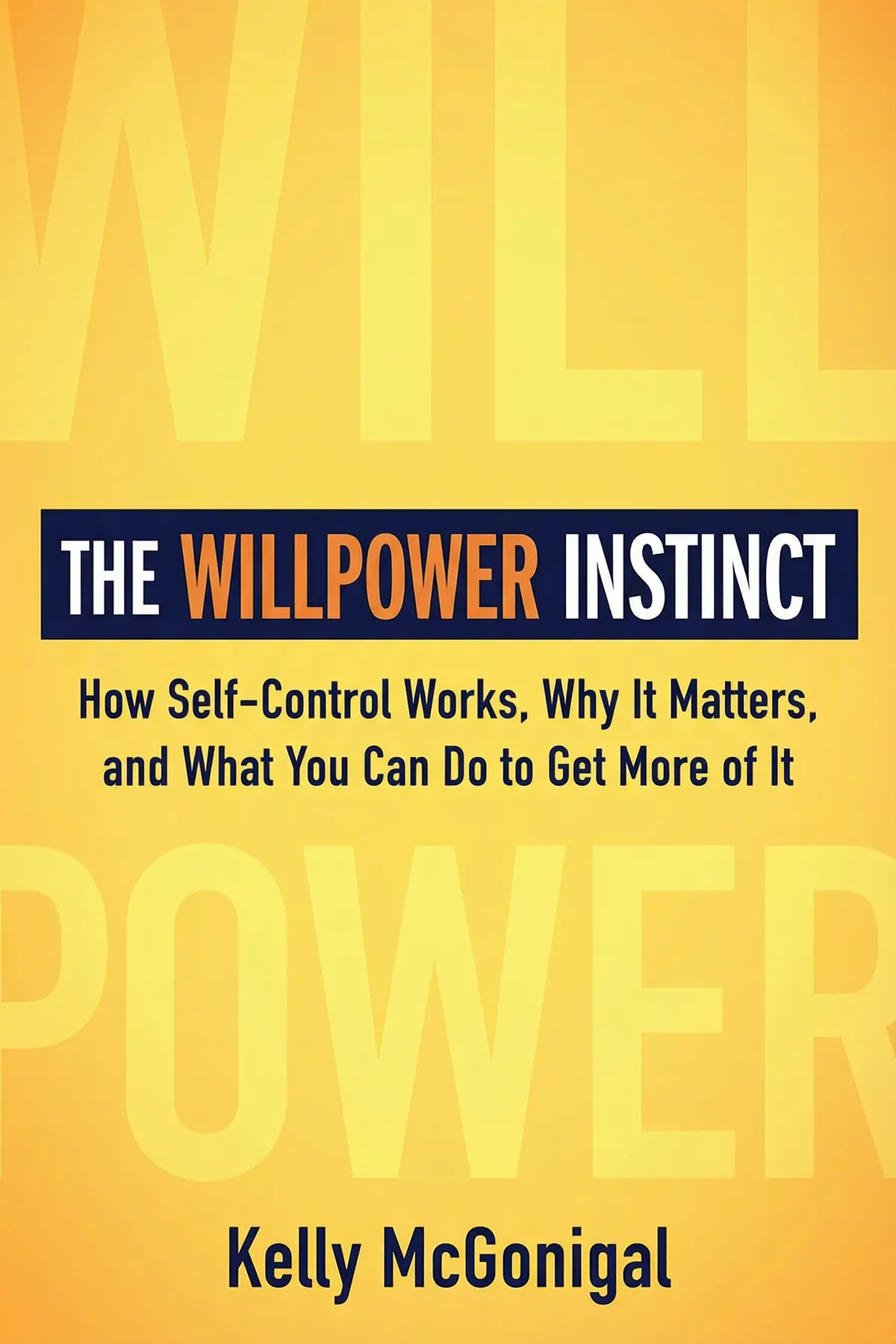
Table of Content
1. Introduction
1 min 07 sec
Most people who lose the fight with a cookie or a cluttered inbox blame their character. In The Willpower Instinct, Stanford lecturer and science writer Kelly McGonigal makes a more hopeful case: self-control is a biological instinct, a state your brain and body can enter, and it rises or falls with stress, attention, energy and the people around you. The stakes are real, since the research she cites links stronger willpower to better health, more lasting relationships, higher earnings and even a longer life.
Her throughline is that willpower grows when you work with your brain instead of against it. You calm the body, train attention, practice in small doses, stop suppressing what you want and stop bargaining with yourself. The tools are modest and a little odd: a jar of sweets you may not touch, a five-minute breathing exercise, a friend signed up for the same goal. Each one answers a specific way self-control breaks down, so you can match a tool to your weakest moment.
2. Name the three fights your willpower is in
1 min 24 sec
Refusing dessert and finally starting a dreaded report feel like the same struggle, yet one person can be excellent at one and hopeless at the other. Seeing why changes where you aim your effort.
3. Calm your body so self-control can work
1 min 42 sec
A prehistoric predator and a plate of cookies trigger two very different responses in the body. When the wrong one takes over, even a strong resolve has little chance, and the cause is usually something you can change.
4. Catch distractions before they choose for you
1 min 30 sec
Holding a phone number in your head seems harmless, until you see what it did to students choosing a snack. The fix takes less practice than most people would guess.
5. Build self-control with small daily reps
1 min 38 sec
A boring meeting and a wall of shampoo brands drain the same reserve you need to resist dessert. The surprising way to grow that reserve involves keeping temptation in plain sight.
6. Hide tempting rewards and protect your future self
1 min 32 sec
A sale sign or the smell of steak can hijack your attention in seconds, and your brain treats the person you will be next year almost like a stranger. Both blind spots have simple counters.
7. Stop fighting cravings and watch them pass
1 min 31 sec
Women told not to think about chocolate did exactly as asked, and then something odd happened at the tasting table. The result explains why so many diets fall apart, and what to try instead.
8. Keep good days and bad days from derailing you
1 min 39 sec
Students who firmly rejected sexist statements went on to make a surprising hiring choice. Feeling good about yourself and feeling terrible can both end a streak, and the remedy for each is smaller than you think.
9. Borrow willpower from the people around you
1 min 22 sec
Watching someone you like act on impulse makes you more impulsive too. A program in Pittsburgh turned that same pull into one of the biggest gaps in results anywhere in the book.
10. Conclusion
1 min 12 sec
The Willpower Instinct ends up redrawing what a lapse means. The second cookie, the postponed report, the hour lost to clips: McGonigal reads them as signs of a system under strain, stressed, distracted, drained or caught in its own bargains. Because the instinct can be calmed, trained and shared, every lapse also points to where the work should go.
Her most useful suggestion is to study yourself for one ordinary day. Watch your decisions closely. Note when you walked into a situation that drained your supply, and when you gave in because the long-term goal slipped out of sight. Then picture yourself handling that exact moment differently. Pair the audit with the five-minute breathing practice, coming back to inhale and exhale each time the mind wanders, because noticing is the skill beneath every other tool. And choose one I will goal small enough to keep daily, ideally with someone beside you.
Willpower, in this account, was never a test you pass or fail. It is an instinct that kept your ancestors alive, and it responds to care like any other part of the body.
About this book
What is this book about?
Most people treat a broken resolution as a character flaw. Kelly McGonigal sees it differently. Self-control, she argues, is a biological instinct, a state the brain and body can enter when a short-term desire collides with a long-term goal. Like any instinct, it can be supported or undermined, trained or exhausted. McGonigal splits willpower into three powers: the ability to refuse, the ability to act when you would rather not, and the ability to remember what you truly want. She then shows what weakens them. Stress keeps the body stuck in fight-or-flight, distraction lets temptation slip past, dopamine makes visible rewards feel urgent, and pushing cravings away makes them louder. Feeling virtuous and setting huge goals can both backfire. The book pairs each problem with a modest, testable tool: a short meditation, low-glycemic food, a jar of candy you may not touch, a goal phrased as something you will do, and a friend who shares the challenge. Readers learn why their past attempts failed and how to set up self-control that holds on ordinary days.
Book Information
Who it's for
Losing resolve by evening
People whose diets, savings plans or quit attempts keep collapsing by evening.
Professionals wanting focus back
Professionals worn down by long meeting days who want their focus and discipline back.
Curious what shapes choices
Anyone curious about how stress, attention and other people shape the choices they make.
About the Author
Kelly McGonigal
Kelly McGonigal is an award-winning science writer and a lecturer at Stanford University whose research looks at the link between mind and body and at how people build resilience and compassion. She has taught dance, yoga and group exercise in the San Francisco Bay Area since 2000. Her other books include The Upside of Stress and The Joy of Movement. At TEDGlobal 2013 she argued that believing you can cope with stress shapes how you actually respond to it.
Ratings & Reviews
Ratings at a glance
What people think
Listeners find this work well-researched and easy to understand, providing actionable guidance and techniques for enhancing self-discipline and self-control. They appreciate the motivational content, with one listener noting how it helped them develop their willpower to live better. The organization of the book makes it enjoyable to consume; one listener mentions it is best to take a chapter per week, while another describes the text as a thought-provoking exploration of human behavior.
Top reviews
Sara
After hearing so many productivity gurus mention this, I finally committed to the 10-week program. McGonigal really hits the sweet spot between academic rigor and practical, everyday application. The distinction between the "I will," "I won't," and "I want" powers was a massive paradigm shift for my morning routine. I especially appreciated the deep dive into how stress sabotages our prefrontal cortex. It turns out that beating yourself up after a failure actually makes you more likely to fail again. That lesson on self-compassion was probably the most valuable part for me. It’s not just a "feel-good" sentiment; it’s backed by neuroscience. The writing is accessible, though the humor can be a bit cheesy at times. Still, the exercises like the five-minute "greenery" walk or slow breathing are low-effort but high-impact. It’s a solid resource for anyone tired of "just try harder" advice.
Show moreYuki
Ever wonder why you reach for a cookie the second you feel stressed at work? This book has the answer, and it’s not because you’re "weak." I loved the biological explanation of the "pause-and-plan" response versus "fight-or-flight." Understanding that willpower is a biological instinct rather than just a character trait helped me stop the cycle of guilt. The chapter on the "what-the-hell effect" was a total game-changer for my diet. Now, when I slip up, I practice the self-forgiveness techniques McGonigal suggests instead of spiraling into a binge. It sounds counterintuitive, but it works. The prose is clean and engaging, making complex neuroscience feel like a conversation with a smart friend. I’ve already recommended this to three people who feel stuck in their habits. It’s easily one of the best books on human behavior I’ve read in years.
Show moreScarlett
Wow. I didn't think a book about self-control could be this engrossing. The "white bear" experiment—the idea that suppressing a thought makes it more likely to haunt you—was a revelation for me. It completely changed my approach to quitting smoking. Instead of trying to ignore the cravings, I’ve learned to "surf" them as McGonigal describes. It’s much more effective than pure suppression. The writing is incredibly encouraging, and the emphasis on the "willpower muscle" getting tired explains why I make my worst decisions late at night. The structure of one chapter per week is perfect for people who actually want to change their lives rather than just consume information. This isn't just a book; it's a 10-week workshop that actually delivers on its promises. Truly life-changing stuff.
Show moreSuthida
Finally got around to reading this Stanford favorite, and it’s much more than your standard self-help fluff. The author treats willpower like a physical muscle that can be strengthened, which is an incredibly empowering metaphor for someone like me. I found the section on dopamine particularly enlightening because I never realized how our brains confuse the "promise of reward" with actual happiness. It explains exactly why I keep scrolling on social media long after it stops being fun. My only gripe is that some of the cited studies felt a bit small in scope to draw such massive conclusions. However, the actionable tips—like the ten-minute delay for cravings—are working wonders for my snacking habits. It’s a dense read if you rush it, so I’d recommend taking it one chapter at a time to really let the concepts sink in.
Show morePhu
This book changed how I view my "future self." McGonigal points out that we often treat our future selves like strangers, assuming that person will magically have more energy and discipline than we do right now. That hit me hard. I’ve started using her "pre-commitment" strategies to lock my future self into better decisions, and the results are actually visible. The book is structured like a class, which makes it very easy to follow and implement. I did think some of the "moral licensing" examples were a bit repetitive, but the core message is vital. You can't just rely on grit; you have to outsmart your own biology. It’s a well-researched guide that offers a toolkit instead of just a lecture. Definitely worth a spot on your shelf if you struggle with procrastination.
Show morePang
Picked this up to help with my productivity, and I was pleasantly surprised by how much focus is placed on physical health. We often forget that sleep deprivation and poor diet literally starve the prefrontal cortex of the energy it needs to say "no." McGonigal makes a compelling case for exercise and meditation as primary willpower boosters. I’ve started doing five-minute meditation sessions, and I actually feel more in control of my impulses during the afternoon slump. The concept of "willpower contagion" was also fascinating—realizing that the people we spend time with can subconsciously influence our self-control was a wake-up call. The book is a bit long-winded in the middle, but the summary of strategies at the end of each chapter helps keep you on track. It’s a very practical manual for self-improvement.
Show moreCarlos
As someone who enjoys the intersection of economics and psychology, I found the "delay discounting" section brilliant. It explains so clearly why we choose a small immediate reward over a much larger future one. McGonigal’s background teaching this at Stanford really shows in the way she anticipates common pitfalls and excuses. I appreciated that she didn't promise any "easy tricks." Instead, she offers a realistic look at how the brain works. The "I won't" power is harder to master than I thought, but the book provides enough variety in its strategies that something is bound to stick. I did find the constant references to her students a little distracting, but it adds to the "course-like" feel of the book. It’s a solid 4-star read that I’ll likely revisit.
Show moreSukit
The chapter on "moral licensing" alone was worth the price of the book. I never realized that feeling "good" about a small virtuous act (like ordering a salad) often gives us a subconscious green light to do something "bad" (like eating a giant dessert). It’s a subtle trap that explains so many of my past failures. Look, the book isn't perfect—some of the anthropology bits feel a little dated and the puns are hit-or-miss. However, the core strategies are incredibly robust. I’ve started using the "10-minute rule" for everything from checking email to buying things online, and it’s significantly reduced my impulsivity. It’s a thought-provoking exploration of why we do the things we do, and more importantly, how we can stop doing them. I’d recommend it to anyone looking for a nudge in the right direction.
Show moreNim
To be fair, the advice here is practical, but the "science" behind it feels a bit thin in places. I struggled with how the author interprets certain studies to fit her narrative, especially regarding the breathing exercises. Slowing your breath to four to six breaths per minute supposedly boosts your "willpower reserve," but the evidence cited felt more like a personal testimonial than a peer-reviewed certainty. I also found the "multiple selves" concept a bit oversimplified. That said, I can't deny that the "surf the urge" technique has helped me manage my phone addiction. It’s a weird mix of great tactical advice and questionable theoretical framework. If you can ignore the occasionally "try-hard" jokes and focus on the exercises, you'll get something out of it. Just don't expect a rigorous academic textbook.
Show moreKru
Not what I expected from a Stanford professor. While there are a few decent nuggets of advice scattered throughout, the tone felt surprisingly unscientific and even borderline "anti-science" in its delivery. McGonigal relies heavily on anecdotes and very small studies that don't always justify her sweeping claims about human evolution. Also, the humor was quite cringeworthy; I didn't need a joke about 100,000-year-old loincloths to understand basic psychology. The book spends way too much time on the Phineas Gage story and the marshmallow test, which felt like filler if you've read any other psych book in the last decade. Frankly, it felt more like a transcript of a lighthearted lecture series than a serious deep dive into neuroscience. If you want rigorous data, you might be disappointed. It’s okay for a casual reader, but it lacked the academic depth I was hoping for.
Show moreQuestions about this book
What is the main idea of The Willpower Instinct?
Kelly McGonigal argues that self-control is a biological instinct, a pause-and-plan state of the brain and body that helps you resist impulses that threaten long-term goals. Stress, distraction, fatigue and even feeling virtuous weaken it, while meditation, sleep, steady energy, small daily practice and supportive people strengthen it. You get more willpower by managing these conditions instead of simply trying harder.
What are the three powers of willpower according to Kelly McGonigal?
McGonigal describes I won’t power, the ability to say no to a temptation such as cigarettes or chocolate; I will power, the ability to do an unpleasant task now for a better future, like studying for exams; and I want power, the ability to keep your true long-term goal in mind. That goal fuels the other two by reminding you what is at stake.
Why does dieting fail according to The Willpower Instinct?
Suppressing a craving makes it stronger. In a study McGonigal describes, women told not to think about chocolate had fewer chocolate thoughts but then ate twice as much at a tasting. She suggests not banning favorite foods, setting a positive goal such as eating more healthy food, and observing urges as passing clouds instead of fighting them.
How can I improve my willpower quickly?
The book offers several fast options. Five minutes of activity outdoors gives a quick boost. A five-minute meditation, silently repeating inhale and exhale and returning whenever the mind wanders, trains awareness, and McGonigal reports that about three hours of regular practice improves self-control. Moving temptations out of sight also helps: office workers ate a third less candy when it sat in a drawer.
Who should read The Willpower Instinct?
It suits anyone whose resolutions about food, money, smoking or procrastination keep fading, and professionals whose discipline wears thin after long days of meetings and decisions. It also helps people who want to involve others: a University of Pittsburgh program found 66 percent of participants who joined with a partner kept weight off after ten months, versus 24 percent of those who joined alone.

Readers also enjoyed


A Liberated Mind: How to Pivot Toward What Matters
Steven C. Hayes



Acting with Power: Why We Are More Powerful Than We Believe
Deborah Gruenfeld




Age of Propaganda: The Everyday Use and Abuse of Persuasion
Anthony Pratkanis

AUDIO SUMMARY AVAILABLE
Listen to The Willpower Instinct in 15 minutes
Get the key ideas from The Willpower Instinct by Kelly McGonigal, plus 5,000+ more nonfiction titles.
- 5,000+ titles
- Listen as much as you want
- 7-day free trial
- Cancel anytime









