

13 min 31 sec
Available in: English
The Technological Republic: Hard Power, Soft Belief, and the Future of the West
Palantir's leaders argue that artificial intelligence will decide who holds power in this century. They make the case that Silicon Valley must stop chasing trivial apps and rejoin the old American partnership between government and inventors.
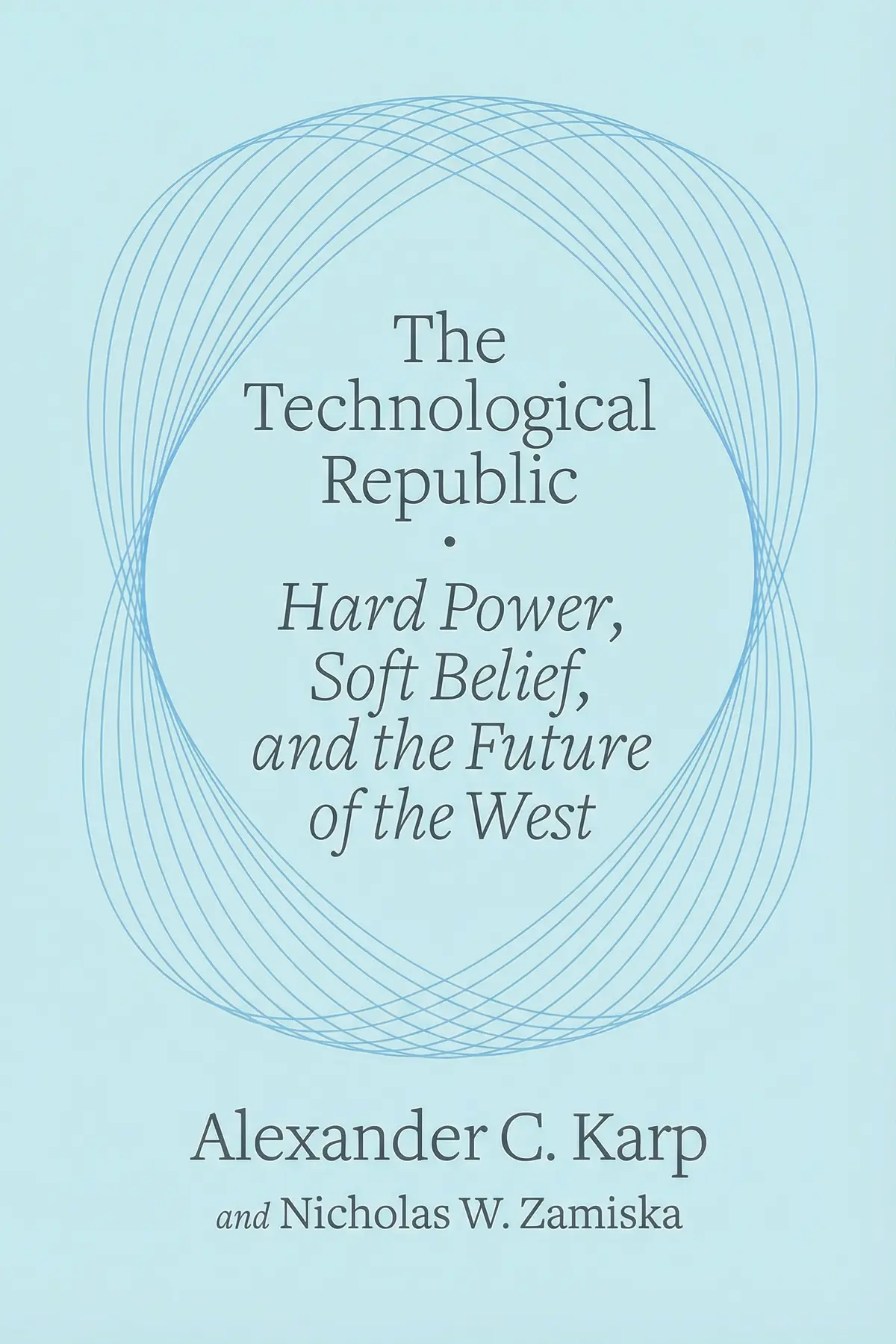
Table of Content
1. Introduction
57 sec
If you work near technology, it is easy to think the industry’s main job is to make apps more engaging and ads more precise. In The Technological Republic, Palantir chief executive Alexander C. Karp and his colleague Nicholas W. Zamiska call that belief a danger to the West. Their charge is direct: Silicon Valley has spent its best engineers on phone games, delivery apps and photo filters while authoritarian rivals race to build weapons guided by artificial intelligence.
The authors trace America’s strength to an old partnership between the state and its inventors, the one that produced GPS and the internet. In their account, it is fraying just when it is needed most. Their case is that power in this century will be written in software, and that the West stays free only if its builders find a shared purpose again. By the end, you can explain their argument clearly and judge your own work against it.
2. See why the end of history never came
1 min 55 sec
In 1989 a famous political scientist declared the great contest of ideas finished. Within a generation he had to take it back, and the events that forced him say a lot about the world we live in now.
3. Look past budgets to who can actually build
1 min 42 sec
A country can spend enormous sums on defense and still run short of the most basic supplies within days. The cause the authors identify has little to do with money or political will.
4. Learn why software now decides global power
2 min 04 sec
Oppenheimer built the bomb because someone else would have. The authors believe the same choice has returned in a new form, and a fighter jet meant to fly until 2088 shows what is at stake.
5. The partnership that gave us GPS and the internet
1 min 52 sec
The tools on your wrist and in your pocket began as defense projects. The authors trace a bond between inventors and government that runs from Franklin’s workshop to an urgent White House meeting in 1957.
6. Peace depends on builders willing to deter
1 min 53 sec
The inventor of dynamite believed only fear stops nations from fighting. The authors connect his overlooked idea to the open letter from Google employees and the objections Microsoft staff raised against military work.
7. Discover what a shared story does for a nation
1 min 55 sec
A French philosopher said a nation must be chosen again every single day. The authors argue that when Americans stopped making that choice, they went looking for meaning somewhere far less sturdy.
8. Conclusion
1 min 13 sec
In the end, Karp and Zamiska lay out a chain that runs from a phone game to a battlefield. A country’s power to deter now runs through software. Software comes from engineers. Engineers choose their work by what they believe matters. And belief, as Renan saw, has to be renewed every day or it fades. Break any link, the authors warn, and the West puts at risk the freedoms it treats as permanent.
History gives their warning its weight. The partnership that answered Sputnik within an hour and paid for GPS and the internet is, in their telling, worn down by consolidation, complacency and an industry more at home with photo filters than with defense.
You can use their lens without accepting every conclusion. When a defense headline boasts of a budget, ask about the factories behind it. When a long plan rests on today’s technology, picture the F-35 in 2088. And when you decide where your own skills go, ask the question the book keeps pressing: does this work serve something larger than the next click?
Oppenheimer’s dilemma never went away. It only moved from the atom to code.
About this book
What is this book about?
For decades after the Cold War, the West assumed the big contest of ideas was over. Alexander C. Karp and Nicholas W. Zamiska, who lead Palantir Technologies, argue that the assumption has proved costly. Russia, Iran and China are pressing hard. America's defense industry has shrunk to a few contractors, and its best engineers are building food-delivery apps and ad algorithms. The authors trace American strength to a partnership between the state and its scientists that goes back to Jefferson and Franklin. That partnership landed a man on the moon and paid for GPS and the internet. They set it beside the moral dilemma Oppenheimer faced and Alfred Nobel's view that fear keeps the peace. From there they argue that AI-enabled weapons are the new atomic moment, and that tech workers who refuse military projects are leaving the field to rivals. Readers get a clear account of a forceful and debated argument. It explains why software has become hard power, why a nation needs a shared story to stay strong, and what the authors believe the technology industry owes the country that made it possible.
Book Information
Who it's for
Wondering what tech serves
Engineers and tech workers wondering whether their work serves anything beyond engagement metrics.
Curious about AI geopolitics
Professionals and students who follow geopolitics and want to understand the AI arms race.
Weighing defense partnerships
Founders and policy readers weighing whether, and how, companies should work with governments on defense.
About the Author
Alexander C. Karp
Alexander C. Karp is an American businessman who studied at Haverford College and Stanford Law School and holds a doctorate in social theory from Goethe University Frankfurt. After working in finance and founding Caedmon Group, he started Palantir Technologies in 2003 with Peter Thiel and three others. Time named him to its Time 100 list in 2025. Nicholas W. Zamiska heads corporate affairs at Palantir, serves as legal counsel to the CEO's office and sits on the board of the Palantir Foundation for Defense Policy and International Affairs. He studied at Yale College and Yale Law School.
Ratings & Reviews
Ratings at a glance

What people think
Listeners find the book thought-provoking, with one review highlighting its intellectual rigor and the persuasive nature of its arguments for both external and internal purposes. They also value its clarity; one listener notes that the writing makes complex subjects accessible to a wide range of people. Additionally, the book is praised for its innovative take on the technology industry, wealth of historical context, and nationalistic approach. Listeners view it as a necessary read for all civic-minded humans.
Top reviews
Vera
Finally, a tech leader who isn't afraid to talk about national values and the importance of hard power. The Technological Republic is a bold, intellectual defense of the West that we haven't seen from the California Ideology crowd. Karp and Zamiska provide a rich historical context that traces the evolution of American industry from the Eastern Establishment to the current fragmented state of the Valley. It’s an innovative take on the industry that prioritizes national greatness over consumer convenience. Personally, I found the arguments about the problem of the unmoored engineer to be the most persuasive part of the book. It’s readable, urgent, and deeply patriotic. We need more of this kind of thinking if we want to maintain our global edge in the age of AI.
Show moreRatchada
Absolutely essential reading for anyone concerned with the West's future. The Technological Republic manages to make complex geopolitical and philosophical subjects accessible to a broad audience without losing its edge. Karp and Zamiska argue persuasively that the survival of our republic depends on a tighter fusion of technological innovation and national purpose. Not gonna lie, the sections on the safetyism of the modern academy really hit home. It’s a brave book that challenges the moral relativism currently paralyzing much of the tech sector. Whether you agree with Palantir’s mission or not, the intellectual framework presented here is incredibly important for the next generation of builders. Five stars for the sheer audacity of the vision.
Show moreViolet
Rarely do you see such a blend of historical depth and modern tech urgency. This isn't just another CEO book about disruption or scaling. It’s a serious inquiry into what it means to be a citizen in a technological age. The authors' take on the engineering elite and their debt to the civilization that fostered them is a perspective that is sorely missing from today's debates. In my experience, most tech books are either overly optimistic or doom-driven; this one is grounded in the reality of hard power and deterrence. It’s thought-provoking and highly readable. If you care about the role of technology in preserving democratic values, you need to read this. It’s a masterclass in patriotic intellectualism.
Show moreKanchana
This book feels like a much-needed splash of cold water for the Silicon Valley bubble. Karp and Zamiska argue that our greatest minds are wasting their brilliance on trivial lifestyle apps while our national security infrastructure rots. The prose is surprisingly accessible for a philosophy-heavy text, bridging the gap between high-level theory and the practical reality of global competition. I found the section on the unmoored engineer particularly convicting. While the authors are clearly biased toward their own corporate model, their plea for a renewed sense of patriotic duty is hard to ignore. To be fair, it gets a bit repetitive in the middle chapters, but the overarching vision of a Technological Republic where innovation serves the state is both provocative and timely. It’s an important read for any civic-minded person watching the shift in global hard power.
Show moreSavannah
After hearing Karp speak on several podcasts, I grabbed this expecting a deep dive into AI ethics. What I got instead was a fascinating, if sometimes rambling, cultural critique of the modern engineer. The book is most effective when it contrasts today's tech elite with the techno-nationalists of the late 19th century. It’s an intellectual rigor that you don't usually find in business books. My only gripe is that it feels a bit repetitive toward the end, and Zamiska’s influence as a legal counsel sometimes makes the tone a bit too procedural. Still, for anyone interested in the future of American power, the arguments here are well worth your time. It’s a refreshing departure from the usual libertarian tech-bro drivel.
Show moreBee
As someone who has worked in the Valley for a decade, this was uncomfortable but necessary. Karp and Zamiska take aim at the California Ideology and its failure to provide a meaningful framework for the challenges we face today. The book is at its best when it's being provocative, questioning why we prioritize consumer baubles over national survival. To be fair, I think they are a bit too harsh on the market's role in innovation, but their point about the unmoored engineer is spot on. The writing is punchy and the historical parallels are well-researched. It’s a significant contribution to the conversation about tech’s role in society, even if I didn't agree with every single conclusion.
Show moreTaweesak
Is Karp a philosopher or a CEO? This book tries to be both and occasionally lands in a confusing middle ground. On one hand, the critique of Silicon Valley’s meager secular ideology is thought-provoking and likely to resonate with anyone tired of the status quo. On the other hand, the disdain for market-led innovation feels a bit out of touch. Look, delivery apps might be baubles to Karp, but they represent the capital allocation of millions of people. I appreciated the call for closer cooperation between the state and business, but the book lacks the how-to part of the equation. It's a great conversation starter, but it leaves you hanging just when it gets to the most difficult questions. A decent 3-star read for the perspective shift alone.
Show moreOrawan
I really wanted to like this, but it felt like a series of loosely connected TED talks rather than a cohesive manifesto. Karp has a reputation as a philosopher king, but this reads more like a generic airport business book. The truth is, the arguments are incredibly thin when you look for actual policy solutions or economic data. They spend so much time complaining about secular ideologies and the lack of shared values without ever defining what those values should actually be in 2025. It’s a lot of throat-clearing without much substance. If you're looking for an inside look at how Palantir was built or a rigorous defense of their methods, you won't find it here. It’s a disappointment given the intellectual weight Karp supposedly carries.
Show moreNoah
The core problem here is the lack of substance. For a book that promises to explore the rich space between politics and business, it stays remarkably shallow. Karp and Zamiska lament that Silicon Valley has lost its way, yet they never offer a concrete path back beyond more patriotism. It's mostly a collection of vague essays about the good life and national identity without ever defining either. I found the dismissive attitude toward consumer technology particularly annoying—as if building things people actually want is somehow beneath the engineering elite. It’s a book that says nothing wrong because it says nothing much at all. Definitely not the intellectual heavyweight I was expecting from someone with Karp's reputation.
Show moreSukit
Completely missed the mark for me. The authors seem to have a fundamental misunderstanding of how innovation actually happens. They claim Silicon Valley was built on government-business cooperation, but that ignores the massive role of venture capital and bottom-up disruption—just check out Sebastian Mallaby’s 'The Power Law' for a better history. The whole thing is strung together with anecdotal evidence and vague calls for virtue that are never explained. Frankly, it felt like a ghostwritten PR piece designed to make Palantir look like a moral crusade rather than a defense contractor. The writing is pretentious yet shallow, and the refusal to take a stand on actual political issues makes the call to action feel incredibly cowardly. Skip this one.
Show moreQuestions about this book
What is the main argument of The Technological Republic?
Karp and Zamiska argue that artificial intelligence, not atomic weapons, will shape world politics in this century, so software has become hard power. They say Silicon Valley wastes its talent on trivial consumer apps while authoritarian rivals build AI-enabled weapons. Their remedy is to revive the old partnership between the American government and its scientists and engineers, supported by a renewed sense of national purpose.
Why do the authors say America is unprepared for a major war?
They point to production. NATO kept Ukraine from losing but could not provide what it needed to win, and experts the authors cite suggest that against China the United States might exhaust its artillery and tank shells in a matter of weeks or even days. They blame consolidation: the Pentagon once had more than fifty major suppliers and now has five, all built for predictability more than innovation.
What do Oppenheimer and Alfred Nobel have to do with AI?
Both appear as warnings and lessons. Oppenheimer built the bomb knowing Nazi Germany was also researching one, so the real question was who would get there first; the authors say AI weapons pose the same choice. Nobel believed his explosive’s terrible power might prevent war through fear, an idea the authors connect to deterrence and to their claim that tech workers who want peace should help America win.
Who should read The Technological Republic?
It suits tech workers and founders thinking about whether to take on government or defense work, and readers who want to understand the competition between the United States and China over AI. It also speaks to anyone interested in how national identity connects to economic and military strength, through the authors’ use of Ernest Renan’s idea of the nation as a daily vote.
How can I apply the ideas in The Technological Republic?
The book offers several lenses. Judge organizations by what they can actually produce, not by their budgets, and watch for risky dependence on a few suppliers. Ask whether long-term plans assume today’s technology, as the F-35 did. And consider whether your own skills serve a purpose larger than engagement metrics, which is the question the authors put to Silicon Valley.
Readers also enjoyed

Adults in The Room: My Battle With Europe’s Deep Establishment
Yanis Varoufakis



Age of Anger: A History of the Present
Pankaj Mishra


A Different Kind of Power: A Memoir
Jacinda Ardern

Age of Propaganda: The Everyday Use and Abuse of Persuasion
Anthony Pratkanis

AUDIO SUMMARY AVAILABLE
Listen to The Technological Republic in 15 minutes
Get the key ideas from The Technological Republic by Alexander C. Karp, plus 5,000+ more nonfiction titles.
- 5,000+ titles
- Listen as much as you want
- 7-day free trial
- Cancel anytime









