

13 min 52 sec
Available in: English
The Stress Prescription: 7 Days to More Joy and Ease
By Elissa Epel
A one-week plan of short daily practices to stop rehearsing worst cases, drop worries you cannot fix, reframe pressure as a challenge and train your body to recover from stress faster.
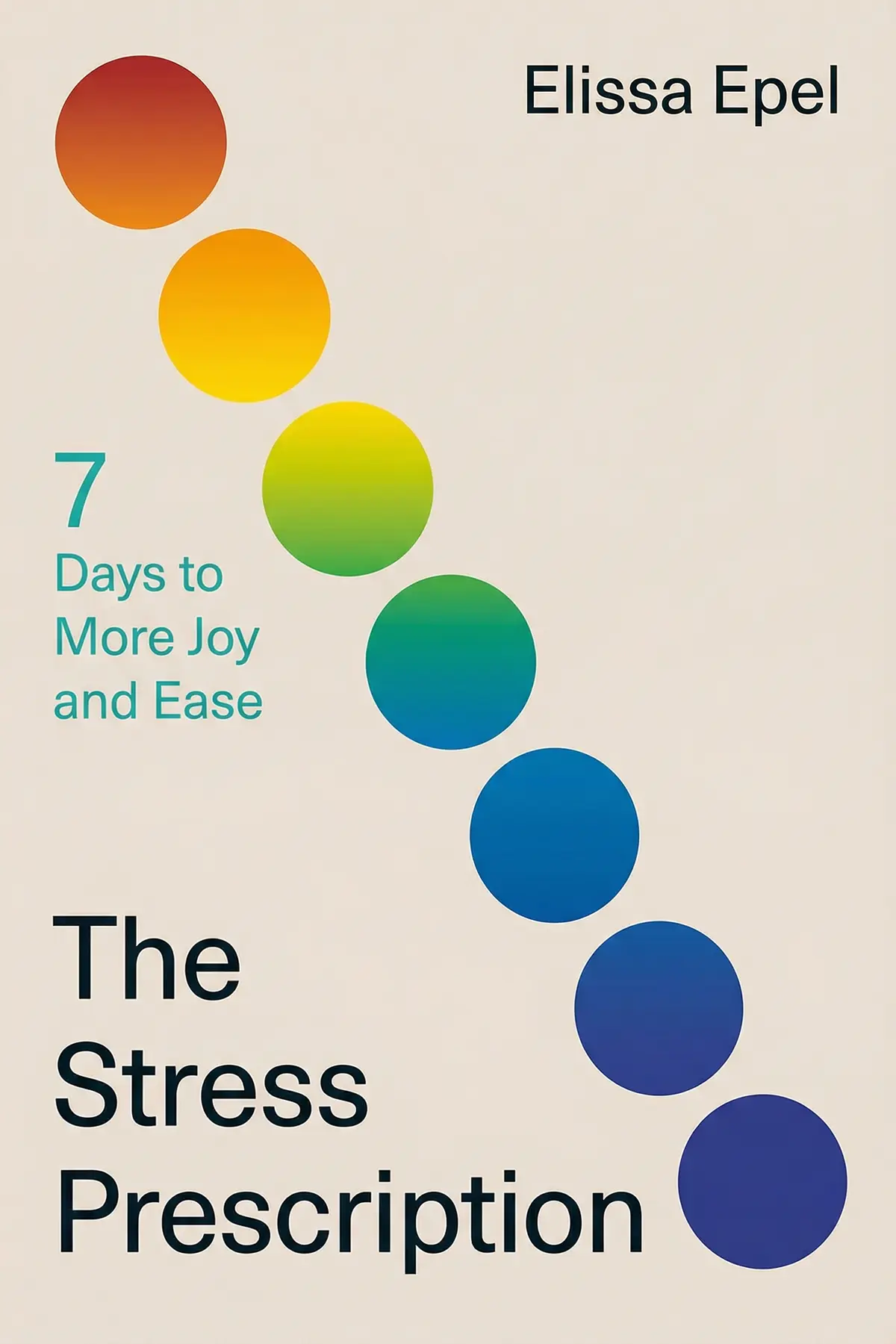
Table of Content
1. Introduction
53 sec
People who live with constant pressure often try to get rid of stress altogether, and health psychologist Elissa Epel argues that this is the wrong goal. In The Stress Prescription, she describes an experiment in which people who got an electric shock only some of the time were more stressed than people shocked every time. Not knowing was harder on them than the bad news itself.
Epel’s argument is that stress itself can’t be removed from a life, but the way you meet it can be trained, until pressure starts to feel like energy. She turns that idea into a one-week program, with one skill for each day, covering both the mind and the body.
Each day comes with its practice, the reasoning behind it and a version small enough to try tomorrow. They range from a worry list sorted with circles and boxes to a cold finish on your morning shower and a breathing count you can fall asleep to.
2. Stop paying for disasters that haven't happened
1 min 44 sec
Three groups played the same game with the same snakes, and one group’s bodies stayed on high alert the whole time. The cause was something most of us do every evening and call preparation.
3. Sort your worries into what you can change
1 min 54 sec
Some of the weight you carry every day belongs to problems no one could solve. A simple exercise with a pen, some circles and some boxes shows which burdens to work on and which to put down.
4. Turn a scary deadline into a challenge
1 min 50 sec
A lion and a gazelle are both stressed during the same chase, yet the gazelle feels a fearful threat response while the lion feels a challenge. Only one of them experiences it as fear, and Epel thinks you can choose which one you are.
5. Train your stress response with cold and sweat
1 min 36 sec
A blast of cold water feels like the last thing a stressed person needs. Epel argues that short doses of deliberate discomfort are exactly how the body learns to stay steady when stress you didn’t choose arrives.
6. Calm your body with five minutes of breathing
1 min 41 sec
Under pressure, the body changes how it breathes without asking you. Epel’s day of rest centers on a simple counting pattern, and one part of that count does most of the calming work.
7. Let a few green minutes reset your mind
1 min 42 sec
During the pandemic lockdowns, some people stayed noticeably calmer than others, and the difference wasn’t money or age. What they had is easier to find than most busy city dwellers assume.
8. End each day by counting what went well
1 min 29 sec
The brain holds on to the one rude email and forgets the ten kind ones. Epel closes the week with two brief rituals designed to correct that imbalance, and the most effective version needs only a pen.
9. Conclusion
1 min 03 sec
What the week adds up to is a new relationship with stress. Epel never promises a calm life. What she offers is a set of responses, each trained like a muscle. You let the future arrive instead of rehearsing it. You put down what you cannot carry. You read pressure as a chase you can win, and you give your body short shocks along with real recovery. The gazelle and the lion feel the same rush. What separates them is what the rush means.
The practices are small enough to start before the week is out. The next time your jaw tightens over something that hasn’t happened yet, lean back in your chair and name the outcome you’re bracing for, knowing it is only one of several. Make the Stress Inventory on paper, with circles for what you can move and boxes for what you will set down. End tomorrow’s shower cold, relax into it, and fall asleep to a slow count of four, six and eight.
Stress will keep arriving. With practice, you can start meeting it the way the lion meets the chase.
About this book
What is this book about?
Most advice about stress treats it as something to remove. Health psychologist Elissa Epel takes a different line. Some stress is normal and even useful, she argues. The real problem is a response that stays stuck in fear, worry and tension. The Stress Prescription is built as a seven-day program, with one skill for each day. Epel starts with a study showing that uncertainty stresses people more than a certain bad outcome. From there she moves through a written inventory that separates what you can influence from what you cannot, self-talk that turns threats into challenges, and planned discomfort through exercise and cold water. The week ends with time in nature, the 4-6-8 breathing method and morning and evening gratitude rituals. Every practice is small enough to start the same day. Readers come out with a set of tools for both the mind and the body. Taken as a week, the program shows that how you respond to stress is a skill, and that it gets stronger with practice.
Book Information
Who it's for
Workers kept awake worrying
Professionals who lie awake rehearsing tomorrow's worst cases and want a way to stop.
Deadline-stuck students and managers
Managers and students facing hard deadlines who freeze instead of rising to the challenge.
Nearly burned-out adults
Anyone close to burnout who wants short daily practices for both mind and body, not a long program.
About the Author
Elissa Epel
Elissa Epel is an American health psychologist and a professor in the Department of Psychiatry and Behavioral Sciences at the University of California, San Francisco, where she is also vice chair. She directs UCSF's Aging, Metabolism, and Emotion Center and is associate director of its Center for Health and Community. Her research looks at how stress affects aging. She co-wrote The Telomere Effect, a New York Times best-seller.
Ratings & Reviews
Ratings at a glance

What people think
Listeners find this guide practical and simple to digest, with one listener highlighting that it contains gems of wisdom on every page. They also appreciate how it fundamentally shifts their perspective on managing stress and has the potential for significant impact. Furthermore, the book is direct and well-researched, providing deep insights that make listeners feel it is well worth the read.
Top reviews
Earn
After hearing Dr. Epel on a podcast, I was immediately struck by her warmth and kindness, which radiates through every page of this guide. She manages to balance high-level biological research with practical, bite-sized tasks that don't feel overwhelming to a fried brain. The seven-day structure provides a clear path forward, though it's obvious these habits are meant to be lifelong practices rather than a quick fix. I particularly loved the section on monotasking and how observing nature can help us reclaim our focus. Truth is, we are all breathing far too fast and living in a state of constant anticipation. By implementing her 4-6-8 breathing technique, I’ve noticed a measurable shift in my daily heart rate. It’s a beautifully written, well-researched book that offers genuine wisdom on every page.
Show morePranee
Wow, this is the first wellness book that actually feels like it's grounded in hard biological reality rather than just empty 'vibes.' Dr. Epel explains the measurable negative influence of chronic stress on our biology, which was the wake-up call I desperately needed. She doesn't just tell you to relax; she explains how acute physical stress, like holding your breath or heat exposure, actually builds long-term resilience. I’ve started the practice of asking myself what I'm grateful for every morning, and it really does set a different tone for the day. The writing style is very encouraging, making you feel like you have a wise mentor guiding you through the wreckage of your busy life. It’s a rare find that is both deeply scientific and incredibly kind.
Show moreIce
Finally got around to finishing this after a long hiatus, and I’m kicking myself for not doing it sooner because it’s a total game-changer. The way Epel discusses 'suffering twice' by anticipating problems that haven't happened yet was a massive lightbulb moment for me. I’ve started incorporating the evening practice of recalling joy and the morning practice of looking forward to small things. It sounds simple, but these small acts of kindness toward oneself create a powerful shield against daily frustrations. The book is well-researched, straightforward, and filled with gems of wisdom that actually feel doable in a normal life. I love that she includes extra resources and references for those who want to dive deeper into the molecular biology. It’s a beautiful marriage of science and soul.
Show moreAubrey
Ever wonder why some people bounce back from adversity while others seem to stay stuck in a cycle of tension? This book provides the scientific 'prescription' for building that specific kind of resilience through manageable, daily interventions. Dr. Epel’s expertise as a professor shines through, but she never talks down to the reader or makes the data feel inaccessible. I found the section on 'floating in water' and its impact on anxiety to be fascinating and something I hadn't considered before. Not gonna lie, I was skeptical about the 7-day format, but it actually helps to prevent the feeling of being overwhelmed by too much information at once. It’s a thoughtful, well-paced guide that encourages you to embrace uncertainty rather than fighting a losing battle against it. Truly a must-read for our high-pressure modern era.
Show moreChanikarn
To be fair, most of this isn't necessarily 'new' information, but Epel organizes it in such a compelling, actionable way that it feels fresh. I’ve read dozens of books on meditation, yet her explanation of why we need to slow our breathing rate was the most convincing I've encountered. The book is a bit heavy on the personal stories at times, which can feel like filler when you just want the facts. However, the 'experience awe' to-do list item is a brilliant way to shift your focus from tasks to presence. I also appreciated the mention of the 'post-vacation blues' and how gratitude can help bridge that emotional gap. It’s a very practical guide that doesn't demand hours of your time, making it perfect for the very people who need it most.
Show moreThanakorn
The chapter on uncertainty changed my entire perspective on how I handle workplace anxiety and unpredictable life events. Instead of dreading the unknown, Epel encourages us to embrace it as a gateway to awe and joy. This shift from 'threat' to 'excitement' is backed by solid research, which makes the advice feel more credible than your average self-help book. I did find some of the instructions a bit repetitive by the time I reached the final chapters. However, the specific tips on cold water exposure and the importance of nature are gems that I've already integrated into my routine. It's not a magic wand, but it’s a very solid toolkit for anyone feeling the weight of the modern world. If you commit to the exercises, you will definitely see a benefit.
Show moreBo
Picked this up during a particularly brutal month at work, hoping for a quick fix for my spiraling cortisol levels. What I found was a thoughtful, seven-day curriculum that challenges you to relinquish control over things you simply cannot change. The focus on physical sensations—like the feeling of a hot cup of coffee or the chill of a cold shower—really helps ground you in the present moment. Some might find the advice about breathing and gratitude to be a bit basic, but Epel provides the biological 'why' that makes it stick. My only gripe is that the workbook elements could have been a bit more robust to help with the habit-forming process. Overall, it’s a straightforward and highly accessible read for anyone needing to lower their expectations and find some peace.
Show moreTim
As someone who has struggled with chronic burnout for years, the concept of 'rest as a social justice issue' really hit home for me. It’s easy to feel guilty for taking a break, but this book frames restoration as a fundamental responsibility to ourselves and our community. The practical tips on using essential oils and finding 'awe' in daily life are surprisingly effective for such simple actions. I’ll admit that the sections on animal experiments felt a bit unnecessary and distracted from the human element of the narrative. Even so, the core message about reframing anticipatory stress is worth the price of admission alone. It’s a well-referenced piece of work that offers a unique take on easing the mental burden we all carry. Highly recommended for those ready to commit to a lifestyle change.
Show moreOoi
Look, the science is clearly there, but I struggled with how repetitive the advice felt after the third or fourth chapter. Dr. Epel is clearly an expert, and her voice is very soothing, yet I found myself skimming through the personal anecdotes quite often. The 7-day plan is a good idea in theory, but the distinction between the days feels a little forced and could have been condensed. I did appreciate the 4-6-8 breathing exercises and the emphasis on 'monotasking' to reduce the friction of a busy schedule. If you’ve never read a book on stress management, this will be a goldmine of information for you. For those of us who have read a lot in this genre, you might find yourself wishing for a bit more 'meat' and fewer reminders to take a walk.
Show moreNoi
Not what I expected from a world-renowned PhD expert, especially given the bold 'prescription' title. While I hoped for rigorous clinical evidence for every single tip, I found myself wading through far too many personal anecdotes and irrelevant molecular biology data. Frankly, telling a stressed person to 'just breathe' or 'take a walk' feels dismissive when they are looking for a scientific breakthrough. The animal experiments mentioned felt disconnected from my daily reality of bills and deadlines. To be fair, some people might like the storytelling, but for me, it just added to the frustration. I wanted a roadmap, not a collection of Sleepy Time tea-style platitudes mixed with dense academic filler.
Show moreQuestions about this book
What is the main idea of The Stress Prescription by Elissa Epel?
Epel argues that stress cannot and should not be removed from life entirely, since some of it is normal and healthy. What matters is how you respond. She lays out a seven-day program with one skill per day, from accepting uncertainty and sorting out what you can control to reframing threats, controlled discomfort, time in nature, deep breathing and gratitude.
Why is uncertainty so stressful according to The Stress Prescription?
Epel describes a study in which people played a game where snakes hid under rocks and could bring a real electric shock. Players shocked only some of the time were more stressed than those shocked every time, with higher heart rates, slower decisions and worse play. She concludes that uncertainty can weigh on us more than a bad outcome, and that worrying ahead doesn’t help us cope when trouble comes.
What is the 4-6-8 breathing method?
Sit or lie down with one hand on your belly. Inhale softly via your nose while counting to four, pause for a count of six, then exhale slowly out of your mouth for eight. Repeat for at least five minutes. Epel says the long exhale is the key part, because it triggers relaxation. She suggests sessions after waking, during breaks, before bed and while falling asleep.
What is hormetic stress and how can I practice it?
Hormetic stress means short, deliberate doses of discomfort that train your body to handle stress better later. Epel suggests two methods. The first is exercise, from a walk for beginners to high-intensity interval training, pushed far enough to feel some discomfort. The second is cold: finish a warm shower with water as cold as you can bear, for as long as you can, and try to relax into it.
How do I make a Stress Inventory?
Write down everything causing you pressure, anger or uncertainty without trying to solve it. Cross out what doesn’t really matter by asking who said it was important and what would happen if you skipped it. Circle what you can influence and add one small step for each. Box what you cannot control, look for any partial action, and otherwise accept those items and set them down.
Readers also enjoyed





Alcoholics Anonymous
Alcoholics Anonymous World Services

A Liberated Mind: How to Pivot Toward What Matters
Steven C. Hayes



AUDIO SUMMARY AVAILABLE
Listen to The Stress Prescription in 15 minutes
Get the key ideas from The Stress Prescription by Elissa Epel, plus 5,000+ more nonfiction titles.
- 5,000+ titles
- Listen as much as you want
- 7-day free trial
- Cancel anytime









