

14 min 59 sec
Available in: English
The Simplicity Principle: Six Steps Towards Clarity in a Complex World
Julia Hobsbawm shows how to cut through digital overload and crowded schedules by narrowing life to six priorities, from switching off at night to asking in person and setting deadlines that match your pace.
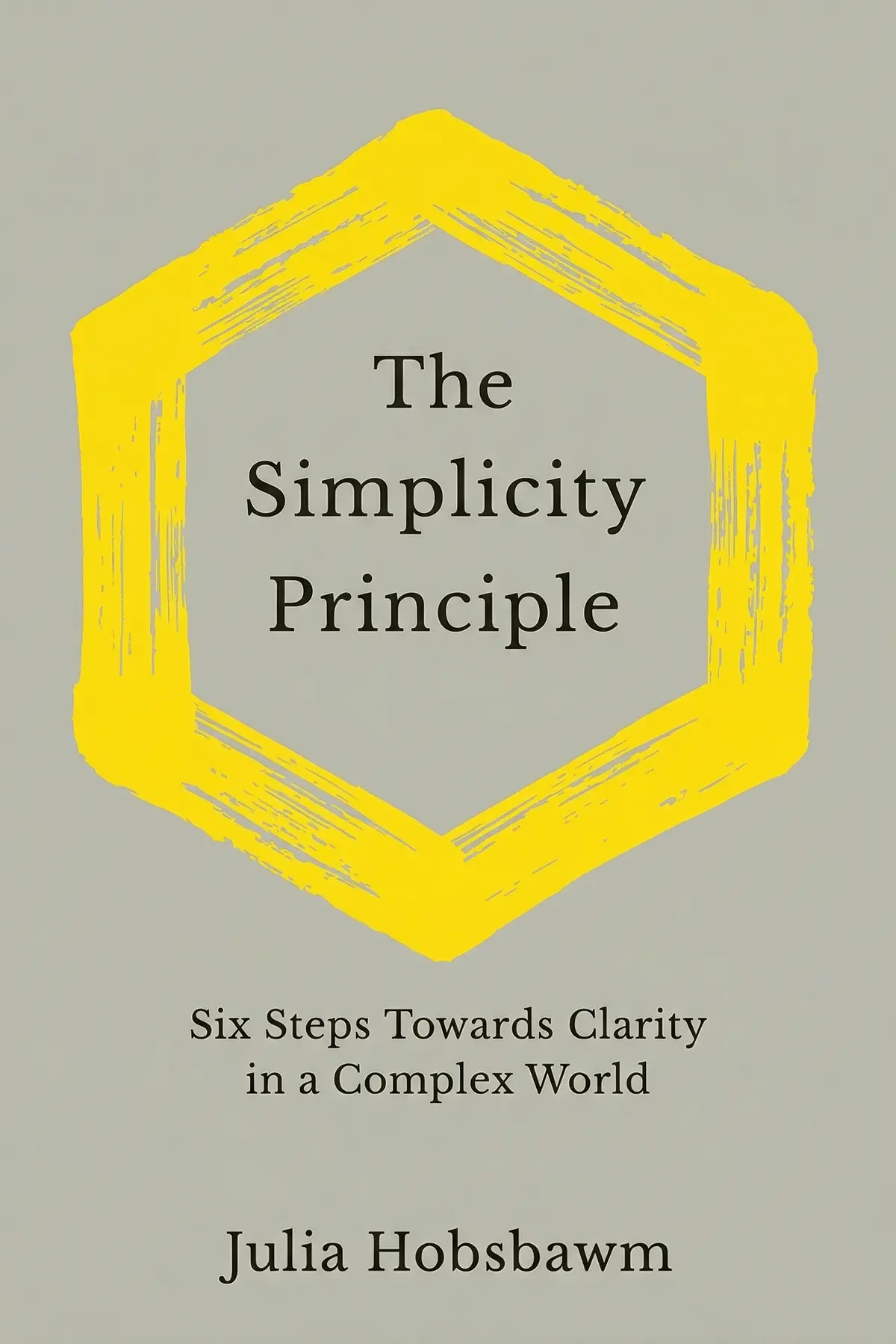
Table of Content
1. Introduction
1 min 06 sec
Half-finished tasks, open tabs and a buzzing phone feel like normal working life, yet they carry a real price: one University of California study found that each check of a newsfeed costs over 23 minutes of focus. In The Simplicity Principle, entrepreneur and broadcaster Julia Hobsbawm argues that the way out is to choose fewer things and build your days around them, not to try harder. Her model is the honeybee, whose six-sided cells make strong structures from light material.
Hobsbawm turns that hexagon into a personal system with six sides: clarity, individuality, reset, knowledge, networks and time. Her case is that a crowded life becomes manageable when you protect a few priorities you can actually keep in mind. Each side comes with a test to try this week, from a weekend offline to Warren Buffett’s habit of refusing nearly everything, plus a finding about asking face to face that may change how you make your next request.
2. See how simple offers win customers and voters
1 min 42 sec
A computer that needs five minutes before you can message a nearby colleague says something about modern life. Hobsbawm finds the same frustration behind business winners and election upsets, and it points to what people want most.
3. Six priorities your memory can actually hold
1 min 27 sec
Bees solved an engineering problem with one shape that people mostly ignore. That same shape happens to match a limit inside your own head, and Hobsbawm builds her whole system on it.
4. Say no to almost everything that distracts you
1 min 37 sec
One famous and extraordinarily wealthy investor owns no smartphone and keeps no computer on his desk. His reasons, and the true cost of one glance at a newsfeed, show what a life without firm lines loses.
5. Stand by your values before problems pile up
1 min 35 sec
Accepting one awkward contract can seem harmless. Hobsbawm traces how going along silently with work you oppose multiplies trouble, and why the people mocked as snowflakes may have a point.
6. Stop completely before burnout stops you
1 min 47 sec
A fictional ad man collapses at 36, and the cause still looks familiar. Hobsbawm’s way back involves something stranger than mindfulness, plus a habit her historian father used on every trip.
7. Put your news on a strict diet
1 min 32 sec
Social scientists now have a name for the way we stuff our heads with half-read articles. Hobsbawm’s cure starts with your browser tabs and ends with a skill no website can teach.
8. Ask face to face and get more yeses
1 min 32 sec
One study found that a simple change in how you ask multiplies your chances of a yes many times over. It has nothing to do with wording and everything to do with where you stand.
9. Set deadlines that fit how you work
1 min 30 sec
Deadlines get projects finished, yet many are set for reasons that have little to do with the work itself. Hobsbawm explains whose clock your schedule should follow, with teenagers as a telling example.
10. Conclusion
1 min 11 sec
A honeycomb is strong because each cell is small, simple and joined to the others, so the whole holds without being heavy. Hobsbawm’s argument is that a life can be built the same way. Devices, workplaces and endless information push toward complexity, and that pressure will not ease by itself. What you can shape is a short set of priorities, each light enough to carry and linked to the rest.
That is why her closing advice is modest. Set a few realistic targets instead of a long list of resolutions, perhaps a chapter of a novel or one investment goal, and arrange your time and resources so they stay within reach. Pick an hour when the screens go off. Make your next important request in person. When a deadline feels wrong, reshape it to your own pace.
None of this means leaving modern life. It means being a little more connected to yourself and a little less to your phone. Six sides are enough to build a hive, and probably enough to build a calmer week.
About this book
What is this book about?
Updates, notifications and half-read articles make ordinary days feel complicated. Julia Hobsbawm argues that what people want most in response is simplicity. She sees that wish in the success of companies like Apple and Amazon, which hide complex operations behind easy experiences, and even in election campaigns built on short, simple slogans. Her answer comes from the honeybee. Bees build their hives from hexagons, a shape that interlocks and stays strong even when the material is light. Hobsbawm turns it into a system she calls Hexagon Action. Its six sides match the number of things working memory comfortably holds: clarity, individuality, reset, knowledge, networks and time. Each side comes with practical habits. Readers meet her weekend internet Shabbat, Warren Buffett's practice of declining nearly every invitation, a historian father who traveled to recover, a Knowledge Dashboard for trusted sources and research finding that people who ask in person are 34 times more likely to get a yes than those who ask by email. What readers get is a short, usable framework for a calmer and more focused week.
Book Information
Who it's for
Overwhelmed desk workers
Office workers buried in notifications, open tabs and half-finished tasks.
Founders and managers
Managers and founders who want a simple way to set priorities and realistic deadlines.
Near-burnout professionals
Professionals close to burnout who need a method for switching off and recovering.
About the Author
Julia Hobsbawm
Julia Hobsbawm, a British entrepreneur, businesswoman, broadcaster and writer, advises corporations, governments and non-profits on how work has changed and where it is heading. She co-hosts the podcast The Nowhere Office, named after her 2022 book. She helped found the Workforce Institute and was the first person to chair the UK Demos Workshift Commission, created during the pandemic. The Simplicity Principle won two American awards in 2020, and in 2015 she was made an OBE for services to business.
Ratings & Reviews
Ratings at a glance

What people think
Listeners find that although perspectives differ on the book’s intricate structural layout, many value its original intellectual strategy for sharpening focus via the "Hexagon Action" framework. Furthermore, they appreciate the compelling analogies involving nature and the lives of bees to demonstrate ideas of integration and productivity. Additionally, listeners point out the practical tips regarding "mindful-less-ness" and techniques for resetting to avoid burnout, with one listener remarking that the text is notably pertinent for professionals dealing with a persistent "always-on" culture.
Top reviews
Ingrid
Finally got around to reading this and I’m genuinely surprised by how much the geometry of nature can teach us about productivity. The hexagonal framework is a brilliant way to visualize the different facets of our lives, from Time to Networks. I loved the historical references, especially the bits about her father, Eric Hobsbawm, and his approach to noticing while traveling. It’s a very grounding book that encourages you to step back from the 'always-on' machine age. Some might find the language a bit high-brow, but I thought it added a layer of sophistication that is usually missing in this genre. It’s not just about doing more; it’s about being more connected to the natural rhythms of life. This is definitely a book I’ll be returning to when I feel the need to reset.
Show moreDome
Ever wonder why a beehive is so efficient? This book dives deep into that question, using nature’s geometry as a framework for human productivity. I actually enjoyed the Hexagon Action system, even if it feels a bit rigid at times. The author draws fantastic parallels between the way bees organize their hives and how we can structure our chaotic digital lives. It’s definitely more of an intellectual business read than a standard self-help book. I found the Reset chapter particularly helpful for dealing with my 'always-on' work mentality. The advice on noticing during travel was a highlight for me. However, the sheer number of sub-lists can be overwhelming if you try to implement everything at once. It’s best to treat it as a philosophy rather than a step-by-step manual.
Show moreYongyut
As someone working in a corporate environment, I found the intellectual depth here quite refreshing compared to standard self-help fluff. Julia Hobsbawm is clearly a brilliant thinker, and she brings a high level of academic rigor to the table. The way she links the concept of Clarity to the structure of a hexagon is fascinating. It’s refreshing to see a business book that doesn't talk down to its audience. I particularly appreciated the references to Adam Galinsky's work on how new stimuli affect the brain. Yes, the structure is complex, but the world we live in is complex too. It’s a book for people who want to understand the why behind their lack of focus. It might not be for everyone, but it’s a solid read for the right professional.
Show moreJin
After hearing so much buzz about the 'always-on' culture, I appreciated how this book addresses the need to disconnect. The Reset pillar was particularly impactful for me, especially the discussion on how travel and meditation can prevent burnout. Hobsbawm’s writing is very intellectual, which makes the advice feel more grounded in research than your average blog post. I liked the inclusion of the Hexagon Action steps, as they provide a visual way to think about personal growth. That being said, the book can be quite dense. It’s not something you can breeze through in an afternoon; you really have to sit with the concepts and reflect. It’s a great resource for business professionals who feel overwhelmed by the complexity of the modern world. I’m glad I took the time to finish it.
Show morePot
To be fair, Hobsbawm offers some truly interesting concepts like 'mindful-less-ness' that resonate in our burnout-prone culture. The idea of shutting off the subconscious to allow for restoration is a powerful alternative to the typical mindfulness tropes we see everywhere. That said, the obsession with the number six feels a bit like a gimmick after a while. Every single section has to have exactly six points, which often leads to filler content that doesn't add much value. The book struggles with its own identity, wavering between a business text and a philosophical treatise. It requires a lot of mental energy to sift through the complex language to find the actionable gems. I’d recommend it to people who enjoy deep, theoretical dives into productivity. Just don't expect a quick fix.
Show moreNarongrit
Look, there is a decent core message buried under the heavy layers of organizational theory and hexagonal obsession. I think Hobsbawm makes some great points about the dangers of our 'always-on' culture and the need for a total reset. Her advice on noticing your surroundings to stimulate neuroplasticity is genuinely helpful for mental health. However, the book desperately needs a better editor to trim the fat. The structure is so repetitive that it starts to feel like a gimmick halfway through. It’s as if she forced her thoughts into this six-sided mold even when they didn't fit. If you have the patience to dig for the good bits, you’ll find some value. Just be prepared for a lot of academic jargon and odd tangents along the way.
Show moreCha
Not what I expected from a book titled after simplicity. I thought this would be a practical guide to decluttering my life, but it turned out to be a very complex deep-dive into geometry and social theory. The author is clearly very smart, but her style is more suited for a lecture hall than a self-help shelf. I did enjoy the bits about 'mindful-less-ness' and the importance of emptying the mind. Those sections were actually quite liberating. But the constant focus on the number six—six steps, six fixes, six thinkers—felt forced and made the whole thing harder to remember. It’s a bit of a mixed bag. There are some gems of wisdom here, but you have to be willing to wade through a lot of fluff to find them.
Show moreRiley
Picked this up because the cover looked sleek and promising, but the content inside is a labyrinth of lists. You’d think a book about simplicity would be, well, simple. Instead, Hobsbawm gives us six main pillars, each with six sub-steps, and then even more variations on top of that. It’s mathematically perfect according to her, but it’s practically exhausting for the reader. I struggled to keep track of the different axioms by the time I reached the halfway point. The rambling sections on bee larvae and hexagonal cells felt a bit too esoteric for a book supposed to help with clarity. There is some decent research buried in here, particularly regarding neuroplasticity and travel. Unfortunately, the delivery is so dense that it defeats the purpose of the message.
Show moreMontri
The irony is almost too much to bear with this one. For a book that claims to champion simplicity, the organizational structure is incredibly dense and, frankly, quite messy. Julia Hobsbawm attempts to use the hexagon as a grounding metaphor, but she ends up burying her best points under endless lists of six-within-six. It felt like I was reading a collection of the author's random daily thoughts rather than a cohesive strategy for productivity. While the sections on the life of bees were charming, they didn't actually help me navigate my digital clutter. If you are looking for a quick guide to clearing your head, this isn't it. The writing style is far too rambling and esoteric for a general audience seeking practical advice. I wanted clarity, but I left feeling more confused than when I started.
Show moreLucas
This book felt more like a stream-of-consciousness journal than a structured guide to clarity. It’s ironic that a book called The Simplicity Principle is one of the most incoherent things I've read all year. The author seems obsessed with the number six, even reaching for bizarre connections like people being buried six feet deep. What does that have to do with being productive? The metaphors about bees and honeycombs were stretched way too thin and became a distraction from the actual advice. I felt like I was losing the will to finish as the chapters became more rambling and less focused. There are much better books on productivity that actually practice what they preach. This one is just too much snowflakery and not enough substance.
Show moreQuestions about this book
What is The Simplicity Principle by Julia Hobsbawm about?
Hobsbawm argues that technology and modern work have made daily life needlessly complicated, and that people want simplicity above all. She borrows a model from bees, whose hexagonal cells make strong structures from light material, and turns it into a system called Hexagon Action. Its six sides help readers narrow their lives to a few priorities they can keep in mind, from setting firm boundaries to managing time by their own rhythm.
What are the six sides of Hexagon Action?
Hobsbawm names six: clarity, individuality, reset, knowledge, networks and time. Clarity means boundaries and purpose. Individuality means trusting your intuition and values. Reset means stopping fully to avoid burnout. Knowledge means curating trusted sources. Networks means favoring real, in-person connection. Time means setting personal deadlines and respecting your body clock. She chose six because it matches roughly how many things working memory can comfortably hold.
What is an internet Shabbat?
It is Hobsbawm’s name for a fixed period completely offline. She disconnects from 8 p.m. on Friday until Monday morning. Her reasoning is that social networks are designed to be addictive, so willpower alone rarely works, and removing the option does. She cites a University of California study finding that each check of a newsfeed costs 23 minutes and 15 seconds of refocusing.
How can I apply The Simplicity Principle at work?
Start small. Choose a few realistic targets instead of many resolutions. Set a daily hour when screens go off. Build a Knowledge Dashboard of the few sources you trust and drop unreliable ones. Make important requests in person, since research Hobsbawm cites found people are 34 times more likely to get a yes than by email. And set deadlines that match your own pace.
Readers also enjoyed





AUDIO SUMMARY AVAILABLE
Listen to The Simplicity Principle in 15 minutes
Get the key ideas from The Simplicity Principle by Julia Hobsbawm, plus 5,000+ more nonfiction titles.
- 5,000+ titles
- Listen as much as you want
- 7-day free trial
- Cancel anytime









