
14 min 03 sec
Available in: English
The Secret World of Weather: How to Read Signs in Every Cloud, Breeze, Hill, Street, Plant, Animal, and Dewdrop
Shows how to read clouds, shifting winds, dew, animals, plants and city streets so you can predict the weather where you stand, instead of trusting a forecast built for a whole region.
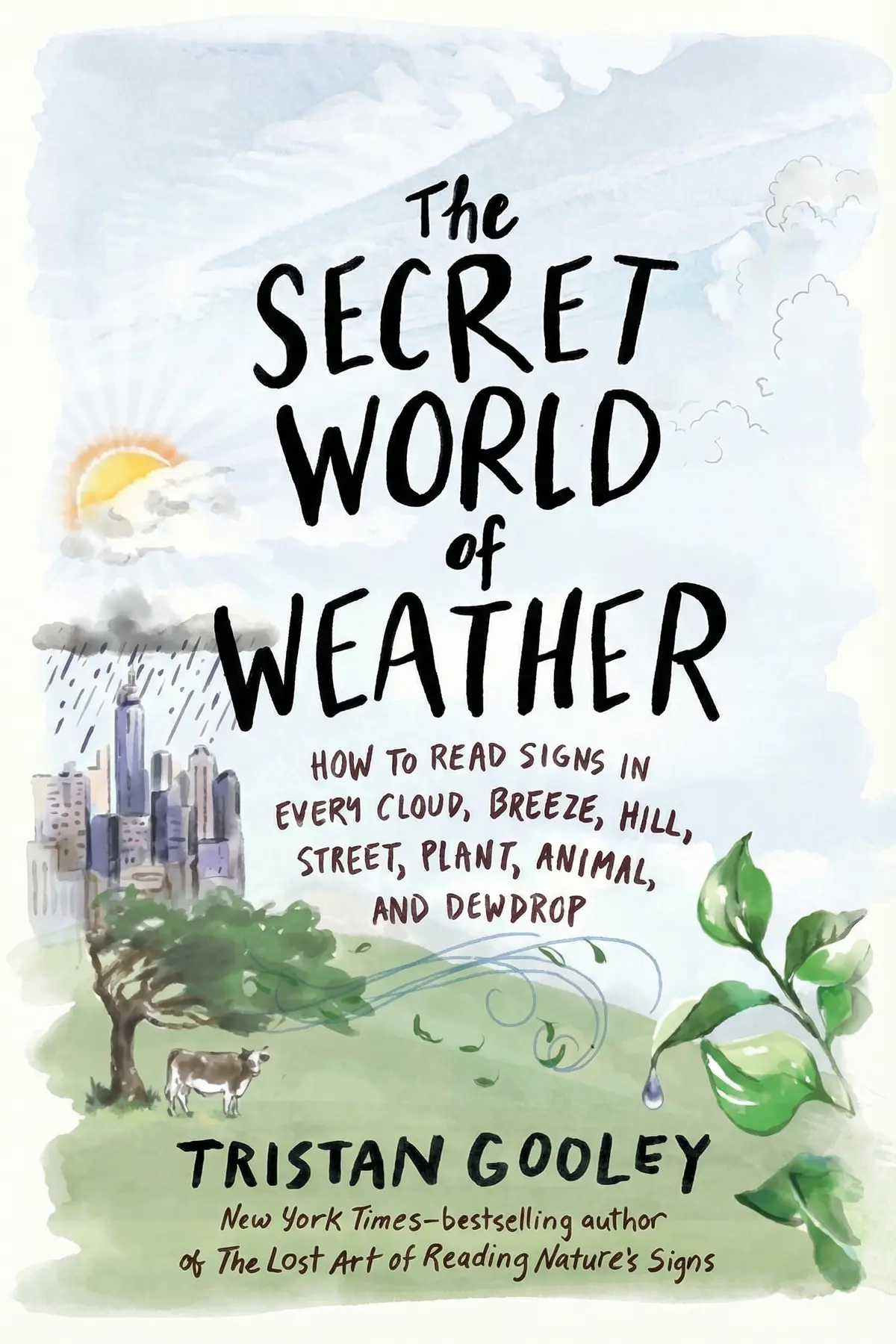
Table of Content
1. Introduction
1 min 05 sec
A weather app can promise a dry afternoon and still leave you soaked, because it was never describing the street you stand on. In The Secret World of Weather, navigator and expedition leader Tristan Gooley argues that forecasts work at the scale of whole regions, while the weather you feel is made within a few meters of you, by trees, buildings, hills and soil.
These small pockets are microclimates, and Gooley believes anyone can learn to read them. The clues are already overhead and underfoot: the shape of a cloud, a wind that turns against the one above it, a horse standing with its back to the breeze, frost that thins out beneath a tree. Once you know what such signs mean, local weather stops being a surprise and becomes something you see coming. What follows works as a field guide: three cloud families, three layers of wind, the link between dew and snow, the warnings inside a storm cloud, and the private weather of forests, islands and cities.
2. Read the weather your forecast cannot see
1 min 47 sec
The man who invented the weather forecast was mocked so cruelly for his mistakes that it destroyed him. Yet the gap his critics noticed is still real, and it lies somewhere surprisingly close to home.
3. Name three cloud families and see storms coming
1 min 41 sec
Feathery wisps, gray blankets and white puffs each carry a different message about the hours ahead. One particular combination in the sky is a warning that most people look at without ever noticing.
4. Learn your local wind and skip the forecast
1 min 37 sec
The wind on your face is rarely the wind the forecaster is talking about. When the layers above you start to disagree, they are telling you something the app has not caught yet.
5. Predict cold and wet from the dew point
1 min 45 sec
Dew on the lawn, frost on a windshield and snow on the hills look like separate events. They share one cause, and seeing it lets you guess how hard and how long the next rain will fall.
6. Let horses, birds and buttercups confirm the signs
1 min 36 sec
Some old country weather lore turns out to be nonsense, and some of it holds up. The animals and flowers worth watching are telling you about the wind and about the place itself.
7. Spot fog, storms and hail before they hit
1 min 46 sec
A single night of fog on an American freeway left a trail of wrecked cars. Understanding how such weather forms tells you when to take shelter, and how much one storm cloud can hold.
8. Find shelter in forests, islands and city streets
1 min 40 sec
Two trees standing side by side can offer very different winters, and a city can run far hotter than the fields around it. Each kind of place quietly writes its own weather.
9. Conclusion
1 min 06 sec
Robert FitzRoy paid a terrible price because people expected his forecasts to be perfect. Gooley’s response is to stop asking the forecast to describe your own street and to read the street yourself. The forecast sees regions. You can see the cirrus thickening, the winds aloft pulling in different directions, the horse turning its back, the frost thinning out beneath the trees. Each sign is small. Read together, they tell you what the next few hours will bring where you actually are.
The skill begins with attention. Gooley suggests studying the sky closely for a few minutes, then closing your eyes and describing it as if to a friend who is about to paint it. Do that often and the details stop blurring into one gray picture. Alongside it, keep a simple record of the wind before each forecast change, and look for your own version of the breeze that runs from the church to the hill before rain.
One morning all three cloud families will share the sky, and you will reach for a coat before any app tells you to.
About this book
What is this book about?
Most people check a weather app, trust it, and still get caught in the rain. Tristan Gooley argues that the app is not lying. It simply describes weather at the scale of regions, while the weather you feel is shaped within a few meters of you by trees, hills, buildings and soil. These local pockets are microclimates, and they leave clues that no computer fully maps. Gooley, a navigator and expedition leader, teaches the reader to see those clues. He sorts clouds into three families that each forecast something different, separates the wind into three layers and explains why it matters when they disagree. He links dew, frost, rain and snow to one process, shows what horses, birds, spiders and buttercups reveal, and explains fog, storm clouds and hail through their physics. The book ends in forests, on islands and in cities, each with its own private weather. Readers come away with a field method: watch the sky closely, keep track of the local wind before every change, and learn to see the next few hours of weather coming without a screen.
Book Information
Who it's for
Commuters, walkers and runners
Walkers, runners and commuters tired of being caught out by a forecast that promised sun.
Hikers, sailors and gardeners
Sailors, hikers and gardeners who want to read local conditions for themselves.
Curious urban residents
City dwellers curious why their street feels hotter or windier than the report says.
About the Author
Tristan Gooley
Tristan Gooley, born in 1973, lives in Sussex in the UK. He has trekked in remote regions, sailed small boats across oceans, sailed solo across the Atlantic and flown small aircraft to Africa and the Arctic. He has led nature expeditions on all five continents and is a Fellow of the Royal Geographical Society and of the Royal Institute of Navigation. His books teach readers to spot clues and signs in nature.
Ratings & Reviews
Ratings at a glance
What people think
Listeners find this book highly educational, with one highlighting how it encourages a greater awareness of nature’s nuances. They also value the meteorological insights, with one mentioning how it teaches local weather prediction, and describe the prose as engaging and well-crafted. The title earns further praise for its outdoor applications, with one listener noting it is particularly fun to use while out on a hike. However, listeners express differing views on how easy the text is to read.
Top reviews
Tun
This book completely changed how I view a simple afternoon walk. Tristan Gooley invites us into a world where every breeze and cloud formation tells a specific story about the coming hours. I was particularly struck by the discussion on microclimates, which explains why my garden feels different from the park down the road. Frankly, the way he describes the sound of wind through different tree species is poetic yet grounded in solid observation. It’s perfect for hikers who want to sharpen their senses during outdoor excursions. While the text is quite dense, the depth of information provided is second to none for nature lovers. I feel much more connected to the sky now.
Show moreNuk
Ever wonder why the rain smells different in the city compared to the woods? Gooley breaks down these subtle shifts in nature with a contagious level of enthusiasm that makes you want to run outside immediately. I’ve started paying much closer attention to how my local environment reacts to pressure changes. The section on how birds indicate wind direction by the way they face was a total revelation for me. It’s a thick read, sure, but the wealth of knowledge is absolutely phenomenal for anyone tired of inaccurate digital forecasts. Learning to identify the variety in raindrop size has made even the gloomiest days feel like a science experiment.
Show moreIsaiah
Wow, the level of detail regarding microclimates in this volume is just staggering. Living in a mountainous area means the general forecast is almost always wrong for my specific valley. This book gave me the tools to understand why frost appears on my shed while the air stays warm just a few feet away. I loved the bits about the taste and speed of raindrops, which I had never considered before. It's an analytical look at the world that somehow remains deeply emotional and grounding. Tristan Gooley is a true weather detective. This is a must-read for anyone who lives off the beaten path and wants to predict their own sky.
Show moreManee
Finally got around to finishing this, and while it's a bit of a slow burn, the payoff is worth it. Gooley teaches you how to become a weather detective using nothing but your own senses and the clues left by plants. I found the explanation of how land characteristics influence local wind patterns to be particularly enlightening for my morning runs. The truth is, we take the sky for granted every single day. By the end of the book, I felt like I had gained a superpower for predicting small-scale changes. It’s a brilliant, well-written guide that rewards patient readers with a new, sharper perspective on the natural world.
Show moreOoi
After hearing so much about Gooley's previous work, I was thrilled to find this weather-focused guide just as enlightening and oddly calming. There is something deeply meditative about learning to interpret the way a breeze shifts through the grass or the height of a cloud. It actually helped with my daily anxiety to focus on these tiny, predictable patterns in the natural world rather than the news. Gooley is a master at making the invisible visible through his writing. I recommend buying the physical copy over the ebook so you can flip back to the reference sections more easily. It truly opens your eyes to the secrets of the air around you.
Show morePla
As someone who spends every weekend hiking, I found the section on tree types during rainstorms absolutely practical and eye-opening. I never realized that standing under a fir tree offers significantly better protection than a broadleaf variety during a sudden downpour. The book encourages a level of observation that most of us have completely lost in the digital age. Gooley’s writing style is generally engaging, although he does occasionally drift off into irrelevant topics that stall the momentum. Regardless, learning to 'read' the local terrain has made my outdoor excursions much more interesting. It’s a solid addition to any naturalist’s library, even if it requires some wading through filler.
Show moreDen
To be fair, Gooley clearly knows his stuff, but the delivery is a bit hit-or-miss for me personally. There is a fantastic book about reading the atmosphere hidden somewhere inside these chapters. However, it often feels like the science is secondary to the author's personal travel stories and various digressions. I appreciated the debunking of the 'cows lying down' myth, yet I found the lack of cloud photos to be a massive missed opportunity for a visual learner. It’s an interesting reference to keep on the shelf, though I wouldn't call it an easy or particularly fast read. You have to be patient to find the real gems.
Show moreSomchai
Look, there are some genuine gems of wisdom hidden in these pages if you have the patience to dig for them. I enjoyed learning about the 'red and green' on apples as a weather indicator, which was a totally new concept for me. But the pacing of the book is very uneven, with some chapters feeling packed while others just meander aimlessly through the author's memory. It’s a bit too science-heavy in places without enough visual aids to bridge the gap for casual readers who aren't experts. If you're a hardcore weather enthusiast, you'll likely love the depth. For the average person, it might feel a bit like a chore.
Show moreEmma
Not what I expected based on the beautiful cover and intriguing premise. While the author is clearly an expert, the writing is unfortunately buried under an incredible amount of meandering nostalgia. I was looking for a practical, illustrated guide to decoding weather signs during my treks. Instead, I found myself wading through long-winded anecdotes that often lost their point before the chapter ended. To be fair, there are some fascinating snippets about cloud height and position, but they are far too rare. It desperately needs more diagrams to help visualize the concepts being discussed. If you want a no-nonsense manual, this probably isn't the one for you.
Show moreKanokporn
Gotta say, I found myself getting quite frustrated with the lack of clear organization throughout this book. The topic is one I normally love, but the text is just so heavy and lacking in helpful illustrations or diagrams. When you’re talking about complex cloud formations or the twinkling of stars, a single image is worth a thousand words of nostalgic storytelling. I felt like the author spent more time talking about his own expeditions than actually teaching the reader how to decode signs. It started off strong but eventually lost coherence with every passing chapter. I’ll keep looking for a more no-nonsense, practical guide to the subject.
Show moreQuestions about this book
What is The Secret World of Weather about?
Tristan Gooley argues that forecasts describe weather over wide regions, while the weather you feel is shaped by your immediate surroundings: trees, hills, buildings and soil. These local pockets are called microclimates. The book teaches you to read their clues in clouds, layers of wind, dew and frost, animal behavior, plants and different landscapes, so you can predict the weather where you stand more accurately than a general forecast can.
How can you predict the weather from clouds according to Tristan Gooley?
Gooley sorts clouds into three families. Cirrus that grow longer, thicker and more numerous warn of worse weather. Flat stratus mean stable conditions that will last a while, sometimes a full day of rain. Puffy cumulus come from local heating; tall and low ones bring heavy showers soon. If all three show up in the sky together, that signals an unstable atmosphere and bad weather on the way.
Do animals really predict the weather?
Some do and some do not. Gooley says cows lying down before rain is a myth. But spiders spin smaller webs in wind, prey animals such as horses stand with their backs to the wind to hear predators, and birds face into it to take off. Birds changing direction through the day can mean a weather change, and birds flying high often signal unstable air or storms.
Why are cities hotter than the countryside?
Roads and buildings warm far more quickly than trees, fields and earth, which makes cities islands of heat. According to Gooley, in summer a city may be as much as 12 degrees warmer than the countryside around it. That heat also explains the cumulus clouds often seen over towns and creates a local wind called the city breeze.
How can I start reading the weather myself?
Gooley recommends two habits. Study the sky closely for a few minutes, then close your eyes and describe it as if to an artist friend about to paint it; repeated often, this trains your eye. And compare the forecast with what you observe, especially the local wind just before a predicted change, until you learn which wind patterns in your area come before rain.
Readers also enjoyed


Beyond Words: What Animals Think and Feel
Carl Safina

Cradle to Cradle: Remaking the Way We Make Things
William McDonough
Cod: A Biography of the Fish That Changed the World
Mark Kurlansky
Comfortably Unaware: What We Choose to Eat is Killing Us and Our
Richard A. Oppenlander

Drinking Water: A History
James Salzman
AUDIO SUMMARY AVAILABLE
Listen to The Secret World of Weather in 15 minutes
Get the key ideas from The Secret World of Weather by Tristan Gooley, plus 5,000+ more nonfiction titles.
- 5,000+ titles
- Listen as much as you want
- 7-day free trial
- Cancel anytime









