

14 min 51 sec
Available in: English
Beyond Words: What Animals Think and Feel
By Carl Safina
Shows that elephants, wolves, killer whales and other animals think and feel in complex ways, and explains how to understand them by watching them on their own terms instead of measuring them against humans.
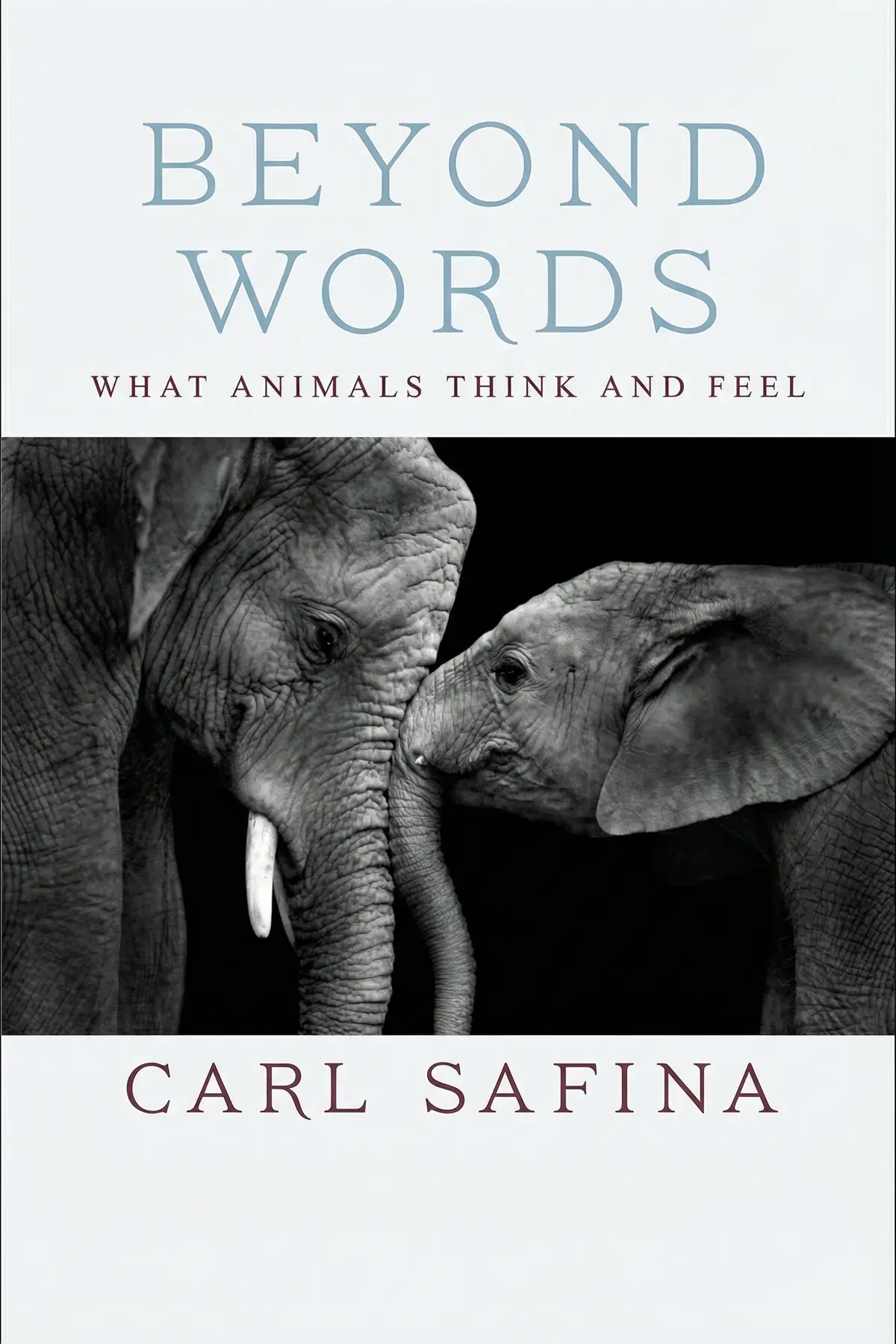
Table of Content
1. Introduction
59 sec
Most of us read a dog’s sad eyes or a whale’s leap through a human lens, and that habit hides what is really happening inside other animals. In Beyond Words, ecologist Carl Safina argues that animals do think and feel in complex ways, with minds shaped for their own lives.
The trouble runs in two directions. Treat an elephant as a person in a gray body and you misread her. Decide that only humans truly feel and you stop seeing her at all. Safina draws on elephants in Kenya, wolves in Yellowstone and killer whales at sea to argue that we understand animals only when we watch them on their own terms.
You will meet a chimp who starts a fight to win a mate, a wolf who let the young ones beat him, and orcas calling to each other across 150 miles. Afterward, the animals around you, from a neighbor’s dog to the birds overhead, start to look like individuals with something on their minds.
2. Read animal behavior on the animal's own terms
1 min 39 sec
Scientists hesitate to say a mother elephant protects her calf, while many people insist animals feel nothing at all. Both mistakes come from the same place, and fixing them starts with a sense you probably underrate.
3. See what clever lab tests miss about animals
1 min 42 sec
A famous experiment concluded that chimpanzees cannot guess what others are thinking. Out in the forest, a low-ranking male was busy proving otherwise, using a trick that depends on predicting exactly how his boss will react.
4. Understand what dogs gave up to live with us
1 min 46 sec
Some people take a dog’s loyalty to a cruel owner as proof it is dim. The real explanation starts with hungry wolves near human camps, and a Siberian fox experiment with a strange side effect.
5. Recognize the feelings mammal brains share with yours
1 min 47 sec
Science once insisted animals lacked enough brain to be conscious. A man named Roger, missing nearly all of the part supposedly required, complicates that claim, and so does a hormone you share with your dog.
6. See how elephants remember, care and judge people
1 min 59 sec
Researchers handed wild elephants three ordinary T-shirts. Only one made them afraid, and the reason reveals how carefully these animals sort humans into safe and dangerous.
7. Lead the way the best wolves lead
1 min 51 sec
The strongest hunter in Yellowstone could have killed every rival he beat, and he never did. His granddaughter was even more gifted, and what happened to her pack after she was gone shows what one leader is worth.
8. Hear the hidden conversations of killer whales
2 min 03 sec
Orcas look like the most fearsome predators in the ocean, yet their old mothers decide who survives and their calls carry farther than seems possible. A blind cyclist shows how much of that world humans miss.
9. Conclusion
1 min 05 sec
Safina’s book is finally about attention. Each puzzling scene in it makes sense once you drop the human yardstick and ask what that animal needs, senses and remembers. That goes for a chimp staging a brawl, an elephant flinching at a Maasai shirt and a pack falling apart without Oh-Six. The minds were there all along. The real question is whether we look for them.
That habit carries into ordinary days. When a dog waits by the door or a bird keeps returning to the same branch, wonder what it perceives before deciding it is being silly. When someone says a skill belongs only to humans, hold the claim loosely. Teaching was once on that list. Yet cats carry prey that is still alive back to their kittens so the young can learn hunting, and killer whales guide their calves so the calves learn to follow. If you lead people, remember Twenty-One, who stayed on top without ever needing to kill.
Animals have been thinking and feeling beside us the whole time. All that was missing was our willingness to notice.
About this book
What is this book about?
People have lived beside animals forever, hunting them, worshipping them and sharing their homes with them, yet we still argue about whether they think or feel at all. Ecologist Carl Safina argues that they clearly do. Our tests and prejudices are what keep getting in the way. Safina identifies two habits that blind us. One is reading human traits into animals. The other is assuming only humans have an inner life. He shows how lab experiments on chimpanzees and mirror tests miss what wild animals plainly do, and how shared brain structures and hormones such as oxytocin link mammal feelings to ours. Then he follows three societies up close: elephant families led by matriarchs, wolf packs in Yellowstone shaped by remarkable individuals, and killer whale clans that talk across great distances. Readers get a sharper way of looking at any animal, from a family dog to a wild herd. They will see why a loyal dog is no fool, why elephants fear one group of people and not others, and why a strong leader in a wolf pack never needs to kill. They will also come to doubt any claim that a skill belongs to humans alone.
Book Information
Who it's for
Pet owners, animal fans
Pet owners and animal lovers who suspect there is more going on behind an animal's eyes.
Students and the curious
Students and curious readers who want the evidence for animal thought and feeling in one place.
Curious team leads
Team leads interested in what wolf packs show about leading with confidence rather than force.
About the Author
Carl Safina
Carl Safina is an ecologist with a PhD from Rutgers University, where he studied seabirds. He spent ten years campaigning against drift-net fishing on the high seas and for changes to American fishing policy before turning mainly to writing. His books include Song for the Blue Ocean and Eye of the Albatross, and he has received MacArthur, Pew and Guggenheim fellowships. He holds the first endowed professorship in nature and humanity at Stony Brook University, founded the Safina Center, and presented the PBS series Saving the Ocean with Carl Safina.
Ratings & Reviews
Ratings at a glance

What people think
Listeners find this work to be a captivating experience, featuring graceful writing that combines scientific data with sharp eyewitness accounts. The book provides fresh perspectives on how creatures behave, and one listener highlights how the narrative encourages people to recognize animals as distinct personalities. Listeners characterize the content as both reflective and moving, with one review pointing out that it fundamentally alters the audience's outlook. They value the engaging anecdotes and the deep portrayal of animals' inner emotional worlds found throughout the text.
Top reviews
Leo
Picked this up on a whim after seeing it at a used bookstore, and it absolutely devoured my week. Safina doesn't just categorize species; he introduces you to individuals like Ella the elephant and the legendary wolf Number Six. It is a stunning, emotionally charged exploration of the 'someone-ness' of animals. The way he describes the matriarchal structures of orcas and the deep grief elephants feel is nothing short of transcendent. Truth is, we often view the natural world as a backdrop for human drama, but this book shifts the lens entirely. Safina’s prose is eloquent and urgent, reminding us that we aren't the only ones who live epic, complicated lives. I found myself tabbing dozens of pages just to sit with his observations on empathy and consciousness. It is a rare work that manages to be both a scientific wake-up call and a poetic masterpiece.
Show moreBird
Wow, I wasn't prepared for how much this would change my perspective on the wild. This book is structured like an internal trilogy, diving deep into the societies of elephants, wolves, and killer whales. Safina presents a compelling case for animal intelligence that goes far beyond the typical benchmarks we set for them. He highlights how these creatures recognize each other as individuals with distinct personalities—some are shy, some are bullies, and some are natural-born leaders. The research is presented with such keen observation that you can practically see the dust of the Amboseli plains. Gotta say, the section on how orcas never attack humans despite their power was utterly fascinating. It challenges the nonsensical assumptions we’ve relied on to justify our treatment of nature. This isn't just a book about animals; it’s a moral plea for stewardship and respect.
Show moreCaleb
The section on the Yellowstone wolves is worth the price of admission alone. Safina captures the drama of the 'Prefect Wolf' and the complex social dynamics of the packs with such vividness that it feels like reading a historical biography. He argues that we have a common bond with these creatures that goes deeper than biology. His exploration of self-domestication and the similarities between human and wolf males was a 'mind-blown' moment for me. The writing is thought-provoking and stays with you long after you close the cover. While he occasionally gets a bit long-winded in his reflections, his passion for conservation is infectious. He asks uncomfortable questions about human behavior that we really need to answer. If we lose natural beauty, we lose ourselves. This book is a hauntingly beautiful reminder of what is at stake in the modern world.
Show moreHemp
Ever wonder if the creatures we share this planet with are actually 'someone' rather than 'something'? Carl Safina answers this with a resounding yes. Through meticulous field observations, he shows how elephants cover their dead and how dolphins use seduction to help friends. These aren't just 'animal instincts'—they are choices made by individuals. I loved the focus on the names of the animals; it makes their stories feel personal and urgent. The prose is beautiful, almost poetic in places, and it avoids the dry jargon that usually plagues non-fiction. 'Beyond Words' really changed my mind about the cognitive limits of species I previously overlooked. It is much more difficult to be indifferent to the natural world once you realize the depth of grief and joy happening just outside our cities. Truly a heartbreaking and hopeful read at the same time.
Show moreHang
Look, the writing style here is definitely a choice, but for me, it worked perfectly. Safina has 'bars,' as they say—there are lines in here about the ugliness of a man-made world that really hit home. The way he follows the fission of a wolf pack or the navigational genius of an elephant matriarch is riveting. He dares to bridge the gap between human and non-human experience in a way that feels both scientific and deeply spiritual. I was especially moved by the plight of the killer whales in the Pacific Northwest and how our noise pollution and fishing habits are devastating their families. It’s a compelling read that offers new insights into how we are similar to, and different from, our fellow inhabitants of Earth. If you care about the planet, you need to read this book. It’s a masterpiece of observation and heart.
Show morePakinee
Few books manage to balance field research with such poetic, urgent calls for conservation. Safina’s exploration of 'neoteny' and the shared history of humans and wolves was a highlight for me. He shows us that man must begin to work with nature in a moral and ethical manner, rather than just viewing it as a resource. The book is dense with concepts and information, making it a read to be savored slowly. I particularly enjoyed the shorter sections on falcons and chimpanzees, which reinforced the idea that intelligence comes in many forms. While the author's voice is very present—sometimes to the point of distraction—his dedication to the subject is undeniable. He shows us that if we can no longer afford natural beauty, we will be overcome by ugliness. This is essential reading for anyone interested in the emotional lives of animals.
Show moreSuwit
Can a book about biology read like a long conversation with an eccentric, brilliant friend? That is exactly the vibe here. Safina’s writing style is definitely a choice—it’s conversational, peppered with one-word sentences, and occasional circular reflections that feel almost like a YouTube vlog in print form. While some might find the 'personality' embedded in the pages a bit much, I found it refreshed the genre. He moves away from the sterile, lab-based experiments of books like 'The Genius of Dogs' and instead takes us into the field. The chapters on the Yellowstone wolf packs were particularly gripping, showing the sheer brutality and tenderness of their social hierarchies. Personally, I could have done without some of the more repetitive philosophical asides, but the insights into animal cultures are too valuable to miss. It really makes you rethink your place in the world.
Show moreJun
After hearing about Safina for years, I finally dove into this 'internal trilogy' of animal intelligence. It is a wonderful tour that asks us to afford animals the respect they deserve as thinking, feeling beings. I appreciated how he takes laboratory scientists to task for their reticence to acknowledge the obvious: animals have inner lives. His handling of the mirror mark test was especially fiery, and while he was clearly angry, his point about the limitations of human-centric testing landed well. The book is a bit dense with concepts, and the section on wolves felt slightly long-winded compared to the elephants, but the wisdom found in these lines is undeniable. It’s a great catch-up for anyone who hasn't read much on animal behavior since Jane Goodall. Only four stars because the pacing can be uneven, but the content is top-tier.
Show moreNook
Carl Safina doesn't just present data; he delivers a gut-punch of empathy for our non-human kin. The truth is, I usually prefer a more concise approach to non-fiction, and this book could probably be 30% shorter without losing its core message. However, the conversational style eventually won me over. It felt like being on a trek through the bush with a world-class ecologist who isn't afraid to get a little 'off-the-wall' with his reflections. The distinction he makes between humans and animals—noting that self-loathing is uniquely ours—is a profound takeaway. While he’s not a neuroscientist, his background as a marine biologist gives him a unique authority when discussing the social structures of killer whales. It’s a thought-provoking read that will make you look at your own dog with a completely new perspective. Definitely worth the effort to push through the slower parts.
Show morePhimwan
To be fair, I expected a rigorous scientific treatise, but what I got felt more like a personal diary of observations. The book is very light on hard data and heavy on speculation about what animals 'must' be feeling based on a single anecdote. For instance, Safina shares a story about a friend's experience and then leaps to a massive conclusion about an entire species' emotional capacity. If you’re looking for a professional, concise approach to cognitive science, this isn't it. The author also narrated the audiobook himself, and frankly, he reads way too fast for the dense philosophical concepts he's trying to tackle. I also found his constant 'pet peeves' regarding the mirror self-recognition test to be quite distracting. It felt like he was more interested in venting his frustrations with other scientists than providing an objective explanation of animal minds. A bit of a letdown.
Show moreQuestions about this book
What is the main idea of Beyond Words by Carl Safina?
Safina argues that animals think and feel in complex ways, with minds built for their own needs and senses. We underestimate them because we judge them against humans, rely on lab tests that miss real behavior, and assume only people have an inner life. He makes his case through elephant families, Yellowstone wolves and killer whale clans.
Do animals really have feelings, according to Beyond Words?
Safina says yes. Mammal brains share their basic structure with ours, and hormones like oxytocin drive bonding in humans and most other mammals alike. When it is blocked, both tend to become more solitary. Elephants feed injured companions, and that helping releases oxytocin, so compassion rewards them much as it rewards people.
Why does Safina criticize the mirror test and theory of mind experiments?
He argues they miss what animals actually do. In a 1978 study, chimps failed to pick pictures solving human problems, yet wild chimps provoke their alpha male to create a distraction so they can mate behind his back. The mirror test, he says, shows only that an animal understands reflections, not that it is self-aware.
What does Beyond Words say about how dogs evolved from wolves?
Safina explains that dogs largely domesticated themselves. Wolves that tolerated people near human settlements got more food and bred more. They gained safety but lost independence, so a dog facing a locked box looks to a human while a wolf tries to open it. A dog’s loyalty to an abusive owner reflects survival sense, not stupidity.
How can I apply the ideas in Beyond Words?
Before calling an animal’s behavior strange, ask what it might sense, need or remember that you cannot. Be skeptical of claims that a skill is uniquely human, since teaching, once on that list, appears in cats and killer whales. Leaders can also take a lesson from the wolf Twenty-One, whose confidence held his position without cruelty.
Readers also enjoyed

A Life Decoded: My Genome: My Life
J. Craig Venter

A Planet of Viruses
Carl Zimmer

A Short History of Nearly Everything
Bill Bryson

A Thousand Brains: A New Theory of Intelligence
Jeff Hawkins




Alien Earths: The New Science of Planet Hunting in the Cosmos
Lisa Kaltenegger

AUDIO SUMMARY AVAILABLE
Listen to Beyond Words in 15 minutes
Get the key ideas from Beyond Words by Carl Safina, plus 5,000+ more nonfiction titles.
- 5,000+ titles
- Listen as much as you want
- 7-day free trial
- Cancel anytime









