

14 min 44 sec
Available in: English
The Secret Life of Pronouns: What Our Words Say About Us
Shows how tiny, overlooked words like I, we and the reveal a person's feelings, honesty, thinking style and rank, and how matching speech predicts which couples and teams will work.
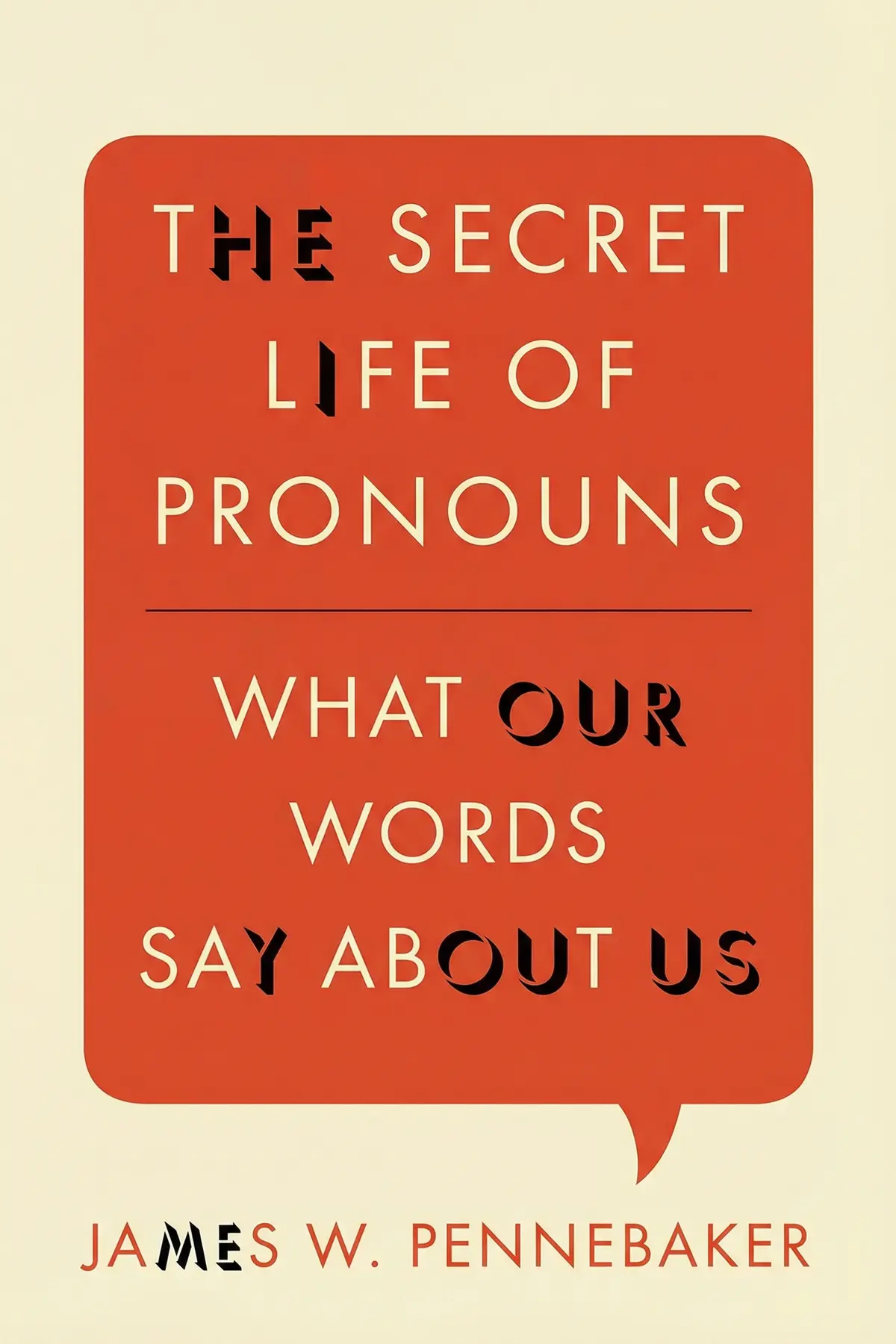
Table of Content
1. Introduction
59 sec
If you have ever read an email and sensed something was wrong without knowing why, the answer may sit in words you never notice. In The Secret Life of Pronouns, psychologist James W. Pennebaker argues that little words such as I, we, the and but say more about a person than the nouns and adjectives carrying the message.
These small words work like a fingerprint of the mind. Pennebaker built one of the first computer programs to count them, and the counts track something simple: where a person’s attention is pointing. That single link explains why pronouns shift when someone is hurting, lying, gaining power, losing it or falling for someone.
What follows is a new way to hear the people around you, from a manager’s short reply to a partner describing your relationship. It ends with a quick test you can run on your own inbox to see where you stand.
2. Listen to the small words everyone skips
2 min 05 sec
A program written to sort trauma essays by mood turned up something its makers never expected. The writers whose health improved did use more hopeful words, but a second look at their essays turned up something stranger.
3. Your pronouns show where your attention goes
2 min 21 sec
Ask people whether men or women say I more often and most will answer with confidence. They are usually wrong, and a diary kept during hormone treatment shows what really moves those numbers.
4. Spot formal, analytic and narrative thinkers in writing
2 min 06 sec
Even a description of a plain bottle of water gives its writer away. Pennebaker found three distinct ways of thinking hiding in ordinary prose, and each one leaves its own trail of small words.
5. Read pain, anger and lies in pronouns
2 min 06 sec
Reporters noticed a famously combative mayor had softened after a cancer diagnosis. A word count of his press conferences found the change too, and the same method caught people inventing their own traumas.
6. Spot status by counting who says I less often
1 min 55 sec
Secret recordings from the White House let Pennebaker watch a president’s words change as his grip on power weakened. The pattern shows up in any office inbox, including yours.
7. Teams and couples that last talk alike
1 min 57 sec
Speed daters who matched each other’s small words were far more likely to still be together months later. The same quiet signal separated strong Wikipedia editing teams from weak ones.
8. Conclusion
1 min 15 sec
Pennebaker’s work turns the dullest words in the language into a reading of the person behind them. Pronouns, articles and little joining words cost nothing to say, so people rarely manage them, and that is what makes them honest. They show where attention points: inward in pain, outward in anger, toward the audience when someone holds power, back toward the self when that power slips, and toward each other when two people are truly engaged.
The most direct test is one Pennebaker proposes himself. Open the last ten emails you sent to one person and the last ten they sent you. Work out what share of the words are I-words, and if you have time, you-words and we-words too. In general, whoever uses fewer I-words ranks higher.
Beyond that, start hearing pronoun shifts in people you know well. A colleague whose I-words suddenly rise may be hurting. A partner who talks about we is a good sign, and a conversation full of you is a warning. A team that begins to sound alike is probably listening to itself.
Nixon never meant his tapes to record his power fading. His pronouns recorded it anyway.
About this book
What is this book about?
We judge people by what they say: their opinions, their topics, the feelings they name. Psychologist James W. Pennebaker argues that the most telling clues sit somewhere else, in the pronouns, articles and prepositions that hold a sentence together and that almost nobody notices. His evidence comes from decades of counting words by computer. A program he built to study how writing helps trauma survivors turned out to reveal far more than their recovery. Pronouns shifted when a mayor fell ill, when people invented stories, when a president's power began to slip and when two strangers on a speed date clicked. Underneath all of it is one simple link: small words follow where a person's attention is pointing. Readers learn to hear three thinking styles in ordinary writing, to notice signs of pain, anger and deception, to read rank in an email thread and to judge from shared speech patterns whether a couple or a team is truly engaged. The book closes with a simple test anyone can run on their own inbox.
Book Information
Who it's for
Professionals reading email tone
Professionals who read people through email and want to sense mood, honesty and rank in a message.
Watching for struggling teams
Managers and team leads who want early signs of a struggling colleague or a team that is not connecting.
Wondering what words reveal
Curious readers interested in what everyday language reveals about the mind.
About the Author
James W. Pennebaker
James W. Pennebaker, born in 1950 in Midland, Texas, is an emeritus professor of psychology at the University of Texas at Austin and a member of its Academy of Distinguished Teachers. With his students he has studied physical symptoms, how writing helps people cope with upheaval, and how everyday word choices reflect personality and mental states. He built computer tools that analyze language as a sign of a person's psychological state, and in 2025 he was elected a Member of the National Academy of Sciences.
Ratings & Reviews
Ratings at a glance
What people think
Listeners find this work to be a captivating look into the link between linguistics and persona, observing that specific word choices disclose an individual's true nature. The prose is approachable and relaxed, making it a simple read, yet listeners still praise the book's scientific rigor. The quality of information is highly valued; one listener points out its accessible summary of quantitative research, while another mentions how word usage can predict behavior.
Top reviews
Grace
Look, I’m a total sucker for books that claim to reveal 'hidden' truths about human behavior. This one actually delivers. Unlike many pop-psychology books that rely on tiny sample sizes, this research is backed by massive datasets from the LIWC program. The truth is that the idea that "I-word" usage isn't about narcissism but actually signals a lower social status or a state of depression blew my mind. It’s completely counter-intuitive! The book is brisk, engaging, and packed with "did you know?" facts that you'll want to share with everyone. I’ve already visited the website to test my own writing style matching with my partner. Whether you're a writer, a manager, or just someone who talks to people, there is something here for you. It’s easily one of the most interesting books I’ve read this year.
Show moreElena
Picked this up because I was curious about why my own writing felt so 'heavy' lately. I didn't realize I was looking for a lesson in "function words," but here we are. Not gonna lie, Pennebaker’s research into how expressive writing helps people process trauma is a beautiful through-line for the book. It’s not just about counting words; it’s about understanding how our mental state shifts our very grammar. The examples using Shakespeare and the Beatles made the academic concepts feel alive and relatable. I found the section on "Language Style Matching" particularly useful for understanding why some conversations feel like a struggle while others just flow. It’s a brilliant mix of hard science and human storytelling. I can't recommend it enough for people who want to understand the "secret" layers of communication.
Show moreRung
As someone who works in communications, this felt like finding a secret decoder ring for the human psyche. In my view, we focus so much on the "big words" that we completely ignore the connective tissue of our language. Pennebaker shows that these tiny words are actually the most revealing. The scientific rigor is evident on every page, but it never feels like a dry textbook. I loved the "Thumbnail Sketch" of Osama bin Laden and the way the author uses language to peel back the layers of public figures. It’s a fascinating exploration of how our brains work on autopilot. Even if you aren't a linguistics geek, the insights into how to tell if a team is actually working together are incredibly practical. This is a five-star read that I’ll be coming back to.
Show moreFilm
After hearing about LIWC for years, I finally sat down with the source material. It's fascinating to see how the words we usually ignore—the ones that make up 60% of our speech—actually carry the most emotional weight. Frankly, Pennebaker does a great job of breaking down how these "stealth words" broadcast our status, gender, and even our honesty. I particularly loved the analysis of the Federalist Papers and the linguistic synchronization between famous literary couples. My only gripe is that it occasionally feels like a sales pitch for his software. Still, the scientific rigor behind the claims is impressive, and it has definitely made me more conscious of my own pronoun usage. It’s a solid pick for anyone interested in the intersection of data and psychology, even if it gets a bit repetitive in the middle chapters.
Show moreSkylar
To be fair, the section on gendered language was worth the price of admission alone. I was skeptical of the idea that women and men use pronouns differently, but the data is pretty hard to argue with. Personally, I think Pennebaker shows that women aren't just "talking about feelings," but are actually more socially oriented in their linguistic markers. The book is written in a very accessible, almost casual style that makes the quantitative research easy to digest. I did feel like the author over-generalized a bit when applying his findings to historical figures like King Lear, but the overarching theme is compelling. It’s one of those books that changes how you hear the world. You’ll start noticing how often people say "I" in a meeting and immediately start judging their social standing. It’s an entertaining superpower to have.
Show moreWanida
It’s rare to find a psychology book that is both data-heavy and surprisingly accessible. James Pennebaker takes something as mundane as a preposition and turns it into a window into the soul. I gotta say, I didn't expect to care about the frequency of the word "the," but seeing it linked to cognitive complexity was eye-opening. The book is filled with juicy examples, from political debates to the ways people bonded on blogs after 9/11. While some critics call it pop-psychology, the foundation of computer-assisted statistical analysis gives it more weight than your average self-help rag. My only minor complaint is that the tone can occasionally veer into being a bit fawning over its own methods. Despite that, it's a quick and thought-provoking read for any word nerd or psychology enthusiast.
Show moreSavannah
The chapter on political speeches—specifically the analysis of Bush and Bin Laden—is hauntingly relevant. Honestly, it’s wild to think that a computer can predict a leader’s aggressiveness or isolation just by looking at how they use "we" versus "I." Pennebaker makes a strong case that our natural speech is a stream of consciousness we can't really fake, making these function words a more honest indicator than the content of the words themselves. The writing is clear and the chapters are well-organized, though some of the "personality types" felt a bit like the Myers-Briggs boxes he claims to avoid. I appreciated the honesty when he analyzed his own emails and discovered his own biases. It’s a humble touch in a book that deals with some pretty bold claims. Definitely worth a read if you're into behavioral science.
Show moreLek
Pennebaker’s premise is undeniably catchy, but the deeper I got, the more skeptical I became. The book explores how tiny "function words"—the "thes," "ands," and "yous" of the world—act as a psychological fingerprint. In my experience, some of the correlations are genuinely surprising, like how higher article usage might predict college success. However, the "correlation is not causation" alarm was ringing in my head every few pages. The author tries to shoehorn every aspect of human life, from the success of a speed date to the outcome of a war, into these linguistic patterns. It’s a fun read if you take it with a grain of salt, but it lacks the actionable tools I was hoping for. I did enjoy the section on the "water bottle" description exercise, though. It’s a decent introductory text, but don’t expect it to change your life.
Show moreIce
I've never struggled so hard to stay awake through a science book. While I appreciate the years of research Pennebaker put into his word-counting software, the results are just... tedious. Truth be told, some of the insights about how "I-words" reveal status are interesting, but the author repeats himself to the point of exhaustion. The prose is pedestrian and lacks the elegance of something like Kahneman’s 'Thinking, Fast and Slow.' It’s a lot of anecdotal evidence mixed with the 'bloody obvious.' For instance, do we really need a statistical analysis to tell us that arrogant leaders use fewer self-references? The whole obsession with function words feels overblown and lacks a real 'so what?' factor. I wanted to be fascinated by the hidden signals in my speech, but I ended up feeling like I was reading a very long, very dry manual for a calculator.
Show moreSupatra
What a colossal disappointment. I went in expecting a rigorous sociolinguistic dive into the works of Halliday or Bernstein, but instead, I got what can only be described as pop-psychology lite. The author’s "discovery" that social class exists in America is laughably late to the party, and his dismissal of cultural nuance is staggering. He basically argues that because a computer program counts words a certain way, it must define our entire personality across all languages and cultures. To be blunt, it feels incredibly reductive and patronizing. If you are looking for real depth on how language keeps people in their social places, read Bourdieu instead. This book dances around a massive hole in its own logic—that personality is static and word choice is an infallible mirror. It’s a series of correlations masquerading as universal truths, and the writing style is as dry as a desert. I stopped reading halfway through out of pure despair.
Show moreQuestions about this book
What is the main idea of The Secret Life of Pronouns?
James W. Pennebaker argues that small function words such as I, we, the and but reveal more about people than the content words carrying their message. Because these words follow where a person’s attention points, counting them shows emotional state, thinking style, honesty and social rank, and how closely two people or a team are connected.
Do men or women use more I-words according to Pennebaker?
Women do, contrary to what most people expect. In conversations, blogs and speeches alike, women use first-person singular pronouns more frequently, and Pennebaker ties this to greater self-awareness and self-focus on average. Women also use more social and thinking words, while men use more articles because they talk more about specific objects. Different upbringing may explain part of the gap.
How can pronouns reveal lies?
In Pennebaker’s experiment, people wrote about real and invented traumatic experiences. Human readers could hardly tell them apart, but a computer analysis could. Those describing real events used a wider variety of words, gave vivid details and used more I, me and my, signaling attention to themselves and their feelings. Invented accounts had fewer I-words.
How can I use the book to find my status at work?
Pennebaker suggests taking the last ten emails you sent to someone and setting them beside the last ten you received from that person. Work out the percentage of I-words in each batch, and, if possible, the you-words and we-words too. Generally, the person who uses fewer I-words holds the higher position, because higher-status people focus attention on their audience rather than themselves.
What is language style matching?
Language style matching, or LSM, is the degree to which two people’s function words, especially pronouns, line up as they talk. It rises when people pay close attention to each other. At a speed-dating event, 77 percent of high-matching couples were still dating three months later, compared with 52 percent of low-matching ones, and similar matching predicted better Wikipedia articles.
Readers also enjoyed

59 Seconds: Change Your Life in Under a Minute
Richard Wiseman




A Liberated Mind: How to Pivot Toward What Matters
Steven C. Hayes


Acting with Power: Why We Are More Powerful Than We Believe
Deborah Gruenfeld


Age of Propaganda: The Everyday Use and Abuse of Persuasion
Anthony Pratkanis
AUDIO SUMMARY AVAILABLE
Listen to The Secret Life of Pronouns in 15 minutes
Get the key ideas from The Secret Life of Pronouns by James W. Pennebaker, plus 5,000+ more nonfiction titles.
- 5,000+ titles
- Listen as much as you want
- 7-day free trial
- Cancel anytime









