

14 min 12 sec
Available in: English
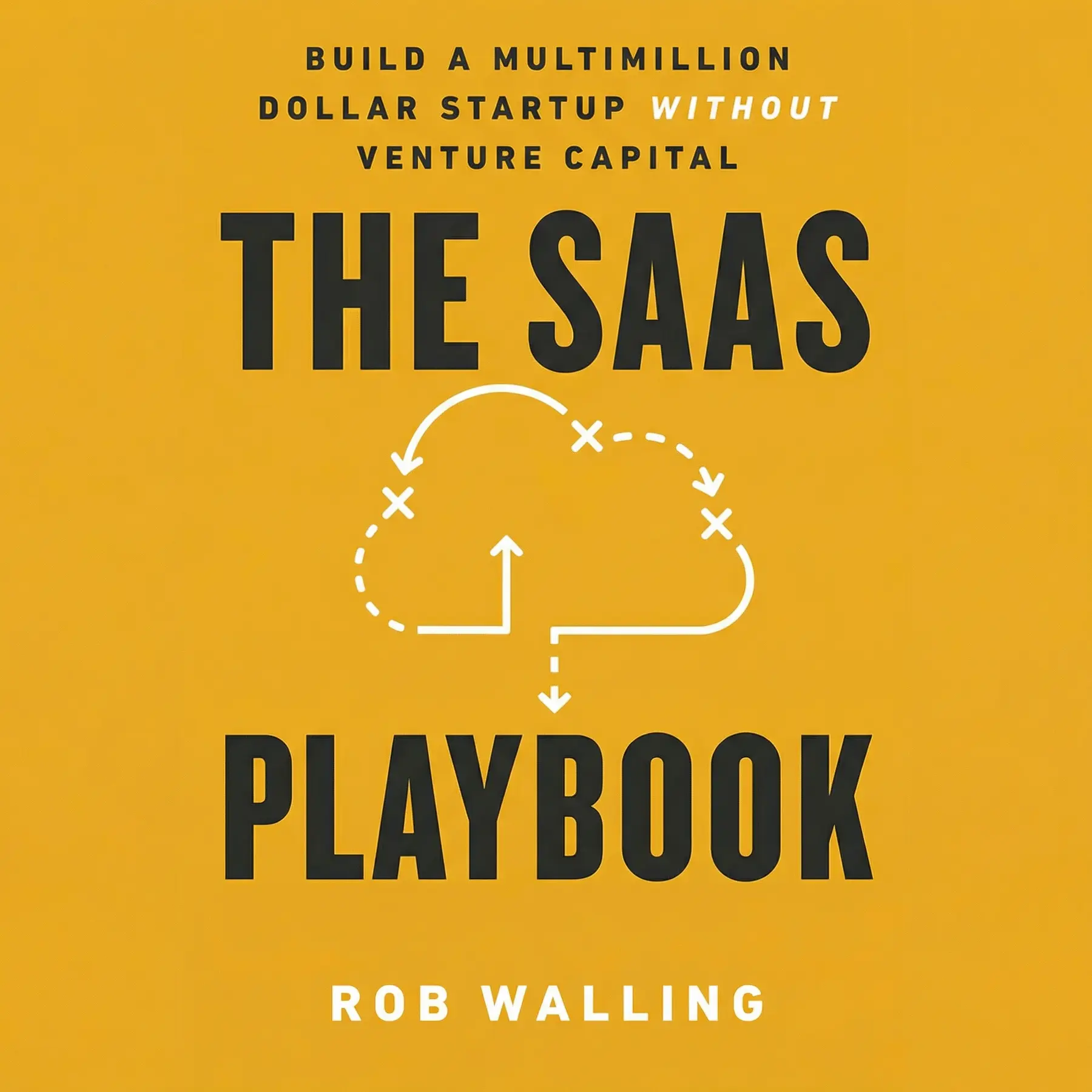
The SaaS Playbook: Build a Multimillion Dollar Startup Without Venture Capital
By Rob Walling
Shows how to build and grow a subscription software company on your own savings and revenue: finding your place in the market, pricing, marketing, hiring, the metrics that predict growth and the mindset that keeps founders going.

Table of Content
1. Introduction
1 min 03 sec
Most founders who chase investors never get a check: more than 99 percent of startups looking for funding are turned down, and many of those that win it fail anyway. In The SaaS Playbook, serial entrepreneur Rob Walling makes the case for the other road, bootstrapping, where a software company grows on the founder’s savings and its own revenue. Such a company needs nobody’s permission, and it ends only if the founder quits, so the hardest thing to manage is motivation.
Walling argues that subscription software fits this path well. Recurring revenue is predictable, it holds up when the economy turns, and it depends on luck far less than a crypto or social media bet. What remains is a series of deliberate choices in six areas: market, pricing, marketing, team, a short set of metrics and mindset. Get them right and a company can reach millions in revenue on its own terms. Along the way, you will learn what to charge, which job to hand off first and which numbers to watch every month.
2. Talk to the customers who walked away
1 min 35 sec
Founders tend to avoid the people most likely to criticize them. Walling thinks those are exactly the people to call, and he offers a way to listen closely without letting every request steer the product.
3. Make your product hard for rivals to replace
1 min 39 sec
Winning a spot in a crowded market is hard. Keeping it is harder, and the thing most founders count on for protection turns out to be the easiest for a competitor to copy.
4. Charge enough that a few customers complain
1 min 47 sec
Cheap plans feel like a safe way to win customers. Walling sees them as one of the quickest ways to weaken a software business, and he puts rough numbers on where different products should sit.
5. Plan your marketing before you hire a marketer
2 min 04 sec
Founders who would rather write code than sell often hope to hand marketing to someone else. Walling explains why that handoff fails without one piece of work done first, and how one company mixed two sales approaches.
6. Hand off the work you do worst first
1 min 41 sec
Every founder reaches the point where doing everything alone stops working. Choosing the first hire is where many get stuck, and a job ad can help or hurt in ways that seem to contradict each other.
7. Track six numbers that show where revenue heads
1 min 45 sec
Revenue figures tell a founder where the company has been, but not where it is going. Walling pairs them with a small set of signals, and one rare result lets a company grow without new customers.
8. Keep setbacks from stalling your progress
1 min 31 sec
Effort and skill are only part of what makes a software company succeed, and the rest cannot be controlled. Walling describes the habits that keep founders working, and sane, while they wait for it.
9. Conclusion
1 min 07 sec
Walling’s real argument is about control. Investors, luck and the wider economy sit outside a founder’s hands, yet a surprising amount sits inside them: whom you talk to, what you charge, how buyers find you, whom you hire, which numbers you watch and how you treat a bad week. A bootstrapped company is built from those choices, and because it answers to no investor, it keeps going for as long as the founder does.
That makes the advice unusually concrete. Call someone who canceled, and test each feature request against your long-term vision. Look honestly at your price: if nobody ever complains, a raise for new customers only may be overdue, provided it lifts recurring revenue by at least 10 percent. And watch churn next to the revenue existing customers add.
Net negative churn is the picture worth keeping. It describes a company whose current customers pay for its future, the very thing venture money promises, earned here by the business itself.
About this book
What is this book about?
Almost every startup that asks investors for money is turned away, and many of the few that get funded still fail. Rob Walling argues that founders of software businesses have a sturdier option: bootstrapping, or growing a company on personal savings and its own revenue. A bootstrapped company needs no one's permission, and it survives as long as its founder keeps going. Walling, who has built several multimillion-dollar companies and backed more than 120 startups, makes the case that subscription software suits this path because its recurring revenue is predictable and holds up in hard times. He then works through six areas a founder has to get right: understanding the market and protecting a position in it, setting a price that signals value, planning marketing before handing it off, hiring for clear roles, tracking a small set of telling numbers, and keeping the mental resilience to last. Readers get concrete benchmarks, from typical monthly price points to a healthy churn rate, plus practical methods such as the dual funnel, the 3 high, 3 low metrics framework and a simple way to choose the first role to hire.
Book Information
Who it's for
Developers and technical founders
Developers and technical founders with a software idea who would rather not raise venture capital.
Running a small SaaS
Owners of small SaaS companies unsure what to charge, whom to hire first or which numbers to track.
Considering a subscription product
Nontechnical business owners considering a subscription software product.
About the Author
Rob Walling
Rob Walling is a serial entrepreneur who has built several multimillion-dollar companies and backed more than 120 startups. He leads MicroConf, a community for bootstrapped software as a service founders, and TinySeed, an accelerator for business-to-business SaaS companies. He also hosts the podcast Startups for the Rest of Us, which has passed 10 million downloads, and has written several best-selling books.
Ratings & Reviews
Ratings at a glance
What people think
Listeners find this SaaS business guide beneficial and enlightening, with one listener highlighting how the perspectives are uniquely crafted for SaaS companies. Furthermore, the work offers actionable tips and simplifies complex ideas, resulting in a comprehensive manual that remains straightforward to digest. Listeners also value the book's overall worth, as one listener points out its potential to conserve both time and financial resources.
Top reviews
Suwit
Rob Walling has distilled years of MicroConf wisdom into a single, punchy volume that feels like having a seasoned mentor in your pocket. Frankly, the chapter on mindset and burnout alone is worth the price of admission, especially for founders navigating the 'trough of sorrow.' Most business books are 300 pages of fluff, but this is a concentrated manual on SaaS-specific metrics and marketing strategies that actually move the needle. I appreciated how he leaned on his personal experience selling Drip and investing in hundreds of TinySeed startups to provide concrete examples. The writing style is direct and focused, refusing to waste your time with endless anecdotes. If you want to understand the trajectory of a modern software company without the VC-or-bust hyperbole, this is the definitive guide.
Show moreWoramet
Finally got around to reading this, and the biggest takeaway is just how tailored the advice is to the 'indie hacker' lifestyle rather than the Silicon Valley bubble. The SaaS Playbook walks you through the gritty realities of pricing and product-market fit with a level of clarity that is rare in this genre. Walling doesn't just tell you to 'scale'; he explains the mindset shifts required to stop being a developer and start being a CEO. The section on 'magic numbers' like valuation multiples was particularly eye-opening for me. It’s an informative, high-value read that bridges the gap between 'having an idea' and 'having a business.' I suspect I’ll be referencing the hiring framework for years to come.
Show moreAlice
Stop wasting months on 'market research' and just read the framework Walling lays out for finding product-market fit. This book is a masterclass in SaaS-specific strategy, covering everything from the nuances of annual vs. monthly pricing to the psychological toll of bootstrapping. I’ve read a lot of business books, but few are this actionable for the solo founder. The way he breaks down complex metrics into understandable milestones—like the path to your first $1,000 in revenue—is incredibly motivating. It’s a thorough guide that stays grounded in reality. Whether you call your business a SaaS or just a software product, you’re going to find something here that changes your company’s trajectory.
Show moreSophia
Walling’s experience building and selling multiple startups shines through every page, offering a level of authenticity you simply don't get from generic business gurus. Personally, I found the section on masterminds and mentors to be the most impactful, as it addresses the isolation many founders feel. The book is remarkably easy to read, with a direct tone that respects the reader's time. It provides a clear roadmap for scaling without losing your mind in the process. I particularly appreciated the focus on 'boring' but essential topics like churn reduction and pricing tiers. This isn't just a book; it's a blueprint for building a sustainable, profitable software business. Highly recommend for anyone serious about the long game.
Show moreArnav
After hearing Rob speak at several events, I knew this would be good, but I didn't expect it to be this comprehensive. The SaaS Playbook is the definitive resource for anyone wanting to build a software product in the modern era. It hits all the right notes: from the technicality of metrics to the emotional weight of founder mindset. In my experience, most founders fail because they focus on the wrong things at the wrong time, and this book serves as a corrective lens for that. It’s a future re-read for sure. The advice is practical, the style is engaging, and the value for money is off the charts. If you are even 10% serious about SaaS, just buy it.
Show moreDen
As someone who has followed the Startups for the Rest of Us podcast for years, much of the material here felt familiar, but having it organized into a cohesive playbook is incredibly useful. The metrics section is absolute gold, providing a level of detail on churn and LTV that most 'general' business books gloss over entirely. To be fair, if you’re a MicroConf veteran, you might find some of the concepts to be a review of Rob’s previous talks. However, the way he structures the transition from founder-led marketing to building a real team is top-tier advice. It’s a practical, easy-to-read guide that will likely save me thousands of dollars in avoidable mistakes. I just wish there were a few more deep-dive case studies from the TinySeed portfolio to illustrate the tactics in action.
Show moreSiraporn
Picked this up during my pre-code research phase and it has completely changed how I’m approaching my MVP. Not gonna lie, I initially thought I knew enough about SaaS from YouTube, but Walling manages to highlight the 20% of effort that drives 80% of the results. The chapter on team building was a standout, offering practical advice on writing job postings that actually entice high-quality talent to join a small startup. My only gripe is that some of the examples felt a bit overwritten, leading me to skim a few pages here and there. Still, the core framework is solid. It’s an investment that pays for itself by helping you avoid the common pitfalls of the 'build it and they will come' mentality.
Show moreVera
Ever wonder why some SaaS products fail despite having great tech? This book explains the 'why' by focusing on the business side of the equation: market, pricing, and team. While I would have loved more specific case studies involving the TinySeed accelerator, the general advice provided is still top-notch. The mindset chapter is a necessary addition, as it tackles the burnout that kills so many promising startups. I did feel like some sections could have been more granular—it's a bit of a 'list of topics to study further'—but as a foundational text, it’s excellent. It’s clear, concise, and avoids the usual corporate jargon found in similar titles.
Show morePan
The truth is, if you are already deep into the SaaS world and have built a few apps, you might find this book a bit light on new insights. While it’s a great high-level overview of things like market selection and basic metrics, many topics are explained at a surface level before moving on to the next chapter. I was hoping for more 'meat on the bones' regarding specific outbound sales tactics or technical scaling hurdles. Instead, it feels a bit like a blog post series that was expanded to meet a book's word count. It is a good starting place for someone with zero experience, but for established founders, there aren't many groundbreaking 'nuggets' here. It’s a decent summary, just not earth-shattering.
Show moreUbolwan
Look, I wanted to love this because I respect Rob Walling’s work, but this felt like a collection of common-sense tips for beginners. If you’ve ever worked at a startup or spent an hour on a SaaS forum, you already know most of this stuff. Telling founders to 'write job postings that entice people' isn't exactly a revelation. I found the metrics section to be basic, and the 'magic numbers' regarding business value felt arbitrary without more data-backed context. For a 'Playbook,' I expected more tactical, step-by-step instructions. Instead, it’s a lot of high-level discussion that never really gets into the weeds. It’s fine for someone who has no idea what SaaS stands for, but for anyone else, it’s mostly fluff.
Show moreQuestions about this book
What is The SaaS Playbook by Rob Walling about?
It explains how to build and grow a software as a service company without venture capital, by bootstrapping on personal savings and the company’s own revenue. Walling argues that subscription software suits this path because recurring revenue is predictable and resilient. He covers six areas a founder must get right: market, pricing, marketing, team, a focused set of metrics and mindset.
How should a bootstrapped SaaS company set its prices?
Walling says that if no customers complain about price, you are probably charging too little. He cites around $50 a month as a common sweet spot for simple tools, $250 or more for niche products that need demos, near $1,000 for high-touch sales and up to $30,000 for enterprise deals. He suggests reviewing prices every six to twelve months and keeping existing customers on their old rate.
What is the 3 high, 3 low metrics framework?
It is Walling’s way of seeing where revenue is heading, beyond monthly recurring revenue and growth rate, which only reflect the past. The three numbers to keep low are customer acquisition cost, sales effort and churn. The three to push higher are annual contract value, expansion revenue and referrals. Together they warn when growth might stall.
What is net negative churn and why does it matter?
Net negative churn happens when the extra revenue existing customers bring through upgrades and added services is larger than the revenue lost when other customers cancel. Walling calls it the ultimate goal for a SaaS business, because the company keeps growing even without signing new customers. He also recommends keeping ordinary churn between 0 and 3 percent, and notes that low prices tend to raise it.
Who should read The SaaS Playbook?
It suits developers, entrepreneurs and nontechnical business owners who want to build, grow and eventually sell a software company without investors. It is most useful for founders facing practical decisions, such as how to price, whether to use a low-touch or high-touch sales funnel, which role to hire first and which numbers to review each month.
Readers also enjoyed


7 Powers: The Foundations of Business Strategy
Hamilton Helmer



Alibaba: The House That Jack Ma Built
Duncan Clark

Bad Blood: Secrets and Lies in a Silicon Valley Startup
John Carreyrou
AUDIO SUMMARY AVAILABLE
Listen to The SaaS Playbook in 15 minutes
Get the key ideas from The SaaS Playbook by Rob Walling, plus 5,000+ more nonfiction titles.
- 5,000+ titles
- Listen as much as you want
- 7-day free trial
- Cancel anytime









