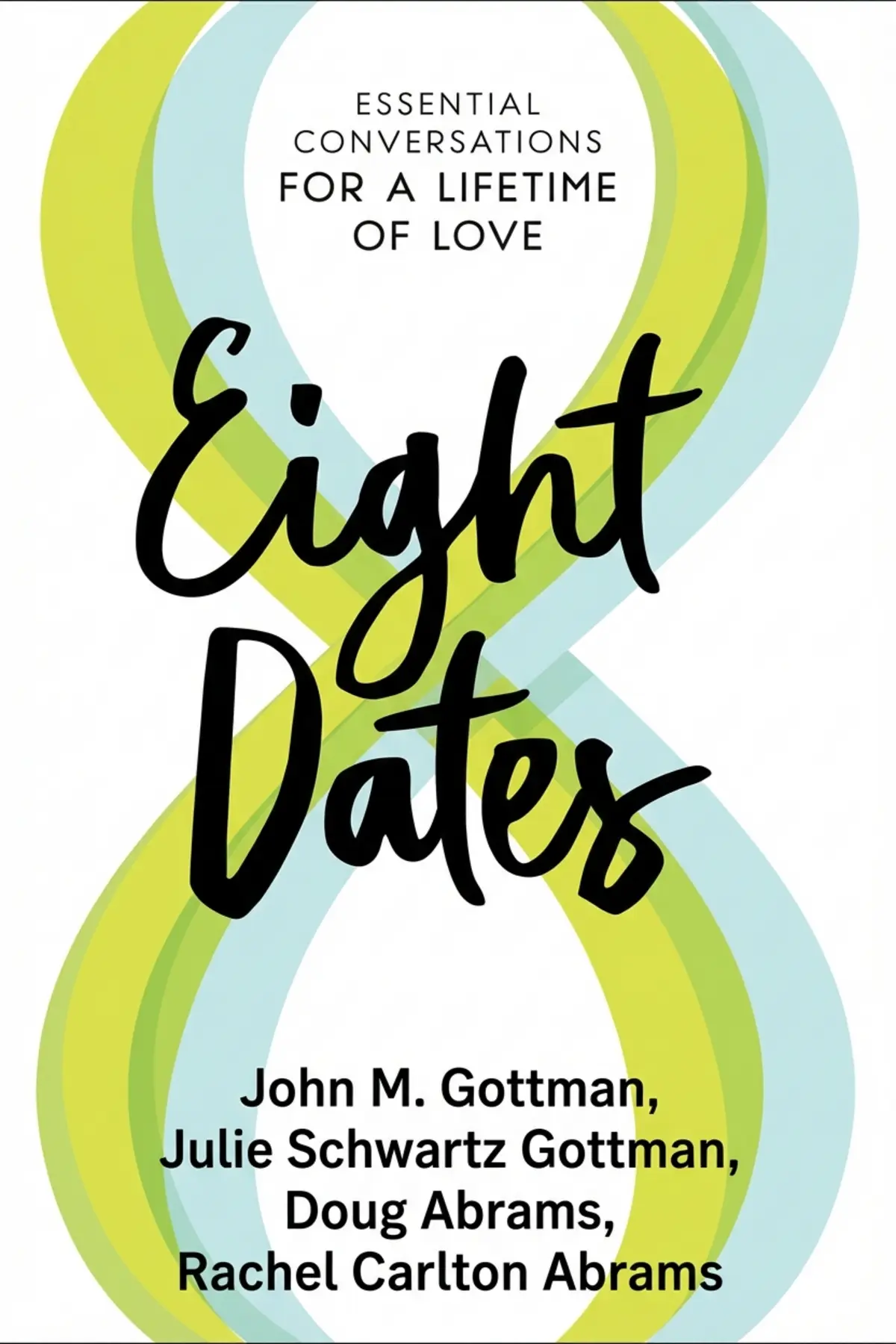
Eight Dates: Essential Conversations for a Lifetime of Love
John M. Gottman
 English
Shows how small everyday remarks are really requests for connection, and how answering them warmly, reading the need behind complaints and asking for what you want gently can strengthen marriages, friendships and working relationships.
1 min 02 sec
If your relationships feel distant and you think the fix is one deep heart-to-heart, the evidence points somewhere smaller. In The Relationship Cure, psychologist John Gottman and co-author Joan DeClaire argue that closeness is built in passing moments: a request for coffee, a comment about a sunset, a remark that the room feels cold. Each one is a bid, a small reach for connection, and the way it is answered decides whether people grow together or apart.
That idea carries the whole book. Relationships with a partner, a child, a friend or a coworker all rise or fall on how we make and answer these ordinary bids. Gottman found it by watching couples live through weekends under cameras, and the pattern holds just as well at the office. What you gain is a way to hear what people are really asking for, to ask for what you need without a fight, and to say no without pushing anyone away.
1 min 40 sec
A psychologist filled an apartment with cameras to catch couples sharing their deepest secrets. He found almost none, and for months he feared the study was wasted, until the dullest moments on tape turned out to hold the answer.
1 min 28 sec
The same request for a cup of coffee can belong in a loving home or in the story of a divorce. The difference has nothing to do with the request and everything to do with what comes after it.
1 min 32 sec
A woman on a sofa mentions that the room feels a little cold. Her partner can answer the words or answer what she meant, and the authors explain why she phrased it that way on purpose.
1 min 29 sec
A child having a tantrum over a toy her father won’t buy and a husband accusing his wife of never calling seem to want very different things. The authors argue both are reaching for the same thing, and badly.
1 min 35 sec
A simple complaint about the television kept turning into a painful fight for one couple in therapy. The real argument involved someone who was never in the room, and most of us bring a similar guest.
1 min 37 sec
A family argument about a gun in the house and a dinner call shouted down the stairs both went wrong in the same way. Two small changes before speaking could have turned each one around.
1 min 41 sec
Two coworkers, one lunch invitation, two very different afternoons. And a third version shows how to turn down a request you cannot accept while leaving the other person feeling more wanted, not less.
1 min 32 sec
One cold answer will not end a marriage. Yet the authors found a single habit that sharply separated couples heading for divorce from stable ones, and the gap between them is startling.
1 min 04 sec
The Relationship Cure turns a vague hope, being closer to the people in your life, into something you can watch happen in a single afternoon. Gottman went looking for intimacy in soul-baring confessions and found it in requests for coffee and comments about comic strips. Every one of those moments asks the same thing, and every reply answers it, for better or worse.
That moves where your effort goes. You don’t need a perfect talk with your partner, your teenager or a distant colleague. You need to catch the bid when it comes, especially when it is disguised as a complaint, and look for the need underneath before you defend yourself. When it is your turn to ask, name what you fear or want and say it gently. When you have to refuse, refuse the request and keep the person.
The authors end with a push not to wait. One shared lunch will not make a lifelong friendship on its own. It might, though, be the first warm return in a very long rally.
Most people believe close relationships are built through deep conversations and honest confessions. Psychologist John Gottman believed that too, until he filmed 60 married couples living ordinary weekends in a University of Washington apartment he called the Love Lab. He found almost no soul-baring. He found requests for coffee and comments about comic strips, and he came to see that these small, ordinary exchanges held the key to close relationships. With co-author Joan DeClaire, Gottman calls these moments bids: any attempt to connect with another person. Each bid can be met by turning toward it, turning away from it or turning against it, and the pattern of those replies shapes partners, families, friends and coworkers alike. The book explains why bids are often vague or disguised as complaints, how a person's past colors what they hear, how to ask for what you need without provoking a fight, and how to decline a request without rejecting the person. Its research also shows how strongly a habit of cold replies predicts a marriage in trouble.
Couples who keep drifting into the same arguments and want to hear what is really being asked.
Parents and managers who meet complaints with defensiveness and want a calmer reply.
Anyone who finds it hard to say no without feeling they are pushing people away.
John M. Gottman is an American psychologist and professor emeritus at the University of Washington, where he set up the Love Lab that hosted much of his research on how couples interact. With his wife, psychologist Julie Schwartz Gottman, he co-founded The Gottman Institute in 1996 and developed Gottman Method Couples Therapy. He has written or co-written more than 40 books and over 200 academic articles, including The Seven Principles for Making Marriage Work. Joan DeClaire co-wrote The Relationship Cure with him.

Listeners feel this guide on relationships delivers actionable methods for strengthening ties, while one review highlights its emphasis on fostering closer emotional intimacy. It provides useful advice backed by concrete data and hands-on activities, ensuring the material remains accessible and engaging. Listeners value the gradual, instructional style that promotes growth and believe the content is well worth the investment.
This book is essentially the missing manual for human interaction, regardless of whether you're trying to fix a marriage or just get along better with your boss. Gottman’s research into 'bids' for connection is revolutionary because it’s so simple to observe in real-time. Once you recognize when someone is reaching out—even with something as mundane as a comment about the weather—you can’t unsee it. Frankly, I found the advice to be much more practical and grounded than the fluffy, romanticized nonsense found in most relationship guides. The way he breaks down 'turning toward' versus 'turning away' creates a tangible roadmap for repairing fractured bonds. It’s dense with empirical data, yet the anecdotes make the science feel incredibly personal and relatable. I've already started applying the 'turning toward' method at my job, and the shift in camaraderie was almost immediate. It’s a resource I’ll keep on my shelf forever.
Show moreWow, the chapter on 'Emotional Command Centers' completely changed the way I view my husband’s need for solitude versus my own desire for constant affiliation. After hearing about the 'bids' concept from a friend, I finally got around to reading the whole thing, and I’m so glad I did. It’s like an owner's manual for people. The author explains that when someone makes a bid and you respond with hostility—'turning against'—you’re basically poisoning the well. It’s such a simple concept, but so hard to master in the heat of an argument. I’ve been using the exercises to identify my own triggers, and the results have been eye-opening. Not gonna lie, some of the quizzes are a bit long, but they provide a level of self-awareness that most books can't touch. This isn't just a book you read once; it’s a reference guide for life. Highly recommended for anyone wanting to deepen their emotional bonds.
Show moreGottman’s work is a breath of fresh air because it’s based on actual observation rather than just philosophical theories. I loved reading about his research and how he can predict the success of a relationship just by watching how couples bid for attention. This book isn't just for people in crisis; it’s for anyone who wants to be more mindful in their daily interactions. I found the 'crabby state of mind' section especially convicting, as it forced me to look for things to be grateful for instead of just cataloging my grievances. The combination of anecdotes and exercises makes the complex psychology very accessible. In my experience, most relationship books focus on the big fights, but this one focuses on the small moments that actually make up 99% of our lives. It’s a practical, wise, and deeply necessary book that I wish I had read ten years ago.
Show moreEver wonder why certain conversations just fall flat despite your best intentions? This book offers a fascinating look at the 'Emotional Command Centers' that dictate how we react to stress, play, and intimacy. I loved the variety of inventories and quizzes included; they helped me realize that my 'Sentry' instincts were often clashing with my partner's 'Explorer' needs. To be fair, some of the middle chapters felt a bit repetitive, and the writing style can be a little dry when he gets deep into the data. However, the step-by-step approach to improving communication is worth the effort. It’s not just about romantic love; the insights into parent-child dynamics and friendships are just as valuable. While the title is a bit generic, the actual content is a goldmine of psychological wisdom. It’s a solid 4-star read that I would recommend to anyone looking to be less of a 'jerk' to the people they care about most.
Show moreAs someone who typically avoids self-help, I was surprised by how much I appreciated the research-heavy approach of this book. Gottman doesn't just give you vague affirmations; he provides tangible facts based on decades of observation. The distinction between 'turning away' and 'turning against' a bid for connection was a total lightbulb moment for me. It made me realize how often I ignore my kids' small requests for attention, which is basically 'turning away' and sucking the energy out of our relationship. My only real gripe is the physical book itself—the font is incredibly small and the layout feels a bit dated. But if you can get past the presentation, the actual tools for developing emotional intelligence are top-tier. It’s a very realistic, unromantic look at how we build a life with other people through small, daily choices rather than grand gestures.
Show moreLook, I’ll admit I was skeptical about how much 'turning toward' a simple comment about the weather could actually matter in a long-term relationship. But after reading Gottman's explanation of how these micro-interactions build a 'bank account' of goodwill, I’m a believer. The book is packed with practical ways to improve connections, moving far beyond the usual 'I feel' statements. I particularly appreciated the advice on 'flooding' and how to take a break when things get too heated. It's incredibly grounding to realize that most of our conflicts aren't about the dishes, but about missed bids for connection. My only complaint is that the writing can be a bit redundant, as if the authors didn't trust the reader to get it the first time. Still, the tangible exercises make it an easy and interesting read for anyone serious about self-improvement. It's definitely worth the price.
Show moreAfter hearing so much about Gottman's 'Love Lab,' I had high expectations for this book, and for the most part, it delivered. The central idea—that relationships live or die based on how we respond to each other’s tiny requests for attention—is incredibly powerful. It’s a very interesting book about what makes relationships work or fail to work in the real world. I appreciated that he included diverse relationship types, like siblings and coworkers, which makes the advice feel much more universal. To be fair, some of the 'Command Center' stuff felt a little bit like filler, but the core message about 'bids' is life-changing. It encourages development through small, manageable steps rather than demanding a total personality overhaul. It’s a great resource for mental health professionals and laypeople alike. I just wish the print was a little larger so my eyes didn't hurt after twenty pages!
Show morePicked this up because I’m a huge fan of Gottman’s marriage research, but it was a bit of a slog to finish after the first few chapters. The premise that relationships are built on tiny 'bids' is absolute genius and earns five stars on its own. Unfortunately, the book suffers from the classic therapy-book trap of being way longer than it needs to be. Once the core concept is explained, the subsequent sections feel like they’re just repeating the same points with slightly different scenarios. Truth is, I found myself skimming the last third just to get to the conclusion. The information is solid and the 'crabby state of mind' section was a much-needed wake-up call for me, but it lacked the punch of his other work. If you have the patience for a lot of case studies, you'll love it, but I think a long-form article could have covered the same ground.
Show moreThe first few chapters are brilliant, but the book eventually loses its momentum. Gottman’s research is undeniably impressive, and his theory about 'bids' is something every human being should understand. However, the tone is quite clinical, which might make it a difficult read for someone looking for a more 'heart-centered' approach. Also, let's talk about the title—it's pretty terrible and doesn't do justice to the empirical work inside. Personally, I found the sections on workplace relationships to be a bit forced compared to the family and marriage advice. While the 'Nest-Builder' and 'Commander in Chief' archetypes are interesting, they felt a bit like personality tests you'd find in a magazine. It’s a good resource, but you really have to dig through a lot of repetition to find the most useful nuggets of wisdom. I’d say it’s worth a library borrow rather than a permanent spot on the shelf.
Show moreNot what I expected, but still quite useful in parts. The research is top-notch, as is always the case with Gottman, but the book feels a bit like a collection of different papers stitched together. I really liked the first third where he explains the mechanics of a 'bid,' but then it branches off into 'Emotional Command Centers' and other theories that felt less cohesive. It’s a bit of a challenge to urge myself to pick it up once I made it past the meaty part. Frankly, the writing is a bit dry for my taste, and some of the examples felt a little dated. That said, the theories are solid and there’s no denying the importance of the work. If you're looking for a quick fix, this isn't it, but if you want a deep dive into the 'why' behind communication failures, you'll find plenty to chew on here.
Show moreJohn Gottman and Joan DeClaire define a bid as any attempt, spoken or not, to connect emotionally with someone. It can be a question, an exclamation, a gesture such as offering a chair, or just a smile. Whatever its surface meaning, the message underneath is that the person wants to connect with you, and the way you reply shapes the relationship.
You can turn toward a bid by responding with interest and warmth, turn away from it by ignoring or sidestepping it, or turn against it with irritation or hostility. In the book’s example, a friend who puts down his phone to see your article turns toward you, one who keeps scrolling turns away, and one who complains that he is busy turns against you.
Gottman expected to see couples bonding through deep self-disclosure, but the 60 couples filmed in the Love Lab rarely did that. Closeness depended on how partners handled small everyday bids. The authors’ research found that in marriages heading for divorce, husbands responded negatively to their wives’ bids 82 percent of the time, compared with 19 percent in stable marriages.
The authors argue you can decline a request while still turning toward the person. Affirm that you want to connect, explain why you can’t this time, and offer another option. When Linda is too busy for lunch with her coworker Jim, she tells him she would love to, then suggests tomorrow or a coffee after work, which keeps the connection open.
Yes. Although the core research filmed married couples, the authors apply bids to partners, children, friends, family and coworkers. Examples include a father facing a child’s tantrum and two colleagues arranging lunch. The same ideas apply everywhere: look for the need behind what people say, ask for what you need gently, and turn toward others most of the time.
AUDIO SUMMARY AVAILABLE
Get the key ideas from The Relationship Cure by John M. Gottman, plus 5,000+ more nonfiction titles.