
14 min 50 sec
Available in: English
 ไทย
EnglishไทยThe Red Queen: Sex and the Evolution of Human Nature
By Matt Ridley
Shows why sex, a costly way to reproduce, persists: it keeps species ahead of parasites. Ridley then traces how the same race for mates shaped two sexes, showing off, faithfulness and human intelligence.
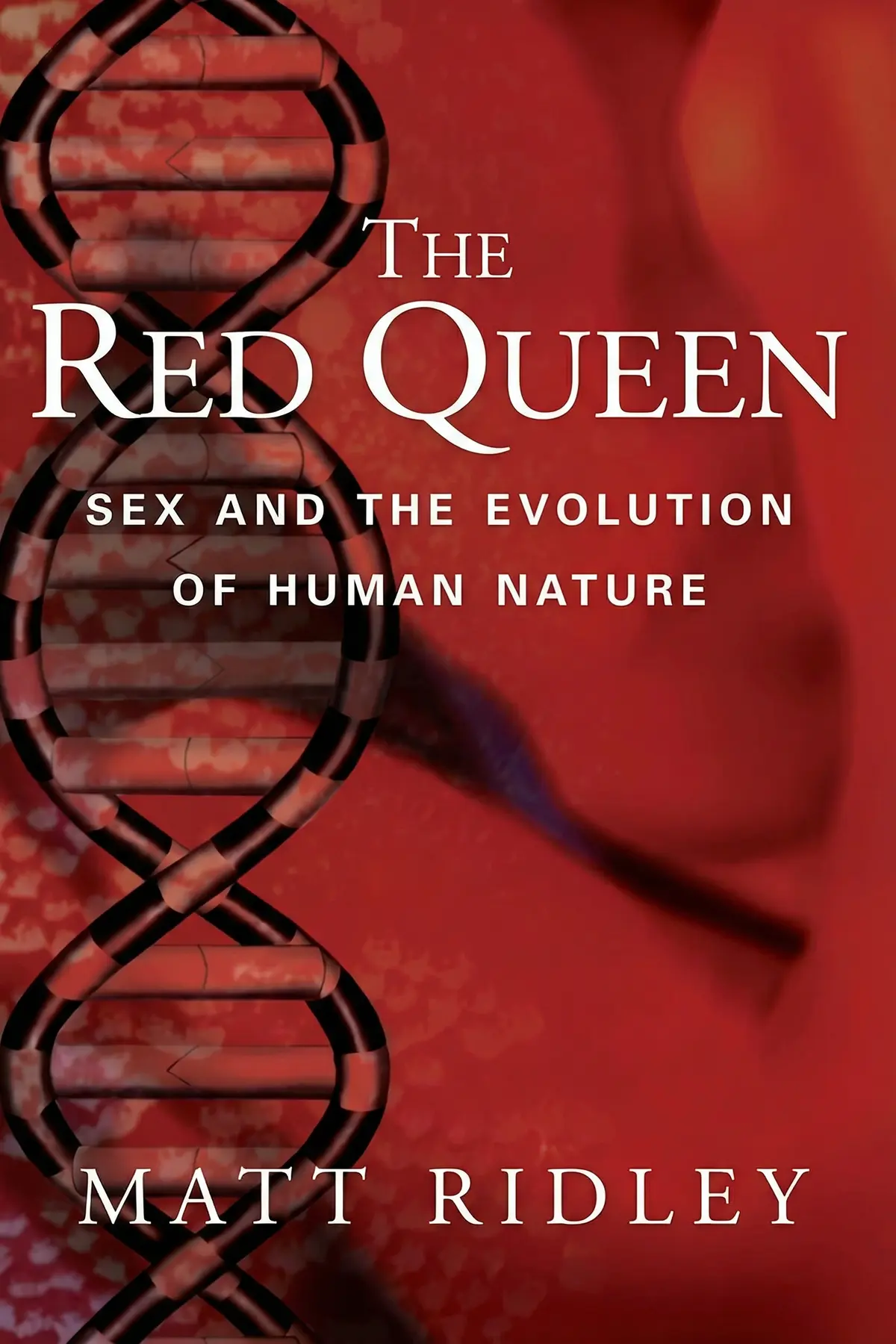
Table of Content
1. Introduction
58 sec
Sex looks like one of evolution’s worst bargains. A dandelion makes copies of itself without a partner, while humans can spend years looking for one. In The Red Queen, Matt Ridley, a longtime writer for The Times, argues that we pay this price because we are caught in a race that never ends. The title is borrowed from the Red Queen in Through the Looking-Glass by Lewis Carroll, who informs Alice that in her country you have to run as fast as you can merely to remain where you are.
For Ridley, sex is how a species keeps running: against parasites that keep evolving to attack it, and against rivals for the best mates. That single pressure, he argues, explains why there are two sexes, why males show off, why most people pair up, and even why human brains grew so large. Follow it through and familiar puzzles about attraction, faithfulness and the gap between men and women begin to make biological sense.
2. See why evolution pays the high price of sex
1 min 28 sec
Cloning is faster, cheaper and needs no partner. A fish that has stayed the same for 300 million years and a yam with eight copies of every gene make the case for sex look surprisingly weak.
3. Variety is your best defense against parasites
1 min 44 sec
The greatest danger to our ancestors was not the saber-toothed tiger. A small Mexican fish that can either clone itself or mate revealed which strategy survives an enemy that adapts faster than you do.
4. Two sexes, explained by a battle inside cells
1 min 29 sec
Nature could have settled on three sexes, or ten. The reason it stopped at two lies inside our cells, and the same hidden pressures may still tilt whether a mother has sons or daughters.
5. Read the hidden message in every showy display
1 min 39 sec
A tail so long it slows its owner down should be a disaster for survival. Biologists found that the burden itself may be the point, and that female taste follows a surprisingly practical logic.
6. Know what makes a species choose one partner or many
1 min 25 sec
Some women in Kenya would rather share a husband than have one to themselves, and in one bird species the females keep harems. Yet across nature, pairing up keeps winning, for reasons that come down to numbers.
7. Understand why faithful pairs still look elsewhere
1 min 30 sec
Humans are the only apes that pair off while living in crowds. Ridley argues this creates a lasting tension between two things a partner may not offer together, and zebra finches show how females resolve it.
8. Accept sex differences without falling into sexism
1 min 42 sec
Israeli kibbutzim began trying to erase gender roles in the 1920s, and three generations later those roles had returned. Ridley takes that seriously, then shows why the same evidence gives no support to treating any individual as less capable.
9. Understand the brain as a tool for courtship
1 min 41 sec
Our brains burn a fifth of our energy, far more than survival seems to need, and chimpanzees make tools without them. Ridley’s explanation for the surplus puts wit and charm at the center of human evolution.
10. Conclusion
1 min 14 sec
In the end, Ridley tells one story about a race with no finish line. Sex began as a defense, a way of reshuffling genes so parasites could never settle on a single lock. Once it existed, the race moved inside each species: cells competing until two sexes won, males displaying, females choosing, and pairs forming wherever children needed two caregivers. The same contest, he argues, built a brain that uses about a fifth of our energy, one that grew because cleverness won partners.
When a behavior seems wasteful, a long tail, a loud song, a sharp joke at dinner, ask what it proves and to whom. When someone claims that men and women differ, remember the kibbutz and the male brain comparison together: a gap between the average man and woman can be real and still smaller than the variety found among male brains alone. And when perfect uniformity looks efficient, picture the cloned topminnows crowded with parasites.
Alice learned from the Red Queen that standing still is never safe. Every trait we carry is the record of a race our ancestors never stopped running.
About this book
What is this book about?
From evolution's point of view, sex looks like a poor bargain. A dandelion copies itself without a partner, and asexual creatures breed faster because they never have to find a mate. Matt Ridley sets out to explain why humans still need sex despite that cost. His answer borrows an image from Lewis Carroll: the Red Queen, who tells Alice that you must run as hard as you can just to stay in place. In Ridley's argument, sex is how a species keeps running. Reshuffling genes every generation keeps parasites from finding one way in, and once sex exists, a second race starts among rivals for the best partners. That single idea carries the book a long way. It explains the battle inside cells that left us with two sexes, the peacock's tail and the songbird's display, why polygamy gives way to monogamy, why affairs make evolutionary sense, and why sex differences are real but give no excuse for sexism. Ridley ends with a bold claim about the human brain: we grew clever because cleverness won partners.
Book Information
Who it's for
Curious why attraction evolved
Curious readers who want an evolutionary explanation for attraction, affairs and faithfulness.
Biology and psychology students
Students of biology or psychology looking for one clear argument linking parasites, sexes and the human brain.
Weighing nature against equality
Anyone tired of the nature versus equality debate who wants evidence on both sides.
About the Author
Matt Ridley
Matt Ridley, born in 1958 in Northumberland, England, has written regularly for The Times. He chaired the bank Northern Rock from 2004 to 2007. After inheriting his title as the 5th Viscount Ridley in 2012, he sat in the House of Lords as a Conservative hereditary peer from 2013 until he retired in December 2021. His other books include How Innovation Works and Genome, which was shortlisted for the Los Angeles Times Book Prize.
Ratings & Reviews
Ratings at a glance

What people think
Listeners find the work thoroughly researched and engaging, with one listener describing it as the coolest textbook they’ve read. They value the intellectually stimulating material, especially the way it facilitates deep insights into human nature, and find the subject matter fascinating. The prose is highly regarded, though opinions regarding the pacing are mixed; some find it slow going, while others say it holds up well. Although some listeners find it easy to understand, others note it is not an easy read.
Top reviews
David
This book is a masterclass in making complex evolutionary biology accessible to the layperson. Ridley explores the 'Red Queen' hypothesis with such clarity that you start seeing the 'arms race' of sexual selection everywhere you look. I found the section on how parasites drive the need for genetic shuffling through sex to be absolutely mind-blowing. Honestly, it reads more like a gripping narrative than a dry textbook, though it does demand your full attention during the more technical chapters. While the book was written in the 90s, the core arguments about why we aren't just cloning ourselves feel as fresh as ever. The way he bridges the gap between animal behavior and human sociology is nothing short of brilliant. If you've ever wondered why gender roles or beauty standards exist, this provides a rigorous, if sometimes provocative, framework. It’s the kind of read that sticks with you long after the final page is turned.
Show morePaisley
As a biology enthusiast, I can confidently say this is one of the coolest 'textbooks' I have ever encountered. Ridley manages to weave together the intricate threads of sexual selection and evolutionary competition into a tapestry that explains so much of the human condition. The 'Red Queen' metaphor—borrowed from Lewis Carroll—perfectly captures the frantic, never-ending struggle of life to outpace its own predators and diseases. I particularly enjoyed the chapters on the power of parasites and how they essentially forced us into becoming sexual beings. Frankly, the author’s ability to synthesize disparate studies into a cohesive argument is impressive, making even the most difficult concepts easy to grasp. While some critics might find his views on gender essentialist, he provides enough biological context to make his reasoning hard to ignore. This book changed the way I look at every social interaction I have. It is an absolute classic for a reason.
Show moreRoydao
Wow, talk about a deep dive into the primal forces that drive us! Ridley’s exploration of sexual Darwinism is both illuminating and, at times, a little bit depressing in its cold logic. He argues that our intelligence, our culture, and even our sense of beauty are all just tools in a grand game of reproductive chess. Personally, I found the evidence for the 'arms race' between males and females to be the most compelling part of the entire narrative. The book is dense with information, so it isn't exactly a light beach read, but it rewards the patient reader with incredible insights. I did feel that he occasionally anthropomorphized animals to make a point, which felt slightly less 'scientific' than the rest of the work. Still, the overall impact is a profound reconsideration of what it means to be a human animal. It's a dense, challenging, and ultimately rewarding piece of popular science literature.
Show moreAroon
Human nature is a mess of contradictions, but Matt Ridley provides a remarkably coherent lens through which to view our chaos. By focusing on the 'Red Queen' effect, he explains how our very existence is a byproduct of an eternal struggle for genetic survival. The book is packed with fascinating trivia about everything from peacock tails to the way sperm competes within a species. I appreciated how he balanced the 'nature vs. nurture' debate, even if he leans more heavily toward the biological side of the scale. The truth is, we are creative apes, and understanding our evolutionary baggage is the first step toward true self-awareness. Ridley’s prose is elegant and fast-paced, ensuring that even the most technical sections remain accessible to a general audience. This is easily one of the most thought-provoking books I’ve read in the last decade. It’s a brilliant synthesis of biology, psychology, and sociology that demands to be discussed.
Show moreAiden
Ever wonder why humans are so obsessed with finding the 'perfect' mate? Matt Ridley dives into the Red Queen effect to explain how we are essentially running as fast as we can just to stay in the same evolutionary place. To be fair, some of the data feels slightly dated, yet the central metaphor remains a powerful tool for understanding our species. The writing is incredibly well-researched and engaging, though I’ll admit some of the pacing felt a bit slow in the middle sections. He doesn't shy away from controversial topics like polygamy or the inherent differences between the sexes, which might ruffle some feathers today. It’s a thought-provoking look at the biological machines we truly are, even when we like to think we're above it all. I appreciated the intellectual honesty when he admits that half of his theories might eventually be proven wrong. This is a must-read for anyone interested in the intersection of science and culture.
Show moreOscar
The chapter on 'The Power of Parasites' alone makes this entire book worth the price of admission. It presents a radical way of looking at sex—not as a source of pleasure, but as a defense mechanism against microscopic invaders that evolve faster than we do. Ridley's writing is sophisticated and bold, frequently challenging the reader to abandon their cherished notions of human exceptionalism. Not gonna lie, some of the sections on human mating strategies felt a bit repetitive, yet they were anchored by interesting references to the animal kingdom. He has a knack for finding the perfect anecdote to illustrate a complex game-theoretic strategy. My only real gripe is that he occasionally treats his hypotheses as universal truths when they are clearly still debated. Regardless of whether you agree with every conclusion, the book forces you to think critically about your own nature. It’s an engaging, well-founded exploration of why we are the way we are.
Show moreKai
Published decades ago, this book still manages to hold its own in the crowded field of evolutionary psychology. Ridley is a gifted writer who knows how to make a sentence sing, even when he’s talking about something as unglamorous as parasite resistance. I’ve read other works on this subject, like Pinker or Dawkins, and while Ridley might not be as pithy, his focus on sex provides a unique angle. The central metaphor of the Red Queen is so intuitive that it’s hard to imagine evolutionary theory without it. Some of the references to 'modern' society feel a bit like a time capsule from the early 90s, but the underlying biology is still sound. I did find the pacing a bit uneven, with the human-centric chapters at the end feeling slightly rushed compared to the earlier sections. However, the sheer breadth of research on display is staggering. It’s an insightful, if occasionally controversial, look at the engine of our evolution.
Show moreRohan
Finally got around to reading this classic, and I must say it lives up to most of the praise. It’s a fascinating exploration of how sexual selection has shaped not just our bodies, but our very minds and cultures. Ridley makes a compelling case that we are all players in an 'intellectual chess game' designed to maximize our reproductive fitness. The book is well-researched and provides a treasure trove of historical and biological insights that are still relevant today. I particularly liked his take on beauty as a signal of genetic health, even if it feels a bit reductive at times. In my experience, the best science books are the ones that make you question your own behavior, and this one certainly qualifies. There are moments where the author’s hubris shines through, but his intelligence is undeniable throughout the entire work. It’s an engaging, challenging read that offers a powerful new perspective on what it means to be human.
Show moreElena
Picked this up because I wanted to understand the 'why' behind human attraction, but I left with mixed feelings. On one hand, the science regarding parasites and genetic mutations is fascinating and provides a solid foundation for why sexual reproduction is necessary. On the other hand, Ridley’s conclusions about human behavior often feel like they’re propping up traditional gender norms under the guise of 'objective' biology. I found his dismissiveness toward certain sociological perspectives to be a bit grating at times, though his prose is undeniably sharp. The book is dense, making it a slow-going journey through various species before finally hitting the human-centric chapters at the end. Look, it’s a brilliant intellectual exercise, but you have to take his more 'authoritative' claims with a massive grain of salt. It serves as an interesting time capsule of 90s scientific thought, even if some of the logic feels wobbly now.
Show moreRungrat
After hearing so much hype about this being a 'scientific masterpiece,' I found myself incredibly disappointed by the blatant bias throughout the text. Ridley seems to start with a conclusion—that men and women are fundamentally, biologically different in ways that mirror 1950s stereotypes—and then hunts for data to support it. The logic is often circular, and he frequently ignores cultural factors that could easily explain the behaviors he attributes solely to evolution. I found the tone to be somewhat smug, as if he expects the 'uninformed' reader to be shocked by his supposedly 'brilliant' reasoning. While the early chapters on genetics and parasites were informative, the transition into human sociology felt like a leap into pure conjecture. It was hard to swallow his claims about what women want or how the male brain is 'wired' for certain tasks. If you enjoy being told that your personality is just a series of pre-programmed biological urges, this is for you. Otherwise, give it a miss.
Show moreQuestions about this book
What is the Red Queen hypothesis in Matt Ridley's book?
The name is taken from the Red Queen in Through the Looking-Glass by Lewis Carroll, who tells Alice you have to keep running just to remain in place. Ridley uses it for the idea that species must keep changing to survive. Parasites adapt fast, so a species that clones itself is easy to wipe out. Sex reshuffles genes every generation, giving parasites a moving target.
Why does sex exist if asexual reproduction is faster?
Ridley grants that cloning is more efficient: no mate to find, faster breeding. Gene repair and faster evolution do not fully justify sex, since many species keep backup gene copies and some, like the coelacanth, barely change. His main answer is parasites. Curtis Lively’s study of the Mexican topminnow found cloned fish were often infested, while sexually produced fish were almost entirely free of parasites.
What does The Red Queen say about monogamy and affairs?
Ridley argues that monogamy usually wins because of the monogamy threshold: when too many females cluster around one male, unmated males and passed-over females do better by pairing up. For women, he claims the most advantageous system is monogamy with the option of affairs, drawing on Nancy Burley’s finding that attractive male zebra finches invest less in their chicks.
Why did humans become so intelligent, according to Ridley?
Not mainly for tools, he argues, since chimpanzees and bonobos make tools with much smaller brains. Humans began competing with each other, and in a social world status went to those best at managing others. Witty, inventive people became the most desired partners, so intelligence worked like a peacock’s tail. Psychologist Geoffrey Miller’s work on the neocortex supports this view.
Does The Red Queen justify sexism?
No. Ridley says differences between the sexes are real, citing cognitive tests and the Israeli kibbutz communities that returned to traditional roles after three generations. But he insists the differences are relative: the range among male brains is wider than the gap between the average male and female brain. Many differences are also shaped by society, which itself influences evolution.
Readers also enjoyed

A Thousand Brains: A New Theory of Intelligence
Jeff Hawkins



A Liberated Mind: How to Pivot Toward What Matters
Steven C. Hayes


Acting with Power: Why We Are More Powerful Than We Believe
Deborah Gruenfeld



Alien Earths: The New Science of Planet Hunting in the Cosmos
Lisa Kaltenegger

Age of Propaganda: The Everyday Use and Abuse of Persuasion
Anthony Pratkanis
AUDIO SUMMARY AVAILABLE
Listen to The Red Queen in 15 minutes
Get the key ideas from The Red Queen by Matt Ridley, plus 5,000+ more nonfiction titles.
- 5,000+ titles
- Listen as much as you want
- 7-day free trial
- Cancel anytime









