

A Promised Land
Barack Obama
 English
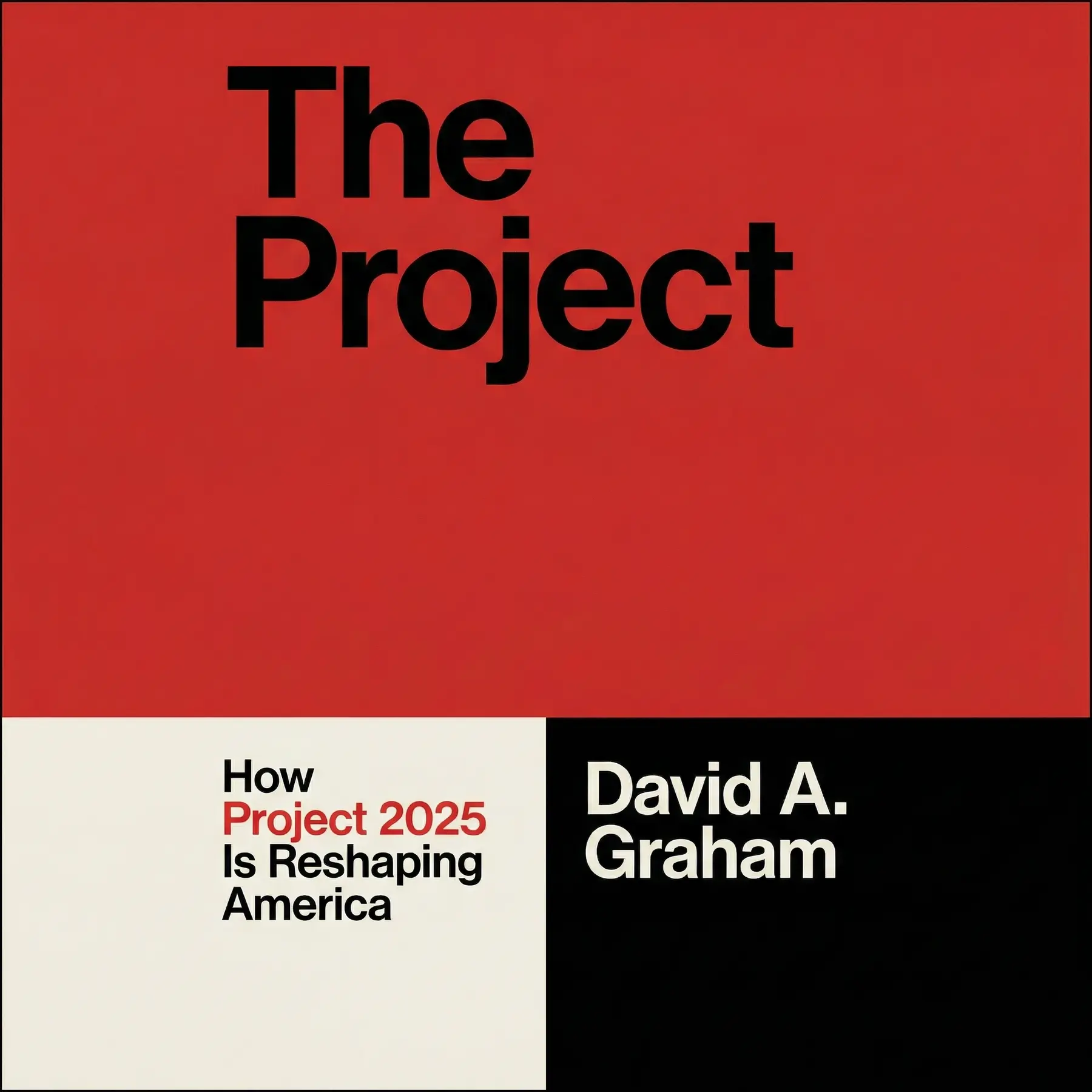
David A. Graham explains what Project 2025 actually proposes: concentrating power in the presidency, replacing career officials with loyalists, and using that control to remake family, immigration, economic, climate and defense policy.

1 min 09 sec
If Project 2025 reaches you mostly as a headline, you likely know the name and little of what it says. In The Project, Atlantic staff writer David A. Graham starts with how its authors read Donald Trump’s first term: the failure, they decided, lay not with the leader but with the government itself, a sprawling system that resisted every push. Their answer, backed by the Heritage Foundation, was to prepare a second term well ahead, with staff, executive orders and a confidential six-month playbook ready before day one.
Graham shows the plan working in two layers. First it rebuilds the executive branch so power flows to the president and loyalists replace career officials. Then it aims that rebuilt machine at five areas of American life: gender and family, immigration, the economy, the environment, and defense. Follow both layers and each new headline becomes easier to place. You will be able to explain what the document proposes, and why its structure matters more than any single policy in it.
1 min 47 sec
Think tanks have advised incoming presidents for decades, and one even claimed most of its ideas became policy. What made this effort different had less to do with ideas and more to do with names on a list.
1 min 51 sec
Nothing in the plan calls for ending elections. That design is what Graham examines closely, and he points to three technical levers behind it.
2 min 03 sec
Daycare, abortion pills, school vouchers and public radio look like separate fights. Graham shows them tied together by one definition of freedom that most listeners would not recognize as freedom at all.
1 min 47 sec
The plan never needs Congress to pass a new immigration law. Graham explains how declarations, agency rules and conditions on federal money could reshape daily life for millions of people, including some citizens.
1 min 56 sec
Free-market conservatives and tariff-loving populists wrote this section together, and they never fully agreed. Yet beneath the contradictions, Graham finds one direction that stays remarkably steady.
1 min 52 sec
The authors avoid saying climate change is fake. What they propose instead may matter more, because it changes who controls the research, the data and the official national assessment itself.
1 min 57 sec
The plan wants a bigger military to face China while removing groups of service members during a recruitment crisis. Graham explains the logic that makes both goals fit together for its authors.
1 min 17 sec
What Graham’s reporting adds up to is a warning about method. Project 2025 rarely asks anyone to give up democracy openly. It works through hiring lists, budget rules, job classifications and funding conditions, the everyday tools of government, and turns them against the checks those tools were built to serve. Run that way, a plan can rewrite family policy, the border, taxes, climate rules and the military while elections still happen on schedule.
That is why the book suggests a different way to follow politics. When a new order or appointment appears, ask whether it moves power toward the president and away from the people who could say no. When a proposal sounds small, such as a census question or a looser child labor rule, place it inside the larger design Graham describes. And when you argue about the plan with friends or colleagues, start from what its own authors wrote, from Roberts and Dans to Vought and Cuccinelli, so the debate stays on the text.
Dans was compiling names long before inauguration day. Graham’s book is a reminder that whoever staffs the government decides much of what the votes will mean.
Project 2025 is more than a set of proposals, and Graham sets out in detail what the document actually says. David A. Graham, a staff writer at the Atlantic, sets out to explain it plainly: who wrote it, what it proposes and how its pieces fit together. His starting point is how a circle of former Trump officials read the first term. In their view the government itself, not the president, was the obstacle. So the Heritage Foundation, led by Kevin Roberts, started its plan well ahead of time, with Paul Dans assembling 10,000 potential hires and Russell Vought supplying the case for a far stronger presidency, from revived impoundment to the Schedule F rule for firing civil servants. Graham then follows that rebuilt machine into five areas: gender and family, immigration, the economy, climate and energy, and foreign policy and defense. Readers get a clear map of the proposals, the people behind them and the internal splits the document leaves open, plus a way to judge new political headlines by asking who gains control and which checks disappear.
Readers who keep hearing about Project 2025 and want to know what it actually proposes.
Professionals and students following US politics from abroad who need a clear map of its people and plans.
Anyone who wants a simple test for judging how a government change shifts power.
David A. Graham is a staff writer at the Atlantic, where he reports on national affairs, politics and criminal justice. His analysis of the 2020 presidential election won the Toner Prize for Excellence in National Political Reporting. He previously oversaw the Atlantic's politics section during a period when it won a Webby Award, and his work has also appeared in Newsweek, the Wall Street Journal and the Berlin Policy Journal.
Listeners find this work vital and accessible, characterized by its straightforward prose and steady tempo. The book's readability is highly praised, with one listener specifically mentioning how Graham simplifies the details of Project 2025. They also appreciate the insightful content, with one review highlighting the thorough breakdown of what the project intends to achieve.
David A. Graham has done a massive service for those of us who lack the time or the stomach to wade through nine hundred pages of dense policy text. This book is a lean, mean, 138-page distillation of the Project 2025 manifesto. It manages to be both deeply informative and terrifyingly easy to comprehend. Graham breaks down complex maneuvers like the proposed changes to the civil service with a clarity that few political journalists can manage. My only minor gripe is that I wish there were more footnotes for the direct quotes, though the narrative flow is admittedly better without them. If you want to understand how the executive branch might be reshaped into a tool for absolute loyalty, this is your guide. It is an essential primer for the modern era.
Show moreFrightening is the only word that truly fits the contents of this slim volume. Picked this up on a whim after a friend mentioned the section on the Department of Education. Graham’s breakdown of the plan to replace public school funding with private vouchers is crystal clear and incredibly urgent. He connects the dots between different policy areas—like how abortion bans and the 'biblical' family model are part of a singular social vision—in a way that makes the larger strategy obvious. The sentences are short, the chapters are manageable, and the impact is immediate. I appreciate that he doesn't waste time with flowery language. This is a functional tool for citizens who want to be informed about the mechanics of current power shifts. Everyone should read this before the next election cycle.
Show moreWow, this was a punch to the gut. I didn't realize how much of the current news cycle was actually a direct implementation of this 900-page document until I read Graham’s summary. The author does a fantastic job of taking the 'boring' parts of government—like administrative law and agency appointments—and showing why they actually matter to our daily lives. The prose is lean and avoids unnecessary jargon, making it accessible for people who aren't political junkies. Personally, the section on Title 42 and immigration was the most eye-opening part of the whole experience. It’s a dark read, but Graham’s writing provides a necessary light. I’ve already bought three more copies to give to family members who don't understand what's at stake. Highly recommended for any concerned American.
Show moreThis book is essentially a roadmap of the radical shifts currently happening in our government. I’ve been trying to keep up with the constant stream of executive orders, and Graham’s book provides the missing context. It shows that these aren't just random decisions; they are part of a cohesive, well-funded strategy to remake America in a very specific image. The writing style is direct and avoids the 'tell-me-what-I-ought-to-believe' variety of political writing that usually annoys me. Instead, it feels more like an investigative report. I was particularly struck by the plans for the Department of Justice and the removal of party-neutral workforces. It’s a sobering reminder that democracy is often changed through bureaucracy rather than just votes. This is a must-read for anyone who values transparency in government. A quick but vital read.
Show moreThe chapter regarding the restructuring of the federal workforce really stopped me in my tracks. I’ve always viewed the 'deep state' as a hyperbolic talking point, but Graham lays out the actual policy plans to convert career officials into political appointees. It’s a sobering look at how the guardrails of the American system are being systematically dismantled. The writing is punchy and moves fast, perhaps a bit too fast in the sections on immigration and trade. While I appreciated the brevity, I felt the nuances of the economic tariffs were slightly glossed over to maintain the brisk pace. Still, it’s a vital read for anyone trying to decipher the daily headlines. You won't find a more digestible version of this specific political strategy anywhere else.
Show moreAfter hearing David Graham on a podcast, I felt compelled to see if his written analysis matched his level-headed interview style. Truth is, the book is even more compelling than his spoken commentary. He handles the 'Mandate for Leadership' with a surgical precision that avoids the usual partisan shouting matches you see on cable news. I particularly liked the section on environmental policy and the proposed gutting of the NOAA. It sounds like science fiction, yet the book proves it’s a very real legislative goal. My only criticism is that the book is so short it feels like it’s over before you can really process the gravity of it. It functions well as a primer, but it left me wanting a much longer book with more investigative reporting. A solid 4-star effort.
Show moreFinally got around to reading this summary after seeing it mentioned all over social media. Graham is a staff writer at The Atlantic, and you can definitely tell—the writing is sharp, professional, and very well-organized. He breaks down the Project 2025 goals into thematic chapters like family, education, and energy, which makes it easy to flip to the sections you care about most. I found the discussion on the 'Bonapartist' approach to executive power especially fascinating. However, I noticed some sections felt a little repetitive, as if the book was rushed to print to meet the news cycle. It’s understandable, but a bit more polish would have made it perfect. Regardless of your political leanings, understanding this blueprint is essential for knowing where the country is headed.
Show moreIs it possible for a book to be too efficient at its job? Frankly, that was my primary feeling after finishing this summary of the Heritage Foundation’s latest blueprint. Graham is an excellent writer—clear, concise, and focused—but the experience felt a bit like reading a series of expanded Wikipedia entries. I wanted more historical context or perhaps a deeper dive into the specific authors behind the project. To be fair, he delivers exactly what the title promises: a summary of how the project is reshaping the country. It’s perfect for a quick airplane read or for someone who just wants the highlights. However, if you are looking for a dense, academic interrogation of conservative theory, you might find this a little thin and unsatisfying.
Show moreTo be fair, the writing is crisp and the pacing is excellent, but I left feeling like I’d only skimmed the surface of the actual 'Mandate for Leadership.' I picked this up because I wanted the 'Sparknotes' version, and that is exactly what Graham provides. However, I think I actually wanted something a bit more substantial. The book is only about 140 pages, which just isn't enough room to really grapple with the philosophical roots of these right-wing shifts. It’s great for a high-level overview, but it lacks the intellectual depth I was hoping for after seeing the author's interviews. If you just want the 'what,' this book is for you. If you want a deep dive into the 'why,' you might be disappointed. It's a decent summary, but ultimately felt a bit slight.
Show moreLook, I was hoping for a balanced breakdown of the Heritage Foundation’s proposals, but this felt more like a political warning label than a neutral analysis. The author clearly has a perspective, and while he tries to maintain an expository tone, the alarmism peeks through in every chapter. I didn’t find it nearly as informative as the CSPAN interviews I’ve seen on the subject. It focuses heavily on the most controversial aspects of the project, like the 'traumatization' of federal workers, while skipping over the actual conservative logic behind some of the economic shifts. It’s well-written, I’ll give it that. But if you’re looking for a book that treats these policy ideas with a sense of objectivity, this isn't it. It felt more like a campaign pamphlet than a book.
Show moreGraham describes it as a Heritage Foundation effort to prepare a second Trump term in advance. Organizers compiled vetted staff, drafted executive orders and wrote a confidential six-month playbook. Its core aim is to concentrate power in the presidency, replace career officials with loyalists and remove institutional checks, then use that control to reshape policy on family, immigration, the economy, climate and defense.
Graham names Kevin Roberts, who became Heritage president in 2021 and launched the project, and Paul Dans, who ran it and helped assemble a list of 10,000 potential hires. Russell Vought, former head of the Office of Management and Budget, supplied its ideology. Contributors include Roger Severino on health and abortion and Ken Cuccinelli on immigration.
The plan would bring back Schedule F, a rule that lets the president remove civil servants holding policy-related positions and put political loyalists into those jobs. Graham places it alongside restoring impoundment, where a president refuses to spend money Congress approved, and removing protections that keep the Department of Justice separate from the White House, including the FBI director’s fixed term.
No, and Graham argues that is the point. The plan does not suspend elections. Instead it weakens checks by concentrating power in the executive and politicizing agencies, building a structure that could run with little accountability whoever is in office. Graham connects this to Trump telling a Christian audience that in four years they would not need to vote again.
Graham’s account suggests a few habits. When a government change is announced, ask whether it removes a check on the person in charge. Look at who is being hired and who is being pushed out, since staffing reveals intent. For economic proposals, ask who ends up carrying the cost. And judge each single policy as part of the larger design rather than in isolation.
Barack Obama

Masaji Ishikawa

John Rawls



Miles Taylor



Tracy Rosenthal

Jessica Valenti
AUDIO SUMMARY AVAILABLE
Get the key ideas from The Project by David A. Graham, plus 5,000+ more nonfiction titles.









