
15 min 09 sec
Available in: English
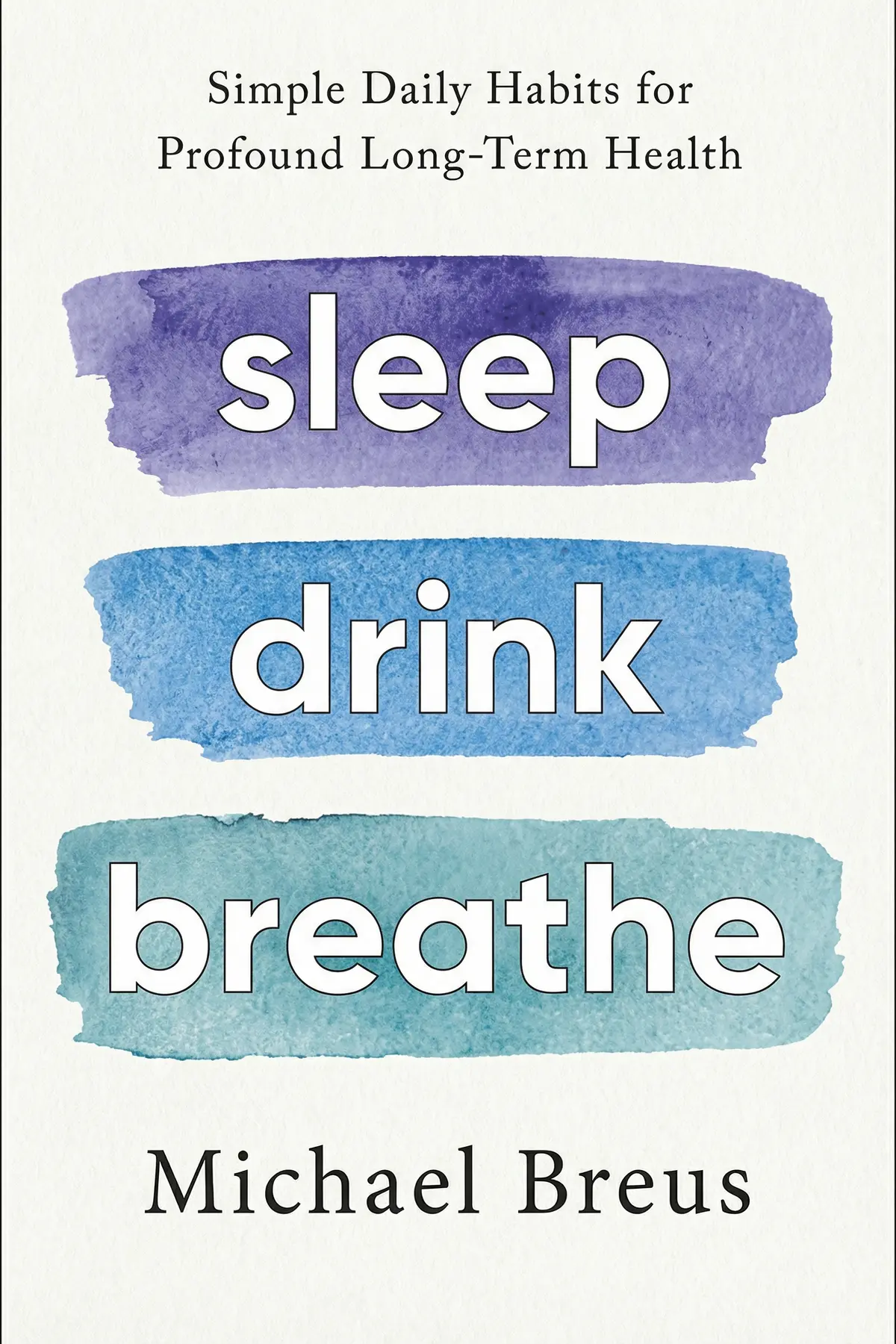
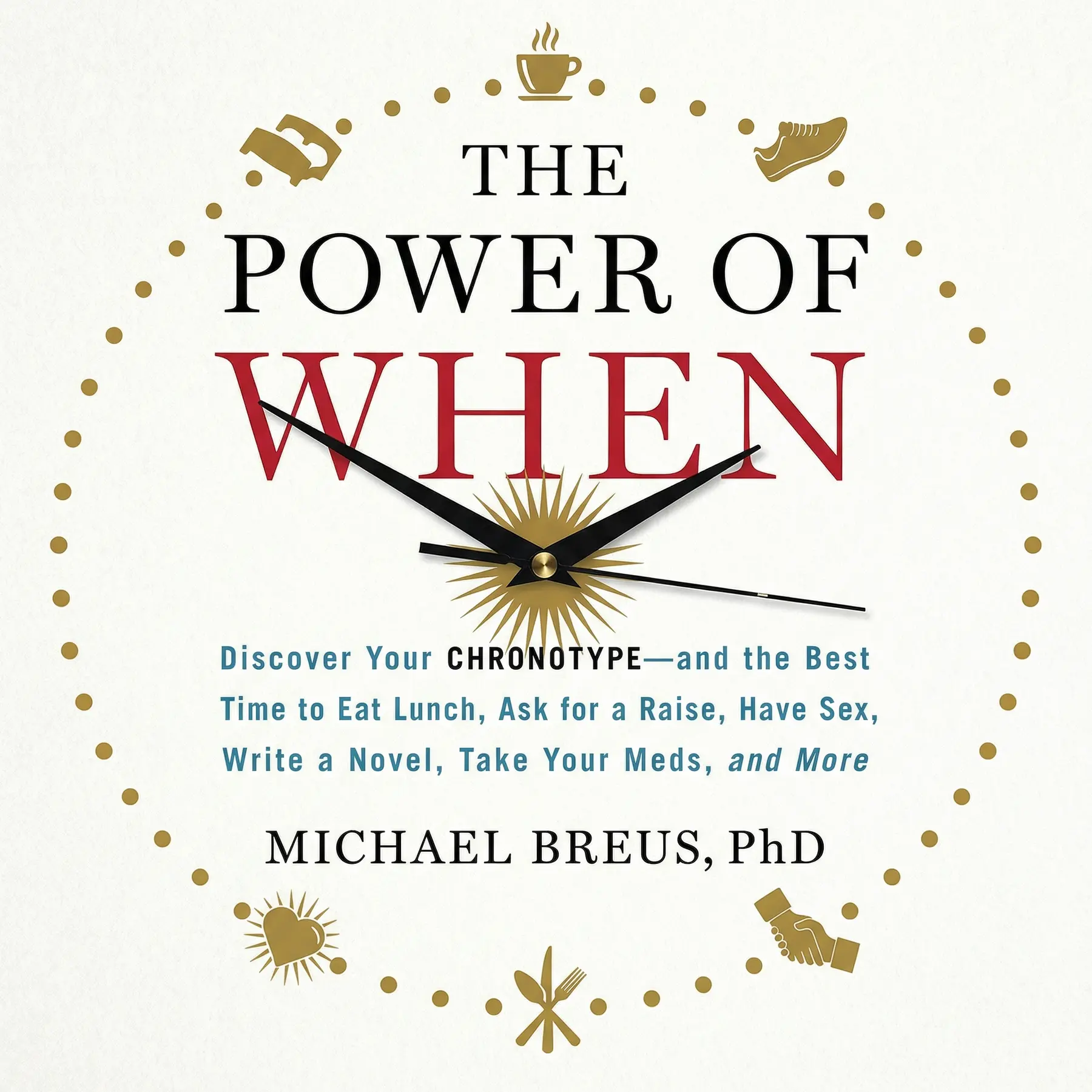
The Power of When: Discover Your Chronotype – and the Best Time to Eat Lunch, Ask for a Raise, Have Sex, Write a Novel, Take Your Meds, and More
Shows how to find which of four body-clock types you are, Dolphin, Lion, Bear or Wolf, and how to time meals, pay requests and sex to match your natural rhythm.
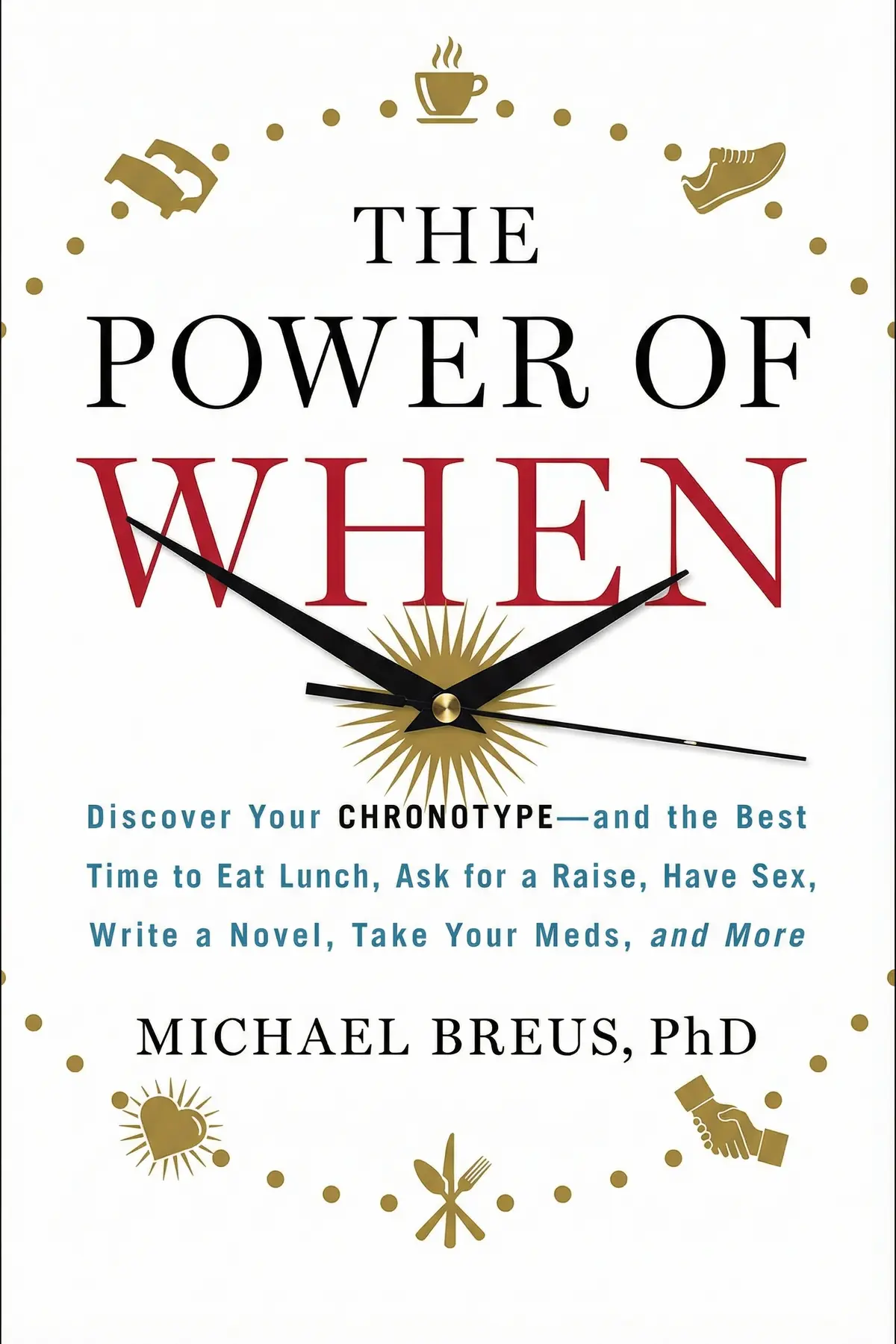
Table of Content
1. Introduction
57 sec
If you push through your day on willpower and coffee, you may be fighting your own biology for hours you could use better. In The Power of When, clinical psychologist and sleep specialist Michael Breus argues that the best hour for any task depends on which of four body-clock types you are. He calls them Dolphins, Lions, Bears and Wolves, and he estimates that about half of us are Bears who rise and fall with the sun.
His case is simple: you cannot add hours to the day, but once you know your chronotype you can place each task where your body is ready for it. That applies to small choices like lunch and bigger ones like the afternoon you ask for more money. By the end you will be able to place yourself among the four types, read what your type reveals about your temperament, and apply Breus’s clock times for meals, for requesting a raise and for sex.
2. Do your hardest work when your body is ready
1 min 20 sec
Some of your best ideas may arrive when you feel slightly tired, while other work punishes anything less than full alertness. A sleep doctor explains why the hour can matter as much as the effort.
3. Find your type among four sleepers
2 min 04 sec
Larks and owls were the standard way to describe early and late people for years. One sleep specialist found that the two birds missed something important about how people actually sleep.
4. Read the temperament behind your sleep pattern
2 min 16 sec
The way you sleep may predict whether you thrive in a team, take risks or crave the spotlight. Each body-clock type carries a temperament, and recognizing it changes how you read colleagues.
5. Work with the clock you were born with
1 min 26 sec
A louder alarm and more discipline seem like the obvious fix for a late riser. Breus explains what biology allows you to change, what it does not, and how the answer shifts with age.
6. Meal times that keep your metabolism on track
1 min 56 sec
Breakfast, lunch and dinner can follow your body clock or fight it. Four short timetables show where each type should eat, and they share one detail that surprises late risers.
7. Pick the best hour to ask for a raise
2 min 09 sec
A well-argued request for more pay can still fail on the wrong day at the wrong hour. Breus maps the moods of both you and your boss to find a better moment.
8. Match two body clocks for better sex
1 min 54 sec
Bedtime is when most couples end up together, yet it may be one of the least suitable hours for desire. Breus offers alternatives for each type and for couples whose clocks differ.
9. Conclusion
1 min 07 sec
The Power of When asks you to stop treating every hour as equal. Breus’s four animals are a way of admitting that a Wolf at 7 a.m. and a Lion at 10 p.m. face the same obstacle: a clock written into their DNA that discipline can move by an hour or two at most. Once that is accepted, lunch, a salary talk and an evening with a partner all become questions of placement.
Begin by naming your type from both your sleep and your temperament, whether that is the light-sleeping Dolphin, the early Lion, the sun-following Bear or the late Wolf. Then move one thing. It might be your meals, set to your type’s three times for a week, or the hard analytical work you have been doing while groggy. If you need something from your boss, wait for a Thursday or Friday afternoon at the hour your pairing suggests. And if a health condition is involved, check any change with a certified health-care provider first.
The day still has twenty-four hours. What changes is which of them you give to the things that matter.
About this book
What is this book about?
Most people plan their days around meetings, commutes and habit. Then they wonder why some hours feel sharp and others feel wasted. Clinical psychologist and sleep specialist Michael Breus argues that the missing piece is timing. Chronobiology, the study of the body's daily rhythms, suggests there is a best time for nearly everything, from analytical work to cancer treatment. After more than 15 years with patients, Breus found the old morning-lark and night-owl categories too crude. They ignored how deeply people sleep and how personality shapes their habits. He proposes four chronotypes instead: light-sleeping Dolphins, early-rising Lions, sun-following Bears and night-loving Wolves. Each comes with its own temperament, and each, he says, is set in your DNA for most of adult life. Readers learn to identify their type and see what it says about their strengths at work and at home. They also get Breus's specific clock times for three everyday decisions: when to eat breakfast, lunch and dinner, which day and hour to ask a boss for a raise, and when to have sex, with a partner's rhythm taken into account.
Book Information
Who it's for
Night owls and larks
Night owls and early risers tired of forcing themselves into someone else's schedule.
Professionals wanting better timing
Professionals who want to plan demanding work, meals and a raise request around their energy.
Couples and managers
Couples and managers who want to understand why the people around them run on different clocks.
About the Author
Michael Breus
Michael J. Breus, Ph.D., is a clinical psychologist who specializes in sleep disorders. He is a Diplomate of the American Board of Sleep Medicine and a Fellow of the American Academy of Sleep Medicine. Besides his private practice, he trains other sleep doctors, has consulted for airlines, hotel chains and mattress makers, and has served as a sleep expert for WebMD. He has appeared on Oprah and The Dr. Oz Show, and his other books include The Sleep Doctor's Diet Plan and Sleep Drink Breathe.
Ratings & Reviews
Ratings at a glance
What people think
Listeners describe this work as accessible and absorbing, with one listener highlighting that it features over 1000 scientific references. They value the actionable guidance and transformative perspective, reporting that it enhanced their sleep quality within a week. The material assists audiences in identifying their specific chronotypes and provides recommendations for sleep schedules tailored to their natural rhythms.
Top reviews
Mint
Finally got around to reading Dr. Breus's work after hearing him on a podcast, and I was genuinely surprised by how much of it landed for me. The 'Lion' description was scarily accurate—I've always been a morning person, but I was doing everything at the wrong times, like exercising too late in the evening. While the 1,000+ scientific references give it weight, it remains incredibly easy to digest because you can skip the chapters that don't apply to your specific animal. It’s not just about sleep; it’s about timing your whole life. I do think the advice to eat breakfast within 30 minutes of waking up is a bit much, especially when your stomach isn't ready for food that early. Still, the insights are life-changing if you actually apply them.
Show moreMethinee
Within a week, my energy levels shifted dramatically just by tweaking when I have my first cup of coffee and when I tackle my hardest work tasks. I used to feel so guilty for being a 'lazy' late-riser, but learning I’m a Wolf changed my entire perspective on my own productivity. It turns out I’m not lazy; I’m just biologically wired to peak at 9:00 PM when the Lions and Bears are already in bed. The book provides a practical roadmap for scheduling everything from sex to surgery based on your DNA. While I didn't agree with every single suggestion—some of the eating windows are quite restrictive—the overall impact on my sleep quality has been undeniable.
Show moreChokdee
I bought this for future reference after borrowing it from the library because the section on timing medications and meals was a revelation. Most wellness books focus on *what* you eat, but Breus makes a compelling case that the clock is just as important as the calories. The advice is actionable, the tone is encouraging, and the science feels grounded despite the quirky animal labels. I’ve already recommended it to several friends who struggle with midday fatigue. It might make your life a little more complicated if you try to follow every single rule, but even adopting 20% of the suggestions can improve your daily flow. Definitely worth the read.
Show moreRatchanee
The structure of this book is its greatest strength because you don't actually have to read it cover-to-cover to get the value. After taking the quiz at the start and realizing I’m a Bear, I just cherry-picked the sections on productivity and exercise. Frankly, the chapter on the best time to argue with your partner was surprisingly insightful, even if it felt a little calculated. The author’s anecdotal professional experience shines through, making the data feel more accessible than a dry textbook. I did find the constant animal metaphors a bit repetitive after a while, though. It’s a solid manual for anyone looking to optimize their daily routine without needing a PhD in biology.
Show moreKob
The sheer volume of scientific references—over a thousand, apparently—is impressive, even if the 'animal' archetypes feel a bit gimmicky at first glance. Dr. Breus manages to make complex circadian rhythm science feel like a conversation with a friend. I appreciated the specific tips for things I never considered, like the best time of day to take certain medications or ask for a raise. My only real gripe is that the book uses fixed wall clock times without accounting for seasonal changes or your specific latitude. In the winter, my 'Lion' schedule feels a lot harder to maintain than in the summer. Regardless, it’s a fascinating dive into the 'When' of life rather than the 'What' or 'How'.
Show moreAroha
Ever wonder why you're a zombie until 11 AM while your partner is already finishing a workout and answering emails? This book explains the genetic 'why' behind those differences with clarity and humor. I’m a Wolf, and finally having a doctor tell me that my brain doesn't function before 10 AM was the validation I didn't know I needed. The world isn't set up for us, but this book offers tactical ways to navigate a society built for Lions. Some chapters felt like padding—I don't really need to know the best time to buy shoes—but the core message about honoring your biological clock is spot on. It’s a quick read that packs a punch.
Show moreCamila
As someone who has struggled with insomnia for years, I found some of this helpful, but much of it felt like common sense repackaged for a general audience. The 'Dolphin' category describes me perfectly—anxious, light sleeper, always tired—but the solution seems to be 'just deal with it' or follow a hyper-complicated flow chart. To be fair, the book is engaging and the focus on the internal body clock is fascinating research. I just don't know if I need a 300-page book to tell me that I should eat dinner earlier. It’s a decent read if you’re new to biohacking, but if you’ve read any other sleep books, you might find this a bit thin on actionable new data.
Show moreAdam
Look, the concept is fascinating: stop worrying about *what* you're doing and focus on *when* you're doing it. For me, the 'Bear' schedule was a bit of a revelation, especially the part about the mid-afternoon energy slump. I’ve started saving my admin tasks for that 3 PM window, and it has made a huge difference in my stress levels. The writing style is very accessible, though it can get a bit 'horoscopy' with how it tries to predict your personality based on your sleep habits. It’s not a perfect science, and you have to take some of it with a grain of salt. But if you want to understand your body better, this is a great starting point.
Show moreSelin
Is it just me, or does this feel like a glorified Buzzfeed quiz wrapped in clinical jargon? To be fair, Breus is a real sleep psychologist, but the way he forces human behavior into these four rigid 'chronotypes' felt remarkably like a horoscope. If you're a Wolf, do this; if you're a Bear, do that. It ignores the reality of modern labor where 90% of us can’t just tell our bosses we’re starting at noon because our 'genetics' demand it. Some of the tips, like powering down phones an hour before bed, are just common sense that we’ve all heard a million times before. I pushed through to the end, but the ROI on my time was pretty low.
Show moreManop
Batshit advice that ignores the reality of anyone with a 9-to-5 job or a family to feed. The author presents his 'chronotypes' as if they are immutable laws of physics, yet the timing often feels completely arbitrary. Honestly, telling an insomniac that they are basically 'effed' as a Dolphin isn't medical advice; it's just discouraging. I also found the foreword by a known health hack to be a major red flag for the scientific validity of the rest of the text. The world is built for morning people, and this book just reinforces that while pretending to offer a 'new' way of living. It’s nicely formatted, sure, but the content is mostly pseudo-science fluff.
Show moreQuestions about this book
What is the main idea of The Power of When?
Michael Breus argues that timing shapes health, productivity and mood, and that the best time to do almost anything depends on your chronotype. He sorts people into four types, Dolphins, Lions, Bears and Wolves, based on when they wake, how deeply they sleep and their personality. Because the type is set in your DNA, the practical move is to schedule meals, demanding work and important conversations into the hours your type favors.
What are the four chronotypes in The Power of When?
Breus describes four. Dolphins, about 10 percent of people, are light, often anxious sleepers who excel at precise work. Lions, 15 to 20 percent, wake early with energy and often take the lead. Bears, around half of everyone, follow the sun, sleep well and enjoy company. Wolves, another 15 to 20 percent, struggle in the morning, peak in the late evening and tend to be creative and impulsive.
Can you change your chronotype according to Michael Breus?
Not really, in Breus’s view. He compares chronotype to height or eye color, something written into your DNA, and says you can shift your timing by only an hour or two. It does change with age: young children tend to be Lions, teenagers Wolves, most adults Bears, and older adults often return to Lion habits or become Dolphins. From the early twenties to about 65 it stays largely stable.
According to The Power of When, what is the ideal moment to request a raise?
Breus says to avoid Monday and Tuesday, usually the busiest and most stressful days, and to aim for Thursday or, best of all, Friday, when the pace slows and moods lift. The hour depends on your type and your boss’s. A Lion asking a Lion boss should try 1:30 p.m., while two Wolves should wait until 5:00 p.m. All his suggested times fall in the afternoon.
Featured in
Readers also enjoyed









AUDIO SUMMARY AVAILABLE
Listen to The Power of When in 15 minutes
Get the key ideas from The Power of When by Michael Breus, plus 5,000+ more nonfiction titles.
- 5,000+ titles
- Listen as much as you want
- 7-day free trial
- Cancel anytime









