

14 min 42 sec
Available in: English
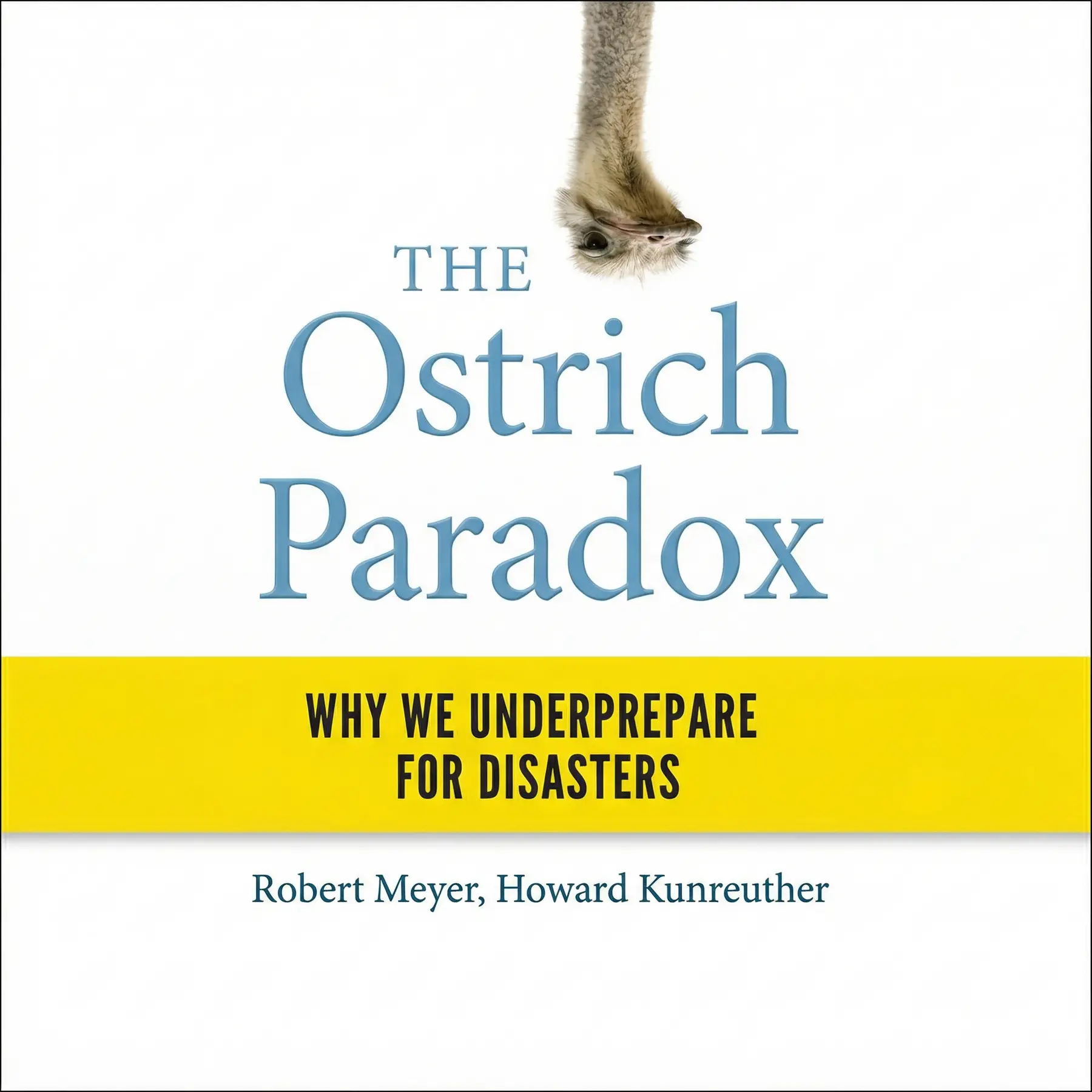
The Ostrich Paradox: Why We Underprepare for Disasters
Explains why people who know a disaster is likely still fail to prepare, naming six predictable mental biases. It also shows how policy and small personal habits can make readiness happen almost automatically.

Table of Content
1. Introduction
1 min 08 sec
Most people who live with a real risk of flood, fire or financial shock know the danger and still have no kit, no plan and gaps in their insurance. In The Ostrich Paradox, Wharton professors Robert Meyer and Howard Kunreuther argue that this failure has little to do with ignorance. It comes from mental shortcuts that once kept our ancestors alive and now leave us exposed.
The authors name six of these biases: myopia, amnesia, inertia, optimism, simplification and herding. They follow them through two disasters that experts saw coming, the flooding of New Orleans and the 2008 housing crash. Their throughline is hopeful. Because the biases are predictable, we can stop fighting them and design around them, through smarter rules and small personal habits.
By the end, you will be able to name the bias behind each task you keep postponing, and you will know a handful of moves that make readiness happen almost by itself.
2. Knowing the risk rarely gets you ready, so learn why
1 min 39 sec
This should be the best-prepared era in human history, with sharp forecasts, strong materials and easy insurance. Instead, households stock almost nothing for emergencies they fully expect. The explanation is not the one most people reach for.
3. Spot the nearsightedness that delays every repair
1 min 46 sec
An engineering report warned a city that its flood defenses could not withstand a major hurricane, and then it was left to gather dust. For four decades, something ordinary kept winning the argument over what to fund, and the cost arrived all at once.
4. Stop past floods from fading into comfortable history
1 min 47 sec
A city can remember every fact about its last flood and still act as if it never happened. The authors explain how that strange forgetting works, and why doing nothing is the easiest plan of all.
5. See past the voice that says not me
1 min 46 sec
Before the 2008 crash, buyers knew housing markets had collapsed before. They had a ready reason why the last crash did not apply to them, and the same reasoning hides inside many everyday decisions about risk.
6. Question the simple story the crowd is telling
1 min 41 sec
A tangled global financial system was reduced to a five-word slogan, and a coworker’s purchase or a sister’s refinancing made it feel safer. The mechanism behind that confidence turns up whenever people decide together.
7. Design rules that make protection the default
1 min 51 sec
Warnings and education have been tried for decades, and they rarely change what people do. The authors look at codes, mortgages, paychecks and window stickers that get results by expecting people to behave like people.
8. Build your own readiness in small, manageable steps
1 min 47 sec
A complete disaster plan sounds responsible, yet aiming for one is often why nothing gets done. A few minutes attached to bills, groceries and one September reminder can quietly outperform any grand resolution.
9. Conclusion
1 min 17 sec
The deepest point in The Ostrich Paradox is that underpreparing is normal. The authors found it in a city that filed away an engineering warning for forty years and in a country that believed house prices could only rise. Nobody in those stories lacked information. They had human minds, built for nearby and immediate dangers, facing threats that were distant, rare and complex.
That diagnosis is also the hopeful part. A bias you can name and predict is a bias you can design around. Governments can build protection into codes, mortgages and paychecks. Neighbors can make readiness something people see and copy. And you can stop waiting for the burst of motivation that a near miss briefly gives you.
Take the protective task you have postponed longest and tie it to something already on your calendar, such as paying the monthly bills. Set one reminder that returns every September. Move a small fixed amount from each paycheck into an account you leave alone.
The gap between knowing about a disaster and acting on it is where most of the damage begins. It closes one small, automatic step at a time, long before the storm arrives.
About this book
What is this book about?
Forecasts are sharper than ever, buildings are stronger and insurance is easy to buy. Yet families in flood zones skip coverage, people in fire country ignore evacuation orders, and most homes hold almost nothing for emergencies everyone expects. Wharton professors Robert Meyer and Howard Kunreuther set out to explain that gap between knowing and doing. Their answer is that our minds handle future threats in fixed ways that once helped our ancestors survive. They name six biases: myopia, amnesia and inertia distort how we treat time, while optimism, simplification and herding distort how we judge the odds. The authors trace them through two disasters experts saw coming, the forty-year path to the flooding of New Orleans and the 2008 housing crash. The book then turns practical. It shows how building codes, mortgage rules, automatic savings, visible neighborhood efforts and well-designed discounts can work with human psychology. It also gives individuals concrete habits, from five-minute insurance checks to a yearly kit reminder, that move them from exposed to ready without demanding perfection.
Book Information
Who it's for
Not yet disaster ready
Homeowners and renters in flood, fire or storm areas who keep meaning to get ready.
Managers, planners and officials
Managers, planners and local officials who need people to act on risk warnings.
Savers with stalled plans
Savers whose emergency fund and insurance review never get past the to-do list.
About the Author
Robert Meyer
Robert Meyer holds the Frederick H. Ecker/MetLife Insurance chair in marketing at the University of Pennsylvania's Wharton School, and codirects its Risk Management and Decision Processes Center. His research has appeared in Marketing Science, Management Science and Risk Analysis. Howard Kunreuther (1938 to 2023) was an American economist who held the James G. Dinan chair at Wharton, where he was emeritus professor of decision sciences and public policy and codirected the center with Meyer.
Ratings & Reviews
Ratings at a glance
What people think
Listeners find the work skillfully composed and educational, with one individual observing its effective coverage of personal cognitive biases. Its clear prose earns appreciation, and one listener characterizes the book as a sobering read. The underlying research is well-regarded, with one listener praising its superb examination of human cognition. However, opinions regarding the book’s overall length and tempo remain varied among listeners.
Top reviews
Boy
Meyer and Kunreuther have managed to condense decades of complex Wharton research into an incredibly readable 125-page guide. This book hits the nail on the head regarding why we fail to act even when the data is staring us in the face. Their 'Ostrich Paradox' thesis—that we need to be more like ostriches by acknowledging our physical and cognitive limitations—is a brilliant bit of framing. The chapters on Herding and Optimism bias were particularly eye-opening for me. It’s rare to find a book that is both an excellent look into human thinking and a call to action for policy changes. I found the pacing to be perfect; it gets straight to the point without the filler you usually find in business books. If you are interested in risk management or just want to understand your own brain better, buy this.
Show morePetch
Finally got around to this after seeing it recommended in a psychology forum, and it was a surprisingly punchy read. Most books on decision-making are massive tomes that take weeks to get through, but this one is short and to the point. The authors break down the six biases—Myopia, Amnesia, Optimism, Inertia, Simplification, and Herding—with such clarity that you’ll start seeing them in your own life immediately. I loved the section on how we simplify complex risks into 'it won't happen to me.' It’s a well-written, digestible piece of work that doesn't hide behind academic jargon. Not gonna lie, it made me rethink my own emergency preparedness kits. Excellent for anyone who wants a quick but deep dive into why we make the mistakes we do.
Show moreSirichai
Wow. This book really changed how I look at news reports about disasters. Instead of wondering 'what were they thinking?' I now understand the specific cognitive shortcuts that lead to those tragedies. The 'Herding bias' explanation was particularly powerful—showing how we look to our neighbors for cues even when the water is literally rising. Meyer and Kunreuther have a very accessible writing style that makes complex Wharton-level concepts feel like a casual conversation. It’s a quick read, but the impact is lasting. I've already recommended it to several colleagues who work in urban planning. It provides a great look into how we can structure 'choice environments' to help people make the right decisions before it’s too late. Truly an excellent piece of research.
Show moreTar
Ever wonder why we keep building expensive homes in hurricane zones only to be shocked when they inevitably flood? This book provides a sobering look into our collective failure to prepare for the worst. Meyer and Kunreuther, both Wharton professors, distill complex psychological theories into six manageable biases like Myopia and Amnesia. It’s a well-written guide that explains why our brains are essentially hardwired to make poor decisions regarding long-term risks. I particularly appreciated the Behavioral Risk Audit framework, which offers a practical way to combat our natural inertia. My only gripe is that it feels a bit too focused on the US context, specifically hurricanes and building codes. Nevertheless, the research is an excellent look into human thinking and serves as a vital reminder that we need to design better systems to protect ourselves from our own cognitive DNA.
Show moreMaya
As a risk manager, I found the concept of a 'Behavioral Risk Audit' to be the most practical takeaway from the whole text. We often assume that giving people more information will lead to better choices, but this book proves that assumption wrong. Our 'System 1' thinking is just too fast and too prone to simplification for raw data to work on its own. The authors do a great job of explaining how insurers can play a larger role in nudging us toward better safety measures. Truth is, we are all prone to the 'Amnesia bias'—forgetting the pain of past disasters as soon as the sun comes out. While the book is quite brief, it’s a dense, informative read that I will likely return to when planning future projects. It’s definitely a sobering read for anyone in the planning or insurance industries.
Show moreChai
It’s a sobering read that highlights just how much our 'cognitive DNA' works against us in times of crisis. I've been reading a lot about behavioral economics lately, and this fits perfectly into that niche. The way they explain 'Hyperbolic Discounting'—our tendency to focus on upfront costs rather than long-term safety—is excellent. To be honest, I think this should be required reading for anyone in local government. We keep seeing the same patterns of destruction because our policies don't account for human nature. The book is light on neurobiology, which I actually preferred, as it kept the focus on behavior and policy. It’s a bit US-heavy, but the principles of the 'Ostrich Paradox' are universal. Definitely worth the afternoon it takes to read it.
Show moreSoontorn
While the core psychological principles here are incredibly valuable, the book feels a bit too US-centric for a global audience. The authors utilize the same few examples—mostly US hurricanes and Air France flight 447—to illustrate every point, which gets a bit repetitive after the first few chapters. Frankly, it’s a very short read, almost like a long-form essay, and I felt it lacked the depth of data I was looking for regarding global disaster trends. That said, the breakdown of the six biases is easy to digest. It’s a good introduction for a layman, but if you’ve already read Kahneman or Tversky, you might find this a bit light on new information. It's informative enough for a quick flight read, but don't expect a deep academic dive into neurobiology or international policy.
Show morePloy
The chapter on the Air France 447 crash was a gripping way to start, but the rest of the book didn't quite maintain that level of excitement for me. It’s a solid, informative look at cognitive errors, but the examples are very repetitive. If you’ve heard one story about a hurricane survivor refusing to evacuate, you’ve heard them all. I did like the focus on the 'Paradox' itself—the idea that we must accept our limitations to overcome them. However, the book ignores how some countries handled crises like COVID-19 or fires much better than the US, which suggests that institutional quality matters just as much as individual bias. It’s a decent primer, but it feels like it’s missing the bigger global picture. Good for a quick overview, nothing more.
Show moreDuangjai
Looking for something that offered a fresh take on risk, I picked this up based on the authors' credentials. The research is clearly there, and it’s an excellent look into human thinking, but the execution felt a bit rushed. The book is only about 120 pages, and a good chunk of that is notes and references. I found the pacing a bit odd; some biases were explored in depth while others felt like an afterthought. I would have liked more discussion on how individuals can mitigate these biases without relying on government intervention. Still, it’s a very informative book that captures the frustration of why we don't learn from history. A decent addition to your library if you like the 'Thinking Fast and Slow' framework, but don't expect a masterpiece.
Show moreSukit
To be fair, I expected a lot more from two Wharton professors. This felt less like a book and more like a recycled summary of 'Thinking, Fast and Slow' applied specifically to natural disasters. The authors spend so much time on the 'what' and 'why' of our biases but offer very little in the way of concrete, individual solutions. Most of the recommendations are large-scale policy shifts, like changing building codes or insurance mandates, which doesn't help the average person much. Also, the pacing was off; it’s so short that it misses several key factors, like how government bailouts actually encourage the very 'inertia' they criticize. I appreciate the readability, but it’s just too thin for the price. Not what I expected given the interesting title.
Show moreQuestions about this book
What is The Ostrich Paradox about?
Robert Meyer and Howard Kunreuther explain why people fail to prepare for disasters they know are coming, even with better forecasts and easier insurance than ever. They argue the cause is not ignorance but six predictable mental biases, traced through the decades before Hurricane Katrina flooded New Orleans and the 2008 housing crash. They then show how policy and personal habits can work with those biases.
What are the six biases in The Ostrich Paradox?
Three distort how we treat time: myopia makes distant threats look small, amnesia lets the fear from past disasters fade, and inertia keeps us doing what we already do. Three distort how we judge the odds: optimism says disaster happens to others, simplification shrinks complex risks into neat stories, and herding makes us copy everyone else’s choices.
How can I prepare for a disaster according to The Ostrich Paradox?
The authors advise small steps instead of a perfect plan. Check your insurance for five minutes when you pay monthly bills, since standard policies often exclude floods or earthquakes. Add one long-lasting item to each grocery trip, set a yearly September reminder to refresh your kit, and automatically move even twenty dollars from each paycheck into a separate emergency account.
Who should read The Ostrich Paradox?
It suits anyone who knows they face a real risk, from floods and fires to a housing slump or lost income, but keeps postponing action. It also serves managers, planners and public officials who need large numbers of people to prepare, since it explains why warnings fail and which designs, such as automatic enrollment and required coverage, actually change behavior.
Readers also enjoyed

Acting with Power: Why We Are More Powerful Than We Believe
Deborah Gruenfeld


Age of Propaganda: The Everyday Use and Abuse of Persuasion
Anthony Pratkanis




59 Seconds: Change Your Life in Under a Minute
Richard Wiseman


AUDIO SUMMARY AVAILABLE
Listen to The Ostrich Paradox in 15 minutes
Get the key ideas from The Ostrich Paradox by Robert Meyer, plus 5,000+ more nonfiction titles.
- 5,000+ titles
- Listen as much as you want
- 7-day free trial
- Cancel anytime









