
15 min 01 sec
Available in: English
 ไทย
EnglishไทยThe ONE Thing: The surprisingly simple truth behind extraordinary results
Shows how to stop treating every task as equal, find the single priority that makes the rest easier, and protect it from multitasking, drained willpower and requests you should refuse.
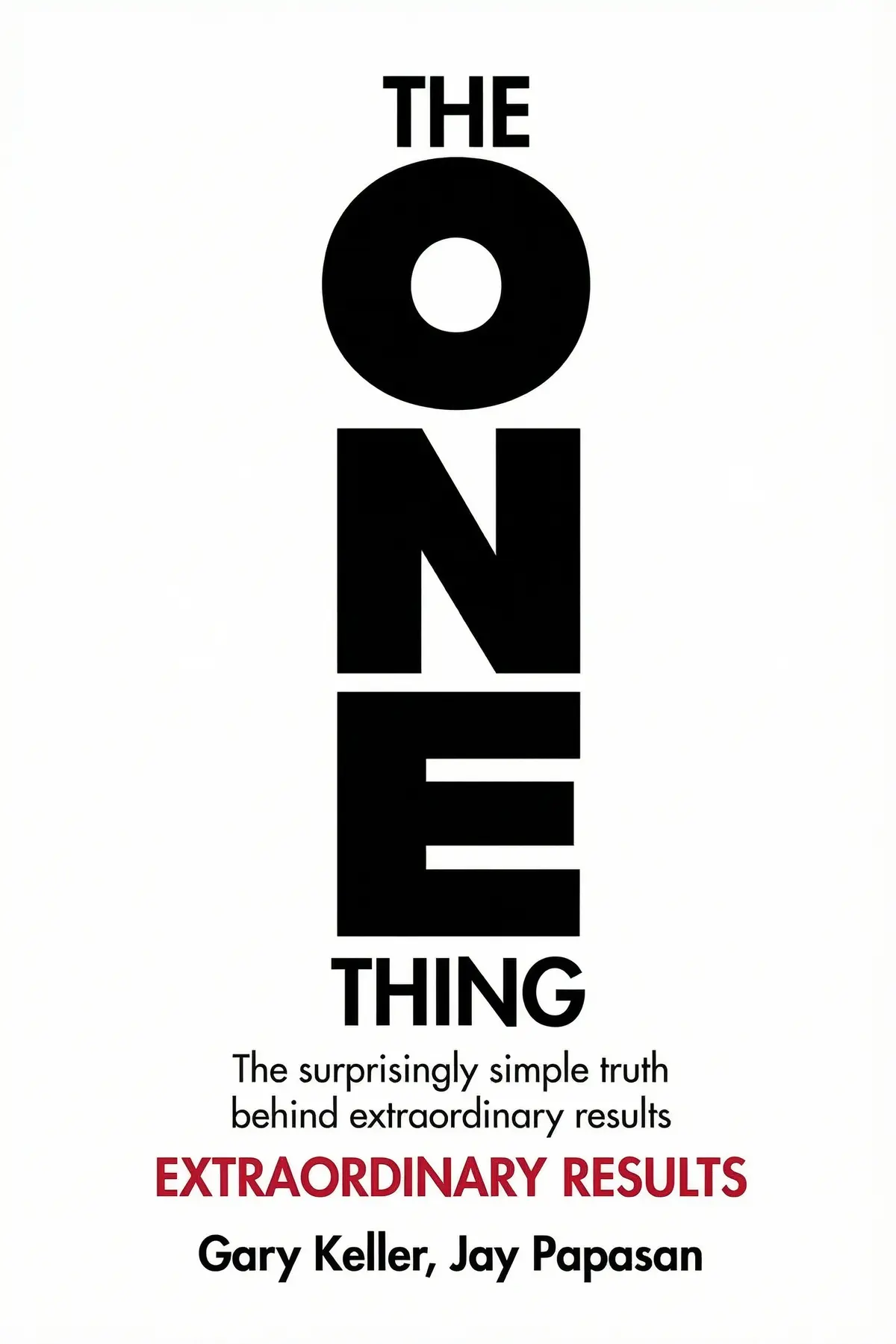
Table of Content
1. Introduction
54 sec
A long to-do list can keep you busy all day and still leave the work that matters untouched. In The ONE Thing, real estate entrepreneur Gary Keller and his co-author Jay Papasan argue that the cause is scattered focus: most of your results come from a small slice of what you do. Their answer is to keep narrowing until one priority is left, then build your day around guarding it.
That idea works at every scale. It shapes the life goal you choose, the task you start this morning and the requests you turn down this afternoon. The authors draw on a quality expert at General Motors, an Olympic swimmer once thought unable ever to focus, and parole judges whose rulings shifted with the clock. What you take from it is a single question to ask each morning, and several practical ways to defend the answer once you have it.
2. Set a goal big enough to shape your plans
1 min 31 sec
A brewer signed a lease that would outlast civilizations, and a writer mapped a whole series before page one. Most of us do the opposite with our ambitions, and the authors say that habit costs more than we notice.
3. Find the few tasks that produce most results
1 min 37 sec
Most people pick their next task by size, speed or simple habit. A discovery on a car factory floor suggests all three methods miss the point, and that your list is far less equal than it looks.
4. Ask one question that sorts every choice
1 min 40 sec
When everything feels urgent, the hardest part is knowing where to start. The authors offer a single question that works for a whole career and for the next ten minutes, plus a study on why picturing matters.
5. Build discipline one habit at a time
1 min 56 sec
Iron self-control looks like the trait that separates high achievers from everyone else. The story of a swimmer once expected never to concentrate on anything points to a far more manageable way to get there.
6. Win back the hours lost to switching
1 min 34 sec
Doing several things at once feels like the mark of a productive person. The history of a single word, and one estimate about office interruptions, suggest it may be costing you a large share of every working day.
7. Make your hardest decisions while your willpower is full
1 min 38 sec
Judges deciding whether prisoners go free should be immune to something as trivial as the hour. Research on parole hearings found they were not, and the pattern behind it shows up in your own afternoons.
8. Say no so your top priority gets done
1 min 30 sec
Being helpful is one of the qualities people value most in a colleague. Yet one of the most famous product leaders of his era was proudest of what he refused, and the authors explain how to refuse without coldness.
9. Protect what can break, and let work pile up
1 min 40 sec
Dividing your time evenly between everything that matters sounds wise and fair. The authors call it an impossible ideal, and a novelist’s image of five juggled balls shows which ones you can afford to drop.
10. Conclusion
1 min 01 sec
The ONE Thing asks for less than it first seems to. It does not demand longer hours, heroic discipline or a perfectly balanced calendar. It asks you to choose, and then to keep choosing the same thing when the day pulls you elsewhere. That is how a 9,000 year lease and a plan for seven books stop sounding reckless: a big aim, broken into one right action after another.
The start can be small. Tomorrow, before email, ask which single task would make the rest easier or unnecessary, and give it a protected block early in the day while your willpower is fresh. Inside that block, do nothing else, and the time you used to lose to switching comes back. When requests arrive, weigh them against that block, and redirect or decline the ones that would break it. Outside work, keep the glass balls in your hands.
A to-do list shows everything you could do. One honest question, asked every morning, shows what to do next.
About this book
What is this book about?
Many capable people end each day busy and behind, with a long list half done and the work that matters most still untouched. Gary Keller and Jay Papasan argue that the cause is scattered focus. A small share of what you do produces most of your results, so success depends on finding that share and guarding it. The authors build their case from a quality expert who traced most of the defects in General Motors cars to a handful of flaws, an Olympic swimmer once expected never to focus, Steve Jobs cutting Apple's products from 350 to ten, and parole judges whose rulings shifted with the time of day. At the center sits one question to ask about your life and about the next hour: which single action would make everything else easier or unnecessary? Readers get a way to choose a big goal, rank a crowded list, build discipline one habit at a time, and defend focused blocks of work while keeping family and health safe from the pressure.
Book Information
Who it's for
Professionals behind on priorities
Professionals who finish busy days with their most important work still untouched.
Overloaded founders and managers
Founders and managers buried in requests who need a clear way to rank and refuse them.
Ambitious career starters
Ambitious early-career people who want a big goal and a daily method for moving toward it.
About the Author
Gary Keller
Gary Keller began in real estate sales, moved into sales management and recruited agents by training them. He grew Keller Williams from one office in Austin, Texas, into a very large company and has served as its executive chairman. He was named an Ernst & Young Entrepreneur of the Year, and his books have sold over 5.4 million copies worldwide. Jay Papasan, a former HarperCollins editor with a graduate writing degree from New York University, has co-authored 12 books. He leads Produktive, the coaching and training company for The ONE Thing, and hosts its podcast.
Ratings & Reviews
Ratings at a glance

What people think
Listeners find this work to be a direct and eye-opening experience that offers practical advice and effective strategies for reaching major goals. They value the emphasis on dedicating focus to a single task and the depth of the research, as one listener pointed out its effectiveness in breaking down life into manageable segments. Listeners characterize the material as exceptionally inspiring and transformative, considering it essential listening for all.
Top reviews
Phu
What’s the ONE thing that changed my productivity this year? It was definitely this book. Gary Keller doesn't just give you a tip; he provides a mental framework for knocking down that first big domino. Most business books are fluff, but I found this incredibly motivating because it forces you to ignore the trivial many for the vital few. Personally, the concept of the 'Focusing Question' has become a daily habit that simplifies my mornings. I used to think I needed to do everything at once, but the authors prove multitasking is a total lie. The book is visually pleasing and keeps the pace high. If you want extraordinary results, you have to stop playing small and start narrowing your focus until only the most impactful task remains.
Show moreKatya
Success isn't about being a workhorse; it's about sequence, and this book illustrates that beautifully. I’ve read dozens of self-help titles, but the insight regarding the 66-day habit-forming window felt more grounded than most. It’s a straightforward read that doesn't hide behind academic jargon. Instead, it offers a clear path to achieving great results by organizing your life into smaller, manageable pieces. The authors argue that a balanced life is a myth, which was a tough pill to swallow at first, but it makes total sense once you look at high achievers. Since finishing it, I’ve stopped trying to 'do it all' and started focusing on my lead domino. Truth is, this book is life-changing if you actually apply the principles instead of just nodding along.
Show moreCarter
As someone who constantly feels buried under a mountain of to-do lists, this book was a lifesaver. I loved how it shifted my perspective from 'everything matters' to 'only one thing matters right now.' The section on protecting your 'maker' time in the morning while leaving 'manager' tasks for the afternoon was an eye-opener. It provides such enlightening and actionable insights that I found myself highlighting almost every other page. My favorite takeaway was the idea of the success list versus the to-do list. One is just a list of chores, while the other is a roadmap to your goals. Not gonna lie, I’ve already recommended this to everyone in my department. It’s a must-read for anyone who wants to achieve extraordinary results without burning out.
Show moreElias
After hearing so much about the 'domino effect,' I finally dove into the source material. It is incredible how such a simple shift in mindset can yield such great results. This book is a masterclass in prioritization. Keller and Papasan show you how to cut through the clutter of daily life to find your purpose. The advice is ridiculously obvious in hindsight, yet so few of us actually practice it. I’ve started implementing the 4-hour time block for my most important task, and the difference in my output is night and day. Happiness really does happen on the way to fulfillment, and this book provides the map to get there. It’s motivating, well-crafted, and honestly, a breath of fresh air for anyone tired of traditional business advice.
Show moreOlivia
Finally got around to this business classic, and it’s surprisingly refreshing despite its simplicity. I’ll admit I was skeptical of a book that hinges on a single concept, but the way Keller and Papasan break down the 'Focusing Question' makes it highly actionable. The layout is great for skim-reading, with important passages already underlined and key takeaways at the end of every chapter. One thing that really stuck with me was the idea that willpower is a limited resource. We often try to do our hardest work when we are most tired, which is a recipe for failure. While some of the corporate anecdotes about Apple feel a bit overplayed, the practical tips for time blocking are gold. It’s a solid guide for anyone feeling overwhelmed by their to-do list.
Show morePete
The authors do a fantastic job of debunking the myth of the multitasker in a way that feels both scientific and accessible. We live in a world of constant distractions, and this book acts as a much-needed anchor. I particularly liked the distinction between being 'busy' and being 'productive'—something most office workers (myself included) struggle with daily. The writing style is very direct, almost like an instruction manual, which I appreciated. However, I did find some of the diagrams a bit simplistic, almost to the point of being satirical. Still, the core message about narrowing your focus until only one thing remains is profound. It’s a well-researched piece that provides useful tips for anyone looking to reclaim their time and sanity in a chaotic work environment.
Show moreJib
The layout of this book is actually quite clever with the built-in underlining and bold summaries. It’s designed for the very people it’s trying to help—busy, distracted professionals who barely have time to read. The 'Focusing Question'—what’s the one thing I can do such that by doing it everything else will be easier or unnecessary?—is worth the price of the book alone. I found the section on the 'Four Thieves of Productivity' particularly relevant to my own life. While the book can feel repetitive, stating the same message in a hundred different ways, that repetition helps the concept sink in. It’s a straightforward read that offers a refreshing alternative to the 'hustle culture' that tells us to be everywhere at once. Definitely worth a spot on your shelf.
Show moreJoy
Look, you can probably get the gist of this in a blog post, but the repetition is actually the point. It takes 140 pages because most of us are so addicted to multitasking that we need to hear the message a hundred different ways before it clicks. I found the chapter on the 'Big Balloon' of success to be particularly enlightening. The book is well-researched and filled with useful tips that you can start using immediately. My only real complaint is that it occasionally feels a bit preachy, especially when discussing personal life balance. However, the core strategy of focusing on a single, impactful task is undeniable. If you’re feeling stuck or spread too thin, this book will help you find your way back to what truly matters. Solid 4 stars.
Show morePui
To be fair, the core message here is essentially just common sense stretched across two hundred pages. It's an enlightening read if you've never thought about priority, but for seasoned self-help readers, it feels like a mash-up of older, better books. I appreciate the emphasis on the 66-day habit cycle, though I'm not sure the science is as settled as Keller suggests. The writing style is very punchy—lots of short sentences and bold headings meant for people with short attention spans. Frankly, I enjoyed the layout more than the content itself. It's a decent reminder to stop multitasking, but you could get 90% of the value by just reading a summary. It's fine, just not the life-changing revolution the cover promises.
Show moreEleni
Not what I expected given the massive hype, and I found myself frustrated by the repetitive nature of the prose. How does it take over 200 pages to tell someone to focus on one thing at a time? To be fair, the central premise is sound, but the authors beat you over the head with it using confusing diagrams and bold text that feels like a marketing brochure. I felt like a 'sedentary desk-worker' being talked down to throughout the chapters. The book lacks the scientific depth of something like Outliers, choosing instead to lean on anecdotes about billionaires. It is an easy read, sure, but it felt more like an elongated LinkedIn post than a profound piece of literature. I didn’t gain much beyond what I already knew from common sense.
Show moreQuestions about this book
What is the main idea of The ONE Thing?
Gary Keller and Jay Papasan argue that extraordinary results come from focusing on one priority instead of many. Drawing on the Pareto Principle, they say a small share of your work produces most of your results. Their focusing question asks which single action would make everything else easier or unnecessary, and the rest of the book explains how to protect that answer from multitasking, drained willpower and low-priority requests.
What is the focusing question in The ONE Thing?
It asks what one thing you can do that would make everything else easier or unnecessary. The authors use it at two levels. At the big level it points to your overall direction, such as a career goal. At the daily level it picks the best next action, like making a phone call you have been avoiding. Asking it repeatedly links the two, so each step builds momentum.
Does The ONE Thing say multitasking works?
No. The authors argue that people cannot focus well on two tasks at once, so what feels like multitasking is really switching between them, which costs time, especially on complex work. They cite an estimate that office workers are interrupted about every 11 minutes and lose up to a third of the day recovering. Their advice is to give the most important task your full attention.
How can I apply The ONE Thing at work?
Start each day by asking the focusing question, then schedule a protected block for the answer and defend it like your most important appointment. Do key decisions early, since the authors describe willpower as draining through the day, as research on Israeli parole judges suggests. Say no to requests that do not serve your priority, redirecting people where you can, and accept that lesser work will pile up for a while.
Readers also enjoyed






AUDIO SUMMARY AVAILABLE
Listen to The ONE Thing in 15 minutes
Get the key ideas from The ONE Thing by Gary Keller, plus 5,000+ more nonfiction titles.
- 5,000+ titles
- Listen as much as you want
- 7-day free trial
- Cancel anytime









