
13 min 44 sec
Available in: English
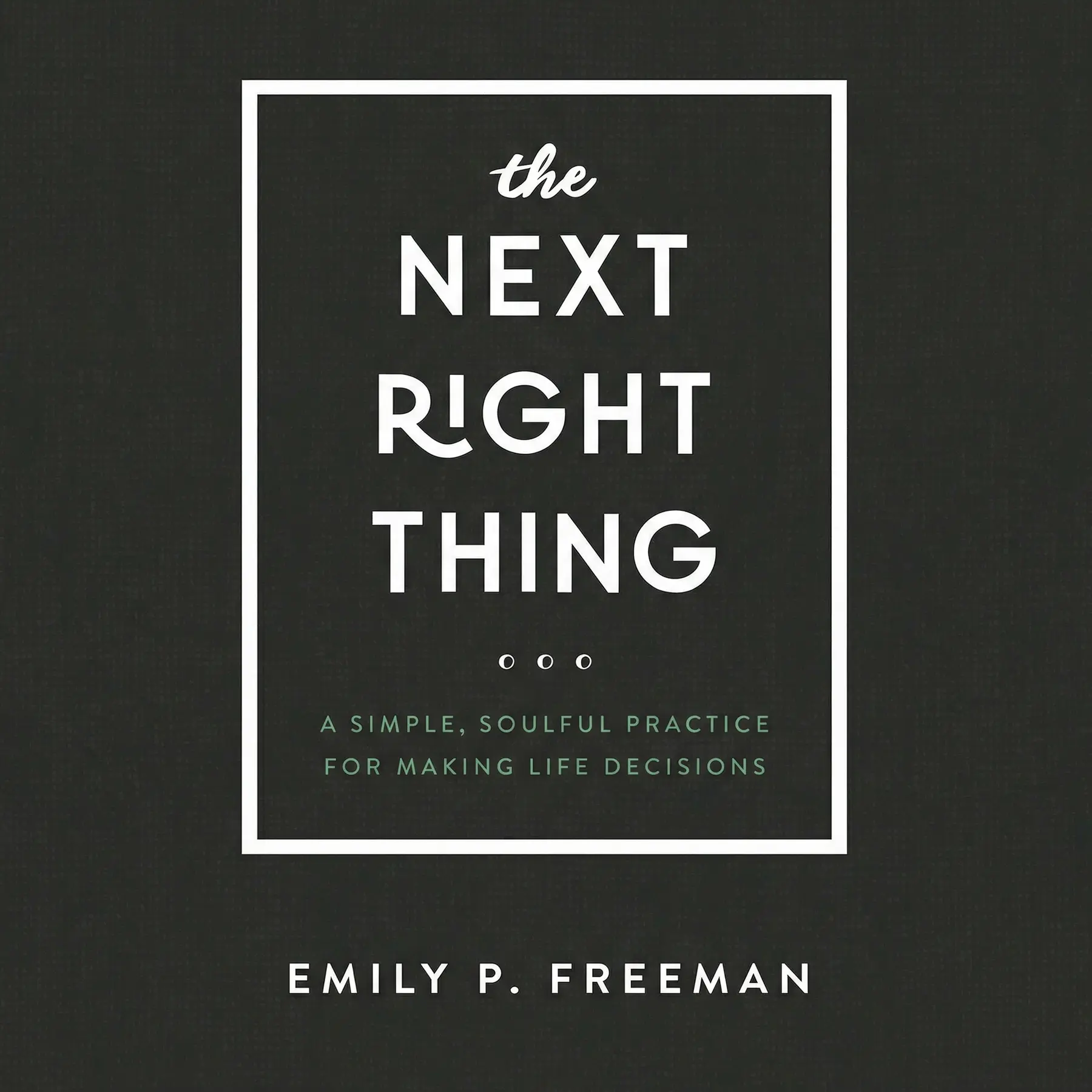
The Next Right Thing: A Simple, Soulful Practice for Making Life Decisions
A faith-based method for making hard life decisions: stop trying to control outcomes, clear away noise, name your feelings and desires, lean on a few good listeners, and take one present step at a time.
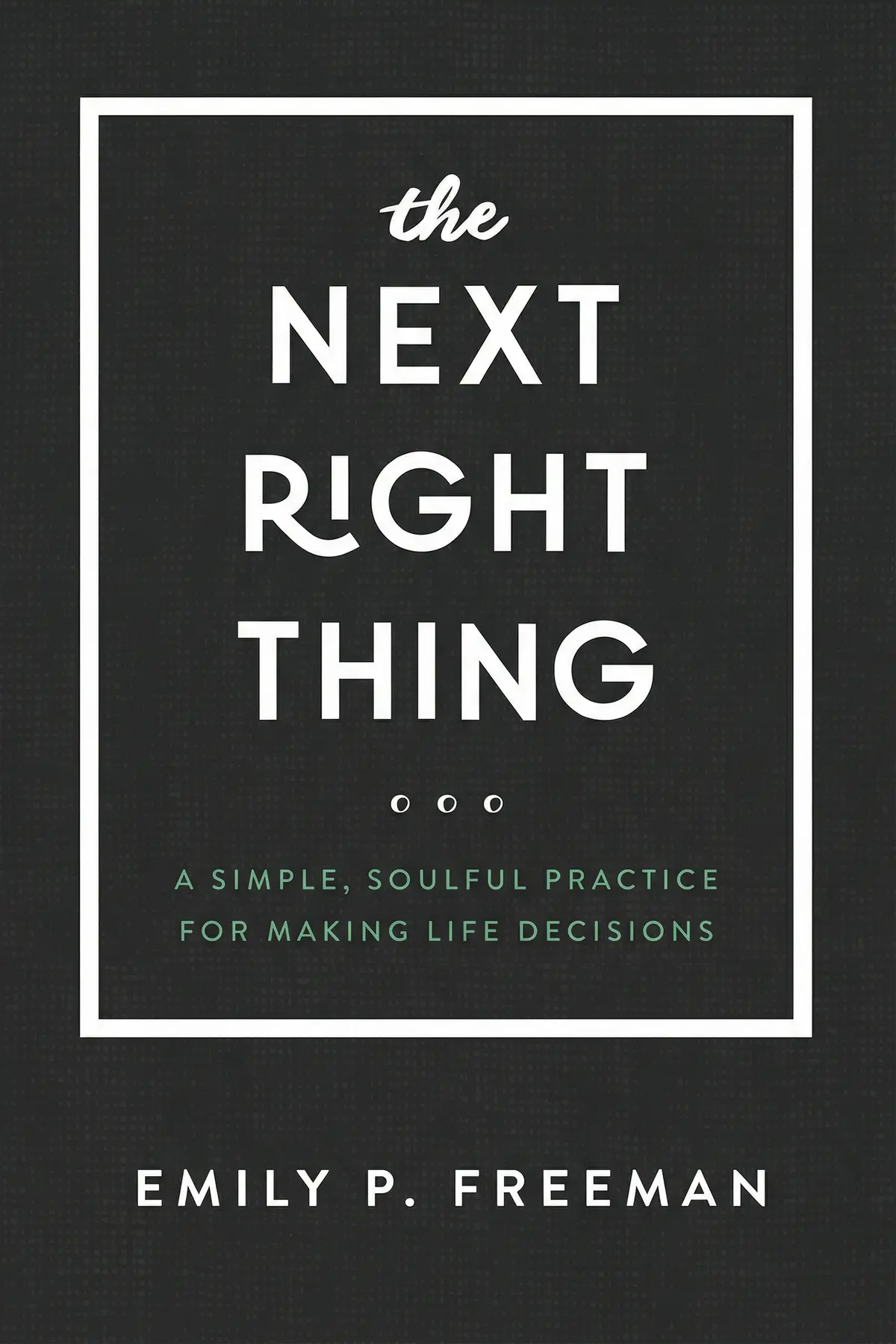
Table of Content
1. Introduction
59 sec
If an unmade decision has been hanging over you for weeks, it is probably the heaviest of the estimated 35,000 choices an adult makes each day. In The Next Right Thing, spiritual director and podcast host Emily P. Freeman argues that the weight comes from trying to control an outcome nobody can see. Her alternative is modest on purpose: take the next right step, then the one after it.
Freeman writes as a Christian and treats every hard choice as a chance for the soul to grow. Her claim is that peace arrives when you work in the present, from where you honestly are, with room to hear your own desires and a few trusted voices, while expecting clarity to come slowly and often by surprise. Her tools are small enough to try before the decision is due: a muted phone, a feeling named in a garden center, an evening with friends who only listen.
2. Swap outcome worry for one present step
1 min 34 sec
A woman with a job and family she loved spent weeks unable to explain why she wanted something new. An odd instruction from the Gospels, about lunch, shows why chasing the perfect reason may be the wrong goal.
3. Calm a crowded mind by naming its story
1 min 39 sec
A shopping trip for houseplants turned into a small crisis of indecision. One word, spoken honestly, ended it in minutes, and the same move works on choices that feel far larger.
4. Start from the place you actually stand
1 min 40 sec
A youth pastor prayed for a clear picture of his future, and then his father died. What finally showed him the way pointed somewhere he could have missed if he had tried to go it alone.
5. Learn what you want and what drives it
1 min 43 sec
Perfectly valid excuses to skip a trip abroad were not the real reason she hesitated. A simple question about love and fear can expose what is really steering a decision.
6. Gather a few listeners instead of more gurus
1 min 35 sec
An overflowing inbox full of quizzes and coaching offers revealed a hunger for direction. The cure Freeman found involved fewer voices, not more, and a living room full of friends.
7. Keep the praise that sees who you are
1 min 37 sec
A teacher’s compliment and a professor’s career advice both landed on a young student. Only one of them went deep, and she did not come home to it until her thirties.
8. Expect surprises when clarity is slow
1 min 40 sec
Lonely on a solo trip, Freeman had to work up the courage to go to church. Saying yes to a lunch invitation put her across the room from someone she had admired since high school, and changed how she thinks about uncertainty.
9. Conclusion
1 min 17 sec
Freeman makes a decision feel smaller without making it matter less. A choice about a job, a parent or a move still counts, but the step toward it can be as ordinary as the lunch Jairus was told to serve. What changes is where you look. You stop staring at a future nobody can control and turn to the present, where your real feelings, wants and limits live, and where a few people can hear you out. In her account, that is also where faith works: direction comes as arrows, seen from where you truly stand, and seldom on demand.
The practice can begin today. When a decision presses on you, take a long walk around your neighborhood without your phone or music, with no agenda and no plan to solve everything before you get home, and just take in where you are. Later, list what gave you energy and what drained you over the past three months, and hold one pending choice up to love and fear. If the choice is large, ask one or two people to listen rather than advise.
Clarity may come later than you hoped, and from a lunch table you never planned to sit at. The next right thing is usually closer than the whole answer.
About this book
What is this book about?
Some decisions follow you around for weeks: whether to leave a job, go back to school, care for a parent or take a trip that frightens you. Emily P. Freeman argues that much of the weight comes from trying to see and secure the outcome before you move. Her answer is old advice that she traces to Martin Luther King Jr., Alcoholics Anonymous and the life of Jesus: do the next right thing. Writing as a spiritual director and a Christian, Freeman treats decision-making as a chance for the soul to grow. She shows how to make room by muting the noise, how to name the feeling driving a choice, how to find out what you really want, and how to tell whether love or fear is steering you. She also explains why a handful of good listeners helps more than a pile of experts, and which words of praise are worth keeping for decades. Her stories come from her own life: graduate school at forty, her husband leaving his work as a youth pastor, a garden center, a trip to the Philippines and a lunch that ended with a famous stranger. Readers get a calmer way to face unmade decisions.
Book Information
Who it's for
Stuck in a transition
People stuck in a transition, after graduating, leaving a job or facing a parent's care, who feel frozen by one big choice.
Christians wanting prayerful decisions
Christians who want a prayerful, unhurried way to decide.
Tired of endless advice
Chronic advice collectors worn out by experts, quizzes and other people's opinions.
About the Author
Emily P. Freeman
Emily P. Freeman has written six books, among them How to Walk into a Room, Simply Tuesday and The Next Right Thing. She also leads workshops and hosts a podcast called The Next Right Thing. As a spiritual director, she makes room for the soul and walks alongside people who find decisions draining. She holds a graduate degree from Friends University, where she studied spiritual formation and leadership, and she lives in North Carolina with her family.
Ratings & Reviews
Ratings at a glance
What people think
Listeners find this work meaningful and recommend taking it in slowly, as it offers useful advice via everyday habits and deep, reflective messages. The poetic nature of the writing receives high praise, and listeners value the way it gently connects with the soul while sharpening their focus on God. Listeners characterize it as a soothing book that organizes chaotic thoughts, with one listener highlighting its effectiveness in helping to manage decision fatigue.
Top reviews
Elise
This was exactly the balm my weary soul needed this year. Emily’s writing is like a deep breath for those of us drowning in what she calls 'chronic hesitation.' I didn't realize how much mental energy I was wasting on unmade decisions until I read her chapter on 'naming the unnamed.' Her poetic prose makes the practical advice feel less like a chore and more like an invitation into peace. I especially loved the prayer prompts at the end of each chapter, as they provided the structure I needed to quiet my mind. It’s a book to be savored slowly, not rushed through in one sitting. For anyone who feels paralyzed by their own thoughts, this is a must-read.
Show moreTun
Finally got around to reading this after hearing so much about it on social media. It is every bit as gentle and beautiful as people say. Chapter 8 alone changed my entire perspective on how I approach my overwhelming Monday mornings. I’ve struggled with decision fatigue for years, and the 'next right thing' mantra has become my new daily anchor. It’s not about finding a ten-year plan; it’s about the quiet confidence of the immediate step. The writing is incredibly lyrical—I found myself highlighting entire pages just for the way she phrased a single sentence. It’s a rare book that manages to be both deeply spiritual and practically grounded without feeling preachy.
Show moreTanawan
Picked this up during a particularly chaotic month, and it was the exact soul-balm I needed to get through. Freeman doesn't give you a formula; she gives you permission to slow down and listen to the Spirit. The way she describes 'naming the unnamed' helped me identify anxieties I didn't even realize were affecting my daily productivity. It’s written with such a poetic flair that it feels more like reading a collection of essays than a manual. Some might find it too 'fluffy,' but for those of us with loud, jumbled thoughts, her quiet approach is revolutionary. It’s a book I’ll definitely be revisiting whenever I feel that familiar decision fatigue creeping back in.
Show moreYanin
Gorgeous is the only word for it. My copy is already filled with pink highlighter and dog-eared pages because Emily’s words resonate so deeply with the weary soul. She reminds us that God is in the mundane, right-now moments just as much as the big life changes. I loved the emphasis on taking 'little steps' guided by love rather than fear. It’s a very grounding read that helps you shift your focus from the overwhelming 'forever' to the manageable 'today.' If you’re looking for something that feels like a warm hug and provides a clear path forward, this is the one. It’s truly a gift to those of us who overthink everything.
Show moreValentina
Frankly, I didn't think a book about making decisions could be this beautiful. It feels less like a self-help book and more like a devotional for the overwhelmed. The concept of 'soul-minimalism' has stayed with me long after I finished the final page. I used to be the person who would stay up all night making pro/con lists until I was dizzy, but Freeman’s approach has helped me trade that anxiety for a sense of quiet trust. It’s a 'life-giving' read in every sense of the word. While it might be too religious for some, for me, the faith element was the most vital part. Highly recommended for the chronic wafflers out there who need clarity!
Show morePaiboon
As someone who lives by pro/con lists, I found this perspective shift incredibly helpful. Freeman hits on something profound with the concept of 'soul-minimalism.' While I found the 'life-giving vs life-draining' metric a little oversimplified at times—because let’s face it, some necessary responsibilities are just draining—the core message remains solid. The book feels like a conversation with a wise friend who isn't trying to fix you but is helping you find your own way. I do think it helps if you’re already a listener of her podcast, as her voice carries over perfectly to the page. My only minor gripe is that it occasionally leans into vague phrases, but the heart behind it is clearly rooted in faith.
Show moreTak
Ever wonder why making a simple choice feels like climbing a mountain? This book tackles that 'chronic hesitation' with a gentleness that is hard to find in the self-help genre today. I appreciated how she integrates prayer into the process of deciding, making it feel like a spiritual discipline rather than a stressful event. Truthfully, some sections felt a bit repetitive, and I think the book could have been slightly shorter. However, the overall impact was immensely calming. It helped me realize that unmade decisions are often the heaviest things I’m carrying around. I’d recommend it to anyone who feels paralyzed by a never-ending to-do list and needs to clear their head.
Show moreDome
After hearing several friends rave about this, I decided to see if it lived up to the hype. To be fair, it’s a very soothing read. Emily has a way of quieting the noise that I really appreciated during a transition in my career. I did find some of the 'inner voice' advice a little questionable—I tend to trust Scripture more than my own intuition—but the practical tips on managing decision fatigue were gold. It’s definitely written for a specific audience (likely women who enjoy her podcast), but the message of doing the 'next right thing' in love is fairly universal. It’s a solid 4-star read that offers a lot of peace in a loud world.
Show moreTantipat
The truth is, I’m torn on how to rate this. On one hand, Emily P. Freeman has a gift for making the reader feel seen, and her advice on 'choosing your absence' is something I desperately needed to hear. On the other hand, the theology feels a bit 'Marie Kondo-esque' and fuzzy around the edges. I wasn’t a huge fan of the liturgical 'Word of the Lord' endings, which felt a bit out of place for the general tone of the book. Is it a helpful book for clearing mental clutter? Yes. Is it a definitive guide for Christian living? Not quite. It’s great for a specific season of life, but I found myself wanting more grit and less polish.
Show moreNatalie
Look, I wanted to love this because so many friends recommended it, but it just didn't land for me. It felt like a strange cocktail of 'trust the universe' vibes mixed with very thin scriptural backing. I am always wary of self-help books that tell you to listen to your inner voice above all else; frankly, my inner voice is usually the one making the mess! The author’s emphasis on what 'feels' life-giving seems to ignore the reality that doing the right thing often feels difficult or even draining. If you’re looking for a rigorous, Bible-based study on discernment, this isn't it. It's more of a 'vibe' book than a practical guide for serious, objective decision-making.
Show moreQuestions about this book
What is the main idea of The Next Right Thing?
Emily P. Freeman argues that hard decisions feel crushing because we try to control outcomes we cannot see. Instead, she recommends doing the next right thing: one present, faithful step at a time. She pairs that with practices for clearing distractions, naming emotions, understanding desires, choosing good listeners and waiting patiently, trusting that God offers arrows of direction rather than complete answers.
What does it mean to be a soul minimalist?
Freeman borrows from Joshua Becker, author of The More of Less, who describes minimalism as building a life where nothing has a grip on you. She applies that to the inner life by cutting the noise that unsettles it. For her, that meant switching off phone notifications so she checked social media and news by choice, which gave her quiet moments to reflect on decisions.
What is a life energy list?
It is a simple tool for discovering your desires. Think back across the last three months and list the things that energized you alongside the things that drained you. When Freeman made one, she realized a summer cookout for her family had energized her, so she planned more. She adds a second check for any choice: whether love is leading you or fear is pushing you.
What are co-listeners, and why does Freeman prefer them to gurus?
Co-listeners are a few trusted people who listen and ask questions instead of telling you what to do. Freeman found that collecting advice from too many sources left her overwhelmed. When her husband faced a career change and grief, the couple invited respected friends home to hear his story. Those meetings, held over several months, brought him peace and eventually helped lead to his next job.
Who should read The Next Right Thing?
It suits people in transition who feel paralyzed by a big choice, such as changing careers, returning to school or caring for aging parents. It is written from a Christian perspective, so readers who want to bring prayer and faith into decisions will find it especially fitting. Anyone who over-researches, collects advice or fears getting it wrong can use its small, practical steps.
Readers also enjoyed


A New Earth: Awakening to Your Life’s Purpose
Eckhart Tolle

A Return to Love: Reflections on the Principles of a Course in Miracles
Marianne Williamson

Aflame: Learning from Silence
Pico Iyer

59 Seconds: Change Your Life in Under a Minute
Richard Wiseman

Alcoholics Anonymous
Alcoholics Anonymous World Services




AUDIO SUMMARY AVAILABLE
Listen to The Next Right Thing in 15 minutes
Get the key ideas from The Next Right Thing by Emily P. Freeman, plus 5,000+ more nonfiction titles.
- 5,000+ titles
- Listen as much as you want
- 7-day free trial
- Cancel anytime









