
16 min 45 sec
Available in: English
The Next Great Migration: The Beauty and Terror of Life on the Move
By Sonia Shah
Shows that humans and animals have always been on the move, traces how bad science and false stories turned migrants into threats, and makes the case for safe, dignified migration.
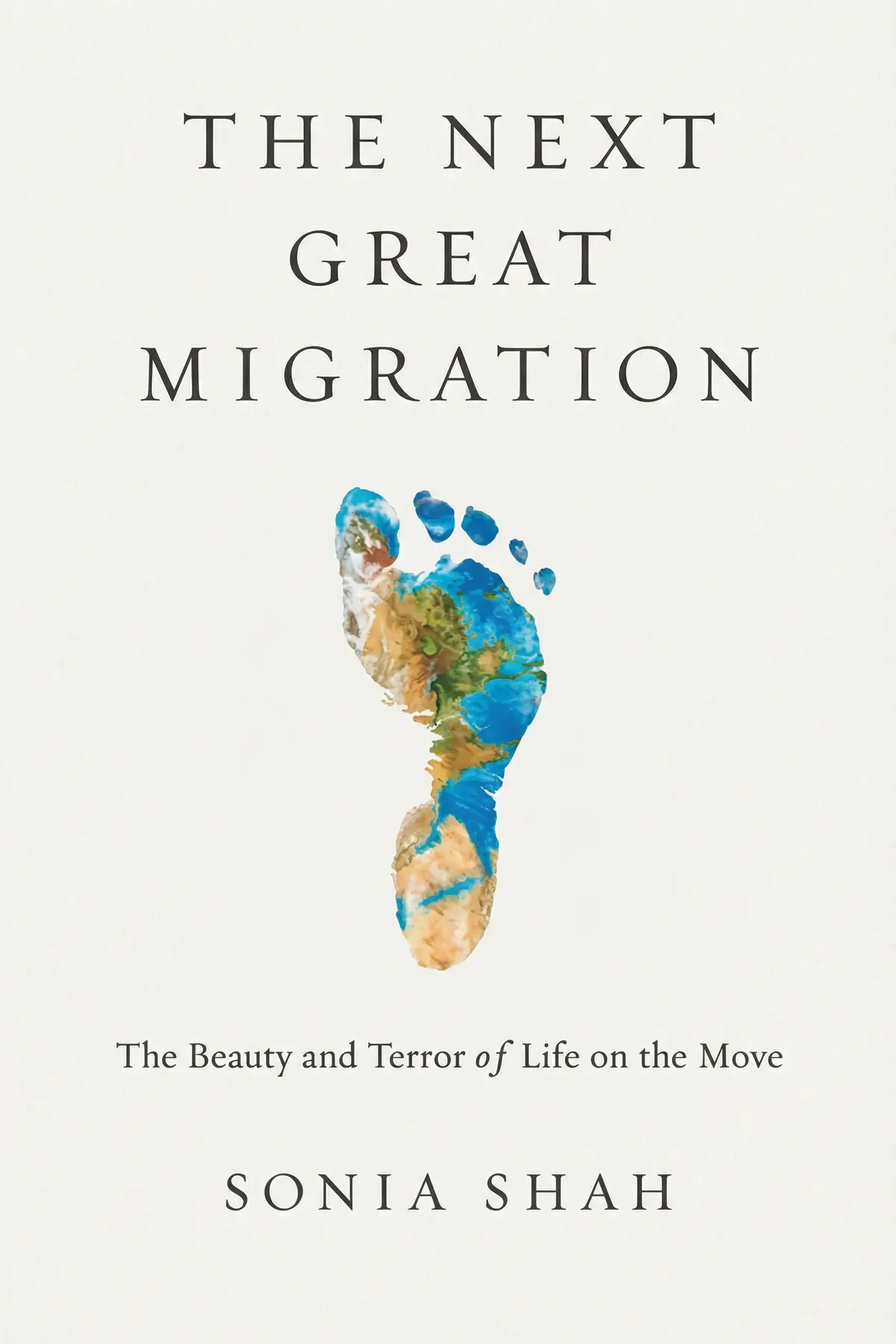
Table of Content
1. Introduction
1 min 05 sec
If headlines about migration leave you uneasy or unsure what to believe, Sonia Shah offers a longer view. In The Next Great Migration, the journalist shows that for centuries experts believed animals stayed put. That changed in 1941, when British radar picked up mysterious signals that turned out to be migrating starlings. Shah argues that the same false picture of a still, sorted world also shaped how scientists and politicians saw human beings.
Her throughline has three parts. Movement is the normal condition of life. Fear of migrants was built on bad science and false stories. The real task is making migration safe. The evidence runs from an eighteenth-century Swedish botanist and two New York eugenicists to a doomed reindeer herd, a burning German church and a hard bone behind the ear. Each episode leaves you a question to ask the next time someone calls newcomers a threat.
2. Treat movement as nature's normal setting
1 min 48 sec
British officers in 1941 watched a vast formation cross their radar screens, found nothing in the sky, and decided they were seeing ghosts. The real explanation overturned centuries of thinking about how living things behave.
3. Trace the idea of separate races to its root
1 min 45 sec
A devout botanist faced a dilemma he could not solve with his Bible or his catalog. The answer he printed in a single edition of his famous book handed empires a convenient excuse.
4. Spot fear dressed up as science
1 min 48 sec
Two wealthy New Yorkers felt their city slipping away from them. With a museum exhibit, an influential book and a president’s signature, they helped turn private resentment into national law.
5. Stop treating every newcomer species as an invader
1 min 49 sec
A yeast experiment in a test tube convinced scientists that newcomers always destroy the natives. Decades later, botanists hacking at a Hawaiian forest discovered what the test tube had left out.
6. See through panic about too many people
1 min 55 sec
Twenty-nine reindeer left on a remote island became thousands, then a field of bones. Scientists drew a lesson for humanity from it, and an entire country paid for that lesson.
7. Check the story before sharing the outrage
1 min 46 sec
Before long, the grief over a drowned child gave way to fury in Europe over assaults and a burning church. One reporter went back to the facts, and they pointed somewhere uncomfortable.
8. Humans are one restless, mixed family
1 min 44 sec
Genetics showed that any two people are almost identical, yet the belief in separate races survived the news. It took the hardest bone in the body to finally tell the real story.
9. Build safe paths instead of higher walls
1 min 51 sec
Grizzly bears in Canada cross busy highways without a scratch, thanks to a simple piece of design. Shah asks whether people fleeing danger could be given the same kind of passage.
10. Conclusion
1 min 14 sec
Shah’s book is about a picture in our heads. Linnaeus imagined a world where every creature stayed where it was found and every people grew up apart. Radar angels, a regrown Hawaiian forest and a hard bone behind the ear all say otherwise. Life moves, and always has. The harm came from believing it did not: eugenic immigration laws, forced sterilization in India, a church fire blamed on people celebrating peace.
The habits the book supports are small and portable. When a newcomer, human or plant, is labeled an invader, ask whether anyone measured the harm. When a frightening migrant story spreads, look for the normal rate and for someone who checked, as the NPR reporter did. When a forecast of overcrowding demands cruelty, recall that rising prosperity is what brought birth rates down.
And when the talk turns to walls, think of the officers watching those signals over the English Channel in 1941. They saw ghosts. A man who knew birds saw starlings, doing what living things have always done.
About this book
What is this book about?
For centuries, naturalists believed animals stayed where they were found. Migration, when anyone noticed it, looked like a sign that something had gone wrong. Sonia Shah argues that this false picture of a still, neatly sorted world shaped how people saw human beings too, and that it still shapes how many people react to migrants today. Shah follows the idea through a series of episodes. Carl Linnaeus divided humanity into subspecies. Two New York eugenicists helped close America's doors. Gardeners and scientists declared war on alien plants. A reindeer herd starved on a remote island and fed fears of overpopulation, which ended in forced sterilizations in India. In 2016, rumors about refugees in Germany spread before anyone checked them. Against all of this she sets the evidence: genetics showing that humans share 99.9 percent of their DNA, and ancient bones recording constant movement and mixing. Readers get a history of how fear of newcomers was built, a set of questions for testing frightening claims, and a concrete picture of what safe migration could look like, from wildlife bridges to softer borders.
Book Information
Who it's for
Unsettled by migration headlines
Readers unsettled by migration headlines who want the history behind them.
Students exploring scientific racism
Students of history, biology or politics curious how science was used to justify racism.
Professionals wanting safer migration
Professionals working with refugees, policy or international teams who want evidence for safer migration.
About the Author
Sonia Shah
Sonia Shah, born in New York City in 1969, writes about corporate power, global health and human rights. Her work has appeared in the New York Times, The New Yorker and Scientific American. The Next Great Migration was a finalist for the PEN/EO Wilson Prize, and her book Pandemic was a finalist for a Los Angeles Times Book Prize. She is a Guggenheim fellow, and more than a million people have watched her TED talk on malaria.
Ratings & Reviews
Ratings at a glance

What people think
Listeners find the writing to be skillful and the research thorough, noting how effectively the text establishes a basis for comprehending migration. It is considered a stimulating read, with one listener highlighting the remarkable depth it brings to such a multifaceted issue. Conversely, the political perspective yields conflicting opinions among listeners.
Top reviews
Jai
Finally, a book that challenges the 'invasive species' narrative with actual data and historical context. I was stunned to learn about the history of purple loosestrife and how much of our 'conservation' logic is actually rooted in old-school xenophobia. Shah’s deep dive into Carl Linnaeus and the early days of taxonomy was brilliant. She shows how these 18th-century ideas about 'fixed' locations for species still poison our thinking today. The book is dense, but the prose is so fluid that it never feels like a chore. The truth is, we live on a planet in constant motion. This book isn't just about people crossing borders; it’s about the fundamental way life survives through movement. It’s easily one of the most important nonfiction books I've read this year.
Show moreFatou
As someone who has always felt a bit of 'nativist' anxiety about changing neighborhoods, this book really shifted my worldview. It forced me to look at the long arc of history. We’ve been moving since the beginning of time! Shah’s prose is evocative and her arguments are backed by a surprising amount of historical detail that I had never encountered. The stories of refugees moving alongside migrating forests really highlight the scale of the transition we are entering. Not gonna lie, some of the facts about the US intelligence tests for immigrants were hard to stomach, but they were necessary to read. This book doesn't just provide information; it provides a much-needed dose of empathy. I’ll be thinking about this one for a long time.
Show moreDuangjai
Wow, I didn't expect to learn so much about the history of eugenics in a book about migration. The way Shah tracks the line from Linnaeus’s taxonomy to the horrors of the 20th century is masterful. She argues that our fear of the 'migrant' is a cultivated bias, not a natural instinct, and she uses both history and biology to prove it. The stories of individual species, from the humble coconut to the majestic wolf, serve as beautiful anchors for her larger points. In my experience, most books on this topic are either too dry or too emotional, but Shah strikes a perfect balance. It’s an urgent, necessary read for the era of climate change. We need to stop building walls and start understanding the flow of life. Truly a brilliant piece of work.
Show moreLook
Sonia Shah brings a remarkably fresh perspective to a topic that usually feels exhausted by the 24-hour news cycle. Instead of viewing migration as a modern crisis or a geopolitical failure, she frames it as a biological imperative, something as natural as breathing. The way she links the movement of humans to the migration of butterflies and plants is truly eye-opening. Personally, I found the section on how we’ve historically categorized 'native' versus 'invasive' species to be the most compelling part of the book. It really makes you question why we view change with such inherent suspicion. The writing is accessible, though the middle chapters drag a bit when the focus shifts heavily toward legislative history. Still, it's a thought-provoking read for anyone trying to understand the larger patterns of life on our changing planet.
Show moreAnchalee
The chapter on the Isla Royale wolves was absolutely fascinating and served as a perfect metaphor for the entire book. Seeing how the introduction of a single lone wolf saved an entire population from the defects of inbreeding was a powerful argument for the necessity of genetic flow. Shah argues convincingly that migration isn't the problem—it’s the solution to a changing environment. While I found the climate change predictions a bit repetitive toward the end, the historical sections on eugenics and intelligence testing at Ellis Island were incredibly well-researched. It’s a sobering look at how 'science' has been weaponized to keep people in their place. This is a must-read for anyone interested in ecology or social justice. It successfully bridges the gap between the two.
Show moreSau
Listening to the audiobook version was a great experience because the author’s narration is clear and engaging. She manages to take complex topics like genetic differentiation and make them sound like a narrative thriller. I especially appreciated the section on how 'invasive' species often provide ecological services we don't recognize because we are so focused on maintaining a static version of nature. My only real gripe is that the book feels a bit one-sided; it dismisses the legitimate anxieties of local populations as mere xenophobia without much dialogue. However, as a work of investigative journalism, it succeeds in making you rethink everything you thought you knew about borders. It’t a very timely piece of work.
Show moreClara
Pick this up if you're interested in how we categorize the world. Shah does a fantastic job of deconstructing the 'native' myth. She explains how our obsession with keeping things 'as they were' is actually a relatively new and scientifically flawed concept. The writing is sharp and the pacing is generally good, though it starts off a little sleepy in the first two chapters. Once she gets into the GPS tracking of animals and the modern movement of species, it really picks up. It’s a very challenging book in the best way possible. It asks us to accept a world that is fluid rather than fixed. Even if you don't agree with every political conclusion she draws, the ecological data is hard to ignore.
Show moreWatcharaporn
Wait, is this a science book or a political manifesto? I picked this up because the title promised a look at how plants and animals are shifting due to climate change, but the focus is overwhelmingly on human immigration policy. To be fair, Shah makes some interesting points about the 'migrant formula,' but I felt she often conflated animal instincts with complex human social structures. Comparing a bird's seasonal flight to a refugee's flight from war feels like a reach that ignores the role of human agency and territorial affinity. The book is well-written, but the 'pop science' feel was a bit much for me. I would have preferred more citations from peer-reviewed journals rather than news articles and op-eds. It’s an okay overview, but it lacks the scientific rigor I was expecting.
Show morePawinee
To be fair, Shah is a gifted writer, but the research felt a bit thin in places compared to other books on this topic. I was really looking forward to a deep dive into the biology of migration, but the book spends more time on the history of eugenics and the prejudices of early naturalists. Those parts are important, don't get me wrong, but they felt like they belonged in a different book. The 'Next' part of the title is also a bit misleading. There isn't as much foresight into the future of migration as I had hoped for. It’s more of a history of why we hate migrants than a projection of what’s to come. It's a solid 3-star read: good, but not quite what the cover promised.
Show moreSupachai
Look, I wanted to love this because the premise of biology meeting sociology is fascinating, but it quickly devolved into a political screed against recent administration policies. Rather than focusing on the science of movement, the author spends a significant portion of the book rehashing talking points about modern immigration laws that I’ve heard a thousand times before. It felt less like an objective investigation and more like a partisan lecture. Frankly, it didn't change my mind on anything because it lacked the nuance required for such a polarized topic. If you're looking for a deep dive into the 'next' migration, you won't find much new here besides the usual rhetoric. It was a major disappointment considering the potential of the subject matter.
Show moreQuestions about this book
What is The Next Great Migration by Sonia Shah about?
Shah argues that migration is the normal state of life for animals and humans alike, and that fear of migrants grew out of mistaken science and false stories. She traces that fear from Linnaeus’s human subspecies through American eugenics, campaigns against alien plants and population panic. She then sets it against genetic evidence that humans are 99.9 percent the same and have always mixed, and closes with a case for safe, legal migration.
What does DNA show about human migration, according to Shah?
The Human Genome Project found that any two people differ in only 0.1 percent of their DNA. Ancient DNA preserved in the petrous bone, the hard bone around the inner ear, showed that early people moved constantly. Some left Africa for Eurasia and the Americas and later returned. Shah concludes that features like skin color are adaptations to place, and suggests we could be called Homo migratio.
Why does Shah say fears about overpopulation were harmful?
Malthus argued that helping the poor would cause famine. A reindeer herd that boomed and then died out on St. Matthew Island revived that fear among biologists. Paul Ehrlich’s The Population Bomb urged sterilization in India, and a 1975 policy there led to more than two hundred deaths. Shah notes that both men were wrong: when poor people become prosperous, birth rates fall.
How can I apply the ideas in The Next Great Migration?
The book offers a few tests. When a newcomer, human or plant, is called an invader, ask whether the harm was measured or just assumed. When a shocking migrant story spreads, check the normal rate and whether anyone verified it, as an NPR reporter did with the 2016 German reports. When you judge a policy, ask whether it makes migration safer or more dangerous.
Who should read The Next Great Migration?
It suits readers who feel uneasy about migration debates and want the history behind them. Students of biology, history or politics will see how science was used to justify racism and border controls. People who work with refugees or on policy get examples of safer movement, from Canada’s wildlife bridges to a United Nations agreement on legal migration routes.
Readers also enjoyed
A Planet of Viruses
Carl Zimmer


A Short History of Nearly Everything
Bill Bryson

A Room of One’s Own
Virginia Woolf

A Thousand Brains: A New Theory of Intelligence
Jeff Hawkins

Abolish Rent: How Tenants Can End the Housing Crisis
Tracy Rosenthal


Abortion: Our Bodies, Their Lies, and the Truths We Use to
Jessica Valenti


AUDIO SUMMARY AVAILABLE
Listen to The Next Great Migration in 15 minutes
Get the key ideas from The Next Great Migration by Sonia Shah, plus 5,000+ more nonfiction titles.
- 5,000+ titles
- Listen as much as you want
- 7-day free trial
- Cancel anytime









