
14 min 31 sec
Available in: English
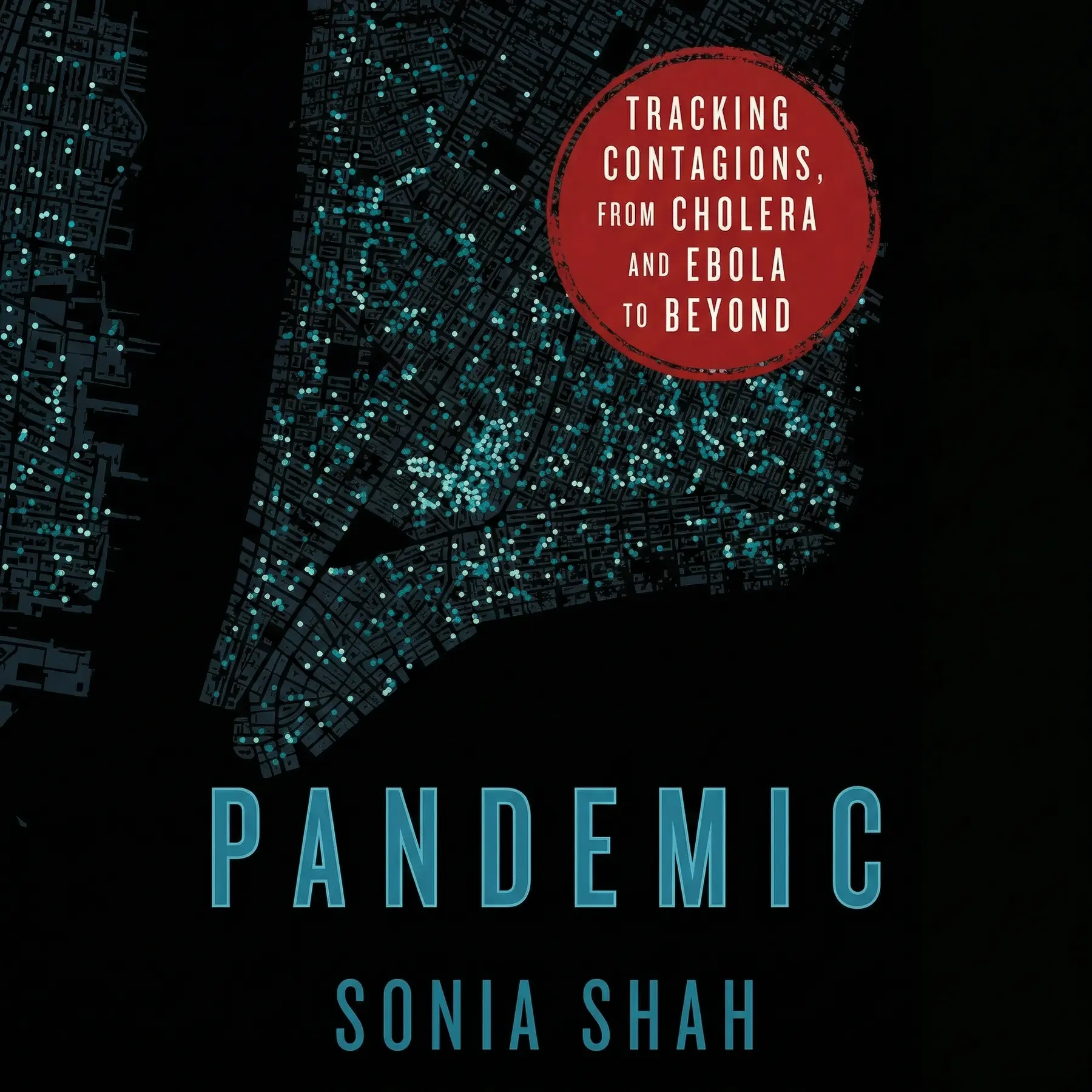
Pandemic: Tracking Contagions, from Cholera to Ebola and Beyond
By Sonia Shah
Sonia Shah traces cholera, SARS and Ebola back to human choices: cleared land, fast travel, crowded cities, filthy water, political lies and medical dogma. Knowing those choices shows where the next outbreak could come from.
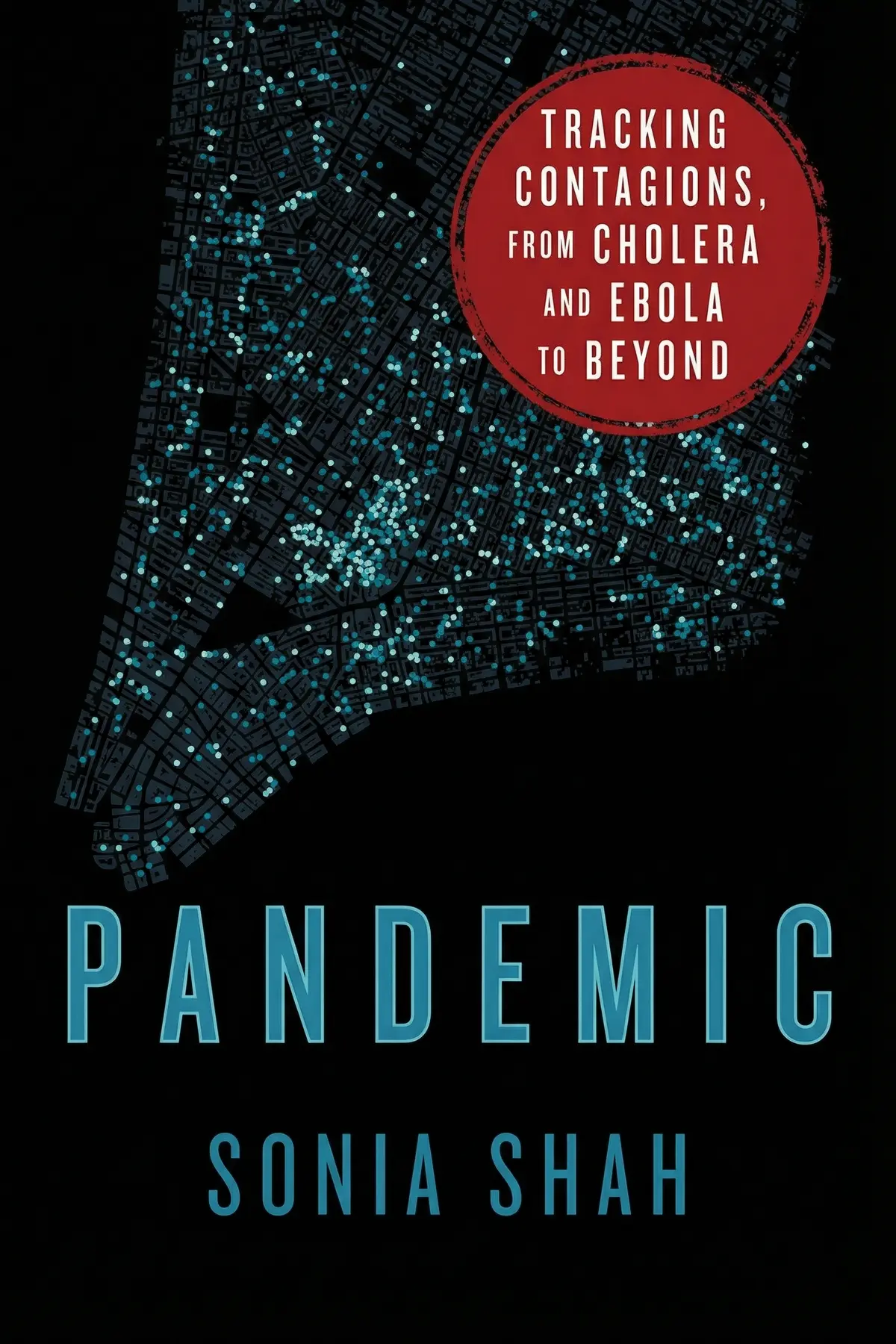
Table of Content
1. Introduction
1 min 01 sec
Most people picture a pandemic as nature striking at random, something modern medicine has turned into a history lesson. In Pandemic, Sonia Shah, a writer on global health, argues that the germs that sweep the world are usually invited in by the way people live. Cholera became a human disease only after a trading company cleared a mangrove forest, and SARS reached five continents in a single day by riding airplanes.
Shah follows contagions from cholera to Ebola and keeps finding the same human ingredients. They are the land we clear, the routes we travel, the crowds we pack, the waste we mishandle, the truths we hide and the ideas we refuse to drop. Knowing those ingredients turns a vague dread into something you can read and judge. After this, an outbreak headline becomes a set of conditions you can recognize, and you will know where your own worry belongs.
2. See where new diseases really come from
1 min 40 sec
Mughal emperors refused to settle a certain forest, calling it an evil place. Centuries later, a trading company moved in, and the bacteria waiting there found a new home that has troubled the world ever since.
3. Learn how a germ crosses five continents in a day
1 min 41 sec
One doctor checked into a hotel. Within hours, a flight attendant, a physician bound for New York and travelers to three more countries were carrying the same unknown illness, and nobody yet knew what it was.
4. Spot the three ways crowds help germs win
1 min 50 sec
Ebola outbreaks used to fade within a few months. In 2014 one kept growing for ten months and longer. The difference had little to do with the virus and a great deal to do with where it landed.
5. Follow the waste to find the next outbreak
1 min 52 sec
Old New Yorkers swallowed something every day that no one today would knowingly touch. The problem looks long solved in western countries, yet contaminated sprouts eaten in Germany showed it has simply moved somewhere less visible.
6. See how lies and secrecy let outbreaks grow
1 min 55 sec
A famous American politician raised two million dollars for clean water and spent most of it on something else entirely. The city paid for half a century, and he went on to one of the highest offices in the land.
7. Look past the single cause and the old rule
1 min 41 sec
A doctor tested a simple cholera treatment on over 200 prisoners and nearly all of them lived. The leading physicians of his day still refused to use it, and their reason sounds strange until you notice its modern version.
8. Put your fear where the real risk lives
1 min 42 sec
A teacher was quarantined for attending a conference ten miles from an Ebola patient. Meanwhile, a disease infecting hundreds of thousands of people a year barely made anyone check their ankles.
9. Conclusion
1 min 09 sec
Shah’s book turns the usual picture of disease around. The danger is rarely a monster germ appearing from nowhere. It is a chain of human decisions: a mangrove forest cleared for rice, a hotel guest boarding a plane, a slum six times denser than a modern city, a pool of manure, a bank dressed up as a waterworks, a theory about bad air, a public frightened of the wrong thing. Each gave a microbe a chance it would not otherwise have had.
That makes the next pandemic, which many epidemiologists expect, partly a question of how we behave. When you read of forests cleared, wild animals crowded into markets or a government silencing its doctors, treat it as an early warning, and support the open reporting that lets health officials step in. If your work sits beside another field, share what you see. And size your own worry to the numbers, starting with the tick on your ankle before the virus on the evening news.
Germs have always traveled the roads we built for them. The useful question is which roads we are still building.
About this book
What is this book about?
Many epidemiologists expect another global pandemic, yet most of us picture outbreaks as bad luck from nature that modern medicine has mostly tamed. Sonia Shah argues that germs spread mainly because of how people live, and that the same human ingredients appear in outbreak after outbreak. She follows cholera from a mangrove forest cleared for rice to the sewage-soaked streets of old New York, and SARS from a crowded wet market in Guangzhou to five continents in a single day. Along the way she shows how crowded slums make germs faster and deadlier. She traces how a politician's bank scheme left a city drinking contaminated water for half a century, and how a government's secrecy kept health investigators away. She also shows how loyalty to an old medical theory let patients die who could have been saved. Readers get a clear way to look at any outbreak in the news: who cleared the land, which routes the germ is riding, how crowded and clean the places it reaches are, and whether leaders and experts are telling the truth. Shah also asks readers to match their fears to real risks, including diseases that are already close to home.
Book Information
Who it's for
Curious how pandemics start
Curious readers who want to understand where pandemics come from and how they spread.
Needing outbreak risks explained
Professionals in health, policy or food supply who need a clear map of outbreak risks.
Unsettled by outbreak news
Anyone unsettled by outbreak news who wants to judge real risks calmly.
About the Author
Sonia Shah
Sonia Shah was born in New York City in 1969 and writes about global health, corporate power and human rights. Her work has appeared in the New York Times, The New Yorker and Scientific American. Pandemic was a finalist for a Los Angeles Times Book Prize in Science/Technology, and her earlier book The Fever was long-listed for the Royal Society's Winton Prize. She is a Guggenheim fellow, and her TED talk on malaria has been viewed more than a million times.
Ratings & Reviews
Ratings at a glance
What people think
Listeners find this work as absorbing as a mystery novel, rich with intriguing scientific facts and historical context. They admire the high quality of the writing and the book's historical accuracy, with one listener contributing an in-depth analysis of cholera outbreaks. The educational value is highly regarded; one review praises the clear explanation of water-borne disease epidemiology, and another highlights the connection made between sociology and epidemiology. Listeners also appreciate the political insights, particularly one mention of how it examines the global economy and cholera.
Top reviews
Por
Shah writes with the pacing of a seasoned thriller novelist, making a history of microbes feel like a high-stakes detective story. Instead of dry data, we get a narrative that links 19th-century New York filth to modern-day wet markets in China. Her investigation into the 'locomotion' of pathogens is particularly gripping, showing how our globalized world is essentially a giant petri dish. The way she connects the dots between political corruption and public health failures feels incredibly relevant today. I loved the blend of investigative journalism and hard science, though some sections on evolutionary psychology felt a bit speculative. Still, for anyone interested in why the world keeps getting hit with new viruses, this is an essential primer. It’s both a haunting history and a necessary warning for the future.
Show morePetch
Picked this up during the height of the recent pandemic and found it incredibly prescient. Shah manages to turn the grim reality of zoonotic spillover into something that reads like a mystery novel. The details about bats being 'hollow tubed disease incubators' because of their immune systems were fascinating and gross in equal measure. She doesn't pull any punches when describing the wet markets in Guangzhou or the crowded tenements of the past. Sentence by sentence, the book builds a convincing argument that we are our own worst enemies when it comes to disease prevention. Some of the talk about 'sexy sons' and David Buss style psych was a bit of a detour, but it didn't ruin the experience. It’s a sobering look at how vulnerable we really are. If you enjoy history mixed with hard-hitting journalism, this is it.
Show moreKung
Wow. This was a masterclass in narrative non-fiction. Shah takes the complex world of epidemiology and makes it feel deeply personal and urgent. The way she describes 'locomotion'—the physical movement of people and goods—as a primary engine for pandemics is brilliant. We often think of diseases as things that just 'happen,' but she proves they are the result of specific human choices and environmental shifts. The sections on the 19th-century cholera outbreaks were so vivid I could almost smell the stagnant water. It’s a heavy read, but the prose is so fluid that it never feels like a chore. I appreciated the 'One Health' perspective, emphasizing that we can't be healthy if our ecosystems are failing. This should be required reading for anyone in public policy. A truly stellar piece of reporting.
Show moreSurasit
As someone who usually finds science books dry, I was pleasantly surprised by how much this felt like a thriller. Shah tracks the 'biography' of cholera with such intensity that you start to view the bacterium as a living, breathing antagonist. The book is incredibly accurate in its historical details, particularly regarding the early industrial revolution and its impact on public health. I was struck by the discussion on how 'superbugs' are cultivated through antibiotic misuse and medical tourism. It’s a political book as much as a scientific one, exposing the cracks in our global response systems. Some of the evolutionary psychology bits felt a little like 'just-so' stories, which slowed the momentum slightly. Regardless, the overall message is powerful and timely. It’s a thoughtful exploration of how our past failures are paving the road for future outbreaks.
Show moreAndrei
The deep dive into cholera was eye-opening, especially the way Shah tracks its seven major pandemics across centuries. Truth is, I never realized how much of our modern infrastructure was shaped by a fear of 'miasmas' and contaminated water. The section on the Manhattan Company’s role in poisoning New York City was a standout for me, blending corporate greed with epidemiological disaster. While the book leans heavily on cholera—sometimes to the exclusion of airborne threats like the Spanish Flu—it serves as a fantastic case study. The writing is punchy and accessible, perfect for non-scientists. I did find the personal stories about her son’s MRSA infection a little distracting from the broader global scope, but they did ground the science in a visceral way. It’s a solid 4-star read for history buffs.
Show moreThawee
Ever wonder why fungal infections aren't a bigger threat yet? Shah explores this with terrifying clarity, linking our warming planet to the potential for new, heat-resistant pathogens to breach our natural defenses. It’s a chilling thought. The book excels when it moves beyond the lab and into the streets, examining how our modern lifestyle—from monoculture farming to international 'medical tourism'—invites disaster. I found the chapter on 'corruption' particularly biting, especially regarding how private donors influence global health policy. Her prose is sharp, making even the most complex epidemiological concepts easy to grasp for a layman. It’s not just a book about germs; it’s a book about how we live now. Highly recommended for those who want to understand the 'One Health' movement.
Show moreDylan
After hearing so much about it, I finally delved into this study of human contagion. The connection Shah draws between the Bantu expansion and malaria resistance was a highlight for me. It’s rare to find a book that treats immunology as a legitimate driver of human history and culture. She avoids the 'alarmist' trap while still conveying the urgency of our current situation. I particularly liked the analysis of how our sense of 'disgust' is a biological tool that we’ve often ignored in the name of progress. The book is well-researched, though I agree with other reviewers that it could use more focus on respiratory viruses. Still, the insights into how the WHO operates are worth the price of admission alone. It’s an intelligent, if slightly lopsided, look at the pathogens that shape our world.
Show moreChanon
Finally got around to this, and it’s a fascinating, if somewhat lopsided, history. In my experience, Shah’s focus on cholera provides a brilliant framework for understanding how pathogens exploit human infrastructure. However, I was hoping for more on the Spanish Flu or modern respiratory threats. The strength of the book lies in its sociological insights. She explains how our cultural behaviors are often just 'immune behaviors' in disguise. It’s a compelling way to view the world. The writing is top-notch—sharp, clear, and occasionally poetic. I did find her dismissal of certain scientific paradigms a bit rushed, and the personal family story didn't quite land for me. Despite those minor gripes, it’s a very informative read. It definitely makes you want to wash your hands every five minutes. A solid addition to any science lover's shelf.
Show moreLaddawan
While the historical context is robust, I found the scientific explanations a bit lacking compared to David Quammen’s work. Shah is clearly a talented journalist, but she sometimes accepts psychological or evolutionary studies without much skepticism. Her focus on the 'sexy sons' hypothesis felt out of place in a book about global contagion. To be fair, the historical chapters on John Snow and the London sewer systems are masterfully written. She does a great job illustrating how 'crowds' and 'filth' act as accelerators for disease. If you want a deep dive into the biology of viruses, look elsewhere. But if you want to understand the sociology and politics behind why pandemics happen, this is quite good. It’s just not as 'scientifically literate' as I had hoped.
Show morePla
Not what I expected, and frankly, I was disappointed by the lack of balance in the diseases covered. It felt like the book should have been titled 'A History of Cholera' rather than 'Pandemic.' Shah spends so much time on one specific bacterium that other major threats feel like footnotes. Look, the writing is decent, but I struggled with her reliance on older scientific paradigms that have since been challenged. The personal anecdotes about her family's struggle with MRSA felt like filler and didn't really mesh with the investigative tone of the rest of the chapters. I appreciate the effort to highlight the WHO's funding issues, but the overall execution was too disjointed for my taste. It was an okay read, but far from the definitive guide I was looking for.
Show moreQuestions about this book
What is the main idea of Pandemic by Sonia Shah?
Shah argues that pandemics grow out of human choices rather than pure chance. Clearing wild land lets animal germs adapt to people, transport carries them across the world, crowded cities make them faster and deadlier, and poor waste handling spreads them. Political secrecy and rigid medical thinking then let outbreaks run unchecked. Understanding these conditions, she says, is how societies can prepare for the next pandemic that many epidemiologists expect.
How did cholera become a human disease according to Pandemic?
Shah traces it to the Sundarbans, a mangrove forest in Bangladesh and India where copepods carried cholera germs. After the East India Company began clearing it for rice around 1760, people settled 90 percent of the area and bathed and worked in infected water. That constant exposure let the bacteria adapt, growing small tails that helped them form a sticky film and colonize the human gut.
Why do crowded cities make pandemics worse?
Shah names three reasons. Germs spread faster because people touch and meet more often. Epidemics last longer because there are more people to infect, as the 2014 Ebola outbreak showed when infections kept rising ten months in, while earlier outbreaks in smaller cities ended within months. And germs can afford to be more aggressive, since a quick new victim is always nearby.
What does Aaron Burr have to do with cholera?
In the late 1700s, Burr blocked a planned $200,000 waterworks for Manhattan and promoted his own water company, mainly as cover for founding a bank. He raised $2 million but spent only $172,261 on the water system. The city drank contaminated water for more than 50 years, and Shah connects this to the 1832 and 1849 cholera outbreaks.
How can I apply the lessons of Pandemic?
Treat news of cleared forests, crowded animal markets or governments hiding outbreak data as warning signs, and value open reporting as a health measure. In your own work, consult neighboring fields, since doctors missed Ebola’s spread in apes partly because they rarely talked to veterinarians. And match your fears to real numbers: Lyme disease infects almost 300,000 Americans a year, yet few people protect themselves from ticks.
Readers also enjoyed

A Planet of Viruses
Carl Zimmer

A Biography of Loneliness: The History of an Emotion
Fay Bound Alberti

Alexander Hamilton
Ron Chernow

A Short History of Nearly Everything
Bill Bryson

Alexander the Great
Philip Freeman

A Thousand Brains: A New Theory of Intelligence
Jeff Hawkins



A History of Iran: Empire of the Mind
Michael Axworthy
AUDIO SUMMARY AVAILABLE
Listen to Pandemic in 15 minutes
Get the key ideas from Pandemic by Sonia Shah, plus 5,000+ more nonfiction titles.
- 5,000+ titles
- Listen as much as you want
- 7-day free trial
- Cancel anytime









