

11 min 17 sec
Available in: English
The Myth of Multitasking: How “Doing-It-All” Gets Nothing Done
Shows that multitasking is really rapid switching between tasks, explains why every switch wastes time, and gives simple tools for protecting your focus at work and your attention at home.
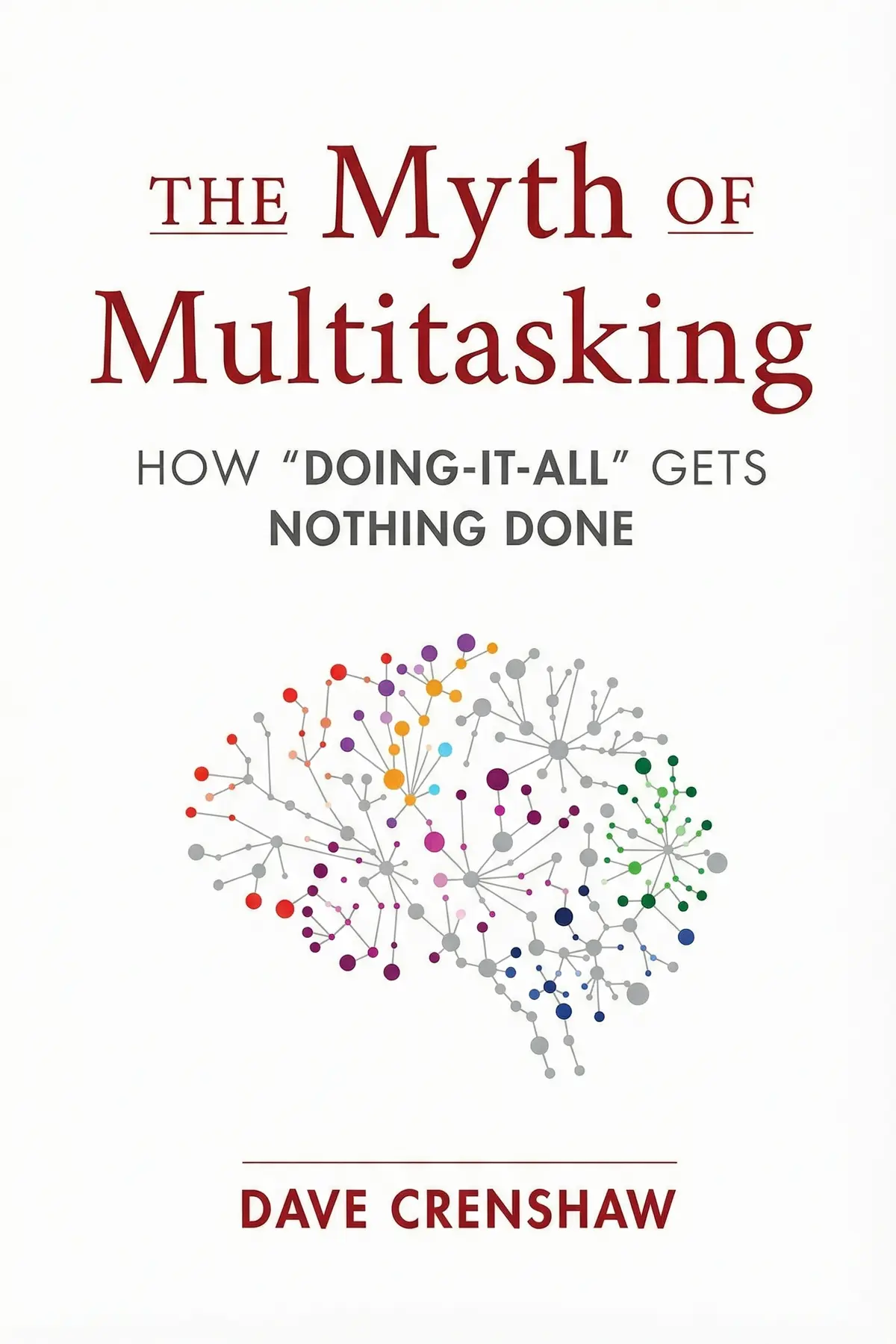
Table of Content
1. Introduction
1 min 04 sec
If your day feels busy but your work moves slowly, the problem may be the habit you are proudest of. In The Myth of Multitasking, small business and time management expert Dave Crenshaw argues that nobody actually does two things at once. The brain only jumps from one task to another, and every jump costs time. Crenshaw has a better name for it: switchtasking.
That one idea changes how the whole working day looks. Once you treat each glance at email during a phone call as a small tax, the fixes are practical. Give colleagues a set time to reach you. Count where your 168 weekly hours really go. Let your team copy a calmer way of working instead of being ordered into it. Crenshaw tells much of this through Helen, the CEO of a clothing company, who found that the evenings she counted as family time often went to email. Use his tools and you spend fewer hours getting more done, and you are actually present for the people and work you care about.
2. Spot the switching your brain hides from you
1 min 56 sec
Juggling a dozen tabs, chats and calls feels like a skill worth putting on a resume. Brain research tells a different story, and once you see what is really happening, every busy hour looks a little different.
3. Stop interruptions from eating your valuable time
1 min 49 sec
A CEO tries to finish an email while answering her assistant’s question, and both tasks suffer. A simple pen-and-paper test makes the hidden price of that moment clear to see.
4. Give people a set time to reach you
1 min 41 sec
Colleagues who keep knocking on your door are usually not being rude. They are reacting to one missing piece of information, and supplying it can empty your day of interruptions without making you any harder to reach.
5. Count where your 168 weekly hours really go
1 min 52 sec
A successful CEO added up her weekly hours and got a total that cannot exist. Finding the mistake hurt, because it showed her where switching had been costing her most, and it was not at the office.
6. Change your team by working this way first
1 min 43 sec
Your first instinct may be to call a meeting and ban switchtasking. Crenshaw thinks that is the slowest way to change a team, and he describes another approach that leaves people adopting the habit as their own idea.
7. Conclusion
1 min 12 sec
Crenshaw’s book rests on one stubborn fact: attention moves one task at a time. Everything else follows from taking that fact seriously. A screen full of tabs, a CEO typing while her assistant talks, an evening split between children and email all look efficient. Each turns out to be the same thing, a series of switches that each charge a fee.
The way out is structure. Catch your own active switches, like the inbox you open in the middle of a call, and stop starting them. Decide when people can reach you, so their questions wait for a known time and your work gets long stretches without interruption. Write down where your week really goes, and if the total is more than 168, find the hours you have been counting twice. Then protect the hours that matter in a budget before the week fills up on its own. If you lead others, show the method before you ask for it.
If anyone doubts the premise, hand them a pen and a timer and ask them to write one short sentence both ways. Helen’s 190 hours came from living in two places at once, and the fix starts with choosing one.
About this book
What is this book about?
Many professionals are proud of juggling email, calls, chat and colleagues all at once. Dave Crenshaw argues that this juggling is a myth. The brain cannot work on two tasks at the same moment. It switches between them, and each switch costs the time it takes to refocus. He calls the habit switchtasking and separates the switches you choose from the ones other people force on you. Most of the book follows Helen, the CEO of a clothing company whose days are broken up by interruptions. Through her, Crenshaw shows how to cut the switches other people cause: standing meetings, posted office hours and a voicemail greeting that tells callers when you will listen. Helen also adds up her week and gets 190 hours, which shows her that she overestimated her family time, since she was often still working at home. Readers get a short, practical method. Make yourself available at predictable times, write down where your hours really go, and budget them ahead. If you lead a team, show the method in your own work and let people adopt it because they see it working.
Book Information
Who it's for
Workers juggling every inbox
Professionals who feel busy all day but finish little, and who keep email, chat and calls open at once.
Interrupted managers and founders
Managers and founders whose door never stops opening and who want focused hours back.
Working parents replying evenings
Parents who are home in the evening but still answering work messages.
About the Author
Dave Crenshaw
Dave Crenshaw, born in 1975, is an American author and public speaker who specializes in time management and small business. He works with leaders at large companies, universities and other organizations to help them become more productive, and his online courses on LinkedIn Learning have been viewed tens of millions of times. He has written five books, published in eight languages, and some universities have used his work in their teaching.
Ratings & Reviews
Ratings at a glance
What people think
Listeners describe this work as a revelation and a quick read that can be finished in only a few hours. They value the useful efficiency strategies and approachable storytelling, while one listener points out how the concepts are relevant to every part of life. The text boosts output using straightforward techniques, and one listener mentions reclaiming an incredible amount of time. Listeners consider the content highly influential, with one individual even characterizing it as life-altering.
Top reviews
Pia
Picked this up during a particularly chaotic week at the office, and it was exactly the wake-up call I needed. The core concept—that multitasking is actually just 'switchtasking'—hit me like a ton of bricks because I realized how much time I lose just recalibrating between emails and projects. Dave Crenshaw uses a simple narrative about a consultant named Phil and a stressed CEO named Helen to illustrate his points, which makes the information incredibly digestible. While the dialogue is a bit scripted, the exercise where you time yourself writing letters and numbers is a game-changer that proves the efficiency drain. I finished the whole thing in about an hour and immediately started blocking my time to avoid interruptions. My productivity has genuinely improved because I stopped trying to do everything at once and started focusing on one task at a time. It's a short read, but the impact on your daily workflow is massive.
Show moreSurasit
As someone who prides themselves on being a high-level juggler, this book was a painful but necessary reality check for my ego. The truth is, I wasn't being efficient; I was being rude to my family and slow at my job. Crenshaw points out that multitasking is often just a polite way of telling someone you aren't listening to a word they say. That hit home for me, especially regarding how I use my phone during conversations. The book is written as a parable, which makes the concepts stick much better than a dry textbook would. I found the advice on being intentional with availability to be life-altering for my stress levels. If you feel like there aren't enough hours in the day, stop what you're doing and read this. It’s a tiny investment of time for a massive return in focus and relationship quality.
Show moreSue
Look, the dialogue between Phil and Helen is incredibly cheesy and feels like a bad corporate training video from the nineties. However, I’m giving this five stars because the actual message changed how I operate my business on a daily basis. I used to think I was a master of multitasking, but after doing the exercises in this book, I realized I was losing hours every week to 'switching costs.' The realization that multitasking is literally impossible for the human brain was the shift I needed to stop the madness. My stress has plummeted since I started focusing on single-tasking and setting boundaries with my time. It’s a very fast read, which is perfect because if you’re the target audience, you probably don't have time for a 400-page tome anyway. It is simple, effective, and provides a clear path toward reclaiming your focus and your life.
Show moreKanchana
Ever wonder why you feel completely exhausted at 5:00 PM but realize you haven’t actually finished a single major project? This book explains that phenomenon perfectly by breaking down the 'myth' of doing it all simultaneously. I loved the practical distinction between background tasking, like listening to music while cleaning, and switchtasking, which is the toxic habit of toggling between two things that require mental focus. The 1-27 exercise mentioned in the text is eye-opening and provides immediate, undeniable proof that our brains aren't wired for dual-processing. Although the fictional framework is a little bit patronizing at times, the brevity of the book is a major plus for busy professionals. It doesn't respect your time by being long; it respects your time by being fast and actionable. I’ve already recommended it to several colleagues who are constantly 'juggling' too many balls.
Show moreSomsri
Wow, I managed to finish this in less than two hours and the ROI is already looking pretty great for my weekly schedule. The book is structured as a conversation, which some people might find annoying, but I thought it made the productivity tips feel more applicable to real-life scenarios. I specifically appreciated the section on how switchtasking damages personal relationships, not just business output. We often forget that giving someone 'piecemeal time' is actually a form of disrespect that costs more than just the minutes involved. While the writing is a bit simplistic and the CEO character is a total caricature, the diagnostic exercises are genuinely effective at proving the author's point. It’s a great 'reset' book for anyone feeling overwhelmed by the constant barrage of notifications and pings. I’m definitely going to stop committing to things without having my calendar physically in my hand from now on.
Show moreNong
Finally got around to reading this after hearing about the '1-27' exercise for years, and I’m glad I did. It’s a simple, straightforward guide that dismantles the idea that we can do two focus-heavy things at once. Personally, I found the advice on limiting availability to be the most helpful part for my current role. We live in a culture that demands instant responses, but this book gives you the permission to focus on one thing until it's done. The writing style is definitely geared toward people who don't usually like reading business books, as it's very conversational and moves quickly. It might be a bit too basic for productivity junkies, but for the average person drowning in emails, it’s a goldmine. It really highlights how 'doing it all' usually results in getting nothing done well. I’m giving it four stars for the practical exercises.
Show moreTar
To be fair, the core message here is undeniably important for our digital age, even if the delivery feels a bit dated. The author argues that multitasking is a lie and that we actually lose time every time we switch our attention. It’s a very quick read, taking maybe ninety minutes if you really take your time with the exercises at the back. My main gripe is that the fictional CEO, Helen, is written as if she’s never encountered a calendar or a clock before in her life. It makes the 'consultant' character look like a genius for stating the obvious, which felt a little manipulative as a reader. However, the Russian proverb about chasing two rabbits and catching neither really stuck with me. It’s a solid 3-star book—useful for the tips and the diagnostic tests, but the narrative style is definitely an acquired taste that I didn't quite enjoy.
Show moreSawit
The distinction between background tasking and switchtasking is the most valuable part of this entire book, but the rest feels like filler. I struggle with the 'business parable' format because the characters never feel like real people with real problems. Helen is the lowest-IQ executive I've ever encountered in literature, making the 'wisdom' Phil provides seem much more profound than it actually is. That said, the science mentioned regarding how the brain handles transitions is fascinating, even if it’s only touched upon briefly. It’s a decent book for a plane ride or a quick lunch break because you can finish it so fast. You’ll walk away with two or three solid time-management tips, which is probably worth the price of admission. Just don't expect a deep dive into psychology; it's a very surface-level look at focus and efficiency.
Show moreWan
It’s hard to take business advice seriously when it’s delivered through a dialogue with the world's most oblivious executive, but there is some gold here. The book is barely 140 pages with large font, so it’s more of a long essay than a traditional book. I think Dave Crenshaw makes a vital point about how we deceive ourselves into thinking we are being productive when we are actually just being busy. The concept of 'switchtasking' is a great term for what most of us do all day. I liked the focus on how this behavior ruins relationships by making people feel unheard. Still, I wish there was more meat on the bones of this narrative. It feels like it was written for a very specific type of person who needs everything spelled out in a story format. It’s a helpful reminder to slow down, but it’s definitely not a deep scholarly work.
Show moreGin
This book is essentially a ten-page white paper stretched into a 130-page fictional narrative through the most unnecessary padding I have ever encountered. The author uses a gimmick where a productivity coach explains basic concepts to a CEO who seems to have the cognitive functioning of a toddler. Frankly, if you need a hundred pages of cheesy dialogue to understand that distractions are bad for your focus, then this might be for you. I was hoping for deep neurological insights, but instead, I got a 'story' that could have been summarized in a single paragraph. To be fair, the distinction between background tasking and switchtasking is a helpful framework, but it doesn't justify the price of a full book. You are better off reading a summary online and saving yourself the hour of reading through this forced, unrealistic conversation between Phil and Helen.
Show moreQuestions about this book
What is the main idea of The Myth of Multitasking?
Dave Crenshaw argues that multitasking does not exist. Citing a Vanderbilt University study, he says the brain cannot work on two tasks at once. It only switches between them quickly. He calls this switchtasking, and every switch costs the time needed to refocus, so trying to do everything at once means spending more time to get less done.
What is the difference between active and passive switchtasking?
Active switches are ones you start yourself, like checking email while on a phone call. Passive switches are started by someone or something else, like a coworker who stops by to chat while you are preparing documents for a deadline. Crenshaw separates them by who starts the switch, you or someone else, and his remedies, such as scheduled meetings and office hours, aim at cutting down interruptions.
How do you reduce interruptions at work according to Dave Crenshaw?
Make yourself available at predictable times. Set up regular meetings with the people who need you most, so they save their questions for those meetings. Post open office hours on your door and email them to everyone. Record a voicemail greeting that tells callers when you check messages. Helen’s daily 10:00 meeting with her assistant ended about a dozen knocks on her door each day.
What is the pen and paper multitasking test?
Start a timer, then copy out the sentence Multitasking is really switchtasking, placing a number beneath each letter as you write it: letter, number, next letter. Then do it again, writing the full sentence first and all the numbers afterward. Crenshaw says the second way is always faster, which shows that doing one thing at a time beats switching back and forth.
How can a manager get a team to stop multitasking?
Crenshaw advises against simply ordering it. Because multitasking has been admired for so long, changing the habit is a process. Build your own system first, with standing meetings, office hours and a time budget. When employees see that you are reliable, consistent and still easy to reach, they tend to copy the approach, and a habit they choose sticks better.
Featured in
Readers also enjoyed



AUDIO SUMMARY AVAILABLE
Listen to The Myth of Multitasking in 15 minutes
Get the key ideas from The Myth of Multitasking by Dave Crenshaw, plus 5,000+ more nonfiction titles.
- 5,000+ titles
- Listen as much as you want
- 7-day free trial
- Cancel anytime









